

China's Biotech 'Reverse Licensing' Era: A New Wave of Global Innovation Partnerships
Innovent
High-end Biologics Developer
Hansoh Pharma
Pharmaceutical Research, Production, and Sales

GSK
Pharmaceutical R&D Manufacturer

Hengrui Pharma
Innovative and High-Quality Pharmaceutical Developer

Global Top Pharmaceutical Company Roche of Switzerland Quietly Signs Two Important Chinese Agreements.Early 2025,Roche and Innovent Bio Reach a $1.08 Billion Deal, obtaining a DLL3-targeted antibody-drug conjugate (ADC);In October, Roche once again signed an agreement with Hansoh Pharma., with 1$450 millionAcquire an ADC drug targeting CDH17. This is not Roche's solo performance in China, but rather a microcosm of numerous multinational pharmaceutical companies vying to collaborate with Chinese biotech firms.
A deal potentially worth up to $11.4 billion has also caused a stir in the industry.Takeda Pharmaceuticals and Innovent BioThe collaboration covers three novel anti-cancer drugs, including bispecific antibodies and ADC technology, setting a new record for the largest outbound licensing deal by a Chinese biotech company.
Meanwhile, French pharmaceutical giant Sanofi reached an $1.845 billion collaboration with Earendil Labs to develop bispecific antibodies targeting TL1A. These data come together to formThe Magnificent Picture of "Reverse Licensing" for China's Innovative Drugs。
The Trend of Multi-Billion Dollar Licensing is Inevitable
China's biotech industry is undergoing a fundamental transformation. According to the latest data, just in the past year,More than 30 disclosed outbound licensing deals of China's innovative drugs have been made, with over one-third being "blockbuster deals" with a total value exceeding $1 billion.。
2025Summary of China's Innovative Drug Out-Licensing Deals
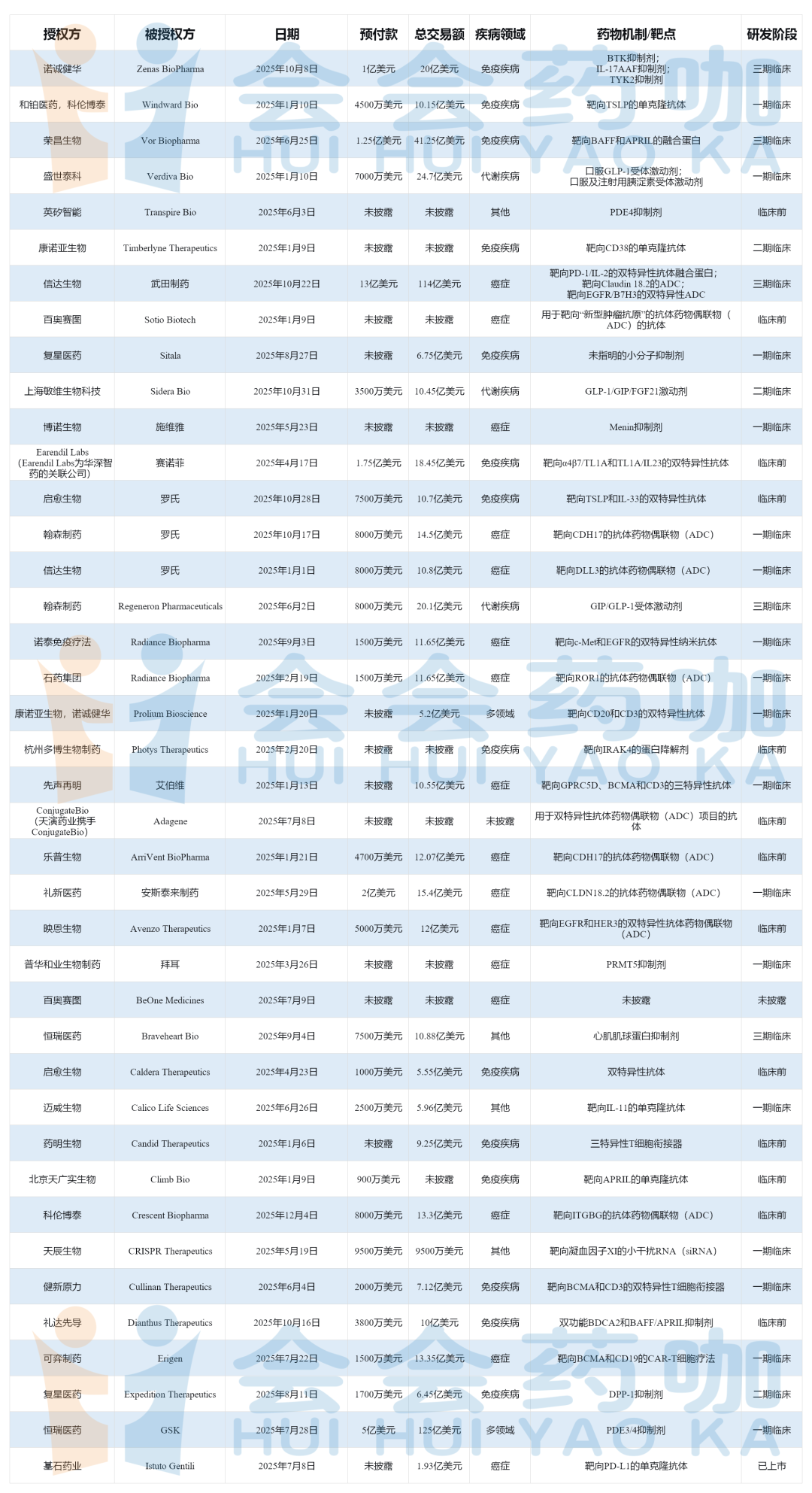
Takeda's $11.4 Billion Deal with Innovent Bio Tops the List, While GSK's Deal with Hengrui Pharma Reaches a Staggering $12.5 Billion.
Notably, the bargaining power of China's innovative pharmaceutical companies has significantly increased. In these deals, upfront payments ranged from several million to hundreds of millions of dollars. For instance, the deal between Takeda and Innovent Bio included a $1.3 billion upfront payment, a figure that would have been unimaginable just a few years ago.
At the same time, the transaction structure has also become more complex and sophisticated. In addition to traditional upfront payments and milestone payments, an increasing number of deals also include innovative cooperation models such as profit-sharing and co-development.
Chinese companies are no longer just recipients of technology but equal partners and even leaders in technology.
ADC and Bispecific Antibodies Become "Hard Currency"
A close look at these deals shows a clear trendADC (Antibody-Drug Conjugates) and bispecific antibody technology become the hottest targets. In more than 30 transactions, involvingThe proportion of ADC technology is close to 40%, and the proportion involving bispecific or multi-specific antibodies also exceeds 30%.。
The ADC targeting DLL3 from Roche's collaboration with Innovent Bio, the ADC targeting CDH17 from Roche's collaboration with Hansoh Pharma, and the bispecific ADC targeting EGFR and HER3 co-developed by DualityBio and Avenzo Therapeutics, all represent the latest advancements in this field.
These technologies are highly favored because they represent the future direction of cancer treatment. ADCs can precisely deliver potent cytotoxins to tumor cells, enhancing efficacy while reducing toxic side effects; bispecific antibodies, on the other hand, can simultaneously target two different antigens or epitopes, boosting anti-tumor activity.
In addition to the oncology field, metabolic diseases have also become a new hotspot.Verdiva Bio and CStone Pharmaceuticals' Oral GLP-1 Receptor Agonist Deal Worth $2.47 Billion; Regeneron and Hansoh Pharma's GIP/GLP-1 Receptor Agonist Deal Worth $2.01 Billion
The Role Transition of Chinese Pharmaceutical Companies
The role of Chinese biotech companies is undergoing a fundamental change. Historically, Chinese pharmaceutical companies mainly served as "market channels" or "production bases" for multinational corporations, but now,Increasingly becoming the source and exporter of innovative technologies。
A typical example is Hengrui Pharma, a pharmaceutical company that was once dominated by generic drugs but has now transformed into an innovation-driven enterprise. The $12.5 billion deal between Hengrui and GSK involves a novel PDE3/4 inhibitor, which is the result of years of R&D accumulation in the field of respiratory diseases.
Innovent Bio's situation is also noteworthy, as it not only collaborates with Roche in the ADC field but also has out-licensing deals in multiple cutting-edge areas such as bispecific antibodies and cell therapy.
More notably, some relatively young Chinese biotech companies are also beginning to make their mark on the international stage. For instance, Kelun-Biotech has simultaneously partnered with Windward Bio and Crescent Biopharma, with the total deal value exceeding 2 billion US dollars.
The ADC deal targeting CLDN18.2 between Lixun Pharmaceuticals and Astellas Pharma is valued at $1.54 billion, showcasing its technological advantage in specific targets.
These changes indicate that the innovation ecosystem of China's biotech industry is maturing, gradually shifting from "catching up" in the early stages to "running neck and neck" and even "leading the way" in certain fields.
Conclusion
In the already announced deals, a small interfering RNA drug targeting coagulation factor XI has drawn attention. The collaboration between CRISPR Therapeutics and Tianchen Bio focuses on this innovative technology, representing a breakthrough for China in the fields of gene editing and RNA interference.
More cutting-edge, the DPP-1 inhibitor deal between Fosun Pharma and Expedition Therapeutics is valued at $645 million, reflecting the deep layout of Chinese companies in the field of immune diseases.
These data come together to form a panoramic view of the globalization of China's innovative pharmaceutical companies.China's biotech industry has undergone decades of accumulation and development, and is now transitioning from "Made in China" to "Created in China."
The first ADC drug targeting Claudin 18.2 developed by a Chinese innovative pharmaceutical company has entered Phase III clinical trials. The global rights to this drug have been licensed to an international pharmaceutical company for billions of dollars, marking the beginning of a new era.
The tide has turned, and China's biopharmaceutical industry is standing at a new historical starting point.

Recommended with Charge
Recommended 15 Classic Books for Systematic Learning of Biopharmaceutical CMC
The Bioprocess Industry "Gathers Momentum," Breakthroughs in Key Process Points!
In-depth Review of Nucleic Acid Drugs
The Four Classic Site-Specific Conjugation Technologies of ADC
A Brief Discussion on the CMC Research Focus at Each Stage of Innovative Drugs
✦
Boutique Conference
✦
✦
High-Quality Community
✦
✦
Project Roadshow
✦

Scan the QR code to follow us
Reply in the background "Target Audience", let's chat with the小伙伴们 in the biopharmaceutical industry~"

Forward, like, check, and arrange.