Home Pharma Giant Novo Nordisk's Semaglutide Fails in Alzheimer's Phase III Trials Amid Industry-Wide Setbacks

Pharma Giant Novo Nordisk's Semaglutide Fails in Alzheimer's Phase III Trials Amid Industry-Wide Setbacks

Dec 12, 2025 20:02 CST Updated 20:02

Johnson & Johnson

Medical Device R&D and Manufacturer

Image


Image
Image
Image

Recently,Danish pharmaceutical giant Novo Nordisk announced that two Phase III clinical trials of its oral semaglutide for the treatment of early Alzheimer's disease failed to meet the primary endpoint. The drug, which has worked wonders in the fields of diabetes and obesity, has encountered a major setback in the area of neurodegenerative diseases.

In the same week, Johnson & Johnson also announced the termination of its anti-TauThe Phase II Clinical Trial of Protein Antibody Drug Posdinemab. This drug, which had received FDA Fast Track designation and was expected to achieve high peak sales, also failed to demonstrate significant clinical benefits in patients with early-stage Alzheimer's disease.

These latest setbacks have further made the industry realizeAlzheimer's Disease "R&D Black Hole"The name speaks true.。Over the past few decades, there have beenHundreds ofClinical trials have failed in this area.

But in the "valley of death" for Alzheimer's disease research and development, failure has never deterred adventurers.


TONACEA

01

Cross-Border Setback


Clinical Trials on Alzheimer's Disease Conference held in December(CTAD)Above, Novo Nordisk released detailed data. By measuring patients' cerebrospinal fluid, researchers found that certain markers of neurodegeneration, inflammation, and Tau proteins associated with Alzheimer's disease decreased by 10% or less. However, among the 30 biomarkers analyzed, most showed no changes.

These trials are an attempt to open up new markets for Novo Nordisk's star ingredient, semaglutide. Notably, studies show that although the clinical endpoint was not met, semaglutide did indeedImprovedAlzheimer's DiseaseRelevant biomarkers.

Vice President of International Medical Affairs, Clinical Drug Development at Novo NordiskPeter JohannsenSaid: "Semaglutide did have an impact on certain biomarkers." But he also acknowledged that these results were roughly equivalent to Roche's unsuccessful candidate drug Gantuzumab, while the approved Alzheimer's drugs usually have an impact amplitude of about 30% on biomarkers.

Novo Nordisk's attempt is a high-risk "cross-border surprise attack," aiming to leverage its ace in the metabolic disease field to open up a new battleground in neurodegenerative diseases.

This attempt is not without precedent. In 2020, Novo Nordisk discovered in a post-hoc analysis of clinical research data on semaglutide for cardiovascular indications that the risk of dementia in the GLP-1 treatment group was 53% lower than in the placebo group among 15,820 patients.

This stunning dataThis prompted Novo Nordisk to adopt an extremely bold strategy: skipping Phase II clinical trials and moving directly into Phase III studies. Internally, the company described this strategy as a "lottery-style approach"—highly risky, but if successful, the rewards would be transformative.

The Theory of Alzheimer's Disease as "Type 3 Diabetes"This attempt provides scientific evidence. Studies show that insulin resistance exists in the brains of Alzheimer's patients, causing neuronal damage due to energy deficiency. Semaglutide, with its anti-inflammatory and metabolism-improving properties, is expected to intervene in the disease process through this mechanism.

A large study involving more than 3,800 patients ultimately showed that, although some biomarkers improved, the drug failed to translate into clinical benefits for patients. Novo Nordisk's stock price fell accordingly.Cumulative decline of approximately 51% since the beginning of this year

Morgan Stanley previously estimated that the probability of Novo Nordisk's trial success was only about 25%. However, if successful, it is expected to bring the company an annual revenue increase of up to $5 billion. This is of great significance for Novo Nordisk, which faces fierce competition from Eli Lilly.

Johannsen said that the company is still analyzing the data and it's too early to talk about next steps.


TONACEA

02

The traditional path was not spared.


Unlike Novo Nordisk's "cross-border" attempts, Johnson & Johnson's failure occurred in a more traditional Tau protein target in Alzheimer's disease research and development. Posdinemab is a precision-targeted phosphorylated Tau protein.(pT217)A monoclonal antibody designed to clear extracellular pathological Tau protein and prevent its transmission between neurons.

Johnson & Johnson had high hopes for Posdinemab. The company predicted that the drug could be launched as early as 2028, with peak sales potentially exceeding $5 billion. However, this project, namedAutonomyThe Phase II study showed that the drug could not significantly slow down the clinical decline of patients.

At Lilly and Eisai with targeted beta-amyloid(Aβ)After the drug established its leading position in the market, targeting Tau protein is considered the next most promising breakthrough. However, Johnson & Johnson's Phase IIb study once again demonstrated that even if certain pathological signals of Tau protein in the brain can be reduced, it does not necessarily slow down the clinical decline of patients.

Johnson & Johnson's failure is not an isolated case. In recent years, the field of anti-Tau protein therapy has faced repeated setbacks. UCB's bepranemab, Roche's semorinemab, and Eli Lilly's LY3372689, among other Tau-targeted therapies, have all failed to demonstrate consistent efficacy in clinical trials.

Chief Clinical Officer of EisaiLynn KramerHas his own insights into the reasons for the recent failures of a batch of anti-Tau candidate drugs. He pointed out that those failed anti-Tau candidate drugs did not succeed because they "did not target the correct site." The "key" area to prevent the progression of Alzheimer's disease is a region in the Tau protein involved in its self-propagation as a "seed," and Johnson & Johnson's drug did not hit that seed region.

Aside from Eisai, companies like BMS and Merck continue their anti-Tau campaigns.

BMS's BMS-986446 binds to the R1-R3 region within MTBR,Mainly used for the treatment of early Alzheimer's disease.And Merck's MK-2214Targeting Phosphorylated Serine 413(pS413)Tau Protein, received FDA Fast Track designation earlier this month.


TONACEA

03

"Let a hundred flowers bloom"


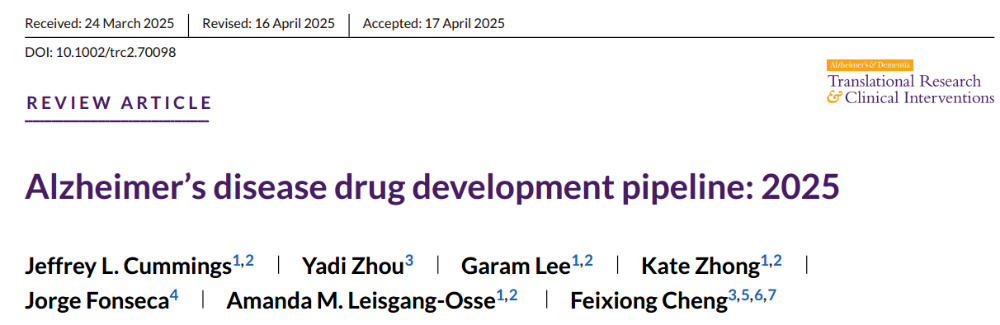
The industry's focus is shifting away from the two traditional targets, Aβ and Tau. According toAlzheimer's disease drug development pipeline: 2025Report: In 2025, there are 182 related clinical trials in progress, marking an 11% increase from 2024. These trials cover 138 different drugs targeting 15 distinct pathological processes.

Image

In the current R&D pipeline, treatment strategies targeting Aβ account for only 18%, while those targeting immune inflammation and Tau protein make up 17% and 11%, respectively. An increasing number of companies are beginning to explore non-mainstream targets such as the brain-gut axis and neuroprotection in search of disruptive breakthroughs.

Co-Founder and Chief Scientific Officer of the Alzheimer's Drug Discovery FoundationHoward FillitIt was pointed out that inflammatory targets are becoming a new research hotspot. "In my personal view, whether it is systemic inflammation or neuroinflammation, it is a very important target in this disease." Currently, there are over 30 clinical trials for Alzheimer's disease targeting inflammatory markers underway.

According to Roots Analysis, the global market size for AD diagnosis and treatment is expected to reach $12.4 billion in 2025 and $29.4 billion in 2035, with a CAGR of 9%. The enormous market potential is attracting more companies to invest in this field.

In the global Alzheimer's disease R&D landscape, Chinese pharmaceutical companies are showing an increasingly active posture. Industry data shows that China's activity in Alzheimer's drug development ranks second globally.

Hengrui Medicine's SHR-1707(Humanized Anti-Aβ Monoclonal Antibody)A Phase II clinical trial for early Alzheimer's disease is currently underway, becoming the first domestically developed anti-amyloid antibody in China. Connomab's CM383, a monoclonal antibody targeting Aβ protofibrils, has now initiated Phase I clinical trials.

Akeso BiopharmaAK152, a bispecific antibody drug independently developed to synergistically target Aβ and highly expressed receptors in the BBB, received NMPA approval in November this year to commence clinical trials for Alzheimer's disease, becoming the first of its kind in China.Alzheimer's DiseaseBispecific Antibody New Drug for Disease-Modifying Therapy.

CSPC Group announced in September that its self-developed Lecanemab Injection has been approved by the NMPA to conduct clinical trials in China, applicable for treating mild cognitive impairment and mild dementia caused by AD.

New paths of innovation are constantly emerging. CKBA, an innovative drug under Tai'en Kang, isAlzheimer's DiseaseThe foundational research phase has achieved interim results, and the relevant research content has been published in international academic journals.Nature AgingThe core value of CKBA-related research lies in its first-time exploration fromMechanismThis level reveals the crucial role of a novel "lipid-inflammation" axis, involving "lipid metabolism—microglial activation—neuroinflammation," in the pathogenesis of AD.

In October, CDE announced that Zai Lab has introduced the oral M1/M4 muscarinic acetylcholine receptor agonist KarXT capsule.(Tropsium Chloride Capsules)Clinical application accepted again. According to the Drug Clinical Trial Registration and Information Disclosure Platform, the speculated indication this time is behavioral and psychological symptoms associated with Alzheimer's disease.

Reference Article:
1、https://mp.weixin.qq.com/s/f3GCcz6qk9fj2J3U6AJ2rg

2、https://view.inews.qq.com/k/20251204A05HJI00?web_channel=wap&no-redirect=1


3、https://www.biospace.com/drug-development/eisai-still-confident-in-anti-tau-asset-as-j-j-becomes-latest-victim-in-spiraling-space


4、https://www.bloomberg.com/news/articles/2025-12-04/novo-not-ready-to-quit-alzheimer-s-after-ozempic-pill-setback?srnd=phx-industries-health


The tweet is used to convey knowledge. If you have any questions about copyright, etc., please contact PharmaExpress within 30 days of the publication of this article.
Original content cannot be reproduced on other platforms without authorization.
©2021 PharmaExpress. All rights reserved.


Previous Links
"The Little Vaccine" Growth Story | Pipeline Review of Pharmaceutical Companies
Everyone Learns ImmunologyEveryone Learns Immunology (Audio Version)
Interpretation of Review Articles | Skimming Through Literature | Medical Science Popularization|Frontiers in Medicine Notes
PROTAC TechnologyAntibody DrugAntibody-Drug Conjugate - ADC
Nucleic Acid Vaccine | CAR TechnologyChemical Biology
图片
图片

Warm Tips

图片


The Medical Express WeChat Official Account currently hasNearly 12 communication groups(Eager to learn, interesting, and bustling with pharmaceutical talents gathered here). To join the group, please scan the QR code above and note “Name/Nickname - Company/University - Specific Research Field/Major”. This group is solely for scientific research exchange. No soliciting.
Simple operations can star ⭐️ Pharma Insights, and you will receive our push notifications in the first place.
①Click "Pharmaceutical Insights" below the title
② Tap the “...” in the upper right corner ③ Click “Set as Star