2025 Landscape of Oligonucleotide CDMO Capabilities and Product Portfolio
Argo
RNAi Drug Developer
Ribo Life Science
Small Nucleic Acid Drug Developer
SANEGENEBIO
Small Nucleic Acid Drug Developer
WuXi AppTec
New Drug R&D and Production Service Provider

Note:This article does not constitute any investment opinions or suggestions; please refer to official/company announcements for accuracy.This article only introduces drugs related to medical health, not a recommendation of treatment options (if involved), and does not represent the platform's position.Any article reprinted requires authorization.
After 2016, several重磅small nucleic acid drugs were successively launched, achieving significant breakthroughs in the fields of genetic rare diseases and chronic illnesses. The global small nucleic acid drug market has entered a high-growth channel.The market size has grown fromFrom USD 2.7 billion in 2019 to USD 6.2 billion in 2024, and is expected to reach USD 46.7 billion by 2033,CAGR as high as 25% between 2024-2033。
Globally, 23 small nucleic acid drugs have been approved for marketing. In the early stages, they were mainly concentrated in the rare disease field. Since the approval of Inclisiran, co-developed by Novartis and Alnylam, their application has gradually expanded into chronic disease areas. The sales of Inclisiran have grown rapidly, reaching $112 million in 2022. From Q1 to Q3 of 2025, its sales amounted to $863 million, a year-on-year increase of 61%, with the full-year sales expected to exceed $1 billion. Notably, Novartis' PCSK9 siRNA was officially included in China's National Reimbursement Drug List (NRDL) in December 2025. This key move will significantly enhance its accessibility in the Chinese market and is expected to accelerate sales growth.
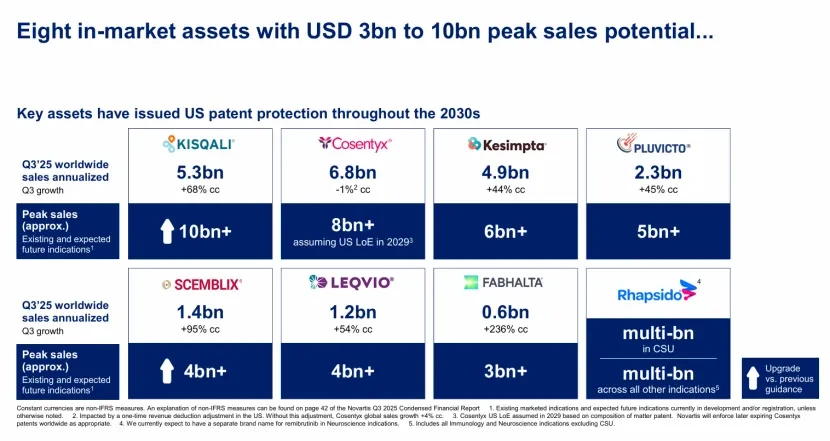 Figure: Novartis Management CEO PPT
Small Nucleic Acid BD Transactions Active
The prosperity of the market has directly stimulated the interaction between capital and industry. In recent years, BD transactions in China's small nucleic acid field have been exceptionally active. Among them,Argo BiopharmaRibo Life Science Granted Product Rights to Novartis in 2024 and 2025, with Total Agreement Value Reaching Nearly $10 Billion`, setting an industry record.`
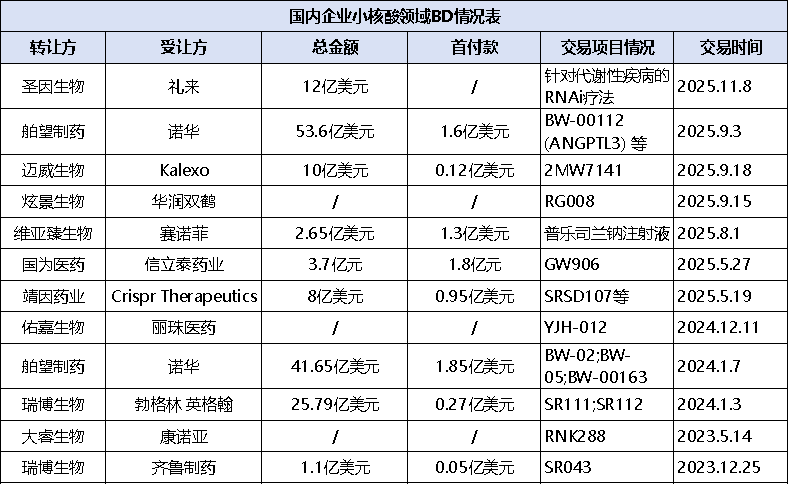
Data source: collated from public information, incomplete statistics
In addition, major collaborations such as Ribo Life Science with Boehringer Ingelheim, SANEGENEBIO with Eli Lilly, and Mabwell with Kalexo have successively materialized. These high-value, high-density deals also indicate that international MNCs are accelerating their strategic layout in China's small nucleic acid sector. The burst of upstream innovative power will undoubtedly inject strong demand momentum into downstream CDMO services.
Industry Chain Opportunities: Domestic Small Nucleic Acid CDMO Layout
Against this backdrop, the CDMO industry chain — a crucial link supporting the R&D and production of small nucleic acid drugs — is also ushering in unprecedented development opportunities.
WuXi AppTec:With its unparalleled scale and full industry chain layout, it has successfully replicated its proven "end-to-end" service model in the small molecule field to the emerging TIDES (oligonucleotides and peptides) field.
GMP-dedicated workshops for oligonucleotides have been established in key R&D and production bases in Wuxi, Changzhou, Shanghai, and other locations in China. The company has continued to ramp up investment in production capacity. As early as last year, WuXi AppTec established a separate business unit specifically for oligonucleotide and peptide lines, which boasts 27 oligonucleotide production lines.
Its TIDES business has become one of the company's fastest-growing segments. According to the 2025 interim report, the TIDES businessRevenue reached RMB 50.3 billion, a year-on-year increase of 141.6%, with orders in hand also growing by 48.8% year-on-year.
Asymchem:As a representative of expanding from a small-molecule CDMO giant into emerging fields, it systematically transfers its process development experience in chemical synthesis and mature commercial production management expertise to the nucleic acid field. It has established an oligonucleotide solid-phase phosphoramidite synthesis platform, possessing full-chain capabilities ranging from nucleotide monomer synthesis to complex oligonucleotide modifications.
Asymchem Layout 10 Oligonucleotide Pilot-Commercial Production Lines in the First Half of 2023, with a Synthesis Capacity of 500kg/Year. The company has clearly planned to further expand its commercial production capacity in the future, making full preparations for undertaking later-stage projects.
According toMid-Year Report 2025: The CDMO business segment for chemical macromolecules, including oligonucleotides, peptides, and more, achieved revenue of 379 million yuan, with a year-on-year growth rate exceeding 130%.。
Porton Advanced:According to the company's communication with investors in October this year, the new molecular business currently includes ADC, peptides, and small nucleic acids, providing IND full-package services as well as early-stage research services. Peptides and small nucleic acids have reached pilot-scale production, and this year, related conjugation projects have successfully implemented overseas IND full-package business.
The company's core focus is to provide one-stop solutions centered on differentiated services, including peptides, small nucleic acids, conjugation and formulation, analysis, etc., intervening in customer projects at an early stage and offering technical support both in China and internationally. In the short term, it will use payload linkers in ADCs and novel conjugation technologies in AOCs as entry points to build capabilities and technical reputation, gradually advancing the development of backend capabilities.
Jiuzhou Pharma:With its solid industrial foundation in specialty active pharmaceutical ingredients (APIs) and nucleoside intermediates, the company is actively upgrading to higher value-added oligonucleotide API CDMO services upstream in the supply chain. The company has systematically advanced the construction of its technology platforms, establishing small nucleic acid drug discovery platforms in both the United States and China, and now possesses service capabilities ranging from early-stage R&D support to customized production.
As of the first half of 2025, the company is accelerating the construction of a pilot platform and commercial production facilities that comply with GMP standards. The platform has been put into operation and started generating revenue; the company has publicly stated that it has "undertaken multiple custom projects."
Nuotai Bio:To fully leverage its years of technical accumulation in solid-phase peptide synthesis, complex modifications, and purification—technologies that are highly transferable to oligonucleotide production—thus forming a distinctive competitive edge in nucleic acid synthesis, particularly in the synthesis of complex modified nucleic acids.
In terms of production capacity, the subsidiaryRibo Life Science and Suzhou Ribo Life Science Co., Ltd. have an annual production capacity of10-20kg of GMP capacity at the pilot scale, mainly used for small-scale R&D and process validation.The ton-scale commercial production workshop for oligonucleotides, which began construction at the end of 2024, is expected to commence operations by the end of this year. Once operational, it will have an annual production capacity of 1,000 kilograms of oligonucleotides, 100 kilograms of PMO (phosphorodiamidate morpholino oligomers), and 200 kilograms of PEG-conjugated cyclic peptides, primarily targeting the commercial production of small nucleic acid drugs.
Aurita:Long-term engagement in the production of specialty APIs and nucleoside intermediates positions it as the "water supplier" for nucleic acid drug manufacturing. Its advantage lies in the scaled and compliant production capacity of key starting materials for nucleoside compounds.
The first production line participated in by Cytiva has been launched, which adopts the Oligo FlexFactory GMP production line at a commercial production level, aiming to achieve an annual capacity of hundreds of kilograms of GMP-grade pharmaceutical small nucleic acids. Aorti has planned three commercial production lines for small nucleic acid drugs in Yangzhou, and after completion, the final product capacity will reach 150-200 kilograms per year.
HitGen:With globally leading DNA Encoded Library (DEL) technology, it has a natural advantage in the early discovery and screening of oligonucleotides, occupying the very upstream of the innovation chain.
In terms of production capacity, its holding subsidiary Xian Dong Pharmaceutical can provide commercial small nucleic acid API CDMO services that meet GMP conditions, mainly fulfilling the demand from clinical Phase I to Phase III at the hectogram scale, as well as early commercial demands ranging from hectograms to kilograms. Additionally, a production line at the tens-of-kilograms scale can be established in accordance with the progress of product development.
With the acceleration of small nucleic acid drug commercialization, CDMO companies in China are facing definite growth opportunities. Future competition will focus on process innovation and efficient delivery capabilities, and the cost and efficiency advantages of the Chinese supply chain are expected to become further highlighted in this emerging field.
References:
Announcements, financial reports, and public materials of various companies, etc.
Copyright statement: This article is reproduced from the Biopharmaceutical Era, Media or individuals who do not wish to be reprinted can contact us, and we will delete it immediately.
Copyright statement: This article is reproduced from the Biopharmaceutical Era, Media or individuals who do not wish to be reprinted can contact us, and we will delete it immediately.
Copyright statement: This article is reproduced from the Biopharmaceutical Era, Media or individuals who do not wish to be reprinted can contact us, and we will delete it immediately.