

TIDES Weekly Recap | Global Peptide and Oligonucleotide Drug Highlights (Dec 12–18, 2025)
AusperBio
Biological Vaccine and Nucleic Acid Drug Developer

Huadong Medicine
Large Comprehensive Pharmaceutical Product Developer
On December 12, 2025, AusperBio, a biotechnology company dedicated to achieving clinical cure for chronic hepatitis B (CHB) through innovative targeted small nucleotide technologyRecently announced the end of follow-up (EOF) data for the Phase IIa clinical trial (AB-10-8002) of its core product AHB-137.

Data show that in patients with baseline HBsAg of 100-1,000 IU/mL, 24 weeks of AHB-137 monotherapy achieved a 30% clinical cure rate at week 72 (EOF). This breakthrough data further demonstrates the potential of AHB-137 to become a significant advancement in hepatitis B treatment.The Potential of Liver Healing Cornerstone Drugs.
AB-10-8002 is a multicenter, randomized, open-label Phase II clinical study designed to evaluate the safety and efficacy of 24 weeks of AHB-137 monotherapy in HBeAg-negative chronic hepatitis B (CHB) patients receiving stable nucleos(t)ide analog (NA) therapy. Participants receive 24 weeks of AHB-137 treatment at a dose of 300 mg or 225 mg once weekly (with two loading doses on Day 4 and Day 11). After completing AHB-137 treatment, all patients continue NA therapy for an additional 24 weeks. Subjects meeting the NA discontinuation criteria stop NA treatment at Week 48, as assessed by the investigator, and are followed up until Week 72.
AHB-137 is a novel unconjugated ASO drug developed by AusperBio based on its proprietary Med-Oligo™ antisense oligonucleotide technology platform. As an investigational therapy, it aims to achieve clinical cure for chronic hepatitis B. The drug features a triple mechanism of action and has demonstrated positive results in preclinical and clinical trials, with findings presented at prestigious international conferences including EASL (2023-2025), AASLD (2024-2025), and APASL 2025. AHB-137 has completed its global Phase I clinical trial and is currently advancing multiple global Phase II clinical trials alongside Phase III clinical trials in mainland China.
On December 15, 2025, Huadong Medicine's wholly-owned subsidiary, Hangzhou Zhongmei Huadong Pharmaceutical Co., Ltd. (hereinafter referred to as "Zhongmei Huadong"), developed an innovative polypeptide human GLP-1 (glucagon-like peptide-1).HDM1005 Injection, a Long-Acting Dual Agonist of GLP-1 (Glucagon-Like Peptide-1) Receptor and GIP Receptor (Glucose-Dependent Insulinotropic Polypeptide), Achieves Positive Results in Phase II Clinical Trial for Weight Management in China.

The above-mentioned Phase II clinical trial in China is a study evaluating HDM1005 injection in obese, non-diabetic adult subjects.A multicenter, randomized, double-blind, placebo-controlled parallel group Phase II clinical trial was conducted to evaluate the efficacy and safety of the solution. A total of 243 subjects were enrolled, with a dosing period of 22 weeks. Prior to dosing, baseline characteristics such as weight, waist circumference, and BMI were balanced across all dose groups.
HDM1005 Injection is a Class 1 new chemical drug independently developed by Huadong Medicine with global intellectual property rights. It is a long-acting dual agonist targeting both the human GLP-1 receptor and GIP receptor in the peptide class. Preclinical studies have shown that HDM1005 promotes the production of cyclic adenosine monophosphate (cAMP) by activating GLP-1 and GIP receptors, increases insulin secretion, suppresses appetite, delays gastric emptying, and improves metabolic function, thereby improving plasma volume, reducing oxidative stress and systemic inflammation, and enhancing cardiovascular adaptability. It demonstrates effects in lowering blood glucose, reducing body weight, and improving MASH as well as heart failure with preserved ejection fraction (HFpEF). Current data also indicate that HDM1005 has significant weight loss efficacy with good safety and tolerability.
On December 15, 2025, the U.S. clinical trial registry website showed that Eli Lilly had initiated the first Phase III clinical trial (ENLIGHTEN-2) of Eloralintide (LY3841136).
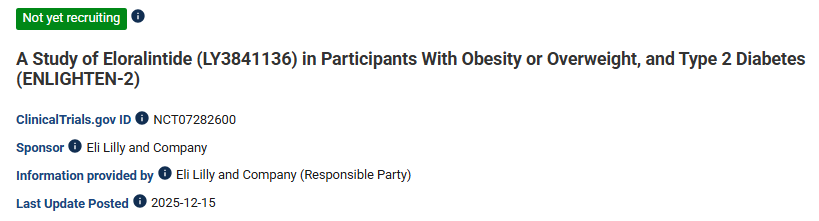
This Phase III study aims to evaluateEloralintide (Four Doses, Subcutaneous Injection)Compare the efficacy and safety of placebo treatment in obese or overweight subjects with type 2 diabetes. The primary endpoint of the study is the percentage change in body weight from baseline at week 64.
Eloralintide (LY3841136), developed by Eli Lilly and Company, is a once-weekly subcutaneous injectable selective amylin receptor agonist currently under research. It reduces calorie intake to achieve weight loss by enhancing satiety and delaying gastric emptying through mimicking the action of amylin. It has been modified to possess advantages such as a long plasma half-life and low immunogenicity. The results of its 48-week Phase 2 clinical trial have been published in *The Lancet*. This trial included 263 obese or overweight adults without type 2 diabetes but with weight-related comorbidities. The results showed that the average weight reduction across all dose groups ranged from 9.5% to 20.1%, with the 9mg fixed-dose group achieving a 20.1% weight loss, far surpassing the 0.4% reduction in the placebo group. Additionally, it improved multiple cardiometabolic risk indicators such as waist circumference, blood pressure, and lipid levels. In terms of safety, it was generally well-tolerated, with common mild-to-moderate gastrointestinal symptoms and fatigue. The incidence of such adverse events can be reduced using a dose-escalation regimen. Based on the positive Phase 2 data, Eli Lilly initiated its first Phase 3 clinical trial in December 2025. The company is also evaluating its potential application in combination with tirzepatide, offering hope as a new option for obesity treatment beyond incretin-based therapies.
On December 16, 2025, SinoBiologics, a clinical-stage biotechnology company focused on the development of innovative RNA interference (RNAi) therapies, announced that the clinical trial application for its self-developed small interfering RNA (siRNA) candidate drug, SGB-7342, targeting inhibin βE subunit (INHBE), has received tacit approval from the Center for Drug Evaluation (CDE) of the National Medical Products Administration (NMPA).Approved for the treatment of obesity.

The INHBE gene is primarily expressed in the liver, and its encoded secreted protein, Activin E, regulates lipolysis and storage by binding to the ALK7 receptor in adipose tissue. Genetic studies have shown that individuals carrying INHBE loss-of-function mutations (pLOF) exhibit favorable metabolic health characteristics, such as reduced abdominal fat and lower triglyceride levels.This provides a basis for the development of drugs targeting INHBE: by inhibiting this target, it is expected to mimic this natural advantage, thereby potentially promoting lipolysis selectively, reducing abdominal and visceral fat, and improving metabolic indicators while avoiding unnecessary muscle loss.Therefore, RNAi therapy targeting INHBE not only has the potential to provide a new treatment strategy for obesity but also shows promise in combination with existing standard therapies such as GLP-1, offering patients a more comprehensive solution.Currently, the global development of RNAi therapies for obesity is still in its early stages, but a few candidate drugs have already entered clinical trials, preliminarily demonstrating the significant potential of this therapy in the field of obesity treatment.
SGB-7342 is an siRNA candidate drug targeting INHBE for the treatment of obesity, developed using AusperBio's next-generation technology.GalNAcCoupling Technology. Its mechanism of action is to precisely silence the expression of INHBE mRNA in the liver through RNAi technology, reducing the level of its encoded protein Activin E, thereby promoting fat breakdown without inducing muscle breakdown, ultimately improving metabolic abnormalities and insulin resistance. Preclinical trial data show that after a single subcutaneous administration of SGB-7342, potent and long-lasting knockdown of liver INHBE mRNA can be achieved, with significant weight loss, improved body composition, and the expected effect of maintaining muscle observed in animal models, while demonstrating good safety and tolerability.
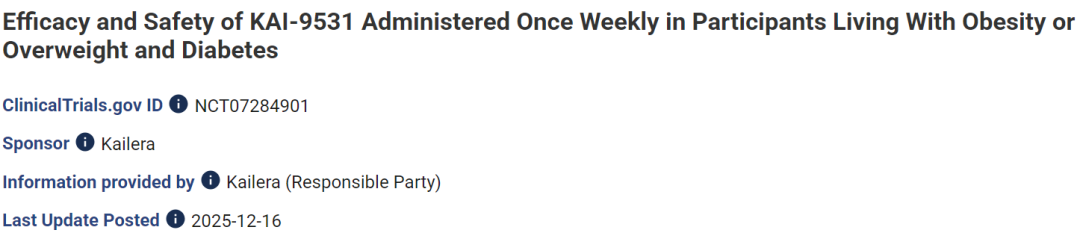
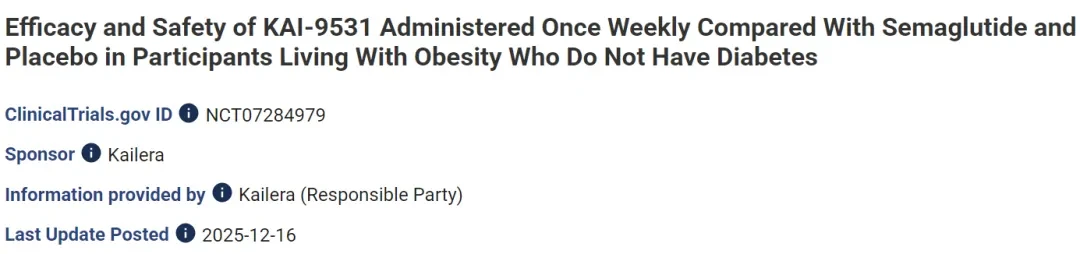
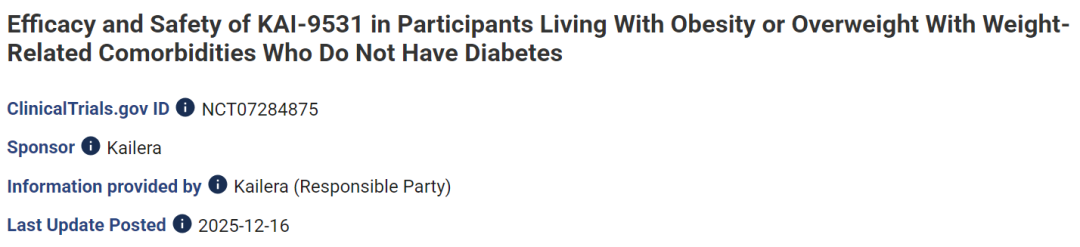
On December 16, 2025, Kailera registered three global Phase III clinical trials for KAI-9531 on the Clinicaltrials.gov website, targeting obesity with diabetes, and obesity without diabetes, respectively.The disease indications are planned to enroll 1,700, 1,200, and 1,800 subjects respectively, with an expected completion date of March-April 2028.
In May 2024, Hengrui Medicine Achieved 6 Billion USDNewCo ModelGoing Global: Kailera Therapeutics recently announced the completion of a $500 million Series B financing round to accelerate the clinical development of its pipeline. The GLP-1/GIP dual-target agonist HRS-9531 had its market application in China accepted in September this year, and has now initiated global Phase III clinical trials. Following this, there will also be a small-molecule GLP-1 receptor agonist HRS-7535, an oral version of HRS-9531, as well as GLP-1/GIP/GCG Tri-Target AgonistHRS-4729 is in Phase I clinical stage.
HRS9531 Injection is a dual receptor agonist of Glucagon-like Peptide-1 (GLP-1) and Glucose-dependent Insulinotropic Polypeptide (GIP) independently developed by Hengrui Medicine. It is under development for the treatment of overweight/obesity and related comorbidities, as well as Type 2 diabetes and other indications. To date, multiple clinical trials of HRS9531 have been conducted in China, with over 2,000 Chinese participants having received HRS9531 treatment.
On December 17, 2025, Haihuanma Biopharmaceutical Co., Ltd. (Huanma Bio) announced that its self-developed circular RNA drug, HM2002 Injection (HM2002), has received clinical trial approval (IND) from the National Medical Products Administration (NMPA) for the third time. The approved indication this time is Chronic Coronary Syndromes (CCS), with the first introduction of transcatheter endocardial injection as an interventional delivery method. This marks that HM2002 has completed a dual-track clinical development layout in the field of ischemic heart disease, encompassing both surgical and interventional approaches.
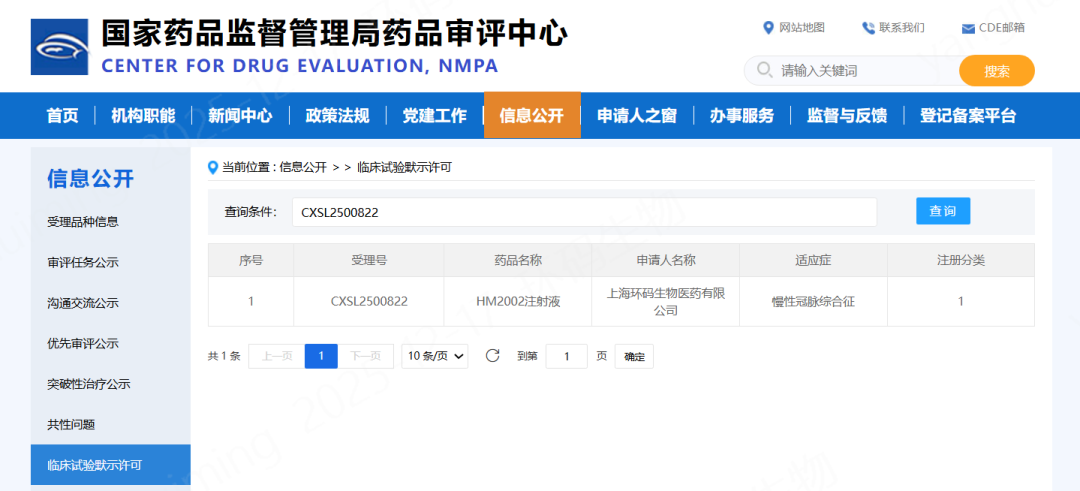
HM2002 is the world's first circular RNA drug, developed依托环码生物自主研发平台打造, with the advantages of high stability and low immunogenicity. It can promote therapeutic angiogenesis in ischemic myocardial regions through specific molecular mechanisms, thereby improving microcirculation function. Unlike the previously used epicardial injection applicable only in surgical scenarios, this drug has now been approved for endocardial injection via catheter, a cardiology interventional technique. This innovative technology utilizes a steerable catheter to deliver the drug precisely and quantitatively to viable but ischemic myocardial segments without the need for open-heart surgery, directly expanding the application of HM2002 from cardiac surgery to cardiology cath labs and significantly enhancing its clinical accessibility for a broad population of patients with chronic coronary syndrome.
Thus, HM2002 has established a drug delivery platform that combines epicardial injection with endocardial injection. This strategy ensures that the drug can cover a range of conditions from complex lesions requiring surgical intervention to chronic ischemic lesions treatable by interventional therapy alone, providing differentiated treatment options for patients at different stages. Huadong Medicine will continue to advance the circularRNAThe research and development of drugs and their clinical applications are committed to providing new treatment options and hope for more patients facing unmet clinical needs.
2025Year12Month 17 Days, focused on developing the next generationRNAiGlobal Biopharmaceutical Company for TherapiesDaru Bio (Rona Therapeutics)Announced that the company has successfully submitted to the Australian Human Research Ethics Committee (HREC) SubmitRN5681The clinical trial application to advance the company's first dual-targetsiRNAEntered the clinical development stage. ThisIThe phase clinical trial is expected to begin in2026Drug administration began in the first quarter of the year.

RN5681 is a GalNAc-conjugated dual-targeting siRNA that can simultaneously silence PCSK9 and LPA, two genetically validated complementary drivers of atherosclerotic cardiovascular disease. This drug, with a single molecule, can synchronously reduce low-density lipoprotein cholesterol and lipoprotein (a), achieving potent and long-lasting lipid regulation, thereby addressing persistent residual risks that existing therapies struggle to eliminate.
AboutDaru Biotech
Rona Therapeutics, a globally leading RNAi therapeutics platform company, is dedicated to leveraging next-generation RNA technology platforms to develop drugs for cardiometabolic diseases, obesity, and neurodegenerative disorders. Since its establishment in 2021, the company has advanced four programs into clinical stages, driven by its proprietary advantages in delivery systems, multivalent structural design, and oligonucleotide chemistry platforms. To date, the company has raised approximately $200 million from several top-tier global healthcare investment firms and strategic partners.
December 18, 2025, CAMP4 Therapeutics, a clinical-stage biopharmaceutical company dedicated to developing RNA therapies for genetic diseases, announced that it has entered into an agreement with GlaxoSmithKline (GSK).K) Reached a strategic research, collaboration, and licensing agreement to jointly identify and develop antisense oligonucleotide (ASO) candidate drugs targeting multiple gene targets associated with neurodegenerative and kidney diseases.
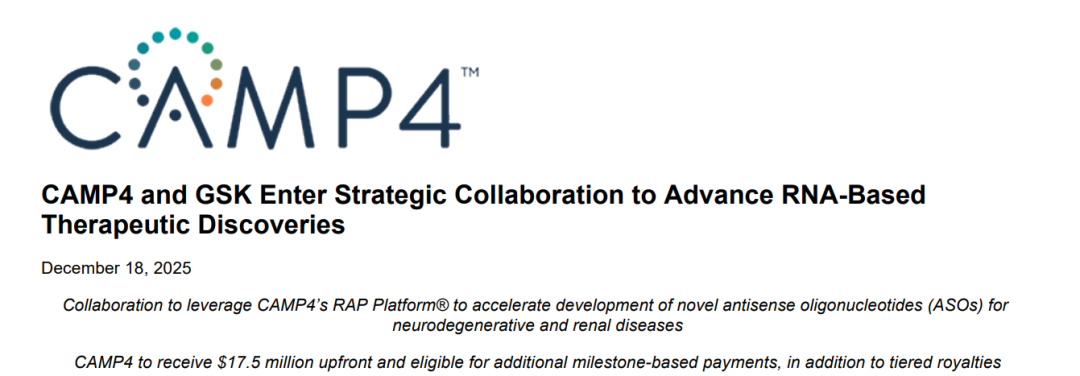
According to the terms of the agreement, CAMP4 will receive an upfront payment of $17.5 million (approximately 123 million RMB). In addition, CAMP4 may also receive additional payments for certain research and development and commercial milestones, as well as tiered royalties on future product sales.
CAMP4 will utilize its proprietary RAP platform® to identify regRNAs that regulate the expression of multiple gene targets and generate ASO candidates targeting regRNAs to enhance target gene expression for potential subsequent development; GSK will be responsible for screening through this collaboration.The subsequent development and commercialization of the ASO candidate drug.
In the field of cell therapy, GSK had made extensive investments. However, in 2022, GSK terminated several collaborative projects in cell and gene therapies, and in 2023, the giant announced a complete halt to its R&D investment in cell and gene therapy. While exiting the CGT field, GSK is embracing the small nucleic acid drug sector.
In 2019, GSK entered into a collaboration with Ionis Pharmaceuticals worth a total of $262 million to gain the rights for the development and promotion of two ASO new drug therapies under research. In 2021, GlaxoSmithKline reached a cooperation agreement with Arrowhead to introduce the latter's RNAi therapy ARO-HSD for NASH, with a total deal value of $1.03 billion; In December 2022, GSK collaborated with Wave Life Sciences in a partnership worth up to $3.3 billion to jointly advance the research of oligonucleotide drugs, with the core project being Wave’s preclinical RNA editing program WVE-006 targeting alpha-1 antitrypsin deficiency (AATD); According to GSK's 2024 financial report, the collaboration with Ionis Pharmaceuticals on hepatitis B...ASOThe launch time of the new drug Bepirovirsen has been confirmed for 2026, and the more comprehensive Phase III clinical data is also expected to be released in 2026.