

AusperBio's Breakthrough Hepatitis B Drug AHB-137 Achieves 30% Functional Cure Rate with 24-Week Therapy, Shifting Paradigm from Lifelong Treatment to Short-Term Cure
AusperBio
Biological Vaccine and Nucleic Acid Drug Developer
The burden of hepatitis B in China remains heavy, with significant gaps in diagnosis and treatment.
"Hepatitis B is one of the infectious diseases with the heaviest global disease burden and also one of the significant public health issues faced in China," said Professor Wang Guiqiang from Peking University First Hospital.

Professor Wang Guiqiang from the First Hospital of Peking University
China's 2024 National Hepatitis B Survey Shows Steady Decline in HBsAg Prevalence to 5.86% in General Population; However, an Estimated 75 Million People Still Live with Chronic Hepatitis B Virus Infection, with Diagnosis and Treatment Rates at Only 22% and 15%, Respectively, According to the "Guidelines for the Prevention and Treatment of Chronic Hepatitis B (2022 Edition)"
"Beyond discovery and treatment, the higher goal is to achieve 'clinical cure,' meaning sustained clearance of surface antigens, which implies that patients may potentially stop medication and significantly reduce the risk of end-stage events such as liver cancer and cirrhosis." Professor Wang Guiqiang introduced that in recent years, the level of evidence for clinical cure of hepatitis B in and outside China has been continuously improving. However, current treatments for chronic hepatitis B mainly include nucleos(t)ide analogs and pegylated interferon alpha.
Dr. Guofeng Cheng, co-founder and CEO of AusperBio, explained that nucleos(t)ide analogs can effectively suppress HBV replication but have limited effect on surface antigen clearance and often require lifelong medication. While long-acting interferons possess both antiviral and immune activation effects, enabling clinical cure in some patients, they are limited by a smaller effective population, longer treatment duration, and significant side effects. Recognizing this unmet clinical need, Dr. Guofeng Cheng led his team to focus their research efforts on the field of HBV cure, turning their attention to antisense oligonucleotide (ASO) therapy.
24-Week Limited Course of Treatment Achieves 30% Clinical Cure Rate
AHB-137 is an innovative non-conjugated antisense oligonucleotide drug developed by AusperBio using its proprietary Med-Oligo™ platform. It employs chemical modification technology to treat hepatitis B through a triple mechanism of action: transcription-level targeted inhibition of hepatitis B surface antigen (HBsAg), suppression of viral genetic material replication, and reactivation of specific immune responses, breaking through the limitations of traditional therapies.
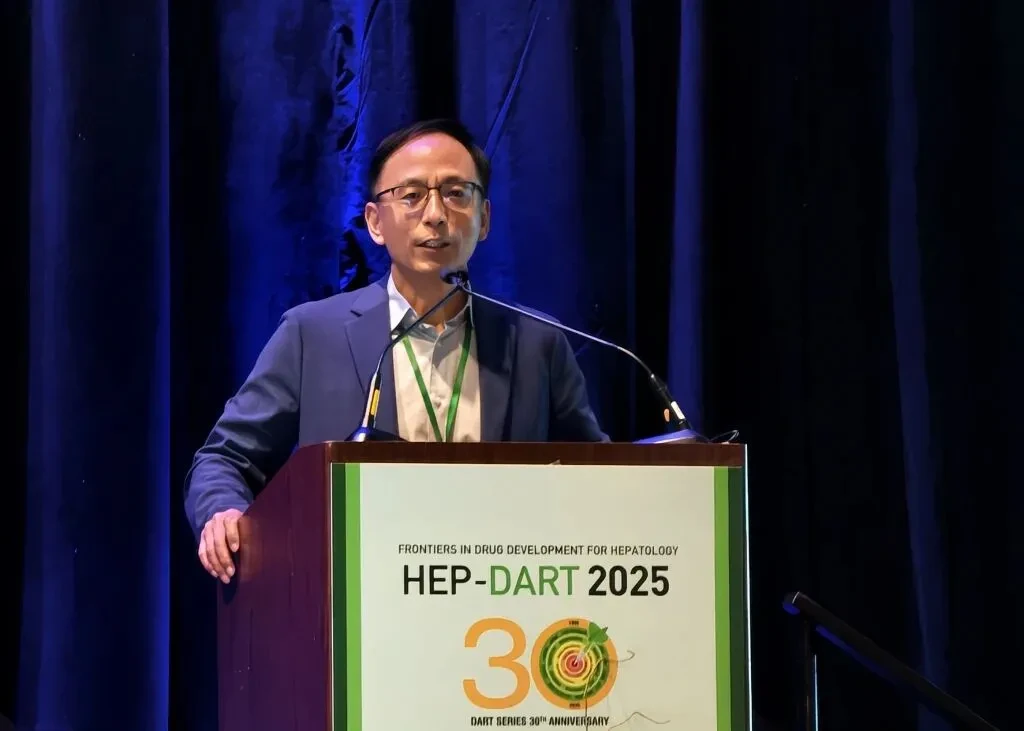
Co-Founder and CEO of AusperBioDr. Guofeng Cheng
Latest research data from the Phase IIa clinical trial of AHB-137 showed that, in chronic hepatitis B patients who were HBeAg-negative, had a baseline HBsAg level of 100-1000 IU/mL, and were stably receiving nucleos(t)ide analog treatment, the clinical cure rate reached 30% after 24 weeks of short-term treatment and 48 weeks post-treatment discontinuation. Additionally, 100% sustained suppression of HBV DNA was achieved after discontinuation, and patients who reached complete response at the end of treatment demonstrated favorable long-term outcomes.
"This indicates that China has achieved a fundamental shift in the field of hepatitis B treatment, moving from 'long-term control' to 'short-term cure,'" said Professor Wang Guiqiang. "Not only that, but the drug also demonstrated significantly better tolerability. In this Phase II clinical trial, no patients discontinued treatment early due to drug-related adverse reactions."
For the emerging AHB-137, its innovative value lies in its distinct mechanism of action. "It can rapidly and powerfully reduce surface antigen levels, achieving a high proportion of surface antibody seroconversion, a characteristic not seen in any previous drugs." Dr. Cheng Guofeng further explained that AHB-137 inhibits viral RNA, directly targeting and blocking the production of surface antigens and viral replication, while also possessing immune activation potential, thus forming a unique multi-action mechanism.

Chief Expert of the Liver Disease Research Center, Beijing Friendship Hospital, Capital Medical University
Professor Jidong Jia
Professor Jia Jidong, Chief Expert of the Liver Disease Research Center at Beijing Friendship Hospital, Capital Medical University, also told reporters that this drug is one of the representatives with rapid progress and outstanding potential among innovative hepatitis B drugs. "Its advantages are mainly reflected in two aspects: First, it has good safety without significant adverse reactions; Second, among patients with surface antigen levels (100-1000 IU/mL), about 30% achieved sustained surface antigen seroclearance and a higher proportion maintained sustained viral DNA seroclearance after six months of monotherapy and six months post discontinuation of nucleos(t)ide analogues."
Achieve Clinical Cure, Contribute Wisdom to Global Hepatitis Prevention and Treatment
Professor Jia Jidong believes that the success of AHB-137 is not accidental but rather the result of China's long-term accumulation in the field of hepatitis B drug research and development. He stated that in the past, new drug development in China was mainly follower-based, but currently, the gap between domestic companies and international leaders in cutting-edge technology directions such as oligonucleotides has been significantly narrowed, and even surpassed in some aspects. "This is due to the continuous investment in the National Science and Technology Major Project for Infectious Diseases and the New Drug Creation Project, the ongoing optimization of China’s drug evaluation and approval system, as well as years of collaborative efforts and long-term accumulation by research institutions, innovative enterprises, and clinical academia."
In addition to its R&D strength, the convenience of administration is also an important advantage of AHB-137. Dr. Guofeng Cheng introduced that the drug is currently designed for once-weekly subcutaneous injection over a 24-week treatment course. "This is already one of the more simplified regimens among similar therapies," said Dr. Guofeng Cheng. He also revealed that AHB-137 has received Breakthrough Therapy Designation from the National Medical Products Administration (NMPA), been approved to conduct Phase III clinical trials, and the progress has been very smooth.
Looking ahead to future treatment strategies, Professor Wang Guiqiang stated that the clinical cure of hepatitis B will move towards a "multi-component joint operation," meaning nucleoside drugs as the foundation, ASO drugs rapidly reducing surface antigen, followed by sequential use of immune modulators to consolidate efficacy; AHB-137 is a key component of this integrated approach. “ASO drugs provide a crucial foundation for improving cure rates, acting as an important ‘backbone,’ and combining them with other treatments on this basis is expected to achieve better outcomes.”
Professor Jia Jidong concluded that the development of new hepatitis B drugs is a systematic project that integrates basic exploration and discovery, systematic preclinical research, high-quality clinical trials, optimized policy support, and extensive social collaboration. He believes that the breakthrough of AHB-137 marks a crucial step forward for China on the path to a hepatitis B cure. However, achieving a comprehensive and substantial increase in cure rates will still require continuous efforts and collaborative innovation from academia, industry, and policymakers.
Source of the article:People's Daily Health Client
About AusperBio
AusperBio, a clinical-stage innovative drug development company operating simultaneously in China and the United States, focuses on developing proprietary targeted delivery small nucleic acid drugs with First-in-class and Best-in-class potential. The company owns the fully proprietary Med-Oligo™ ASO technology platform, primarily concentrating on the clinical cure of chronic hepatitis B (HBV) and highly efficient targeted treatments for liver diseases, while actively expanding into new target areas beyond the liver. AusperBio’s strategy is to combine its globally leading Med-Oligo™ oligonucleotide technology with a specifically efficient targeted delivery platform to drive the development of a series of innovative therapies, addressing significant unmet medical needs.
About Hancang Capital
Hankang Capital is a venture capital fund focused on the pharmaceuticals and healthcare industry. With the mission of "empowering pharmaceutical innovation and safeguarding human health," the fund collaborates with top scientists and entrepreneurs to develop breakthrough drugs for major diseases. Rooted in China while embracing a global perspective, Hankang Capital has invested in multiple enterprises that have grown into industry leaders, such as Akeso Inc. (09926.HK), InnoCare Pharma (09969.HK, 688428.SH), Keymed Biosciences (02162.HK), AusperBio (02256.HK), Duality Biologics (09606.HK), Viva Biotech Holdings (09887.HK), Chipscreen Biosciences (688321.SH), and OPM Biosciences (688293.SH).