

Babytree Files for Hong Kong IPO with RMB 14 Billion Valuation, Reporting RMB 729 Million Revenue in 2017 Driven by Advertising and E-commerce
Image provided by the company
VCBeat (WeChat: vcbeat) has learned that on June 28, BabyTree submitted its prospectus to the Hong Kong Stock Exchange. The joint sponsors are Morgan Stanley, Haitong Securities, and China Merchants Securities International; UBS serves as the chief financial advisor, and Fosun Hengli is the joint financial advisor.
BabyTree launched babytree.com in 2007, creating an online platform for expectant and young parents in China to interact with each other and access the best pregnancy and parenting advice. Currently, it has alreadySocial FunctionandHigh-Quality ContentBuilding a Vibrant Community for Young Families on Two Major Pillars.
The prospectus shows that BabyTree’s revenue from 2015 to 2017 was RMB 200 million, RMB 509 million, and RMB 729 million, respectively. The gross profit margins were 54.6%, 53.1%, and 63.2%, respectively. The annual net losses for 2015 to 2017 amounted to RMB 286 million, RMB 934 million, and RMB 911 million, respectively. The adjusted net losses for the year were RMB 172 million in 2015, RMB 44 million in 2016, and RMB 138 million in 2017.
There are several key milestones in the development history of BabyTree. In October 2014, it launched the Xiaoshiguang platform; in June 2015, it introduced its e-commerce platform, Meitun Mama. In 2016, BabyTree completed a financing round led by Fosun, with total funding amounting to approximately RMB 3 billion. In May 2018, it entered into a strategic cooperation agreement with Alibaba, which made an equity investment of approximately RMB 214 million, accounting for 9.90% of BabyTree’s share capital as of the last practicable date.
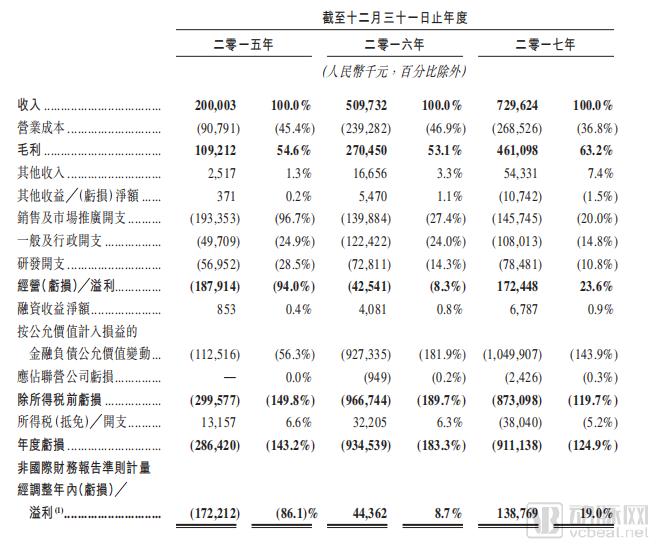
Consolidated Statement of Profit and Loss
According to public records, the major shareholders of Babytree include Fosun, TAL Education Group, Jumei International Holding Ltd., and Alibaba. The largest shareholder is the family of founder Wang Huainan, holding a 26.09% stake; the second-largest shareholder is Fosun, with a 24.84% stake; the third-largest shareholder is TAL Education Group, holding 10.18%; and Alibaba holds a 9.90% stake.
Meeting Four Key Needs: Learning, Sharing, Recording, and Shopping
When developing features on its platform, BabyTree has taken into account the emotional needs of young users of childbearing age, with a focus on social elements to foster interactive and spontaneous user experiences. By building a warm community where users actively engage in various forms of interaction, the platform generates substantial amounts of user-generated content (UGC). This UGC is highly valuable as it helps strengthen community cohesion and enriches content offerings.
In addition to UGC, BabyTree also maintains a large and growing library of expert-generated content (or PGC), which serves as a supplement by curating professional or semi-professional users to foster original content creation.
On its platform, BabyTree offers comprehensive products and services to meet the four fundamental needs of young Chinese families: learning, sharing, recording, and shopping. Its two main platforms are:
1. BabyTree Pregnancy. As the flagship platform, it comprises the BabyTree Pregnancy mobile app and the PC and WAP versions of babytree.com, serving as the primary portal for user traffic;
2. Xiao Shiguang. A second platform designed exclusively for mobile use, focusing on child development. It serves dual purposes: as an image-rich social recording medium and as an online platform offering early education content and tools. As a natural extension of the flagship Babytree Pregnancy platform, Xiao Shiguang extends user lifecycle and further expands the user base.
In addition, it also owns Meitun Mama, an e-commerce platform for maternal and infant products, whose functionalities are deeply integrated into the Babytree Pregnancy platform.
Monetization Model: Data-Driven Advertising and E-commerce Business
BabyTree obtains highly valuable core fertility data from its registered users, while user interactions within its ecosystem generate vast amounts of behavioral data. This high-quality and extensive user dataset facilitates a deeper understanding of users, precise identification of their needs, more accurate personalization of user experiences, and the development of new product and service categories.
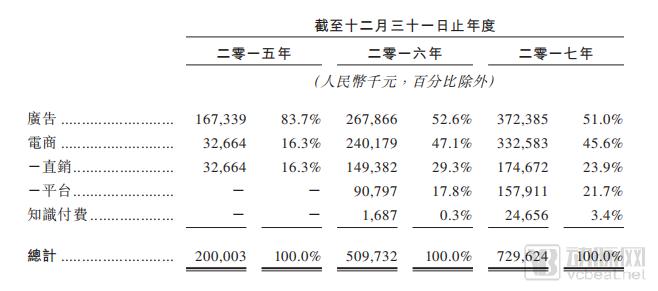
Babytree’s Monetization Model
BabyTree has developed an effective and efficient monetization model on a scalable platform.Data-driven advertising and e-commerce businesses are the primary sources of revenue., it has also successfully launched two additional revenue streams: Consumer-to-Manufacturer (C2M) and paid knowledge services.
BabyTree has built a growing ecosystem that enables business partners and users to connect not only for maternal and infant products and services, but also for the consumption of other types of household goods. As of December 31, 2017, the BabyTree platform connected 338 advertisers, 2,253 third-party e-commerce merchants, 80 C2M manufacturing partners, and 542 contracted experts for high-quality content programs.
1. Advertisement
Leverage its entire multi-platform ecosystem to provide advertising opportunities. Initially, the majority of advertisers came from industries related to maternal and infant products. Over the past few years, by virtue of its high-quality user base comprising its target demographic and its technical capability to precisely acquire the most relevant user segments, BabyTree has further accumulated a growing number of advertisers from non-maternal-and-infant service sectors, such as pharmaceuticals, cosmetics, personal care, automotive, and financial services.
2. E-commerce
Meitun Mama conducts its e-commerce business primarily by leveraging the e-commerce functionalities deeply integrated into its flagship platform, BabyTree Pregnancy. It operates its e-commerce business through two models:Direct Sales and PlatformsUnder the direct sales model, BabyTree purchases products from suppliers and sells them to customers on a self-operated basis, recognizing sales proceeds as revenue. Under the platform model, third-party merchants offer products to customers on the e-commerce platform, and BabyTree, as the platform owner and operator, records commissions from such sales as revenue.
3. Paid Knowledge
In 2016, BabyTree began offering paid premium content. It currently provides a wide range of premium content products and has entered into various revenue-sharing arrangements with content providers for multiple such offerings. For the “Kaijiang” (Lectures) and “Zhuanjiada” (Expert Answers) sections, where BabyTree acts as the principal, the Company records the full amount paid by users as revenue and recognizes the amounts shared with experts as cost of revenue. For the “Kuaidao Wenshen” (Quick Doctor Consultation) and “Zhuanjiada” (Expert Answers, excluding user-reviewed content) sections, where BabyTree acts as an agent, the Company records the net amount collected as revenue, with no significant direct service costs.
Four Major Business Strategies
In May 2018, BabyTree received strategic investment from Alibaba (through its indirect wholly-owned subsidiary, Taobao China) and agreed to engage in deep cooperation with Alibaba in e-commerce, advertising, C2M (Consumer-to-Manufacturer), paid knowledge services, and other potential business areas. Alibaba’s industry-leading e-commerce operations, user and service resources, and execution capabilities can help BabyTree enhance its existing monetization models and develop new ones, thereby further unlocking the commercial potential of our ecosystem. Following this round of financing, BabyTree’s valuation reached approximately RMB 14 billion.
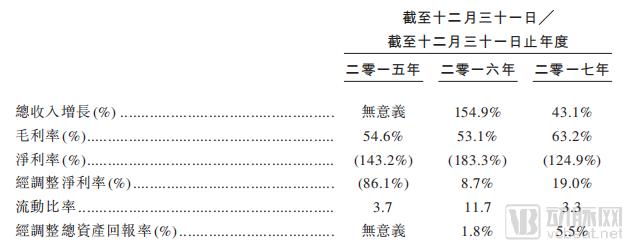
Key Financial Indicators
Overall, BabyTree plans to adopt the following operational strategies: 1) consolidate its industry-leading position through product optimization and extension of the user lifecycle; 2) continue to leverage its business model and deepen monetization efforts; 3) continue investing in R&D and strengthen data analytics and technical capabilities; 4) expand into related businesses and global markets.
Number of Newborns and Birth Rate in China
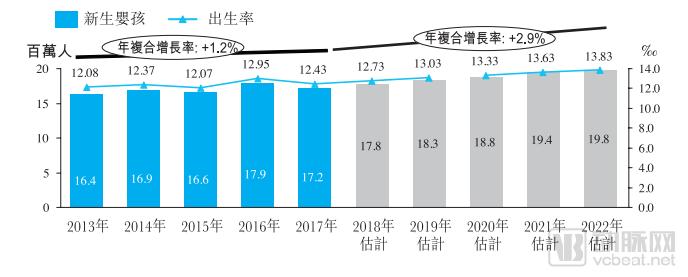
China has gradually relaxed its family planning policies in recent years. The number of newborns increased from 16.4 million in 2013 to 17.2 million in 2017, representing a compound annual growth rate (CAGR) of 1.2% during this period, while the birth rate rose from 12.08‰ to 12.43‰. According to a Sullivan report, the birth rate is projected to steadily increase to above 13‰ in the coming years.
Target User Base Size of China’s Online Platforms for Young Families
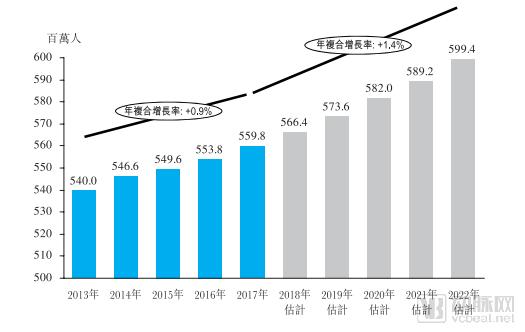
The target users of young family platforms refer to the core members of typical young Chinese families, namely the parents and grandparents of children. According to a Frost & Sullivan report, the number of target users increased from 540 million as of December 31, 2013, to 559.8 million as of December 31, 2017. With the number of newborns expected to continue rising in the coming years, the number of target users for online young family platforms is projected to reach 599.4 million by 2022.
Growth in the Consumer Market for Young Chinese Families
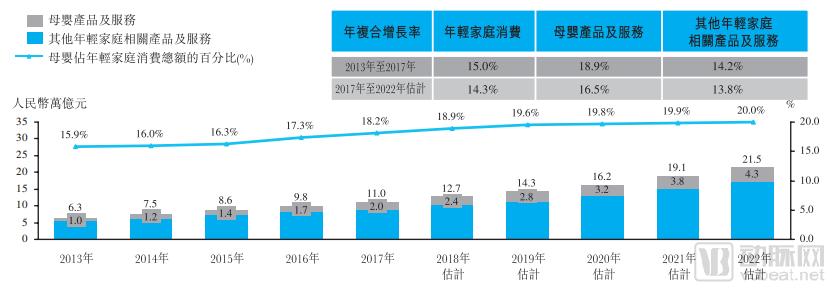
Young Chinese families consume a wide variety of products and services. The market size of consumption by young Chinese families increased from RMB 6.3 trillion in 2013 to RMB 11.0 trillion in 2017, representing a compound annual growth rate (CAGR) of 15.0%.
During this period, the market for maternal and infant products and services expanded from RMB 1.0 trillion in 2013 to RMB 2.0 trillion in 2017, representing a compound annual growth rate (CAGR) of 18.9%. With the continuous growth in consumption and heightened awareness of maternal and infant care and services,Maternal and Infant Products and Services MarketIt was one of the key drivers behind the growth in consumption among young households from 2013 to 2017. This is primarily reflected in the increase in the share of maternal and infant-related spending within total young household consumption, which rose from 15.9% in 2013 to 18.2% in 2017.
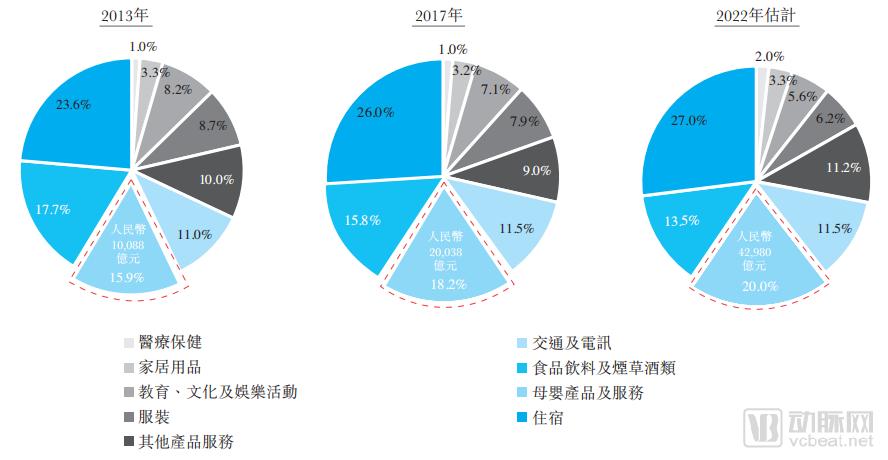
The consumer market for young families is expected to become increasingly diversified, with the needs of other family members being further addressed. Notably, in 2017, spending on maternal and infant products and services accounted for the second-largest share of young families’ budgets, surpassed only by housing expenses, a trend projected to persist in the coming years. The proportion of expenditure related to maternal and infant care is anticipated to continue rising, reaching 20.0% by 2022. Nevertheless, the majority of young families’ spending will remain allocated to a broad range of non-maternal and non-infant products and services.
Mothers are typically not only active in sharing their parenting experiences but are also regarded as the primary decision-makers for consumption in young families. According to a consumer survey conducted by Frost & Sullivan, 90.1% of mothers in China are the sole primary decision-makers for maternal and infant product purchases within their households. Even in terms of general consumption, 82.3% of mothers serve as the sole primary decision-makers. When making purchasing decisions, young families consider brand image to be the most important factor, particularly for maternal and infant products.
Online Platform for Young Families in the Maternal and Infant Sector in China
The diversification of consumption patterns and needs among young families has spurred the emergence of online platforms tailored to this demographic. Young families have diverse needs, including learning, sharing, record-keeping, and shopping. To meet these needs, various maternal and child-focused online platforms have emerged, offering services or features related to e-commerce, online communities, record-keeping and tracking, early education, and health. These services or features are provided by ordinary users, key opinion leaders (KOLs), experts (such as medical and educational professionals), and product suppliers.
Online platforms for young families in the maternal and infant sector primarily include the following categories: e-commerce (such as Beibei and Mia), online communities (such as Mama Wang and Baobao Zhidao), early childhood education (such as Beiwa Nursery Rhymes and BabyBus), and internet healthcare (such as Xiao Dou Miao, Xiao Dou Miao Vaccine Assistant, and Cui Yutao’s Parenting Academy). Although these various online platforms cater to different needs of young families, their business models face similar challenges, namely customer acquisition costs and user loyalty.
1. User Acquisition Cost.Sufficient user traffic is crucial to the development of online platforms. Companies operating in e-commerce, early childhood education, and internet healthcare typically invest heavily in subsidizing new users, which is not cost-effective in the long run. In particular, maternal and infant e-commerce platforms generally target expectant parents, young parents, and their children. Consequently, the duration of user engagement with the platform is inherently limited. From the perspective of individual users, it is difficult to generate sufficient revenue to cover the costs incurred in acquiring user traffic.
2. User Loyalty.If the features no longer attract users, they may lose interest in the online platform and cease using it. Furthermore, as competition intensifies in the maternal and infant sector, competitors may seek to attract users with new products and services that they deem appealing or that offer financial incentives. Consequently, maintaining a relatively high level of user loyalty becomes challenging.
Community-based online platforms with a large base of active users provide mothers with an excellent opportunity to discuss maternal and infant products and share parenting experiences. Furthermore, as these recording tools store extensive archives of photos and videos of children and family members, their lifecycle can be extended throughout the child’s entire childhood and even into adulthood.
Therefore, community-based online platforms have a significant opportunity to monetize their active and loyal user traffic. This demonstrates that, compared to other online platforms for young families that focus solely on e-commerce or early childhood education, community-based online platforms generally possess a relative advantage.
Online maternal and infant communities are social-enabled digital platforms that provide parents, expectant parents, and their families with information related to maternity and childcare, including but not limited to conception, pregnancy, childbirth, and early childhood development. While various online maternal and infant communities may offer similar functionalities, BabyTree stands out as the undisputed leading platform due to its more comprehensive strategic layout and monetization model.
Key Factors Behind the Success of Online Maternal and Infant Communities in China
1. Brand Image.Most users join online maternal and infant communities to acquire relevant knowledge, and they tend to trust platforms with a strong brand image. Even companies with substantial user traffic in other sectors are likely to fail when entering the online maternal and infant community industry, due to the lack of an authoritative brand image that can only be cultivated through long-term brand building.
2. Social Activities.By integrating social features into online maternal and infant communities, industry leaders have managed to stand out from knowledge-based websites. Furthermore, as competition among these online communities intensifies, robust social functionalities not only attract more users but also enhance the loyalty and conversion rates of existing users.
3. Content Quality.Since users can access most online maternal and infant communities free of charge, content quality is crucial for user retention. High-quality content should be both targeted and reliable to ensure that users obtain trustworthy information tailored to their needs.
4. Diversification.Online maternal and infant communities offering a diverse range of services are likely to outperform those providing only a limited selection. Efforts should be made to explore knowledge and topics across related industries and fields to meet the varied needs of community users, thereby further leveraging their value.
5. User Experience.User experience is a key factor influencing users’ evaluation of the community and their duration of stay. Online maternal and infant communities should optimize product development to ensure that the user experience on mobile applications or websites is relevant to their needs and engaging.
6. A robust backbone for big data analytics and computation.Online communities with advantages in big data and algorithms are better positioned to effectively organize content and provide users with relevant information and services. Maternal and infant online communities should actively leverage their accumulated large user traffic and big data, applying them to online advertising, behavioral analysis, and other related areas, thereby continuing to enhance profitability and competitiveness.
Key Entry Barriers to China’s Online Maternal and Infant Community Market
1. User quantity and quality.Existing online maternal and infant communities have all passed their initial stages and acquired substantial user bases. Due to sufficient operational history, user loyalty and engagement levels remain relatively stable. Furthermore, comprehensive social features not only attract new users but also enhance the loyalty of existing ones. This may constitute a major barrier to entry for new market entrants.
2. Accumulated Content.The primary activities of online communities involve curating and sharing content. The longer a platform operates, the more content it accumulates. Such content may include User-Generated Content (UGC), Professionally Generated Content (PGC), and Professional User-Generated Content (PUGC), all of which constitute valuable assets for the platform. Furthermore, once this content is systematically categorized, it can gradually evolve into a useful knowledge base, providing users with more accessible and practical tools. This may create a high barrier to entry for new companies.
3. Technical Support.Establishing, operating, and maintaining a maternal and infant community requires extensive professional expertise and technical support in this field. To accumulate a substantial user base, big data technologies must be leveraged to appropriately analyze user habits and preferences. Layouts and page designs should employ appropriate algorithms for continuous optimization.
Monetization Opportunities in China’s Online Maternal and Infant Communities
Compared with the business models of other online platforms, maternal and infant-focused online communities can attract more active users from young families, obtain more comprehensive user data, and thereby establish viable monetization channels. The community-based business model boasts a stable foundation of user traffic and an extensive database of user behaviors and characteristics, enabling stakeholders to pursue monetization opportunities that meet the needs of young families across various sectors, namely online advertising, maternal and infant e-commerce, and paid maternal and infant knowledge services.
1. Online Advertising Market
Development of the Online Advertising Market for Maternal and Infant Products. The size of China’s online advertising market expanded significantly, growing from RMB 109.6 billion in 2013 to RMB 295.7 billion in 2017, representing a compound annual growth rate (CAGR) of 28.2%. Driven by the increasing number of internet users and technological advancements, China’s online advertising market is projected to further expand at a CAGR of 21.5% from 2017 to 2022.
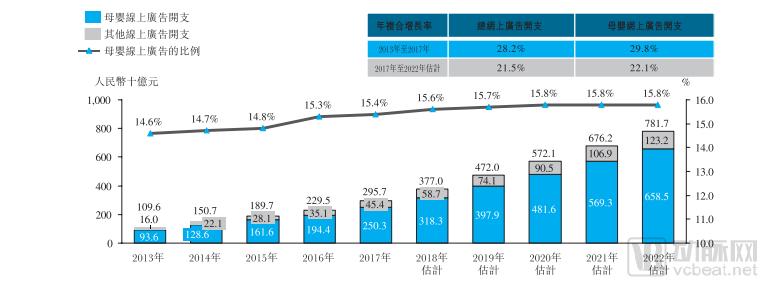
Specifically, the market size of online advertising related to maternal and infant products increased from RMB 16.0 billion in 2013 to RMB 45.4 billion in 2017, representing a compound annual growth rate (CAGR) of 29.8%. According to the Frost & Sullivan report, as maternal and infant brands increase their investment in brand building and place greater emphasis on online marketing, online advertising expenditure in the maternal and infant segment is expected to grow at a CAGR of 22.1% from 2017 to 2022.
Key Growth Drivers. The online advertising market has benefited from the growing number of internet and mobile internet users. Over the past few years, China’s internet and mobile internet user bases have expanded significantly, each approaching half of the total population. This has established a solid customer foundation, unlocking substantial potential and development opportunities for the online advertising market.
Shifts in lifestyle and consumption habits are driving increased market demand. Today, people spend more time on the internet through social and entertainment media. The internet has become one of the most important media channels for directly reaching customers. Online advertising can capture audience attention and convert collected data traffic into economic benefits.
2. Maternal and Infant E-commerce Market
Development of the Maternal and Infant E-commerce Market. Driven by the growth of the internet and mobile internet markets, along with an increase in the per capita disposable income of Chinese residents, China’s e-commerce market has achieved rapid development. The market size of China’s e-commerce industry grew from RMB 1.9 trillion in 2013 to RMB 7.2 trillion in 2017, representing a compound annual growth rate (CAGR) of 39.5%. According to Frost & Sullivan, the market size is projected to further increase to RMB 18.3 trillion by 2022, at a CAGR of 20.5%.
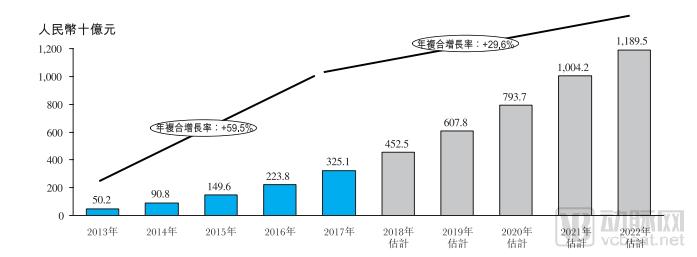
Specifically, the market size of maternal and infant e-commerce (measured by gross merchandise volume) increased from RMB 50.2 billion in 2013 to RMB 325.1 billion in 2017, representing a compound annual growth rate (CAGR) of 59.5%. Other major players in the maternal and infant e-commerce industry include Beibei, Mia.com, and Baobeigezi. With the deepening penetration of the internet and the overall growth of China’s e-commerce sector, the market size of maternal and infant e-commerce (measured by gross merchandise volume) is projected to further grow at a CAGR of 29.6% from 2017 to 2022.
Key Growth Drivers. First, rising disposable income. The continuous increase in disposable income and purchasing power is expected to drive sustainable growth in consumer demand for maternal and infant products.
Second, consumption continues to upgrade. Consumers are increasingly concerned about product safety and quality, and are therefore willing to purchase higher-priced goods perceived as safer and of superior quality. Maternal and infant brands still have ample room to offer high-quality products that remain affordable to consumers while meeting their emerging needs.
Third, deepening internet penetration. With the continuous improvement of China’s internet infrastructure, mobile devices, and applications, internet penetration has deepened, leading to an increased frequency of online shopping by consumers via websites or mobile apps. As an effective sales channel, mobile apps also provide innovative marketing avenues. Sales channels on mobile devices are expected to expand rapidly, thereby driving growth in online sales.
3. Paid Knowledge Market for Maternal and Child Health
Development of the Paid Maternal and Infant Knowledge Market. Due to the rapid circulation of information and the saturation of maternal and infant products in the market, many families focused on prenatal care have gained more choices in recent years. Consequently, numerous paid knowledge platforms have launched maternal and infant-themed content, enabling families to make more informed decisions.
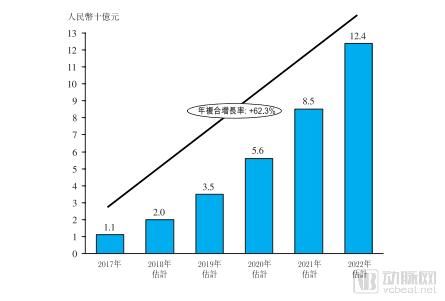
Users prioritize quality and are therefore more willing to pay for content that meets their needs, particularly health-related information. The market for paid maternal and infant knowledge emerged in 2016, and vertical platforms with large user bases proliferated in 2017. This promising market has also attracted active participation from numerous self-media entities. The rise of the middle class and consumption upgrading have brought a substantial audience to these platforms. The market is relatively fragmented and currently remains in its early stages of development.
Driven by multiple favorable factors, the revenue of the paid knowledge market for maternal and infant care is projected to increase from RMB 1.1 billion in 2017 to RMB 12.4 billion in 2022, representing a compound annual growth rate (CAGR) of 62.3%.
Key Growth Drivers. First, targeting young parents. Young parents and first-time parents may experience prenatal anxiety. Paid maternal and child health knowledge services ensure that parents can access valuable parenting information in a timely and cost-effective manner.
Second, a richer product portfolio. By increasing the quantity and variety of products offered, paid maternal and infant knowledge providers strive to attract new users while boosting repurchase rates among existing customers.
Third, users are willing to pay. Enhanced intellectual property awareness and strengthened IP regulations in China have made internet users more willing to pay for online content and services.
Fourth, access to third-party technical solutions is available. Providers of third-party technical solutions can assist smaller content creation startups in commercializing their businesses.
Note: Source: Babytree prospectus.