

FDA's Multi-Pronged Strategy: Digital Health Technologies Emerge as a Promising Avenue to Combat the Opioid Crisis
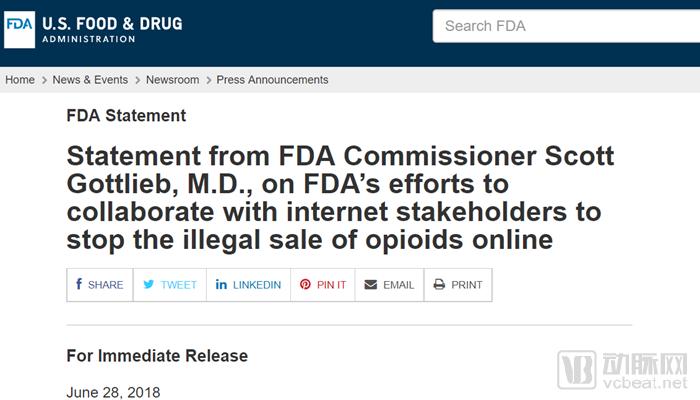
VCBeat has learned that on June 28, the U.S. FDA issued a statement on its official website, announcing that it is working with internet stakeholders to curb the illegal online sale of opioids.
FDACommissioner Scott Gottlieb stated in the announcement that, although the internet is not the sole channel for the illegal sale of prescription drugs, it has the most profound impact and poses unique challenges to technology companies, law enforcement agencies, and the FDA. In the future, the FDA will leverage big data solutions and artificial intelligence technologies to identify the channels and locations involved in the illegal online sale of prescription drugs.
According to statistics from the U.S. Department of Health and Human Services, there are currently14000Multiple institutions have been verified to be abusing opioids, with daily116Americans die from opioid abuse, nearly80%of heroin addicts had used prescription opioids before using heroin.
Take OxyContin as an example. In the last century90Since the [decade],FDAA series of opioid drugs were approved for market launch, including OxyContin. OxyContin is an inexpensive analgesic with a chemical structure similar to that of heroin, capable of producing effects comparable to morphine, yet it is considered safer than both. According to statistics, in the United States, there are10%-40%A significant portion of the population suffers from chronic pain of varying severity, and when combined with the needs of cancer patients and those undergoing surgical procedures, the market demand for opioids is substantial. Consequently, they gained nationwide popularity in China immediately upon launch.
OxyContin works by blocking nerve pathways to prevent pain signals from reaching the brain; excessive use can lead to severe withdrawal symptoms and drug dependence.2000Since [year], the number of crimes caused by OxyContin abuse in the United States has surged, earning OxyContin the nickname “hillbilly heroin,” with more than20Tens of thousands of Americans have died from opioid abuse, with some media outlets even labeling the misuse of OxyContin as the biggest pharmaceutical scandal of the century.
Opioids are a class of drugs similar to the alkaloids found in the opium poppy, including illegal drugs such as heroin, synthetic opioids such as fentanyl, and prescription pain relievers that can be legally used, such as oxycodone (OxyContin), hydrocodone (Vicodin), cocaine, morphine, and various other medications.
Repeated use of opioids significantly increases the risk of developing opioid use disorder. The use of illegal opioid drugs, such as heroin, and the misuse of legally available pain relievers, such as oxycodone and hydrocodone, can have serious adverse effects on health. When used correctly under the guidance of healthcare professionals, prescription pain medications are beneficial. However, the misuse of prescription opioids can lead to dependence and addiction.
Prescription Opioids
Some opioids, including hydrocodone, oxycodone, morphine, and codeine, are prescribed by physicians to alleviate pain and are referred to as prescription opioids. Prescription opioids are used to treat moderate to severe pain and are often prescribed for patients following surgery or injury, or those with health conditions such as cancer.
Heroin
Heroin is a potent opioid drug that appears as a white or brown powder. Physical symptoms following heroin use include euphoria, drowsiness, respiratory depression, miosis (pupil constriction), nausea, and dry mouth. Heroin overdose can cause slow and shallow breathing, cyanosis of the lips and nails, cold and clammy skin, convulsions, coma, and may be fatal in severe cases.
Fentanyl
Fentanyl is a potent synthetic opioid analgesic, typically used to treat patients with severe pain or postoperative pain. It is administered via injection, transdermal patches, or lozenges. Similar to morphine, it is 50 to 100 times more potent. When fentanyl binds to its receptors, it increases dopamine levels in the brain’s reward regions, producing feelings of euphoria and relaxation. Ingestion of ultra-high doses of fentanyl may cause respiratory arrest, leading to death.
In the United States, the development of non-opioid analgesics has spanned more than a decade, yet the results have been less than satisfactory. VCBeat has learned that in the past five years, most so-called innovative analgesics approved by the FDA have been new indications for existing non-specialty drugs. To date, no truly innovative analgesic has emerged as a viable alternative to opioids, and there are no more than two classes of investigational innovative analgesics targeting novel mechanisms.
Upon investigation, industry insiders believe that the main reasons are as follows:
First,Technical Limitations. Pain is a subjective sensation and a symptom of disease, rather than the disease itself. This leads to two challenges: first, there is no biomarker that can accurately monitor the intensification or alleviation of pain; second, patients in clinical trials of analgesics often exhibit a strong placebo effect, making it difficult to isolate the efficacy data of new drugs.
Second,Regulatory Constraints. The regulatory framework for analgesics imposes extensive clinical trial data requirements on innovators. Unlike opioids, which can address a broad spectrum of pain types, novel-target analgesics typically target limited indications, such as chemotherapy-induced pain or pain caused by nerve compression. To comply with regulatory requirements, innovators need to conduct numerous additional clinical trials.
Third,Economic Constraints. Opioids are inexpensive and highly effective, enjoying widespread acceptance among physicians, patients, and health insurance payers. In contrast, innovative analgesics carry relatively higher price tags, and their potential to reduce healthcare costs must be evaluated holistically by considering the economic benefits derived from mitigating side effects. Cultivating the market for these novel agents is a protracted process accompanied by substantial costs.
The path of addressing the opioid abuse crisis through medication substitution has proven unviable, leaving the FDA to seek alternative approaches. On May 30, the FDA launched an innovation challenge aimed at stimulating the development of digital health and diagnostic medical devices for pain and addiction. Innovators can apply to participate in this challenge from June 1 to September 30.
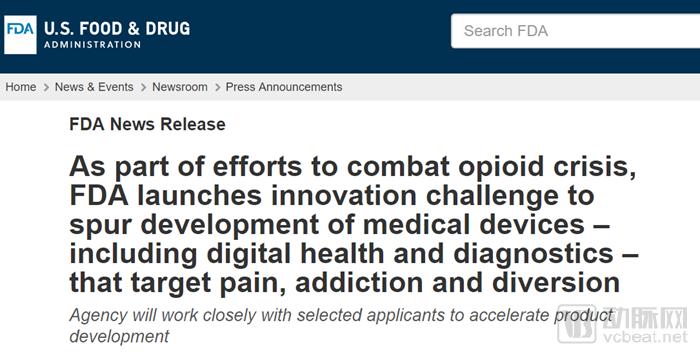
VCBeat has learned that medical devices participating in this challenge will be able to work closely with the U.S. Food and Drug Administration (FDA), thereby accelerating the development and review of innovative products. Meanwhile, the FDA will provide additional incentives to innovators investing in products that address the addiction crisis, promoting the advancement of promising technologies. Furthermore, the FDA will designate these medical devices as “Breakthrough Devices,” thus streamlining their approval process.
FDA staff stated that the approach of launching innovation challenges was previously employed in 2012, resulting in a surge of innovative therapies for fatal, advanced-stage kidney disease; they hope to achieve similar outcomes this time.
The FDA has intensively rolled out policies targeting opioid abuse within less than a month, encouraging digital innovation in medical devices while strengthening oversight of opioid use in both medical and illicit settings—a strategy that combines incentives with strict enforcement. Addressing the opioid abuse crisis cannot rely on mere prohibition (“blocking”); it requires guided management (“channeling”). The FDA has already begun to “channel” solutions through the development of digital pain-management medical devices. Given the intrinsic link between pharmaceuticals and medical devices, the FDA will need to pursue further innovative approaches to overcome the R&D challenges facing non-opioid analgesics. VCBeat will continue to monitor these developments.