

Pear Therapeutics Redefines Medicine with First FDA-Authorized Prescription Digital Therapeutic

Pear Therapeutics
Developer of Digital Healthcare Solutions
We are accustomed to downloading apps from app stores. In the future, we may be prescribed an app by our doctors and download it as required. Just as we are familiar with traditional pill-based medications, apps will emerge as a new form of therapy, combining with conventional drugs to deliver more efficient and widely accessible treatments. This therapeutic approach that integrates software with medication is known as “digital therapeutics.”
Abroad, products have already received FDA approval. VCBeat (WeChat ID: vcbeat) has identified Pear Therapeutics, a U.S.-based company, as a standout leader in the digital therapeutics sector. The company has not only secured FDA approval for its products but also won the favor of Novartis through a partnership to jointly develop pharmaceuticals.
There is no precise definition of digital therapeutics. Drawing on current product examples, digital therapeutics were defined at the 2018 BIO International Convention as clinically validated, FDA-approved software interventions that have been demonstrated in randomized clinical trials to safely and effectively improve patient outcomes. In clinical practice, they can be integrated with existing treatment regimens, such as pharmacological or device-based therapies. Digital therapeutics typically include patient-facing applications, clinical assessment and outcome tracking, clinician monitoring dashboards, and data storage compliant with the Health Insurance Portability and Accountability Act (HIPAA).
There is also a broader definition of digital therapeutics: products that combine any software, hardware, or molecules to improve medical outcomes.
Like traditional medications, digital therapeutics also require a physician’s prescription; however, what patients receive is not a conventional drug.
Pear Therapeutics started by developing digital therapeutics to treat diseases with significant unmet medical needs.
Not only was its product the first FDA-authorized prescription digital therapeutic, but Pear Therapeutics was also selected as one of nine companies to participate in the U.S. FDA’s Digital Health Pre-Cert Pilot Program. The FDA established this program primarily to address regulatory challenges posed by the rapid iteration and updates of electronic products.
Currently, Pear Therapeutics is developing software-based digital therapeutics to treat several serious diseases and is seeking FDA authorization for these products. Pear Therapeutics aims to provide solutions that help patients improve their conditions, offer tracking tools supported by clinicians, and deliver cost-effective options for payers.
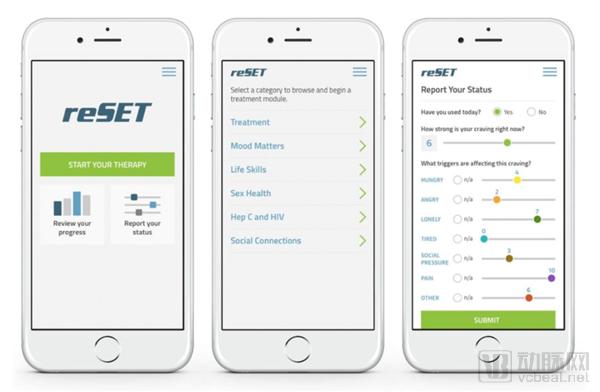
Pear Therapeutics’ ReSETTM
Pear Therapeutics’ most mature product is currently named ReSET.TM。ReSETTMIt is the first FDA-approved digital therapeutic for the treatment of Substance Use Disorder (SUD), helping patients regain control over addiction. It can serve as an adjunctive therapy in the treatment of dependencies on stimulants, cannabis, cocaine, or alcohol. Although it has received FDA clearance, it has not yet been commercialized and remains under further testing.
In 2016, approximately 20 million patients suffered from substance use disorders (SUD) related to alcohol or other non-pharmaceutical substances, resulting in annual losses exceeding $700 billion in medical costs, crime, and lost productivity, while also inflicting endless suffering on families and society. In the United States, drug abuse-related causes account for approximately 90,000 deaths each year.
Existing scientifically validated rehabilitation methods, including active psychotherapy, are known to be effective but often require substantial costs and time, frequently leading to relapse, suboptimal treatment outcomes, and poor patient adherence.
Besides ReSETTMIn addition, Pear Therapeutics is also developing many digital therapeutics products. reSET-OTMis the first to treat opioid use disorder (OUD).reVIVETMis a product indicated for the treatment of generalized anxiety disorder (GAD) and panic disorder (PD), which is also used in conjunction with pharmacotherapy to intervene in the disease.
Another product that has recently drawn attention is THRIVETM, the product also caught Novartis’s attention, and Novartis signed a collaboration agreement with it to jointly develop products including THRIVETMtwo digital therapeutics, including.
THRIVETMA digital therapeutic product for schizophrenia. It is also the first digital therapeutic for schizophrenia. THRIVETMIt can provide patients with 24/7 real-time monitoring and support, while also offering assistance for mood disorders associated with schizophrenia.
Pear Therapeutics’ product portfolio is remarkably robust, enabling it to stand out among hundreds of startups in the digital therapeutics sector. Its offerings span multiple areas of mental health treatment. In addition to the aforementioned therapies for schizophrenia and substance use disorders, Pear Therapeutics also provides a digital therapeutic specifically targeting post-traumatic stress disorder (PTSD) in military personnel.
One-third of U.S. soldiers develop PTSD after experiencing the wars in Afghanistan or Iraq, and two out of every three service members have experiences related to PTSD. Thirty percent of soldiers exhibit mental health issues within three to four months of returning home.
reCALLTMIt provides digital therapeutics for post-traumatic stress disorder (PTSD). It can be used in conjunction with medication to mitigate the psychological and physiological responses to trauma and to treat PTSD. Unlike the aforementioned products, which are delivered as mobile applications, reCALLTM utilizes VR devices to facilitate patient treatment. In this therapeutic approach, patients confront traumatic memories by recounting their experiences.
reCALLTMAdvantages over existing therapies include: 1. Treatment accessible anytime, anywhere; 2. Provision of an immersive environment to maximize therapeutic efficacy; 3. Elimination of prolonged waiting times; 4. Compatibility with standard care protocols during treatment.

Pear Therapeutics’ VR Product for PTSD Treatment: A Schematic
To date, Pear Therapeutics has raised a total of $70 million across three rounds of financing. In February this year, the company secured $50 million in its Series B round, led by Temasek Holdings, the Singaporean sovereign wealth fund.
The prospects for digital therapeutics are highly promising, and major pharmaceutical companies are unwilling to cede this strategic ground, actively vying to capture the digital therapeutics market through investment and development. This May, Novartis entered into an agreement with Pear Therapeutics to jointly develop treatments for multiple sclerosis (MS) and schizophrenia, marking the first collaboration between a pharmaceutical company and a digital therapeutics firm. Novartis had previously invested in Pear Therapeutics during its Series A and B funding rounds. Pear Therapeutics also noted that Novartis has maintained close attention since the early stages, and the collaboration between the two companies has proceeded very smoothly.
Among the two collaborations, the product targeting the treatment of schizophrenia is THRIVE, which Pear Therapeutics has been developing for some time.TM. Another product designed to alleviate the mental stress associated with multiple sclerosis (MS) is a new application developed in collaboration with Novartis.
When discussing the rationale behind partnering with Pear Therapeutics, Joris Van Dam, Head of Digital Therapeutics at Novartis, stated: “In the context of multiple sclerosis (MS), we have engaged in conversations with numerous patients living with MS. Beyond the symptom burden associated with MS, they endure significant psychological distress, including depression, anxiety, fatigue, and cognitive impairment.””
“Current treatment plans do not adequately address patients’ psychological stress, focusing instead on visible symptoms. However, psychological stress is indeed correlated with disease symptoms. If MS symptoms worsen, patients’ anxiety and depression will also intensify,” added Joris Van Dam.
Collaborating with digital therapeutics companies is also part of Novartis’ strategic layout to provide comprehensive medical services in the future. The head of Novartis’ digital therapeutics division pointed out, “Treating only the immediate symptoms without addressing the root cause cannot truly cure patients. Novartis aims to offer not only the best medications but also the best digital therapeutics in the future. Undoubtedly, Pear Therapeutics is currently the leading company in the field of digital therapeutics.””。
Collaborating with large corporations is also part of Pear Therapeutics’ strategy, through which it legitimizes and commercializes its products. These partnerships enable complementary resource integration. Ultimately, the company aims to build its own portfolio and evolve into a disease-focused operating company.
Abilify MyCite
Combination therapy with drugs is a major development direction for digital therapeutics. Another product that has garnered significant attention in the field of digital therapeutics is Abilify MyCite, launched by Otsuka Pharmaceutical Co., Ltd. in Japan.
Abilify MyCite is a digital medicine product launched by the renowned Japanese pharmaceutical company Otsuka Pharmaceutical Co. Otsuka Pharmaceutical has embedded a microchip containing minerals such as silicon, magnesium, and copper into aripiprazole capsules (Abilify). After the chip interacts with gastric acid, it pairs with a wearable biosensor, enabling the data to be uploaded to a smart device within two hours to record the patient's medication intake time and dosage.
The chip is eventually excreted normally through the digestive tract. Although the pill dissolves within 30 minutes, Abilify MyCite takes two hours to register. The product received FDA approval last November.
Otsuka Pharmaceutical spent several years collaborating with Silicon Valley-based Proteus Digital Health on drug testing, with the latter providing technical support for the chip.
Patients with psychiatric disorders often exhibit poor adherence. Many fail to take their medications on time or follow medical advice, while healthcare providers lack effective means to monitor patient status, thereby compromising treatment outcomes. The introduction of Abilify MyCite offers a timely solution to this challenge.

Akili Interactive Labs
VCBeat (WeChat ID: vcbeat) has observed that the disease types treated by digital therapeutics are all related to mental disorders. A product from The Sync Project helps people manage anxiety, stress, pain, fatigue, insomnia, and even Alzheimer’s disease through music playback.
Among digital therapeutics that treat diseases through gamified approaches, Akili Interactive Labs stands out the most. Since its founding in 2011, the company has completed three rounds of financing, raising a total of $127.9 million.
Akili, a subsidiary of PureTech Health, is a pioneer in the field of digital therapeutics. It designs therapeutic activities to resemble engagement with high-end, interactive action games. Built upon an extensive body of peer-reviewed research and through collaboration between world-renowned cognitive neuroscientists and acclaimed entertainment and technology designers, Akili has developed a comprehensive portfolio of programs aimed at treating cognitive deficits and improving symptoms associated with neurological and psychiatric disorders.
Akili’s flagship product, AKL-T01, is a game-based therapeutic intervention for pediatric attention-deficit/hyperactivity disorder (ADHD). In the video interface, players use a mobile device to navigate an alien character, responding to targets by tapping the screen during navigation. The application tracks user interactions, while its algorithms adapt in real time to the individual’s performance and condition.Akili uses video game activities to selectively target and activate cognitive systems in the brain that are impaired due to disease.

Akili’s digital therapeutic is delivered through a creative, immersive action video game experience. The treatment leverages art, music, storytelling, and reward cycles to engage patients in therapeutic activities, thereby enhancing patient adherence. Akili Interactive is committed to providing patients with a comprehensive treatment solution that enables them and their care teams to participate in and monitor the treatment process.
For patients with mental disorders, addressing patient adherence is a major challenge. Akili provides secondary monitoring for the patient’s medical team, enabling physicians and care teams to access treatment data and track progress.
In May this year, Akili secured $55 million in funding. This new capital will support the development, regulatory submission, and commercialization of Akili’s digital therapeutic candidates. This includes AKL-T01, a video game designed to treat pediatric attention-deficit/hyperactivity disorder (ADHD), for which the company will soon seek FDA clearance.
Akili currently has multiple digital therapeutic projects under development, with over a dozen clinical trials underway, including digital therapeutics for attention-deficit/hyperactivity disorder (ADHD), major depressive disorder (MDD), autism spectrum disorder (ASD), and multiple sclerosis (MS). Akili is developing complementary, integrated clinical monitoring and measurement-based care applications to effectively close the feedback loop between patients and caregivers.
Although regulatory forces often pose obstacles to the commercialization of digital health, it is encouraging that the FDA has adopted a relatively lenient stance toward digital therapeutics. Timothy Peters-Strickland, Senior Director of Global Clinical Development at Otsuka Pharmaceutical, spoke highly of the FDA’s field evaluation process for Abilify MyCite.
Furthermore, Otsuka Pharmaceutical executives stated that after breaking through the regulatory barriers, the company’s growth potential has significantly expanded. Timothy Peters-Strickland noted that during the approval process for Abilify MyCite, they held nearly 15 meetings with the FDA—more than in the evaluation of any other product previously. “I believe the FDA, like us, is eager to find a way forward in the application of digital therapeutics,” the Otsuka Pharmaceutical executive added.
Regarding the regulation of digital products, the challenge lies not only in the FDA’s stance but also in the rapid update and iteration cycles typical of electronic products, which pose significant difficulties for regulatory oversight.
The FDA’s current solution is to implement a Pre-Certification Program for medical device companies, which would allow certain companies deemed responsible and safe by the FDA to market products during development without undergoing FDA approval or clearance for each new device. Subsequently, a pilot program was launched, with nine companies of varying sizes participating.
Regarding the barriers to the commercialization of digital therapeutics, international experts have also pointed out that the inherent complexity of the products and the additional processes involved constitute potential obstacles, particularly if they are to be integrated into pharmaceuticals and the broader healthcare sector. The primary concern is that siloed services or products complicate or increase the workload for physicians and staff. Additionally, broader technical challenges arise due to the lack of industry-wide data standards.
Although digital therapeutics may not involve physical drugs, they are not necessarily low-cost.
To earn the trust of the industry chain and secure government reimbursement for digital therapeutics, multiple industry insiders indicate that the key lies primarily in data. The CEO of Magellan Rx Management stated, “When you introduce a product to the market, the first question many people ask is, ‘What exactly is it?’ followed by, ‘What can I do with it?’ and ‘How can I get involved?’” To gain acceptance, digital therapeutics require substantial data to demonstrate their clinical efficacy and utility.
At the 2018 BIO International Convention, Novartis Vice President Jeremy Sohn stated that future medicines would not be limited to pills. “If you consider the trajectory of medical advancement, what constitutes a drug today? Is it a pill, an injection, an infusion, or gene therapy?” he remarked during a panel discussion. He added, “I believe our approach aligns with the FDA’s current direction—adopting data-driven processes that enable us to progressively uncover the truth about efficacy.”
He also stated that companies like Novartis, having recognized the value of digital therapeutics, should rightfully engage in this field and provide greater room for its development.
Eddie Martucci, CEO of Akili Interactive Labs, stated during a panel discussion: “Digital therapeutics are medications that directly treat diseases. Following FDA-cleared clinical trials, these treatments can be prescribed by physicians and covered by insurance providers, just like any conventional medication today.” He added, “Therefore, the term ‘medication’ does not necessarily refer to pills; it can denote digital products, provided they deliver safe and effective therapeutic outcomes.”
Eddie Martucci explained how digital therapeutics challenge the conventional perception that they are fundamentally different from traditional pharmaceuticals: “Although medications vary, all drugs operate through distinct mechanisms. If proven clinically effective, digital therapeutics are simply another mode of action.”