

Integrated Doctor-Patient Ecosystem: A Strategic Blueprint for Collaboration Among Insurers, Pharma, and Healthcare Providers
In today’s medical landscape, which increasingly emphasizes whole-process care, systemic approaches, and humanistic compassion, the needs of healthcare stakeholders—including physicians and patients—are becoming more diverse and customized. Clinical proficiency is no longer the sole criterion for evaluation. Patient engagement and physicians’ service orientation have grown increasingly important. Furthermore, innovations in pharmaceutical distribution and payment mechanisms have become indispensable components of the healthcare system.
Against this industry backdrop, how to make healthcare and services more accessible, affordable, and trustworthy—enabling patients to obtain targeted, high-quality medicines and services at scientifically justified prices—and how healthcare providers can integrate efforts across marketing, sales, IT, and even regulatory bodies to drive commercial innovation, have become common topics of discussion within the industry.
At the 2018 Digital Healthcare China Summit (hereinafter referred to as DHC) held recently, the concept of “integrated doctor-patient care” was widely discussed. Integrated doctor-patient care is a business model that connects and facilitates collaborative cooperation among upstream and downstream stakeholders in the healthcare industry, including physicians, patients, government agencies, medical institutions, insurance providers, and pharmaceutical companies. In the United States, this model has already established highly mature mechanisms. For instance, DXC Technology, a global leader in IT services with diverse business portfolios, focuses on enhancing clinical care and operational efficiency through digital health transformation solutions.
In China, DXY (Dingxiang Yuan), whose name differs from DXC by only one letter, has also been making strategic moves in the area of "integrated doctor-patient services" in recent years. This is regarded as a full-value-chain solution and represents Dingxiang Yuan’s core strategy for the future.
With the rise of internet-based healthcare, DXY, positioning itself as a value connector in the medical industry, has established close partnerships with medical institutions, physician groups, pharmaceutical companies, and insurance providers. Furthermore, behind DXY’s recent initiatives—such as establishing an internet hospital, expanding online consultation services, cultivating physicians’ personal brands, and deploying artificial intelligence in healthcare—lies its clear determination to transform comprehensively from serving physicians to focusing on the patient side.
Therefore, the proposal of the core strategy of “integrated doctor-patient care” is timely. “A comprehensive integrated doctor-patient platform comprises four key components: physician education, doctor-doctor interaction, doctor-patient interaction, and patient management,” said Zhang Wei, Vice President of DXY and Head of the Enterprise Business Division.
First is physician education, which forms the foundation of the entire healthcare core;
Second is physician-to-physician interaction. Medicine is a discipline that requires lifelong learning, making interaction among physicians highly necessary. It would be greatly beneficial for young doctors to engage in customized exchanges and learning opportunities with senior medical experts.
Third is doctor-patient interaction, leveraging internet technology to facilitate interactions between doctors and patients not only in physical spaces but also online;
Fourth is patient management. Currently, public medical institutions are still lacking in managing the pre-admission and post-discharge phases for patients. However, these aspects can be improved through internet-based solutions, particularly for many chronic or severe diseases.
The Rise of Physician IPs: A cohort of distinguished physicians, including Zhang Qiang, Duan Tao, Yu Ying, and Cui Yutao, has cultivated personal brands on internet platforms that rival the reputation of hospitals. To better serve physicians and help them build the value of their personal brands, DXY launched “DXY Broadcast,” a live-streaming interaction tool designed for both physician-to-physician and physician-to-patient engagement. Within just seven months of its launch, the platform has attracted hundreds of experts to conduct live broadcasts. These experts hail from nearly 200 hospitals and departments across dozens of cities. The live content covers 19 therapeutic areas, including cardiology, endocrinology, and oncology, with hundreds of medical topics being broadcast and discussed. More than 280,000 physicians have viewed or participated in these interactive sessions.
Since DXY clarified its integrated doctor-patient strategy, it has achieved remarkable results. To encourage development and innovation in the healthcare industry and jointly deliver higher-value services to both physicians and patients, DXY presents the “MedDigital Innovation Award” to outstanding industry case studies at each annual Digital Health Conference (DHC).
This year, 14 projects from 12 pharmaceutical companies—including Bristol Myers Squibb, HEC Pharm, GlaxoSmithKline, Pfizer, LEO Pharma, Eli Lilly, Merck, Nestlé Health Science, Roche Diagnostics, Sanofi, Abbott, and Sumitomo Pharma—have been honored with this prestigious award. Among the 14 awarded projects, 10 focus on physician education, 2 on patient education, and 2 on platform-based entrepreneurship. The details are as follows:
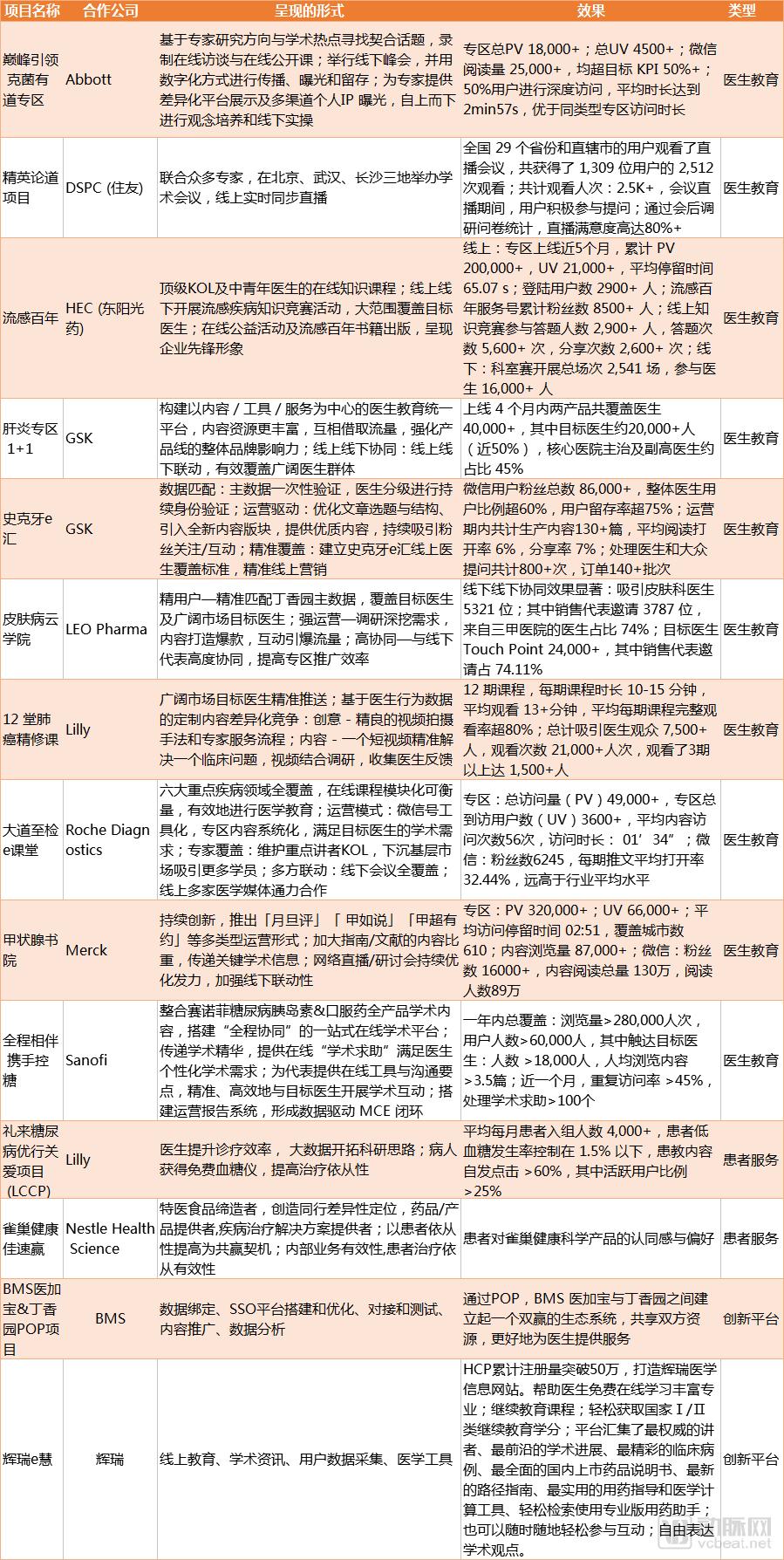
It is evident that physician education still accounts for the vast majority of efforts, compared to patient services. This dominance is inseparable from DXY’s years of deep engagement and accumulation within the physician community. Leveraging its platform of over 2 million physicians, DXY has become a commercial partner for pharmaceutical companies, adopting an integrated online-offline approach to physician education, thereby enhancing the influence and brand reputation of these pharmaceutical enterprises.
Meanwhile, patient services and platform innovation have injected digital vitality into healthcare enterprises and their stakeholders, enhancing the capacity for doctor-patient service delivery.
Behind DXY’s remarkable achievements lies a core strategy of data-driven innovation. This is particularly evident in the integration of physician and patient applications, where the role of data is indispensable. Li Tiantian, founder of DXY, identifies four key functions of data: measurement, connection, guidance, and filtration, which facilitate collaboration among various stakeholders in the healthcare industry.
Building on this core mission of serving physicians, DXY has established multiple business lines targeting hospitals, medical institutions, commercial clients, and the general patient population. Through years of accumulation, DXY has amassed substantial core data from both healthcare providers and patients, driving sustained, rapid, and healthy growth across its various businesses while continuously creating value for society.
Regarding the ongoing collaboration between iFlytek and DXY to apply AI in medical education, Zhang Wei believes that integrating DXY’s professional academic content with iFlytek’s advanced artificial intelligence technologies can help Chinese physicians access medical information more conveniently, thereby further upgrading current digital academic education and interactive models.
Taking DXY BoKa as an example, it is becoming the preferred interactive platform and model for Chinese physicians by aggregating professional expertise and clinical practice insights from top experts across an expanding range of disease specialties. In this process, through collaboration with iFLYTEK, the platform leverages artificial intelligence-based speech recognition technology to reduce the time physicians spend on handwritten medical records, thereby creating greater value for them.
The collaboration between the two parties has successfully achieved its first key milestone. “In subsequent phases of our partnership, we will integrate additional industry resources to accelerate the continuous development of this innovative model,” Zhang Wei stated candidly.
In terms of doctor-patient interaction, on April 27 this year, the first comprehensive AI-assisted diagnosis and treatment platform for dermatology in China, jointly developed by Xiangya Second Hospital of Central South University, DXY, and Ruiqi Software, was officially opened to clinicians, leveraging data and artificial intelligence technologies to assist physicians.
Dr. Yin Heng, an attending physician in the Department of Dermatology at the Second Xiangya Hospital of Central South University, stated that the intelligent dermatology system is currently accessible only to physicians and can assist in diagnosing approximately 85 skin conditions. This range is expected to expand to 300 conditions within the next one to two years, basically covering common and recurrent diseases. Once the diagnostic accuracy reaches a certain threshold, public access will be enabled to facilitate easier medical consultations for patients with skin disorders.
What if AI makes medical errors? Yin Heng explained it this way: Currently, AI is not replacing doctors, as AI provides diagnostic suggestions. The final diagnosis of a disease requires the doctor to make judgments and decisions based on the patient's medical history and the initial diagnosis results provided by AI. In the future, one thing will become clear: if you do not use AI as an aid, you are likely to be replaced by doctors who utilize AI tools.
From the perspective of DXY’s integrated doctor-patient strategy, which involves participants such as pharmaceutical companies, insurance institutions, physicians, and patients, what roles do the various stakeholders in this complete value chain play?
At the DHC Doctor-Patient Integration Roundtable, representatives from the insurance, finance, and pharmaceutical distribution sectors, together with DXY, engaged in high-level discussions to jointly explore solutions for building a full value chain spanning doctors, patients, and payers.
Trust Mutual Life Insurance Society (hereinafter referred to as “Trust Mutual Life”) is the first life insurance institution specially approved by the State Council, funded by Ant Financial, Tianhong Asset Management, and Guojin Securities, with a focus on developing long-term elderly care and health services. Mutual insurance is a form of mutual protection based on voluntary participation in a platform, aiming at mutual assistance, risk pooling, and benefit sharing. Premiums paid by members are pooled into a risk protection fund, which is used to compensate members when losses occur due to disasters or other insured events. This means that users who purchase insurance from Trust Mutual Life Insurance Society become owners of Trust Mutual.
Hu Han, Co-founder, Vice Chairman, and President of Trust Mutual Life Insurance Society, stated that in the business sector, the “Baby Guardian Plan,” jointly launched by Trust Mutual and Alipay, has provided common critical illness coverage with a sum insured of RMB 100,000 to 7 million children. Furthermore, Trust Mutual pioneered the jury system within China’s insurance industry. In cases where members suffer losses from disasters, the decision on claim settlements is not based solely on standard insurance principles but also incorporates a mechanism whereby members determine whether compensation should be paid—a first in the history of insurance.
“Trusted Mutual Life Insurance has always maintained a genuine passion for the industry, adhering to the principle of engaging in meaningful endeavors. As an industry pioneer, we encourage physicians who are members to participate in product design and pricing. Together with DXY, we are committed to caring for both doctors and patients, delivering more tangible protection to the doctor-patient relationship,” stated Hu Han. He emphasized that, in addition to patients, physicians also require adequate protection and care. Given that the DXY platform already aggregates a large community of physicians, there is potential for collaborative development of insurance products tailored specifically for doctors, possibly in partnership with pharmaceutical companies as well.
In the realm of financial services, Zhang Xiaodong, founder of Medbanks Health, stated that the company has long been committed to serving as an expert in innovative medical payment solutions for patients. By collaborating with pharmaceutical companies, Medbanks secures benefits for patients, while also supporting installment payments and outcome-based insurance in the area of medical finance. “Medbanks approaches patient support from a payment perspective, aiming to address the broader issue of healthcare expenditure in China. Medbanks Health hopes to join forces with DXY to create an integrated healthcare ecosystem, enhance patients’ choice, and connect physicians and patients through payment solutions, thereby building a comprehensive value-chain solution that spans from physicians to patients and ultimately to patient payment.”
Zhang Xiaodong introduced,Since 2017, Magnesium Health has engaged in large-scale collaborations with pharmaceutical companies, covering more than 150 cities and over 400 pharmacies across China. It also launched a co-branded credit card with China Everbright Bank. These initiatives have not only saved Chinese patients tens of millions of yuan in medical expenses but also provided premium subsidies exceeding RMB 10 million. Specifically, when patients face high out-of-pocket costs, they can access medical financial protection, with the highest savings reaching 40% of their medical expenditures.
He aspires to become an innovative healthcare payment specialist dedicated to individual patients.“We collaborate with pharmaceutical companies to transform how patients in China pay for medications by leveraging drug benefits, medical finance, and efficacy insurance. This enables installment payment plans, offers full refunds if treatment fails, and provides significant discounts on previously costly therapies through patient benefit programs.”
In the pharmaceutical procurement sector, Hao Jinghui, Senior Vice President of 111 Group, introduced that the group operates two core products: 1 Drug Net (B2C) and 1 Drug City (B2B). Among them, 1 Drug City serves over 100,000 clients, including clinics, pharmacies, private hospitals, and primary healthcare institutions.
Targeting B2C consumers, 111.com has established strategic partnerships with more than 100 pharmaceutical companies, empowering them through information flows, product flows, and supply chain solutions.
From the consumer perspective, he strives to provide users with an optimal experience, including unlimited medication choices, the lowest prices, and the fastest delivery.
Zhang Wei, Vice President of DXY and Head of the Corporate Business Division, believes that the combination of insurance institutions, financial institutions, pharmaceutical e-commerce platforms, and DXY will create new integrated application scenarios for doctors and patients. This model constructs a new chain encompassing doctor-patient interaction and patient management: Trust Mutual Life Insurance Society provides insurance coverage for patients; Medbanks Health creates value and delivers services by enhancing drug accessibility and patients’ payment capacity; 111.com contributes through drug selection and distribution. DXY, leveraging physician education, doctor-to-doctor interaction, and other infrastructure facilities, integrates and builds a complete ecosystem.
In this way, as long as other enterprises, experts, and doctors participate, the entire chain will operate under the precise condition of “physician-pulling-patient,” thereby establishing a new platform. This platform will not only enable win-win outcomes for medical institutions, insurers, and other stakeholders but also improve medical services.
As industry practitioners eagerly seek strong alliances to pursue joint development, favorable policies have also been frequently introduced at the national level. On January 4 this year, the National Health and Family Planning Commission and the State Administration of Traditional Chinese Medicine issued the “Notice on Printing and Distributing the Action Plan for Further Improving Medical Services (2018–2020)” (hereinafter referred to as the “Notice”), which outlined deployments for improving medical services over the next three years. The Notice requires that, starting from 2018, medical institutions establish systems for appointment-based diagnosis and treatment, telemedicine, clinical pathway management, mutual recognition of examination and test results, and medical social workers and volunteers.
The Plan highlights two key priorities: first, building on the experience gained from the three-year Action to Improve Medical Services, it calls for further consolidation of effective measures and their institutionalization into hospital operating procedures; second, it emphasizes the application of new concepts and technologies to innovate models of medical service delivery.
The measures for this round of healthcare service improvement initiatives are more specific than those of the first round, with repeated emphasis on “healthcare services” and “patient-centered care.” For instance, humanistic care is leveraged as a medium to foster harmonious doctor–patient relationships, while logistical services serve as a breakthrough point to comprehensively enhance patient satisfaction.
In February this year, Jiao Yahui, Deputy Director of the Bureau of Medical Administration and Hospital Management under the National Health and Family Planning Commission, summarized the positive achievements made during the 2015–2017 period. More than 4,100 hospitals nationwide now provide patients with information inquiry and push notification services, and 22 provinces have established provincial-level telemedicine platforms. She stated that the first three-year action plan focused primarily on improving in-hospital services to enhance patients’ healthcare experience. The second three-year action plan extends service improvements beyond hospital walls, adopting medical consortia as the organizational model for healthcare delivery to reflect integration and continuity of care, thereby bringing high-quality medical services back to communities.
In the United States, the integrated model of physician-patient care has long been operating efficiently, thanks to its advanced medical resources and insurance system. At this DHC Summit, Robert Wah, former President of the American Medical Association (AMA) and Chief Medical Officer of DXC Technology, was invited to share his insights on physician-patient integration from a global perspective.
Robert Wah joined DXC in 2016. The company has built a health management platform that integrates various stakeholders in the industry—including physicians, nurses, hospitals, research institutions, pharmaceutical companies, and government agencies—enabling information sharing to drive improvements in patient care.
Currently, he has just launched a research initiative in the United States called “All of Us,” which aims to collect blood and urine samples from users over the long term, building a cohort of one million healthy individuals. “I believe this will enable us to provide personalized patient recommendations, thereby improving the doctor-patient relationship,” Robert Wah admitted.
Next, he aims to serve 10 to 20 million users. The data from these users will be accumulated on the Open Health Connectivity Platform (OHCP), enabling his participation in the “Dajia” research initiative.
Robert Wah also shared DXC’s other medical practices worldwide. For example, in the UK, it established an open platform for diabetes that connects patients’ home devices via Internet of Things (IoT) technology to help them better manage diabetic symptoms.
In China, government bodies and enterprises are also engaged in projects aimed at improving the lives of patients with diabetes, such as Guiyang’s Population Health Management Platform. There are also specialized services dedicated to diabetic patients who do not require insulin injections—a particularly challenging demographic that benefits from technological support. Robert Wah believes that technology can provide better information to help healthcare professionals make more informed decisions.
However, when using patient data, enterprises must encrypt the data to ensure user privacy. In May of this year, Europe implemented the EPRS, which covers various industries and imposes fines of up to 4% of revenue. Companies can refer to the privacy protection schemes adopted by the financial sector.
Robert Wah has always regarded the doctor-patient relationship as sacred whenever discussing the progress of integrated doctor-patient services. With the rapid advancement of technology continuously reshaping the environment between healthcare providers and patients, how to effectively leverage these technologies remains an area requiring ongoing exploration.
Perhaps 2018 will mark a significant milestone in the evolution of doctor-patient service models. Starting this year, data-driven approaches and intelligent technologies will create superior value and experiences for both physicians and patients; meanwhile, industry collaboration and integration will foster more efficient and sustainable development across the entire value system.
In Zhang Wei’s view, today’s doctor-patient services will encompass broader connotations, such as an integrated service concept and model that combines physician education, peer-to-peer interaction among medical professionals, doctor-patient engagement, and patient management. This approach will become the core driver for industry participants to differentiate their competitive models and enhance operational efficiency. It is precisely under this development paradigm that the importance of industry collaboration will reach unprecedented heights.
“We will also continue to explore and innovate with an open mindset, working together with all sectors of the industry to empower the healthcare ecosystem through intelligence and integration, thereby creating greater value for doctors and patients,” said Zhang Wei.