

Six Digital Health Innovators Highlighted in Mary Meeker’s 2018 Internet Trends Report File for IPO
Some time ago, "Internet Queen" Mary Meeker released the 2018 Internet Trends Report, marking her 23rd consecutive year of publishing the report.
This year’s report comprises 294 slides, slightly fewer than last year’s 355. Nevertheless, it remains replete with online advertising and business and technology trends, as well as content focused on China. Healthcare-related content is included under the “Consumer Spending” section and accounts for a relatively small portion; only seven pages are devoted entirely to healthcare, a significant decrease from last year’s 31-page analysis of the healthcare industry.
In April 2018, CB Insights released its 2018 Top 100 Venture Capitalists list, in which Meker ranked ninth. As a heavyweight managing partner appointed by KPCB for the healthcare sector, she joined KPCB in 2010 and is primarily responsible for the firm’s fund focused on technology investments, as well as investments in the digital health space.
Since its founding in 1972, KPCB has invested in approximately 500 startups, more than 150 of which have successfully gone public. KPCB’s most notable achievement in the digital health sector is its investment in Teladoc, which later became the world’s first publicly traded telemedicine company.
From Medical Data to Healthcare Expenditures
The core of the healthcare section in last year’s report was “healthcare data.”
The report highlights a specific evolutionary cycle in today’s digital healthcare landscape: the rapid growth of healthcare data sources (such as medical devices and electronic health records) has directly accelerated the digitization of medical information. Once a critical mass is reached, medical insights are derived from integrated data. These insights are then applied to pharmaceuticals and healthcare services, generating even larger volumes of healthcare data and enabling continuous iteration and improvement. Data itself possesses the capacity to inform, educate, and guide both the entire healthcare system and consumer populations.
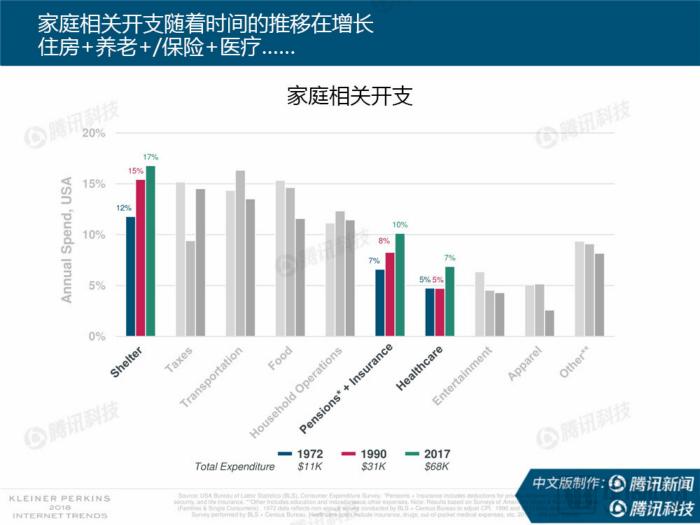
This year’s focus is “healthcare spending.” The report suggests that it is becoming increasingly difficult for consumers to balance their budgets. How have household-related expenses changed? Several clear trends have emerged: housing costs have risen, transportation expenses have remained flat, and healthcare spending has increased.
Healthcare’s share of household spending rose from 5% ($11,000) in 1972 to 7% ($68,000) in 2017, marking the fastest growth rate. Healthcare expenditures are increasingly shifting toward consumers.
In fact, the high cost of healthcare in the United States has become a burden for American businesses and employees. The Affordable Care Act (ACA), implemented since 2010, primarily aims to increase health insurance coverage and control medical expenditure. Measures include providing insurance subsidies for low-income individuals, mandating employers to purchase insurance for their employees, prohibiting insurers from denying coverage or charging higher premiums due to pre-existing conditions, and offering more comprehensive insurance plans covering services such as check-ups, medications, and surgeries.
However, the Affordable Care Act (ACA) has failed to effectively curb healthcare spending, and uncertainty surrounding its potential repeal is intensifying. According to statistics from the Kaiser Family Foundation, U.S. healthcare costs have risen dramatically over the past 60 years. In 1960, U.S. healthcare expenditure stood at $27.2 billion; by 2016, it had surged to $3.3 trillion, with per capita spending reaching $10,348. These costs are shared among the government, employers, insurance companies, and individuals.
In 2018, the United States may continue its efforts to cut and cap federal Medicaid spending, expand access to low-premium health insurance, relax consumer protections under the Affordable Care Act (ACA), eliminate the employer mandate requiring companies to provide health coverage for their employees, and repeal many of the taxes used to fund the ACA.
In this year’s “Internet Trends” report, several notable trends and questions have emerged:
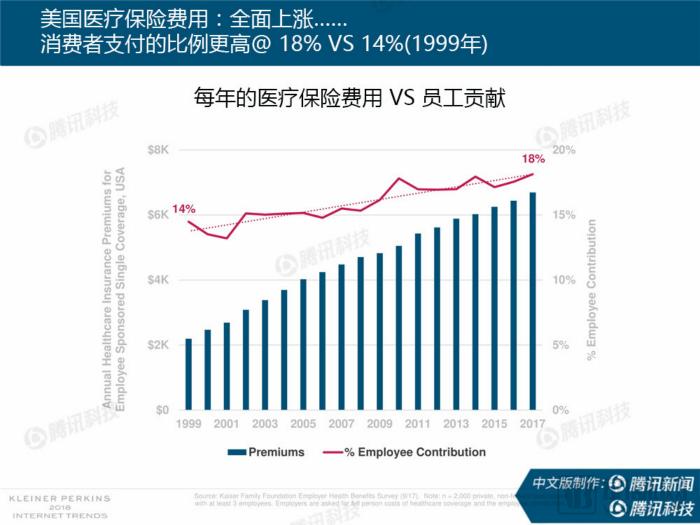
U.S. health insurance costs have risen across the board, with consumers’ share of these costs increasing at an even faster rate; employees’ contribution to annual health insurance premiums rose from 14% in 1999 to 18% in 2017.
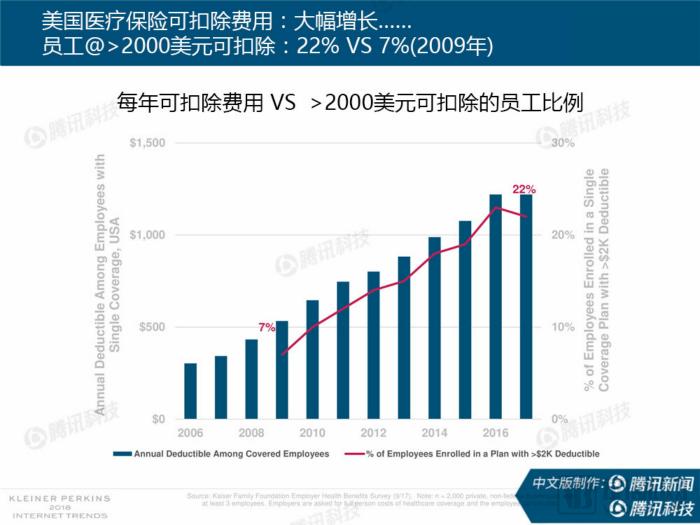
U.S. health insurance deductibles have risen significantly, with the proportion of employees facing deductibles exceeding $2,000 increasing from 7% in 2009 to 22% in 2017.
We cannot help but question: As consumers prepare to increase their spending, will their heightened focus on value and price enable market forces to ultimately reduce their expenditures in the healthcare market? Can the consumerization of healthcare and the growing availability of data lower consumers’ healthcare costs? These questions await resolution through new health insurance policies and technological advancements.
Consumer Needs Are Diverse
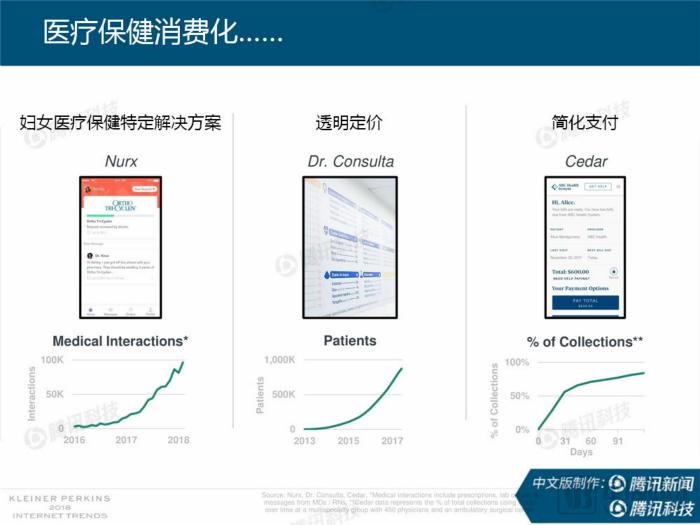
By 2018, when consumers sought medical care, there had been significant changes in the location, timing, and mode of healthcare delivery. These shifts included modernized retail experiences, digital health management, on-demand pharmacy services, tailored women’s healthcare solutions for specific demographic segments, transparent pricing, and streamlined payment processes. Such innovations met consumer expectations typically associated with other types of consumption—namely, convenience, personalized attention, timeliness, value, and price transparency.
The growing number of medical patients has driven diversification in consumer demand. Below are the representative companies mentioned in the 2018 "Internet Trends" report:
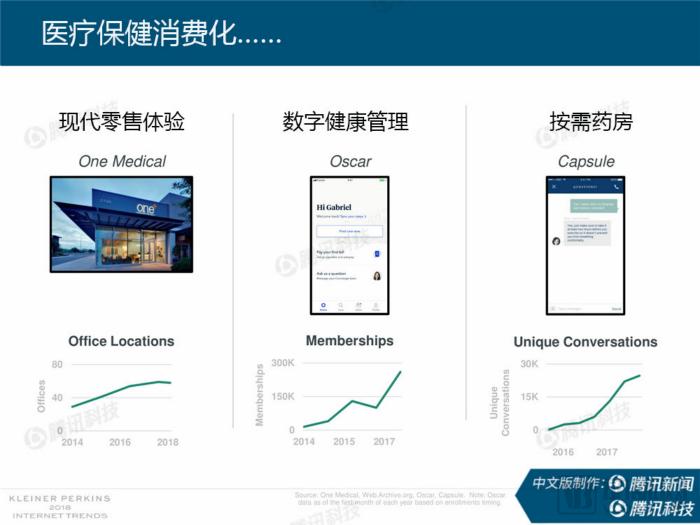
1、One Medical
Direction: Modern Retail Experience
A subsidiary of Life Healthcare, founded in 2007 and headquartered in San Francisco, the company specializes in primary healthcare. Through the One Medical website or app, patients can schedule online appointments for dermatology, family medicine, influenza vaccination, mental health, nutrition, prenatal care, pediatrics, sports medicine, and other services, as well as locate the nearest medical facilities and clinics.
All providers on the One Medical platform rank in the top 10% on Yelp, offering care ranging from preventive medicine to the treatment of acute and chronic conditions, along with personalized, ongoing treatment plans. To access these services, patients are required to pay an annual fee of $149.
2、Oscar
Direction: Digital Health Management
Founded in 2012 and headquartered in New York, Osca primarily provides health insurance services based on the Affordable Care Act. In recent years, Osca has leveraged technology to connect users with physicians, encouraging members to access a network of high-quality healthcare providers.
On Oscar’s personalized platform, users can select their desired physicians through a doctor-matching feature. The platform’s network includes hundreds of providers, ranging from primary care physicians and pediatricians to gastroenterologists and cardiologists.
This platform enhances member engagement within its health plans, while the company guides members toward more affordable care options. On the provider side, it offers operational integration and user-friendly tools to key healthcare institution partners. Oscar’s product suite also includes Doctor on Call, a telemedicine platform with an integrated app that provides members with rapid, low-cost digital virtual care services.
3、Capsule
Direction: On-Demand Pharmacy
Capsule is a startup founded in 2016 and headquartered in New York, USA. Often referred to as the “Uber of pharmaceuticals,” Capsule positions itself as a smart pharmacy accessible remotely via an app, pioneering the next generation of pharmacies. Any physician can prescribe medications directly through Capsule, which then dispatches dedicated personnel to deliver the prepared drugs to any location within New York City within two hours, ensuring they reach patients directly. All delivery services are provided free of charge to consumers.
Furthermore, Capsule offers a dynamic inventory system that enables physicians to optimize medication ratios when writing prescriptions. More importantly, the entire process is conducted online, significantly saving time for both doctors and patients.
4、Nurx
Direction: Specific Solutions for Women's Healthcare
Founded in 2015, Nurx is a mobile health platform designed to enable women to access birth control from anywhere, eliminating the hassle of visiting hospitals. To use the service, women simply enter their personal information into the Nurx app and, upon physician review, receive a contraceptive prescription. Shipping is provided at no additional cost, and for uninsured patients, Nurx assists customers in selecting and enrolling with insurance providers.
5、Dr.Consulta
Direction: Transparent Pricing
A Brazilian company founded in 2011, Dr. Consulta provides high-quality primary healthcare services, with diagnostic speeds 25 times faster than the public system and costs 60% to 90% lower than those of private providers. The company’s core is its scheduling system, where results and monitoring are automated and online. It currently holds a large dataset of over 200,000 patients, which can be used for disease prevention and to facilitate virtual consultations.
6、Cedar
Direction: Simplifying Payments
Founded in 2016, Cedar is a comprehensive healthcare IT services provider that offers hospitals, health systems, and care teams a smarter way to manage the patient payment ecosystem. The platform significantly improves billing operations and ensures patients receive a personalized billing experience.
Text: Gao Daolong / Zhao Qingyun. Images produced and compiled by Tencent Technology.
Related Reading: