

12Sigma Advances Medical AI in Zhejiang with End-to-End Diagnostic Solutions
In recent years, medical AI has become prevalent in nearly all Grade A tertiary hospitals across China. Among these regions, Zhejiang Province has been the most active. Although there are not many medical AI companies in Zhejiang, numerous Grade A tertiary hospitals within the province began embracing AI around 2016 and have since discussed its applications and challenges at various medical conferences.
Last week, medical artificial intelligence made its presence felt at multiple events in Zhejiang, such as the 5th Qianjiang International Imaging Forum and the inaugural promotional event for Zhengcaiyun.As a leading medical artificial intelligence company in China, Tuma Shenwei has actively participated in academic and business exchanges, showcasing its R&D achievements and sharing its insights into the industry, thereby contributing to the development and application of medical AI in Zhejiang Province.
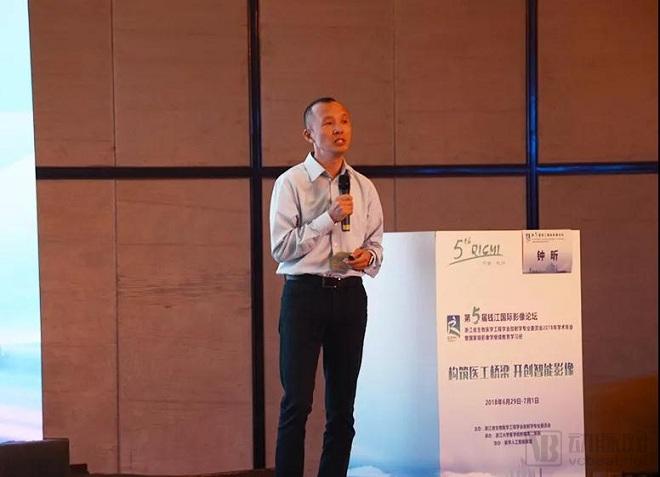
Tumaini Founder and CEO Zhong Xin Delivers Keynote Address at the Qianjiang International Imaging Forum
The 5th Qianjiang International Imaging Forum, themed “Building a Bridge Between Medicine and Engineering, Pioneering Intelligent Imaging,” also organized special sessions on artificial intelligence and informatization construction to address current hot topics in the development of radiology.
Distinguished guests at the conference included prominent industry leaders such as Academician Zhan Qimin, Executive Vice President of Peking University and Director of its Health Science Center; Professor Jin Zhengyu, Chairman of the Chinese Society of Radiology; and Academician Duan Shumin, President of the Chinese Neuroscience Society. Zhong Xin, Founder and CEO of Tumaini, also delivered a keynote presentation titled “An Overview of AI in Medical Imaging,” elaborating on Tumaini’s explorations and future prospects in the intelligent healthcare sector. Additionally, he engaged in a live dialogue on medical AI with Professor Sun Xiwen from the Department of Radiology at Shanghai Pulmonary Hospital.
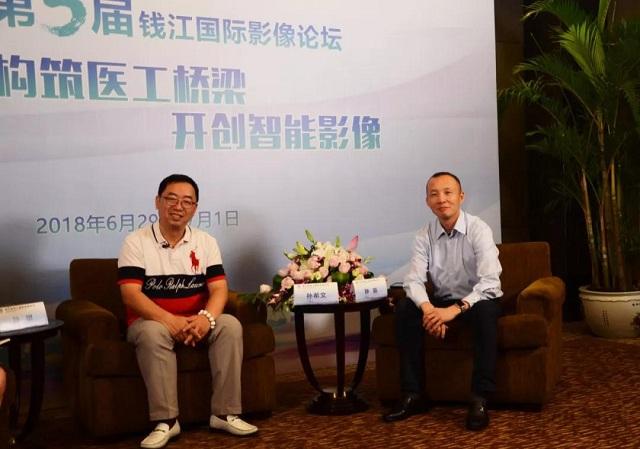
Zhong Xin (right) and Sun Xiwen of Shanghai Pulmonary Hospital (left) accept an interview
Zhong Xin stated that lung cancer is the malignant tumor with the highest incidence and mortality rates worldwide, accounting for 18% of all cancer-related deaths. However, approximately 75% of lung cancer patients in China are diagnosed at an advanced stage, resulting in a five-year survival rate of only about 15.6%. The detection, re-examination, and follow-up of pulmonary nodules can improve the early detection rate of lung cancer, facilitate early treatment, and thereby enhance patient prognosis and quality of life.
Early screening for lung cancer is beneficial, but its implementation is highly challenging. The annual image interpretation workload for radiologists across China has increased by 33%, yet the number of radiologists has grown by only 4%, leaving a significant shortage relative to the demand for image reading. Moreover, image interpretation is a meticulous task; prolonged engagement in such work can impair physicians’ performance, which in turn adversely affects the quality of their readings.
Taking Yinzhou Second Hospital as an example, the radiology department generates approximately 400 CT reports per day, with chest CT scans accounting for one-third of this volume. Among these chest CT images, 90% exhibit pulmonary nodules.
For pulmonary nodules, especially small ones, physicians often need to spend more time reviewing images slice by slice and repeatedly scrolling back and forth to minimize missed diagnoses and misdiagnoses; nevertheless, 100% accuracy cannot be guaranteed. Under constraints of limited energy and time, improving the speed and precision of report generation has long been a major challenge for radiologists.
Tumashenwei’s products have become doctors’ “trekking poles”
Tumashenwei has been committed to developing artificial intelligence-based automated medical diagnostic systems and medical data analysis systems. Zhong Xin pointed out that the development of medical AI has now come to fruition, with over 100 companies worldwide having achieved research outcomes in this field. Their products are deeply applied in areas such as new drug discovery, medical imaging, genomic sequencing data analysis, and insurance.
Among these, medical imaging is the most mature field. Seventy percent of domestic medical AI companies are involved in medical imaging and have promoted their products to hospitals across China. Taking Tumadepth as an example, its products have been deployed in more than 100 hospitals nationwide.
The feedback from physicians has also been highly positive. Professor Sun Xiwen from the Department of Radiology at Shanghai Pulmonary Hospital stated that since the department began using Tumadimwei over a year ago, the product’s pace of improvement has been remarkable. Previously, physicians’ understanding of medical AI was limited to traditional computer-aided detection (CAD) systems. While these systems could detect nodules, their high false-positive rates imposed significant additional workload on clinicians.
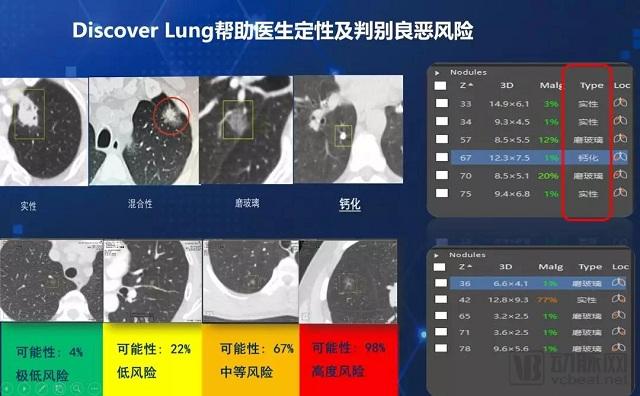
Tumavis’s products are capable of differentiating between benign and malignant lesions, directly determining the nature of pathological findings, thereby providing tangible assistance to physicians in clinical practice.
In addition, Professor Sun Xiwen noted that there are numerous medical AI companies currently. He categorizes their medical imaging AI products into two types: one is an auxiliary screening system, and the other is an expert-assistance system. The auxiliary screening system can only detect nodules, whereas the expert-assistance system possesses the capability to differentiate between benign and malignant lesions, akin to a human expert. Furthermore, owing to the stability and learning capabilities of AI, the system continues to improve. In the daily workflow of the department,Tumashenwei’s products have become indispensable tools, much like trekking poles.
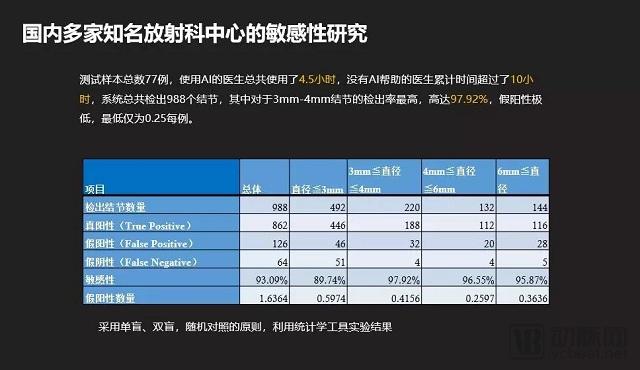
Zhong Xin added that Tuma Shenwei’s σ-Discover-Lung pulmonary nodule detection system has undergone sensitivity studies at multiple renowned radiology centers in China. The study included a total of 77 test cases. Physicians using AI assistance spent a total of 4.5 hours, whereas those without AI support accumulated over 10 hours. The system detected a total of 988 nodules, achieving the highest detection rate of 97.92% for nodules measuring 3–4 mm, with an extremely low false-positive rate of as few as 0.25 per case.
Achieve Full-Process Diagnostic Coverage
Tumour Deep Vision’s products not only enable the assessment of malignancy risk but also provide functionalities such as nodule tracking and follow-up, treatment guidance, automated generation of structured reports, and support for physicians in scientific research. Leveraging these capabilities, Tumour Deep Vision’s products achieve comprehensive coverage of the entire diagnostic workflow.
Malignancy Risk Assessment: Tumor Deepwise has developed a quantitative analysis technique for differentiating benign and malignant lesions, trained on data from over 60,000 cases and validated with more than 10,000 case records, achieving an accuracy rate exceeding 90% in concordance with pathological results.
Nodule Follow-up Monitoring: As CT slice thickness continues to decrease, some nodules detectable by CT screening are only 1–2 mm in size. Tuma Shenwei’s product enables the simultaneous loading of multiple serial examinations for nodule patients, facilitating precise comparison of nodule growth over time. During the loading process, it achieves automatic registration and localization of multiple nodules, with synchronized display of various comparative parameters. It also predicts doubling time and assesses the benign or malignant nature of the nodules.
Treatment Guidelines: Tuma Shenwei’s products leverage 3D algorithms to achieve precise anatomical localization, lung nodule segmentation, and assessment of the relationship between nodules and surrounding tissues, thereby assisting surgeons in planning surgical pathways and strategies. This approach gradually extends the product’s role from diagnosis into the treatment workflow.
In addition, Tuma Shenwei is also conducting research in radiomics, aiming to improve patient diagnosis by integrating clinical information such as imaging, text, and genomics.
Zhong Xin concluded by stating that Tuma Shenwei’s product roadmap aims to achieve full-process diagnostic coverage across multiple anatomical regions. The company will actively advance its efforts in oncology, cerebrovascular, and cardiovascular fields, developing medical AI products that meet clinicians’ needs.