

Billion-Dollar Medical Bills Fall Through the Cracks: Can 'Drug Lords' Really Shoulder the Burden?

"Dying to Survive" movie still, image from Douban
At the end of the film “Dying to Survive,” Officer Cao picks up Cheng Yong upon his release from prison and informs him that Indian Gleevec no longer has a market, as Swiss Gleevec has been included in the national medical insurance coverage.
Art Shines into Reality.In 2013, Jiangsu Province included anti-tumor drugs such as Gleevec in the scope of medical insurance fund coverage, thereby reducing the annual medical expenses for patients with chronic myeloid leukemia from over 70,000 yuan to less than 20,000 yuan.
Experts see the intricacies.In “Dying to Survive,” the high cost of Gleevec, a life-saving drug for chronic myeloid leukemia (CML), placed it beyond the financial reach of patients, with some resorting to suicide as a last resort. Set in 2002, the story unfolds nearly four years after the establishment of China’s basic medical insurance system for urban employees, which by then covered most urban households. As the credits rolled, the author was left in deep reflection: in China, the challenge of medical insurance coverage has never been merely one of breadth; the predicament of insufficient depth is even more difficult to resolve.
In fact, the same issue exists in the United States. Unlike the “strong welfare” systems of established European nations or the “big government” models of affluent Southeast Asian countries, the U.S. healthcare system operates on a market-driven basis, with a “broad but shallow” insurance safety net spread across individual states. Beneath this net lie hundreds of billions of dollars in uncovered medical bills. This article will first examine the problem of inadequate health insurance coverage in the United States and conclude by highlighting some innovative companies’ promising efforts to reduce these uncovered costs.
In 2010, the United States implemented the Affordable Care Act (ACA), commonly known as “Obamacare,” fulfilling former President Obama’s campaign promise to assist low-income individuals. The ACA’s individual mandate required all U.S. citizens to purchase health insurance or face a penalty, unless exempted due to religious beliefs or financial hardship. As a result, approximately 30 million previously uninsured Americans gained health coverage.
In fact, the ACA merely serves as a supplement to the U.S. healthcare system. In the United States, most people obtain health insurance through employer-sponsored group plans. Building on this foundation, the U.S. health insurance system has established Medicare, Medicaid, and the Children’s Health Insurance Program (CHIP) to specifically cover adults aged 65 and older, low-income individuals and people with disabilities, and children, respectively.
The complex health insurance system basically covers nearly everyone in the United States, with very few falling through the cracks.
However, data from U.S. bankruptcy courts has shattered this tranquil and idealized picture. Each year, nearly 1.2 million households across the United States file for bankruptcy protection, with medical expenses accounting for 62% of these filings. Notably, 60% of those filing for medical bankruptcy had private health insurance, while only 22% were uninsured.
In the United States, insured individuals are required to pay thousands of dollars in annual premiums, and when medical expenses occur, they must also bear out-of-pocket costs such as deductibles, copayments, and coinsurance. This is a significant source of inadequate health insurance coverage.
Take a 50-year-old American man as an example. Assuming an annual income of $46,100, he pays $10,585 in annual insurance premiums, accounting for 22.9% of his annual income. If medical expenses are incurred, he must also bear out-of-pocket costs of up to $6,250, raising his total healthcare burden to 36.5%. Under the Affordable Care Act (ACA), individuals with incomes between 100% and 400% of the federal poverty level are eligible for tax credits and health insurance subsidies.
Based on the 2018 Federal Poverty Level (FPL) guidelines, this individual qualifies. Nevertheless, this low-income person’s medical expenditure burden remains as high as 18.6%.Statistically,“Insufficient Health Insurance Coverage” has certain quantitative criteria; one such standard is when an individual’s annual out-of-pocket medical expenses exceed 10% of household income.
According to data from the National Medical Expenditure Survey (NMES), the proportion of individuals with group health insurance who were underinsured increased from 14.2% to 18.2% between 1996 and 2003. Additionally, a survey by the Commonwealth Fund reported that the national underinsurance rate among non-elderly adults in the United States was 32% in 2010.
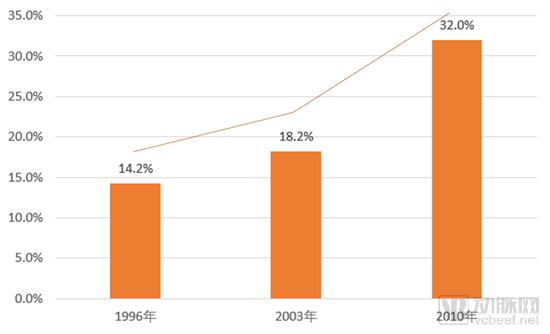
Image compiled by VCBeat based on NMES data
In terms of income level, the low-income group had the highest rate of underinsurance, at approximately 33.3%; in terms of health status, individuals with poor health had an underinsurance rate of 32.3%.
Specifically, 39.1% of patients with diabetes, 30.9% of patients with hypertension, and 29.2% of patients with mental illness lack adequate health insurance coverage; these conditions are the most common chronic diseases among Americans.
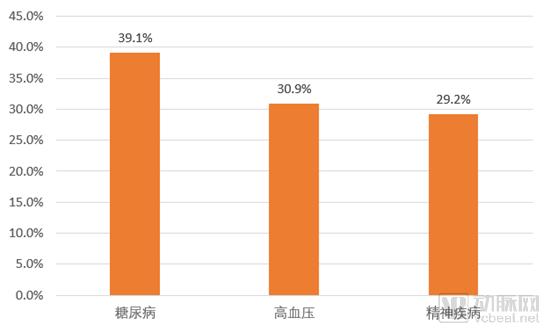
Image compiled by VCBeat based on NMES data
Studies have shown that the harm caused by inadequate insurance coverage to enrollees is not only financial but also involves health and even life. In the RAND Health Insurance Experiment, inadequate coverage led to a 21% increase in the risk of death among low-income enrollees with serious illnesses. Furthermore, a 2007 nationwide survey revealed that 29% of enrollees with high deductibles and 16% of those with low deductibles delayed or forgone care due to costs.
The Affordable Care Act (ACA), mentioned at the beginning of this article, has helped Americans effectively address the problems of being uninsured and underinsured. However, it has objectively exacerbated inadequate insurance coverage. On one hand, regulators allow ACA plans to impose copayments and deductibles on enrollees who receive premium subsidies. On the other hand, the actuarial value of ACA health plans is inherently low. For instance, Bronze plans cover an average of 60% of healthcare costs, Silver plans cover 70%, and even Gold plans, which offer the highest level of coverage, cover only an average of 80% of medical expenses.
The ACA is regarded as the healthcare reform law with the strongest protections in history, but it faced opposition from many quarters from the outset due to the increased fiscal pressure on federal and state governments.
June 2012,The U.S. Supreme Court ruled on the case brought by Republicans challenging the Affordable Care Act (ACA) as unconstitutional. While upholding most provisions of the ACA, the Court held that the federal government’s use of Medicaid funding as leverage to compel states to expand Medicaid coverage was unconstitutional.
In 2017,After Trump took office, he advocated for the repeal of “Obamacare.” In May of that year, the U.S. House of Representatives passed the American Health Care Act (AHCA) of 2017, a new bill intended to replace “Obamacare.” Fortunately, the alternative to the Affordable Care Act (ACA) was not approved in the Senate vote. “Obamacare” has remained in effect to this day.
U.S. media outlets have conducted a statistical analysis showing that if the AHCA were to replace the ACA, the number of uninsured individuals nationwide would increase by 23 million by 2026.
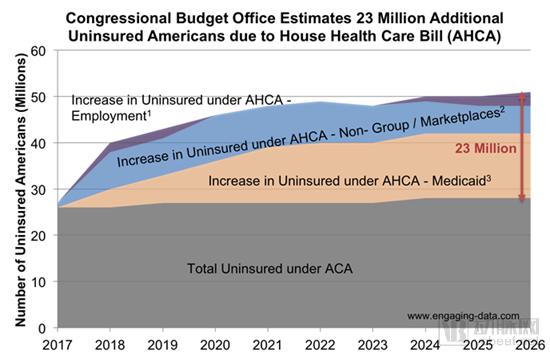
Image from the KFF official website
VCBeat (WeChat ID: vcbeat) conducted a rough estimate. Taking 2018 as an example, there were approximately 130 million employed individuals in the United States, with an average salary of $43,460. Assuming that, after weighting for demographic structure, the proportion of medical expenses borne by individuals is 10%, the total amount of unpaid medical bills nationwide would exceed $560 billion annually. Although this figure is approximate, its magnitude is significant enough to warrant attention. In fact, some companies in the United States have already begun attempting to reduce this burden.
Advocatia Solution: Connecting More People to Insurance Coverage
Recently, at the “Health:US 2018 Initiative” co-hosted by Kaiser Permanente and Village Capital, two startups emerged as winners in the finals, one of which was Advocatia, headquartered in Chicago.
VCBeat has learned that the “Health:US 2018 Initiative” is a specialized venture capital program designed to nurture early-stage companies addressing key challenges posed by population aging. Advocatia provides hospitals with tools to help them assist uninsured and underinsured patients, such as by informing patients about the financial assistance policies available to them.
Co-founder of AdvocatiaHumanLaura RobbiNS believes that over 28 million people lack adequate insurance coverage, including 11.7 million who are eligible for healthcare programs but remain unaware of their eligibility. The latter group constitutes the target population for Advocatia.
Advocatia’s solution comprises three modules: Benefit Triage, Benefit Text, and InsurNav. Benefit Triage is a SaaS-based financial counseling platform designed to help identify financial assistance options for patients’ health insurance coverage, optimize workflows, and improve reimbursement efficiency for services rendered. Benefit Text is a decision engine that engages uninsured or underinsured individuals through instant SMS communication, enabling them to proactively screen for available programs. InsurNav integrates into hospital websites, empowering physicians and patients to better understand local resources.
TCARE: Evidence-Based Solutions for Family Caregivers
TCARE is another company that made it to the finals of the “Health: US 2018 Program” together with Advocatia, headquartered inMadison, Wisconsin: Providing intelligent management to tens of millions of family caregivers across the United States. TCARE’s solution divides family caregiving into two components—identifying problems and providing resources—and optimizes this unpaid care process through six steps.
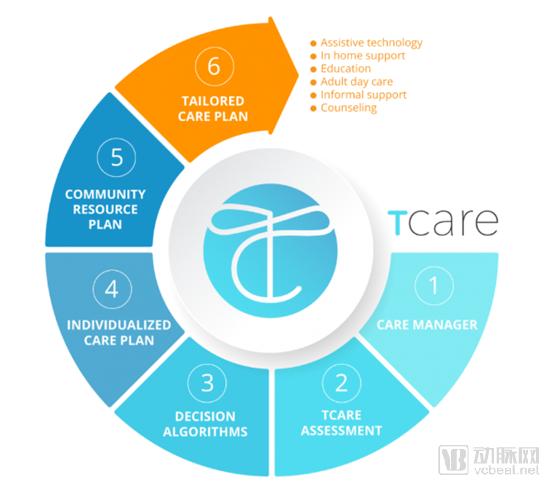
Image from the TCARE official website
Among these, the most critical step is the third one: after family caregivers complete the assessment, TCARE uses a specialized algorithm to determine optimal treatment goals, community support strategies, and a prioritized list of professional healthcare providers. This enables healthcare professionals to better identify care needs and integrate resources.
MDSave:Expedia Healthcare Edition
MDSave, headquartered in Nashville, was founded by former CongressionalXia Professional Lobbyist(lobbyist)and Paul Ketchel, the technical system administrator for former U.S. Senator from Tennessee Bill Frist, in 2011.
In 2013, MDSave officially launched its website, functioning as a healthcare equivalent of Expedia by enabling patients to compare medical procedures and guaranteeing nearly immediate payment to healthcare providers.

Image from the MDSave official website
All patients need to do is enter their location, search for the treatment they require, and select the most suitable care plan based on price, proximity, and physician ratings. For ease of use, all costs are bundled together, so patients will not receive numerous bills with unexpected charges.
In international trade, the simultaneous existence of an independent monetary policy, a fixed exchange rate regime, and free capital flow is impossible, a concept known as the “Impossible Trinity” or the “Trilemma.” In healthcare service delivery, “"The Impossible Trinity"This also exists, namely the impossibility of simultaneously improving the quality of medical services, increasing their accessibility, and reducing their prices.
From a financial perspective, health insurance has improved the accessibility of medical services but has also given rise to the problem of “broad yet shallow” coverage. In the future, only technological innovation can break the “impossible triangle” of healthcare. In the three cases mentioned above, we observe that innovators are attempting to leverage internet technologies and artificial intelligence algorithms to reduce costs falling through the cracks of health insurance coverage. Although the results have not yet been significant, these efforts have nonetheless opened up new avenues for supplying medical services to low-income populations, beyond the scope of policy measures.