

YiSuizhen Dominates China's Oncology Follow-up Market with Over 80% Share and 2800+ Integrated Data Points Within Three Years of Launch
“On average, seven people in China are diagnosed with cancer every minute, with a cumulative cancer incidence rate of 21.58% among individuals aged 0–74 years.”This set of data released by the National Cancer Center in February this year is unsettling.For a long time, cancer has been regarded as a “terminal illness.” The first concern of patients after diagnosis is often not the treatment plan but their life expectancy. Therefore, the medical community uses the “5-year survival rate” as an indicator to measure the effectiveness of cancer care. In January this year, The Lancet, a leading British medical journal, published the “Global Surveillance of Trends in Cancer Survival 2000–14” report. The data showed that the overall 5-year cancer survival rate in China was 30.9%, compared with 81.6% in Japan and 66% in the United States.
The folk belief that “cancer is incurable” has long persisted; lifelong follow-up is the standardized medical approach to controlling recurrence and metastasis. In the 2011 edition of the Implementation Details for the Accreditation Standards for Tertiary Cancer Hospitals, the former Ministry of Health of China required tertiary cancer hospitals to establish independent follow-up departments staffed with appropriate full-time personnel, set up follow-up mechanisms and related databases, and strengthen health education and follow-up appointment management for discharged patients.
Against this backdrop, Yi Suizhen has entered the field of oncology follow-up, leveraging established physician-patient relationships to empower cancer hospitals and clinicians. Recently, VCBeat (WeChat ID: vcbeat) conducted an exclusive interview with Dr. You Jiangyun, founder of Yi Suizhen, who shared insights into the company’s development trajectory, data architecture, and closed-loop business model.
Earlier, the “China Western Hospital Management Support for Poverty Alleviation Project” (hereinafter referred to as the “Angel Project”) was officially launched. The initiating organizations were the former Ministry of Health, the State Administration of Traditional Chinese Medicine, the State Council Leading Group Office of Poverty Alleviation and Development, and the China Foundation for Poverty Alleviation. At that time, Yi Suizhen participated in the project as the implementing entity. The Angel Project promotes the modernization of hospital management by training grassroots hospital management teams. As the management training deepened, the project team identified a significant gap in the development of oncology specialties in hospitals across China.
“Many cancer patients do not receive effective treatment at all.“Dr. You Jiangyun holds a Ph.D. in Medicine and is an expert in clinical research methodology. She believes that improving the standard of oncology diagnosis and treatment requires both strengthening in-hospital oncology specialties and enhancing out-of-hospital oncology follow-up care. In the later stages of the poverty alleviation project, the project team bolstered the development of oncology specialties by partnering with the Cancer Hospital of the Chinese Academy of Medical Sciences and the PLA General Hospital (301 Hospital), establishing oncology departments in 197 primary-care hospitals. After the project’s completion, Yi Suizhen assumed responsibility for out-of-hospital services, focusing on oncology follow-up care.”
In 2015, Yi Suizhen’s mobile cloud platform for oncology follow-up was officially launched.
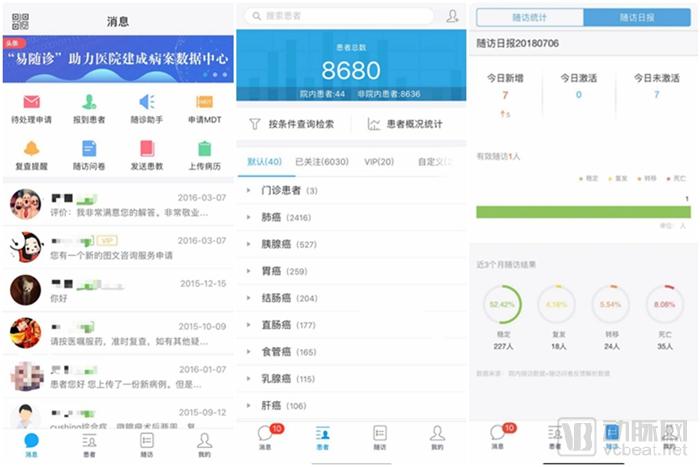
Image of the Yisuizhen Doctor App, provided by Yisuizhen
Oncologists can monitor patients’ post-discharge disease status, schedule follow-up appointments, and remotely address patient inquiries via a mobile app.Typically, once cancer patients are discharged from the hospital, physicians lose precise oversight of their condition. The natural solution is to establish continuous, on-demand communication between doctors and patients. This approach addresses the pain points faced by hospitals, physicians, and patients in post-treatment oncology care from a unique perspective, alleviating patient anxiety and enabling physicians to manage post-discharge services more efficiently.
You Jiangyun introduced YisuiZhen’s “trinity, interconnected” solution.
First, the “Wei” follow-up and big data research platform. This platform integrates with hospital information systems to dynamically collect patients’ personal information, clinical visit records, and laboratory and imaging reports. Leveraging progressively accumulated core technologies, it organizes these data into comprehensive longitudinal medical records in a standardized format, enabling physicians to query and retrieve information for retrospective studies. Meanwhile, the Yi Suizhen platform supports customized clinical research case report forms, facilitating prospective studies by physicians.
Second, the physician-facing app.After logging into the app, physicians can view the complete medical records of all patients from previous visits, manage routine consultations for their assigned patients, and schedule diagnostic and treatment services.New Approaches to Enhancing Diagnosis and Treatment Standards Discovered in Massive Clinical Data. In addition, with the support of hospitals, Yi Sui Zhen will organize unified training for physicians to assist them in utilizing the platform's features.
Third, “Position”: Patient-side Official Account. Yi SuizhenPatient SideThere are two login methods: patient self-login and family member login, thereby maximizing patient coverage and enabling precise profiling. Through Yi Suizhen, patients can report their symptoms to their attending physicians at any time, upload medical records from off-site consultations, and schedule follow-up appointments.
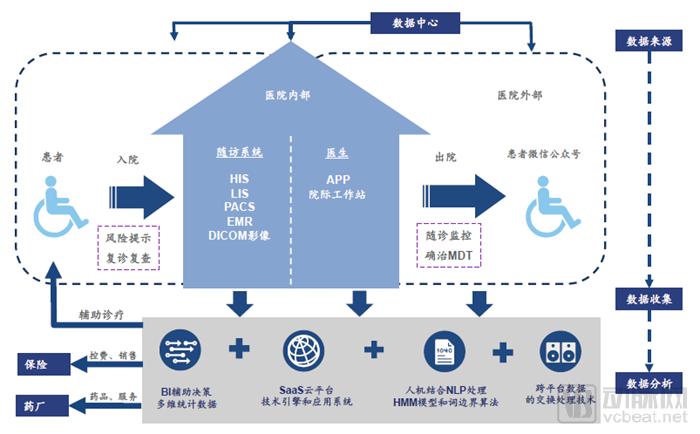
Yi Suizhen Solution Diagram. Image provided by Yi Suizhen.
Leveraging the “Trinity, Interconnected” solution, Yi Suizhen effectively integrates data from multiple visits across N hospitals for each patient, creating a “Comprehensive Master Medical Record.” For an individual patient, this comprehensive record comprises over 2,000 types of in-hospital data and nearly 800 types of out-of-hospital data. Currently, Yi Suizhen has established partnerships with 53 oncology hospitals in China, including 15 provincial-level specialized oncology hospitals, and collaborates with more than 20,000 oncology specialists. It commands nearly 81% market share among the 124 oncology hospitals nationwide and manages data for over 6.2 million patients.
“The most challenging part is data cleaning,” said You Jiangyun, “and the biggest highlight is also data cleaning.” The data collected by Yi Suizhen covers various formats such as text, images, and audio, which must be cleaned and matched before they can be utilized by the platform.
The massive scale places extremely high demands on Yi Suizhen’s data processing capabilities. Chief Architect Long Xiangming holds a Ph.D. in Computer and Network Science from Beijing University of Posts and Telecommunications. He previously served as the Chief Architect at the Internet and System Services Department of China Mobile Research Institute, where he accumulated extensive experience in data processing.Long Xiangming’s role at Yi Suizhen involves designing database structures, as well as performing data error correction, cleaning, and standardization—tasks that pose little difficulty for him.
The real challenge lies in designing new algorithms that leverage artificial intelligence to process data. Liu Dongxu, Chief Technology Officer, believes that with the aid of AI, Yi Suizhen’s data processing is both more efficient and more precise. Currently,Yi Suizhen has already demonstrated significant value in data collection, data cleaning, data error correction, and standardization through its six core technology engines with independent intellectual property rights.
“We have launched and are developing AI-based follow-up services. For example, conducting follow-ups via smart phones has significantly improved the efficiency of hospital follow-up centers. Furthermore,”AI Technology“This system prompts physicians to proactively monitor patients with potential follow-up needs, truly assisting them in completing follow-up tasks more efficiently,” said Liu Dongxu.
Another data-related task is security protection. The "Provisions on the Management of Medical Records in Medical Institutions (2013 Edition)" clearly stipulates that patients own their medical records, and doctors may access and study medical record data in accordance with regulations. Yi Suizhen empowers hospitals by building a follow-up big data platform for them, making the safeguarding of data security critically important. To this end, Yi Suizhen has designed static routing and employs methods such as offline access via isolation cards to ensure data security, while adopting “SSL tunneling + asymmetric key encryption” to secure data communication.
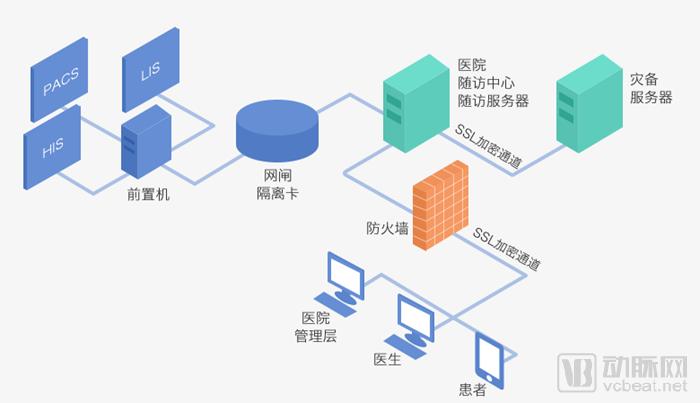
Yi Suizhen Data Security Solution. Image provided by Yi Suizhen.
Currently, Yi Suizhen has passed the security certification by the Software Testing Center of the State Information Center. In January this year, Yi Suizhen was awarded the honorary title of “Oncology Big Data Research Base” jointly conferred by the Chinese Society for Health Informatics and Medical Big Data and the China Association of Geriatric Healthcare Medicine, in recognition of its technological breakthroughs in data processing.
Since its inception, YisuiZhen has undergone two rounds of financing and is currently at the A+ round, preparing for a Series B round. Su Shuang, Vice President of Product Operations at YisuiZhen, previously served as the Head of Wireless Commercial Products at Sina Weibo. She stated that YisuiZhen has already validated its closed-loop business model in several provincial and municipal cancer hospitals.
Su Shuang believes that the development of Yi Suizhen’s business model aligns closely with the follow-up care needs of both doctors and patients. On one hand, it targets hospitals, physicians, and patients, generating revenue streams through IT infrastructure development, research services, and value-added patient services, thereby achieving a win-win outcome for all parties. On the other hand, it collaborates with pharmaceutical companies and insurance providers in areas such as marketing promotion and insurance cost containment, earning recognition from its clients.
Currently, Yi Suizhen is in its 2.0 phase. During the 1.0 phase, Yi Suizhen targeted hospitals through individual integrations and has been implemented in 53 oncology hospitals. In the 2.0 phase, Yi Suizhen has shifted to directly engage provincial cancer centers, adopting a top-down approach to cover oncology hospitals and oncology specialties across entire provinces. Pilot programs have already been launched in two provinces, with future plans for comprehensive deployment in 124 oncology hospitals and the oncology departments of over 2,000 general hospitals.
By Phase 3.0, the Yi Suizhen Program will establish strategic partnerships with cancer centers across China, refine assessment algorithms for the incidence, recurrence, and metastasis of 153 types of cancer, and provide smart medical records and cancer prevention platforms to 22 million cancer patients.
As the interview drew to a close, You Jiangyun remarked that Yi Suizhen is likely the oncology follow-up platform in China that has invested the most effort. Indeed, Yi Suizhen boasts a solid foundation and has pursued a steady path forward. VCBeat believes that Yi Suizhen can do more in the future to improve the five-year survival rate for cancer patients.