

Tami Robotics Secures RMB 200 Million Series B Funding to Advance Comprehensive Service Robots for Hospital Material Management

TMI Robotics
Developer of Intelligent Service Robots
VCBeat (WeChat ID: vcbeat) has learned thatRecently, Shanghai TMiRob Technology Co., Ltd. (“TMiRob”), a leading enterprise in medical service robots, officially announced the completion of its RMB 200 million Series B financing round. The round was led by Gopher Asset Management, with CDH Investments participating as a co-investor. Existing investors, including CAS Star Capital (the angel-round investor), IDG Capital and Ecovacs Robotics (the Series A investors), continued to participate in this financing round. The proceeds will be primarily used to further strengthen TMiRob’s product R&D and market deployment in the medical service robotics industry, and to drive further innovation leveraging TMiRob’s core technological advantages in the field of surgical robots.
Based in Shanghai’s Zhangjiang Hi-Tech Park, TMiRob is China’s first innovative enterprise to provide comprehensive smart hospital solutions for medical institutions, leveraging intelligent medical service robots as its core platform. The company boasts a complete ecosystem integrating independent research and development, manufacturing, and sales, and has pioneered the application of robotic products in the healthcare sector to address practical medical challenges. Since its inception, TMiRob has developed and manufactured nearly 10 models of medical service robots. Its team brings nearly 40 years of combined experience in research, education, and production, with extensive expertise in translating robotics, artificial intelligence, and Internet of Things (IoT) technologies into concrete solutions.
Prior to this, TMiRob secured nearly RMB 10 million in angel financing in June 2016 and RMB 40 million in Series A financing in May 2017. The recently obtained RMB 200 million in funding will continue to be allocated to marketing and technological research and development.
On April 28, the General Office of the State Council officially released the “Opinions on Promoting the Development of ‘Internet + Healthcare’,” which stated, “Strengthen the integration, sharing, and application of clinical and research data, and support the research and development of artificial intelligence technologies, medical robots, large-scale medical equipment, and other healthcare-related innovations.”
According to the "2018 China Robotics Industry Analysis Report" by the China Intelligence Technology Evaluation and Research Center, the market size of service robots in China reached RMB 12.2 billion in 2017, with medical service robots accounting for only 24%.
Driven not only by policy influences and market distribution, but also by increasingly crowded hospital conditions and patients’ growing demand for higher-quality medical services, there is an urgent need for hospitals to innovate their operational planning. TMiRob has seized the optimal market timing.
Although the Mayo Clinic and Cleveland Clinic have long deployed logistics robots, these products have struggled to enter the Chinese market. Large U.S. hospitals were designed with automated material flow in mind and experience lower patient traffic, whereas hospitals in China that can afford logistics robots serve a high volume of patients and were not designed to accommodate robot movement.
TMiRob embraced this challenge and, in light of the actual conditions of hospitals in China, developed the first logistics robot capable of entering operating rooms. This achievement required a level of R&D sophistication far surpassing that of foreign counterparts, and it has been pivotal to TMiRob’s journey thus far.
TMiRob’s logistics robots are specifically categorized into consumables delivery robots, supply delivery robots, medication delivery robots, and waste collection robots. Taking the medication delivery robot as an example, it features functions such as real-time logistics monitoring, RFID identification, and low-inventory alerts. Only authorized professionals can issue commands to the robot. Meanwhile, the entire process of material flow is automatically recorded in the accounts, ensuring full traceability. Its real-time medication replenishment capability helps prevent risks associated with medication shortages.
Furthermore, TMiRob has developed a series of specialized service robots and systems, covering smart medical services, hospital-acquired infection control, and intelligent patient guidance and triage. These specifically include service robots for nuclear medicine wards, PET-CT companion/guide robots, community service robots, intelligent disinfection robots, intelligent patient guidance and triage robots, and intelligent patient guidance assistants.
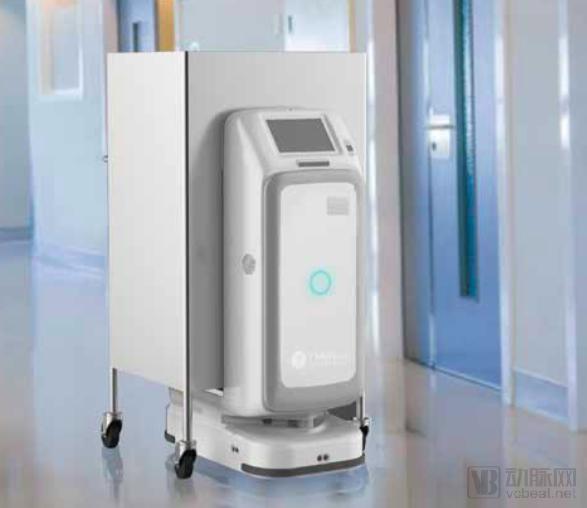
Logistics robots can assist physicians in transporting supplies, which represents their obvious value; however, the core value of in-hospital logistics lies not merely in the transportation of materials, but in logistics management.
Pan Jing, CEO of TMiRob, told VCBeat, “This is a process of refined management. In the past, hospitals adopted extensive management practices and did not control the use of consumables, as these costs were borne by patients. This created an information asymmetry, where patients were unaware of the actual amount of consumables they truly needed. However, under the new medical insurance policies, taking appendectomy as an example, the price for the procedure is set at 3,500 yuan. Therefore, if hospitals wish to achieve higher efficiency and profitability, they must manage the use of consumables.”
“For example, at a tertiary Grade A hospital, the annual consumption of a certain polymer hemostatic material was approximately RMB 17 million before the introduction of logistics robots. After implementing robotic delivery, the total cost for this single consumable item dropped to less than RMB 7 million in the second year. This reduction occurred because the use of consumables was no longer left to doctors’ discretion; instead, it was managed on a per-trip basis with replenishment only after depletion. This approach effectively curbed physicians’ usage of consumables, prevented unregulated stockpiling in operating rooms, and also served as a valuable metric for evaluating physician performance.”
Pan Jing, CEO of TMiRob, graduated from Shanghai Jiao Tong University with a major in Control Theory and Control Engineering. He spent 12 years at National Instruments (NI) in the United States, starting as an entry-level engineer and developing myRIO, a design platform for robotic embedded systems. With myRIO, developers can rapidly design and complete full-scale embedded engineering projects, making it particularly suitable for teaching in fields such as control systems, robotics, and mechatronics.
TMiRob is one of the few high-tech enterprises in China that possess independent intellectual property rights and can independently and rapidly provide comprehensive robotic system solutions. Its core R&D team consists of technical experts from top-tier institutions such as Tsinghua University and Shanghai Jiao Tong University, boasting nearly 40 years of combined experience in industry-academia-research collaboration. The team has participated in dozens of cutting-edge robotic projects both domestically and internationally, including the youBot robot control platform, the Cheetah Robot, and the ReWalk exoskeleton robot, accumulating extensive experience in translating robotics, artificial intelligence, and Internet of Things (IoT) technologies into concrete solutions.
Pan Jing spoke about his team: “Many members of our team previously developed backend tools for robotics in the United States, so transitioning to building actual robots has been relatively easy for them. As a result, our technology is far ahead of the market standard, enabling us to launch multiple robot models simultaneously within a short period.”
The robotics market has become a focal point for capital investment, yet its actual market presence remains limited. Many people only recognize the superficial value of logistics robots. What TMiRob aims to do is to demonstrate to hospital administrators the substantial implicit benefits that hospitals can achieve with robotic assistance, thereby unlocking the true value of these robots.
Consequently, Pan Jing made multiple visits to hospitals for field assessments and engaged in in-depth discussions with hospital administrators. While articulating the value of robotics, he also gained insights into the practical needs of physicians. In an era marked by severe shortages of healthcare resources, enhancing hospital efficiency constitutes a win-win scenario.
Therefore, with the Series B funding, TMiRob will intensify its marketing and sales efforts to help more hospitals recognize the true value of TMiRob robots.
As technology is the core of TMiRob, part of the funds from this round will be used to upgrade robotic technologies, such as nuclear medicine robots. The surgical robot market is also a key direction for TMiRob’s future development.
Lv Houjun, Partner at Jinpu Industrial Investment Fund Management Co., Ltd., stated: “The TMiRob team possesses proprietary algorithms with high technical barriers and robust mechanical structure design capabilities. They are able to identify latent needs within the complex hospital environment and address actual pain points through product solutions. The entire team is filled with entrepreneurial enthusiasm and demonstrates exceptional execution capability. Therefore, we believe that TMiRob will become a great company in the field of medical robotics.”