

HealthMyne IPO Filing Highlights QIDS Platform's Role in Quantitative Lesion Imaging for Precision Oncology
Since the 1970s, the advent of large-scale radiological diagnostic equipment, such as computed tomography (CT) and magnetic resonance imaging (MRI), has provided radiologists with powerful “diagnostic tools.” This advancement has significantly improved the accuracy of disease diagnosis in radiology, playing an increasingly vital role in clinical diagnostics. Today, radiological imaging is often described as the “eyes” of clinicians and serves as an indispensable “roadmap” for clinical treatment and surgical procedures.
Imaging examinations can directly influence clinical decision-making, requiring radiologists to analyze large volumes of image data to determine patients’ disease conditions. To ensure the accuracy of imaging reports, radiologists meticulously review images one by one on monitors and perform post-processing when necessary. From these black-and-white images, radiologists identify subtle clues to locate lesions and underlying causes that pose threats to human health.
Due to the large patient volume and lack of advanced tools, radiologists struggle to provide consistent, standardized data to healthcare professionals, resulting in information gaps in clinical collaboration and communication during diagnosis. HealthMyne’s Quantitative Imaging Decision Support (QIDS)™ software platform is dedicated to providing solutions for clinical interpretation, clinical decision-making, and cross-disciplinary teams, thereby enabling precise patient management and enhancing clinical productivity. The software treats medical images as actionable data capable of unlocking insights into tumors, cancer, and other related diseases.
According to VCBeat (WeChat ID: vcbeat), HealthMyne’s QIDS™ platform helps physicians track clinical trials and assess treatment responses, thereby streamlining workflows. During image interpretation, radiologists no longer need to rely on sticky notes or manual note-taking to follow proper procedures and capture necessary data. The digital input and output of information, along with its associated applications, enable the identification of lesion sites in different patients, ensuring that radiologists can achieve precise readings while improving efficiency and treating more patients.
As highlighted in HealthMyne’s official video, “Every cancer patient’s story begins with an image.” The company’s software integrates medical imaging data with patients’ health records and shares the results with radiologists and oncologists, enabling clinicians to monitor changes in tumor or nodule size. Currently, the QIDS software is being tested at the University of Wisconsin Hospitals and Clinics in the United States, as well as at the Moffitt Cancer Center in Tampa, Florida.
In 2016, HealthMyne won the top award at the Personalized Medicine World Conference in Silicon Valley, being recognized as one of the “Most Promising Companies.” The competition involved evaluations by two rounds of judging panels, which included venture capitalists from Mérieux Développement, Five Prime Ventures, Data Collective, and Faridan Ventures.
In March 2015, HealthMyne secured $4.5 million in Series A financing, led by 4490 Ventures and Venture Investors. In September 2016, the company raised $6.9 million in venture capital, with 23 investors participating in the round. The company plans to allocate these funds toward product development and corporate operations.

Striving Together for the Company's Technological Innovation

From left to right: Rock Mackie, Arvind Subramanian, and Linda Peitzman.
HealthMyne was founded in 2013 and has more than 20 employees. The company was co-founded by Rock Mackie, a medical physicist at the University of Wisconsin–Madison, and an entrepreneurial team with prior experience running multiple imaging companies.
Currently, Professor Mackie serves as the Chairman of HealthMyne and concurrently holds the position of Part-time Director of Medical Devices at the Morgridge Institute for Research in Wisconsin. He earned his Ph.D. in Physics from the University of Alberta, has authored more than 50 publications, and holds over 30 patents in the United States.
Professor Mackie is a principal founder of helical tomotherapy. He leveraged computer technology to help physicians calculate the optimal pathways for delivering radiation to tumors. Helical tomotherapy is a cancer radiotherapy method based on the TOMO helical tomotherapy system and represents the most advanced tumor radiotherapy technology available today. This therapy delivers targeted radiation while preserving healthy tissues surrounding the tumor. In 2014, Professor Mackie received the William D. Coolidge Award, the highest honor bestowed by the American Association of Physicists in Medicine.
In 1997, Professor Mackie, as Chairman and Co-founder of TomoTherapy Incorporated, focused on research and development to achieve precise, image-guided radiation therapy through innovative software systems. Under Professor Mackie’s leadership, TomoTherapy reached a peak market capitalization of over $120 million during its initial public offering in 2007. Prior to its sale to Accuray, the company had generated cumulative revenues exceeding $1 billion.
“The healthcare sector is undergoing rapid change, with HealthMyne at the center of this transformation,” said Arvind Subramanian, Chief Executive Officer (CEO) of HealthMyne. “Historically, radiologists have focused on volume, but currently, amid changes in medical reimbursement and reporting requirements, they are committed to investing in technologies, processes, and innovations that deliver value.”
As President and CEO of HealthMyne, Arvind Subramanian is committed to bringing his 26 years of experience in health technology (diagnostic imaging and healthcare IT sectors) to the company. He has served as Chief Executive Officer, Chief Operating Officer, Vice President, General Manager, and in other management roles at companies of various sizes, including GE Healthcare, Wolters Kluwer, and ProVation Medical, a venture-backed technology startup. ProVation Medical was a Minneapolis-based healthcare software company acquired by Wolters Kluwer in 2006.
Subramanian’s leadership tenure at ProVation Medical earned him the “Distinguished Entrepreneur” award from New Enterprise Associates (NEA). He holds both bachelor’s and master’s degrees from Case Western Reserve University in Cleveland, Ohio.
In addition, Dr. Linda Peitzman has joined HealthMyne as its Director of Medical Informatics. A physician with extensive experience in health technology, she brings over 25 years of expertise in healthcare IT software, informatics, and clinical decision support at HealthMyne. She also possesses deep specialized knowledge in electronic medical record (EMR) integration, quality improvement, medical terminology coding, data integration and management, physician change management, and various other areas of healthcare clinical practice.
Dr. Peitzman is a member of the American Academy of Family Physicians and a diplomate of the American Board of Family Medicine. Dr. Peitzman holds board certification in clinical informatics and earned his M.D. from the University of Minnesota.
HealthMyne’s CEO, Subramanian, and Dr. Peitzman have worked together for 14 years. According to VCBeat, they previously served as colleagues at ProVation Medical and Wolters Kluwer. Subramanian stated that he and Dr. Peitzman share strong professional synergy, as they know each other well.
QIDS Platform: RPM System Resolves Image Consistency Issues
In his paper, “Radiomics: Images Are More than Pictures, They Are Data,” Dr. Robert Gillies, known as the “Father of Radiomics” at Moffitt Cancer Center, stated that radiomics can serve as a new frontier in clinical decision-making. Dr. Gillies believes that when radiologists use software to identify, segment, and extract useful data, these data provide robust evidence for clinical decisions in disease diagnosis, prognosis, and treatment planning.
As an FDA-cleared, one-stop reading platform, the QIDS system quantifies images and provides data analytics and clinical insights for core workflows. CEO Subramanian stated, “For our customers, QIDS breaks through the traditional information landscape, offering radiologists an opportunity to enhance their professional standing within the care team.”
Traditionally, radiologists have relied on PACS systems to measure patients’ injured areas, with PACS serving as the digital “caliper” for medical imaging. Clinical studies have shown that varying interpretations of medical images by different physicians lead to inconsistencies in information, making it difficult to achieve high-quality image interpretation.
HealthMyne’s Rapid Precision Metrics (RPM) is designed to address consistency issues while enhancing efficiency in the identification, measurement, and tracking of lesions in research. The metrics typically integrate patients’ electronic health data with information from other clinical systems.
RPM leverages artificial intelligence (AI) technology to provide image quantification for various lesions, including the detection of volume, density, mass, percentage of ground-glass opacity (%GGO), texture, composition, doubling time, and over 500 other key metrics. Each lesion identified by RPM is subsequently added to HealthMyne’s database, serving as a valuable asset for medical planning, data mining, and research analysis.
The RPM algorithm not only prioritizes the examination of CT values (Hounsfield Units) but also focuses on constructing a more accurate 3D lesion model by calculating geometric features of the lesion, 3D surface deformation, robust statistics, Bayesian probability, and Markov models. Furthermore, specialized intelligent organ identification methods are incorporated, such as differentiating between normal lung tissue and emphysema by comparing normal and abnormal tissues.
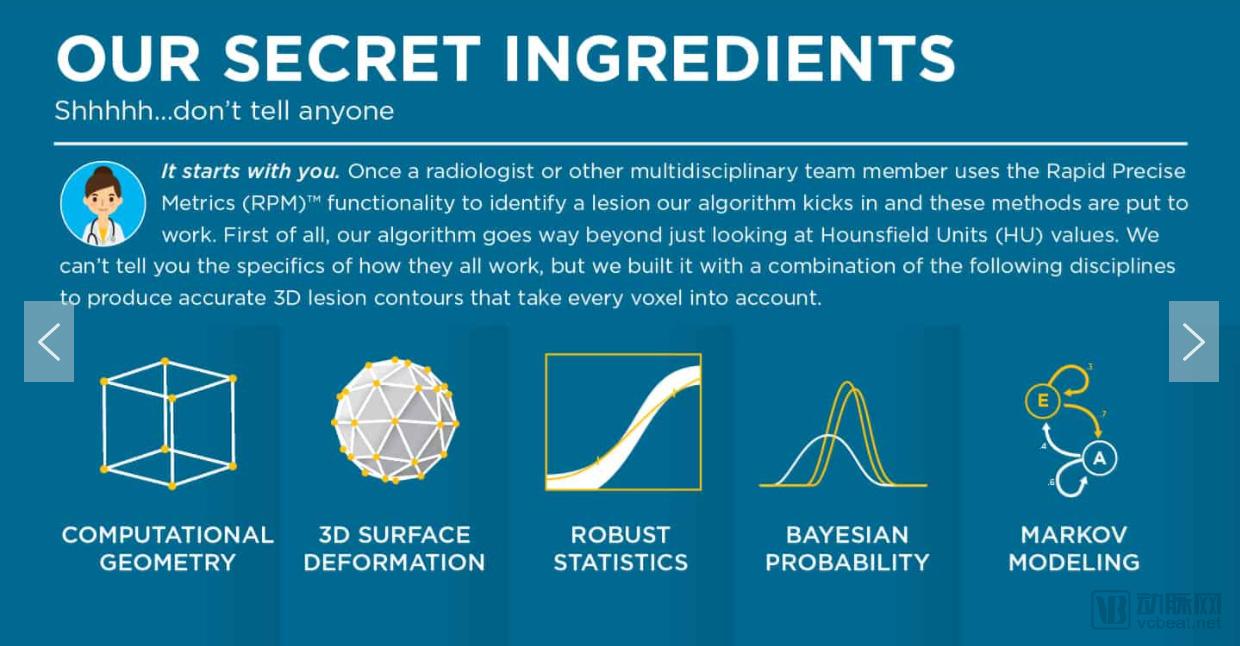
HealthMyne firmly believes that more precise measurement of every element will make significant contributions to improving patient care, clinical research, and decision-making.
Furthermore, the QIDS platform and RPM functionality streamline numerous manual workflows for radiologists, enabling them to concentrate more on their clinical expertise and disease pathology. Key automated features of the QIDS platform include retrieval of relevant prior studies, panning/zooming of current and previous images, localization and identification of lesion characteristics in earlier studies, and comparison of current and prior lesion images. This platform not only optimizes the lesion measurement process but also reduces the need for clinicians to re-evaluate lesions or reinterpret imaging studies.
Comparison between HealthMyne and RADLogics
RADLogics is dedicated to providing medical imaging solutions for radiologists, leveraging scientific and technological advancements to help them serve patients and create better, more accurate reports. By integrating big data image analysis with cloud technology, RADLogics offers radiologists a tool that supports image interpretation. The system features unique algorithms capable of processing large volumes of imaging data within seconds and delivering preliminary reports to radiologists. These reports are typically presented in familiar templates and integrated into PACS (Picture Archiving and Communication Systems), facilitating the review, assessment, and analysis of imaging data.
Compared with HealthMyne, RADLogics primarily focuses on generating reports to provide healthcare professionals with preliminary reference information. Taking CT lung cancer screening as an example, such information includes quantifiable metrics like nodule/mass volume, aortic diameter, and free fluid/air volume. In contrast, HealthMyne’s Rapid Precise Metrics (RPM) offers more detailed and comprehensive measurements, enabling in-depth investigation and analysis of the lesions themselves. Both HealthMyne and RADLogics leverage AI technology to integrate data with imaging, providing radiologists with automated table/report outputs to enhance workflow efficiency.