

35 Overseas Digital Mental Health Companies Profiled: Products Integrated with Insurance Reimbursement, Only 60% Consumer-Facing
As we come to realize that the brain is arguably the most complex entity in the known universe, a multi-billion-dollar market spanning from physical to mental health awaits exploration.
Amid the mental health needs of 250 million people, VCBeat has recently launched a special series on the Mental Health Industry. Spanning from enterprises to markets, and from China to overseas, this sector presents both challenges and opportunities. We will conduct a comprehensive scan of this field. If you are involved in this industry, you are welcome to engage with our authors at any time; for media coverage inquiries, please contact VCBeat directly.
According to statistics from the World Health Organization (WHO), 800,000 people die by suicide globally each year, with one person taking their own life every 40 seconds. Nearly one-quarter of the global population experiences mental disorders of varying severity annually.
Mental disorders can be sequentially categorized by severity into “general psychological problems,” “severe psychological problems,” “neurotic psychological problems,” “neurosis,” and “psychosis.” Currently, there are no clear biomarkers to scientifically distinguish between different types of mental disorders. Clinical decision-making is typically made by psychiatrists based on factors such as the duration of the condition, the degree of generalization, etiology, and insight.

Diagnostic Criteria for the Classification of Mental Disorders
Note:1. “Whether the content is generalized” is the primary basis for determining the type of mental illness;2. “Initial distortion” refers to issues that are unrelated to reality or moral conflicts; 3. “Severe distorted conflict” refers to the presence of hallucinations and delusions.
Among these, the so-called "generalization of content" refers to whether there is a one-to-one correspondence between the causes and psychological issues. For example, if someone is bitten by a snake and feels afraid, this does not constitute generalization; however, the saying "once bitten by a snake, ten years afraid of well ropes" exemplifies generalization. Common conditions such as neurasthenia, depression (accounting for approximately 6.9%), obsessive-compulsive disorder, anxiety disorders (accounting for approximately 18.1%), and phobias fall under neurotic psychological problems. Their pathological causes primarily involve sociological and psychological factors, and treatment generally adopts Cognitive Behavioral Therapy (CBT); hence, such mental disorders are also referred to as behavioral disorders. Behavioral disorders have an extremely high incidence rate among workplace professionals. According to PwC statistics, two-thirds of employees in India are experiencing anxiety, depression, and stress, while this figure is one-third in the UK and one-fifth in the US.
In recent years, “embodied economics,” which focuses on the relationship between individual somatic factors and economic behavior, has garnered increasing attention. Research indicates that somatic factors influence individuals’ psychology and behavior, which in turn directly shape economic decisions. In the workplace, poor psychological well-being among employees leads to absenteeism and presenteeism, severely impacting economic output. The National Alliance on Mental Illness (NAMI) identifies depression as the “leading cause of disability worldwide” and a “major contributor to the global burden of disease.” In April 2016, the World Health Organization (WHO) released a report stating that depression and anxiety disorders cost the global economy approximately $1 trillion annually. According to NAMI data, this figure alone reaches $193 billion in the United States.
On the other hand, digital mental health companies have become new favorites of capital. On July 11, VCBeat interpreted Rock Health’s H1 2018 Investment and Financing Report, which pointed out that in the first half of 2018 alone, 15 digital mental health startups across the United States completed financing, with a total amount reaching $273 million. Among them, the largest single round was raised by AKILI, a digital therapeutics company, which secured $55 million in Series C funding. Rock Health even considered the favor shown by investors toward digital mental health companies to be one of the highlights of the investment and financing landscape in H1 2018.(Details:Interpreting the Five Key Highlights of Rock Health’s H1 2018 Financing and Investment Report: Increased Vertical Integration, Dim IPO Outlook)
Recently, VCBeat conducted a review of 35 overseas digital mental health companies that secured financing within the past five years, compiling the data into the table below. We aim to characterize their features from multiple dimensions to identify the underlying logic driving their future development.
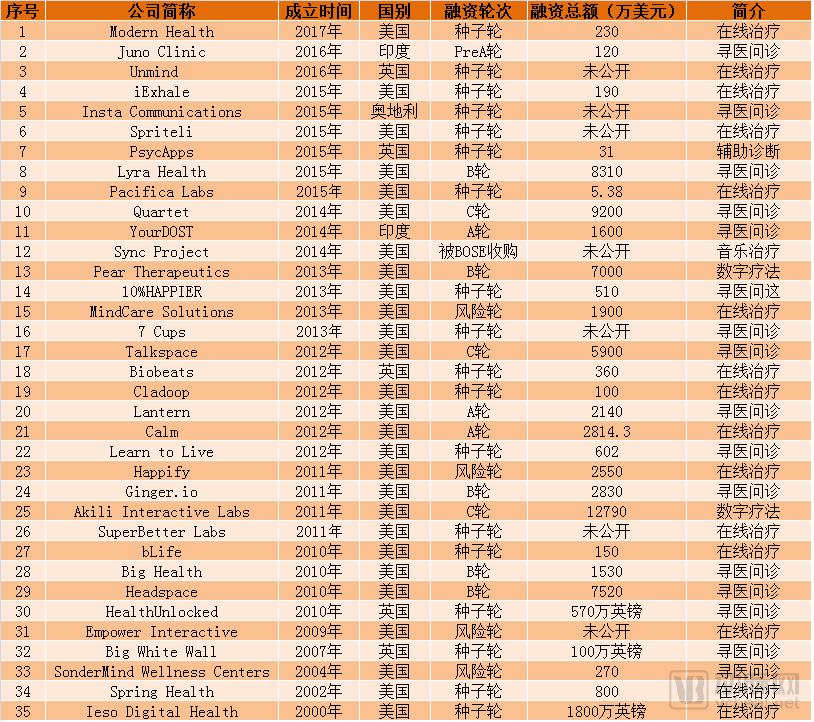
List of 35 Overseas Digital Behavioral Health Companies
Note:1. DataSource: VCBeat database and public information;2. Inclusion criteria: having secured at least one round of financing in 2013 or later; 3. Included companies must offer, at a minimum, functionalities for the treatment of behavioral health disorders.
Time
We have analyzed the timeline from two perspectives—company establishment and initial financing—and prepared the following chart.
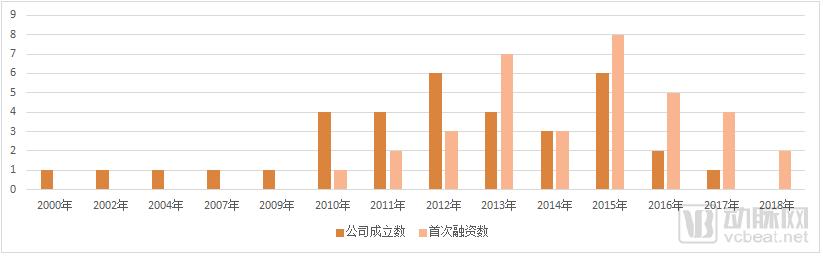
Figure 1. Founding and Initial Financing Dates of 35 Digital Behavioral Health Companies
We have found that since the year 2000, there have been two peaks in the establishment of digital mental health companies, occurring in 2012 and 2015 respectively, while the peak for initial financing appeared in 2015. In fact, some companies that later became industry benchmarks often secured their first round of financing within one year of their founding. For example, Lyra Health was founded in 2015 and completed its first round of financing in the same year; Quartet was founded in 2014 and obtained financing the following year; Talkspace was founded in 2012 and received financing the next year; Calm was also founded in 2012 and secured financing the following year. Of course, there are exceptions, such as Akili Interactive Labs, which was founded in 2011 but did not obtain financing until 2015.
Location
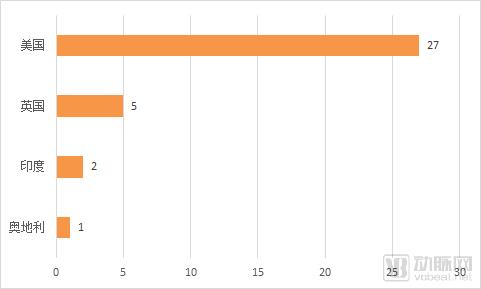
Figure 2 Geographic Distribution of 35 Digital Behavioral Health Companies
Geographically, U.S.-based digital mental health companies hold an overwhelming majority in this review. This is partly due to the United States having the world’s most mature financial market system, and partly reflects the market’s response to American users’ reluctance toward conventional health programs. Data show that although nearly all employers provide Employee Assistance Programs (EAPs) for their staff, employee utilization rates remain below 20%. American employees often refrain from seeking medical care when they suspect they may be experiencing mental health disorders, due to stigma, privacy concerns, and busy work schedules, thereby creating opportunities for digital health solutions.
Current Round
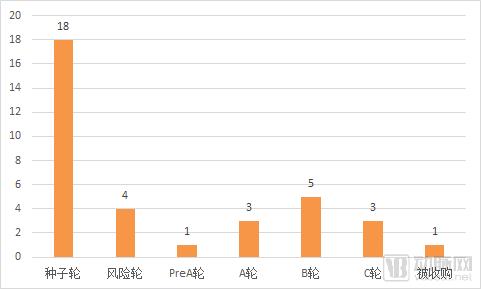
Figure 3. Distribution of Current Funding Rounds for 35 Digital Behavioral Health Companies
In terms of financing, more than half of the digital mental health companies reviewed are still in the seed stage. No investors in digital mental health companies have yet achieved an exit through an IPO; however, many well-known institutions are among the investors. For instance, SoftBank is a repeat investor in Talkspace; Kaiser Permanente Ventures participated in Ginger.io’s Series B funding round; Temasek led the Series C funding for Akili Interactive Labs; and Lantern received investment from UMPC, a Blue Cross Blue Shield (BCBS) entity in the United States. Furthermore, digital behavioral health companies may be acquired by industry giants after gaining market recognition. For example, Canary Health acquired bLife in 2016, and Bose acquired Sync Project in February 2018.
Business Model
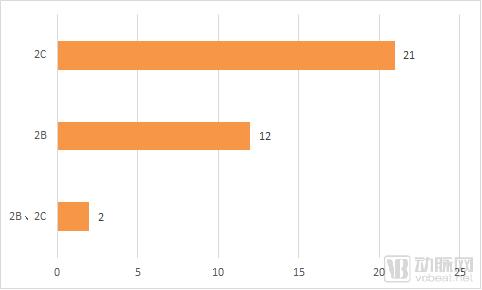
Figure 4 Distribution of Business Models Among 35 Digital Behavioral Health Companies
More than half of digital mental health companies offer direct-to-consumer (DTC) products, which users can download for free or purchase through app stores on smart devices. Other companies provide services via subscription models; for example, users can subscribe to sleep stories on Calm based on their needs, with pricing set at $12.99 per month, $59.99 per year, or $299.99 for lifetime access.
Enterprise-oriented products are primarily offered as employee benefits, with companies purchasing the services and employees choosing to use them. Companies such as Modern Health, Unmind, Talkspace, and Ginger.io adopt this model.
Relatively speaking, products that cater to both consumer and enterprise markets face less competition. However, our observations indicate that “B2B + B2C” products often entail higher technological sophistication; for instance, the offerings from Happify and Headspace both leverage artificial intelligence algorithms to pre-process patient needs.
Application Scenarios
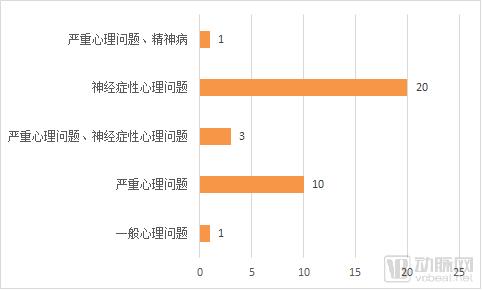
Figure 5 Distribution of Application Scenarios Among 35 Digital Behavioral Health Companies
In terms of application scenarios, neurotic psychological issues constitute the primary battlefield for digital mental health companies. On one hand, as previously mentioned, the main treatment for neurotic psychological issues is Cognitive Behavioral Therapy (CBT). CBT’s efficacy requires little in the way of face-to-face interaction between doctors and patients or specialized equipment, making it highly suitable for online delivery. Currently popular approaches such as mindfulness and meditation fall under the umbrella of CBT.
In regions with high prevalence of mental disorders, such as the United States and the United Kingdom, professional medical resources are severely strained. Taking the U.S. as an example, patients seeking help from CBT therapists must first schedule an appointment, with the earliest available slot often being three weeks later. Digital CBT can effectively leverage the fragmented time of both physicians and patients to enable real-time consultations.
The selection of application scenarios highlights the high degree of specialization among overseas digital mental health companies, particularly those in the United States. Some products are even capable of replacing mental health professionals, rather than merely assisting in diagnosis and treatment. As will be discussed in the next section, based on their core business models, digital behavioral health companies offer modes such as expert opinions, value-added services, and support networks. Among these, value-added services exemplify the disruptive impact of innovative technologies on healthcare, a disruption currently being implemented by certain U.S. digital mental health companies. For instance, Pear Therapeutics’ digital therapeutics have already received FDA approval, while Akili Interactive Labs’ video game-based therapy is preparing to submit an application for FDA clearance. The use of these products does not require expert guidance during implementation.
Business Core
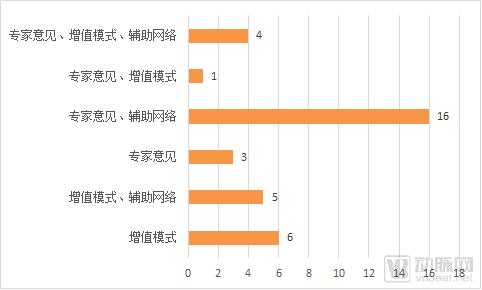
Figure 6 Distribution of Core Business Areas Among 35 Digital Behavioral Health Companies
In the “Core Business” section, we will discuss the internal business organization and service delivery models of digital mental health companies underlying their apps, websites, and other platforms. The core business directly determines the quality, cost, and accessibility of a company’s products, thereby influencing its profitability and growth potential.
In The Innovator’s Prescription, Christensen defines expert opinion-driven models, value-added models, and facilitated networks. Here, we adopt Christensen’s definitions to distinguish the core business nature of digital behavioral health companies.
Christensen posits that the expert-opinion-dominated model primarily delivers value through expert employees. Leveraging their professional intuition, analytical capabilities, and problem-solving skills, these experts identify the causes of complex issues and recommend corresponding solutions. The diagnostic processes in general hospitals and specialized clinics are typical examples of this model. The value-added services model refers to businesses transforming incomplete products into more refined, higher-value finished goods, typically charging consumers based on the outcomes of work processes. This model is predominantly adopted by companies in industries such as retail, food and beverage, automotive manufacturing, and oil refining. In the healthcare sector, many post-diagnosis treatment interventions fall under the value-added services model. The facilitator network is straightforward: it connects supply and demand sides via the internet to achieve efficient operations.
Specifically, in digital mental health companies, the expert opinion model refers to a framework where experts serve as the primary providers of behavioral disorder treatment, with digital products playing a supportive role; the value-added model refers to treating behavioral disorders through digital means without relying on expert experience; the assisted network model is consistent with Christensen’s definition.
As shown in the chart, “Expert Opinion + Support Network” constitutes the core business model for mainstream digital mental health companies. The scarcity of medical resources and patients’ psychological resistance are the primary reasons for the inefficiency in the diagnosis and treatment of behavioral disorders. By leveraging the internet, digital health companies enable patients to schedule appointments and undergo triage via apps or websites, thereby integrating existing resources while ensuring privacy. Due to the low technical barriers of this model, a large number of companies have entered the market. However, our analysis of 16 digital behavioral health companies operating under the “Expert Opinion + Support Network” model reveals a high degree of product homogenization. The main differences lie in non-technical factors such as service regions, linked medical resources, and pricing structures, making these companies highly vulnerable to defeat in fierce market competition.
Consequently, several digital mental health companies have innovated their core business models. For instance, some have established a model centered on “expert opinions + value-added services + support networks.” Ginger.io, for example, collects users’ smartphone usage patterns to assess their mental state and determine the appropriate type of diagnosis and treatment in a standardized manner. This information is then relayed to suitable mental health professionals, who develop personalized treatment plans for patients with the assistance of AI algorithm recommendations, thereby forming an AI-led, expert-supported core business model. Other digital mental health companies bypass experts entirely, delivering treatment directly through computer algorithms; Pear Therapeutics, mentioned earlier, falls into this category. Additionally, Headspace represents a typical “value-added service” model, where patients select from pre-set meditation courses within the app based on their individual needs, without any expert involvement throughout the process. This approach has demonstrated considerable efficacy in addressing non-neurotic psychological issues such as anxiety and stress.
Nevertheless, many mental health experts remain skeptical about whether digital products can replace the role of specialists in the diagnosis and treatment of behavioral disorders. Tanisha Ranger, an American psychologist, stated that although apps enable patients to access professional therapy anytime and anywhere, human experts remain irreplaceable because they can provide personalized understanding and insights grounded in empathy. Psychologist Jean Otto shares this view, arguing that the diagnosis and treatment of mental disorders require patients to fully expose their inner vulnerabilities—an emotional depth that only real human beings can evoke.
Whether value-added digital mental health companies can disrupt the expert model in the future remains to be seen.
Given the high uncertainty surrounding digital mental health products that rely on value-added models, we have decided to analyze three leading and distinctive “expert opinion + supportive network” products at the end of this article, aiming to identify what makes them attractive to top-tier capital.
Quartet
Achievements
1. Completed Series C financing, topping the fundraising charts among 16 “expert opinion + assisted network” companies with a total raise of $92 million;
2. Quartet has over 100 employees, most of whom are data experts and engineers;
3. Already launched in cities such as Boston, Seattle, New Orleans, Sacramento, and Pittsburgh, with a report satisfaction rate of 85%. Quartet serves over 1 million patients, all referred from healthcare and insurance institutions. The utilization rate among contracted institutional members is 61%, and 75% of mental health professionals are able to respond to patients within 36 hours.
4. Quartet is currently collaborating with Horizon Blue Cross Blue Shield to facilitate the implementation of the project in New Jersey.
Features:
Quartet provides patients with expert consultations, telemedicine, health management, online CBT, community support, and other services.
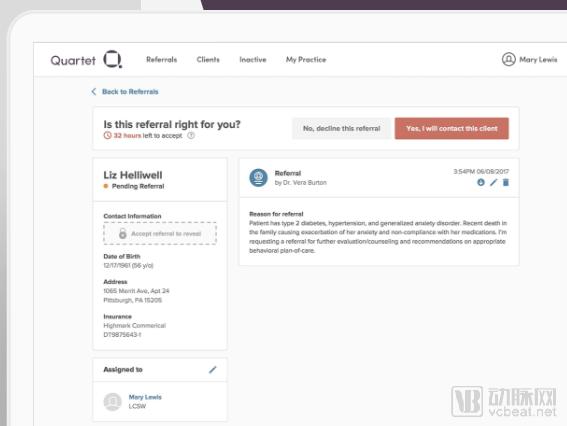
Quartet posits that psychological disorders are both triggers and exacerbating factors for many physical ailments, and that leveraging the intrinsic link between mental and physical health can better serve patients’ overall well-being. Therefore, Quartet integrates behavioral health with primary care services, employing AI algorithms to screen electronic medical records from primary care general practitioners to identify patients with behavioral disorders and refer them to psychiatrists. This approach establishes data connectivity among general practitioners, patients, and psychiatrists, ensuring comprehensive patient health through simultaneous attention to both mental and physical conditions.
Furthermore, Quartet’s approach of engaging patients through primary care physicians effectively ensures that patient visits are covered by health insurance. In 2016, the United States once again enforced the Mental Health Parity and Addiction Equity Act, which requires health insurers to provide coverage for mental health treatment comparable to that for physical health conditions, significantly benefiting Quartet. Statistics show that following Quartet’s rollout, national healthcare expenditures were reduced by 3%–4%.
Lyra Health
Achievements
1. Completed Series B financing, raising $83.1 million, second only to Quaretet, including investment from Venrock, the Rockefeller family’s venture capital fund;
2. Lyra Health has assembled a network of more than 2,500 mental health professionals outside the traditional insurance-based system;
3. Lyra Health’s clients include well-known companies such as eBay and Uber, and it is favored by 95% of their employees.
Features
Lyra Health has deeply refined its healthcare delivery model by targeting employers as the entry point. Recognizing that employees are often reluctant to disclose their mental health challenges, Lyra offers its services as an employer-sponsored benefit. This allows employees to access care with guaranteed confidentiality, helping them safely and comfortably identify the type of behavioral health services they need.
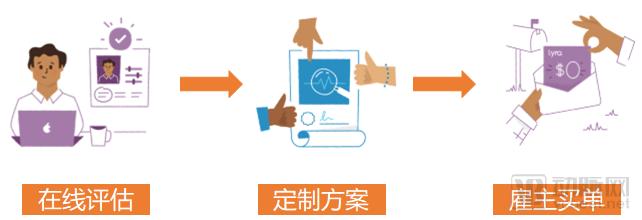
By using Lyra Health, employees only need to answer simple questions about their symptoms, severity, and treatment preferences. A specialized algorithm then matches them with appropriate care, ensuring the entire process remains completely confidential. Lyra Health regularly monitors communications between patients and therapists and reports back to employers.
Talkspace
Achievements
1. Completed Series C financing, with a total funding amount of $59 million. SoftBank participated in each round of financing;
2. Talkspace has 1 million active users and over 9,000 Delta Tau Delta fraternity members, and partners with Alpha Tau Omega fraternity;
3. Talkspace boasts celebrity user “Shark” Phelps and has received free promotion from Facebook.
Features
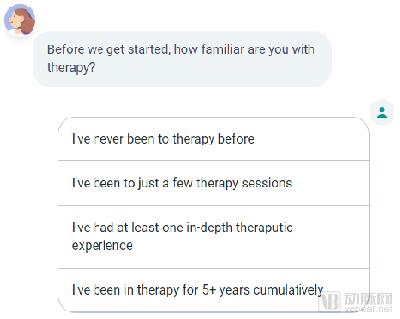
Talkspace is a text-based therapy platform where clinicians communicate with patients entirely via text messages, from initial consultation to prescribing medication. A key feature of Talkspace is its prescription service, which involves independent collaborations with psychiatrists who provide professional pharmacological advice to psychotherapists during the treatment process. Online prescribing helps address users’ challenges related to limited access to prescription medications and high costs.
At this point, it becomes evident that unlike the domestic mental health market, where competition centers on the debate between online and offline service delivery models, competition among overseas mental health products resembles a battle for market entry points. Among the 35 overseas mental health companies we reviewed, the “strong get stronger” pattern in business models emerges as an ironclad rule. The strength of these business models is reflected in the diversity and stability of their B-end clients. Whether in terms of financing rounds or user scale, companies such as Quartet and Talkspace, which have entered the market through employers, health plans, and healthcare institutions, are better positioned to gain competitive advantages.
Furthermore, overseas mental health companies currently exhibit two distinct characteristics. On one hand, although they are not yet mature in the capital markets, their fundraising pace has accelerated; the time spent on early-stage funding rounds has shortened from the previous 3–5 years to just 1–2 years. On the other hand, there is a growing exploration of using digital solutions to deeply replace manual processes. Currently, digital substitution has achieved high penetration rates in the initial diagnosis and triage stages of mental disorders. The next trend is the digital substitution of mental disorder treatment, where some companies have already made breakthroughs, such as Pear Therapeutics and AKILI.
Mental Health + Case Series: Related Links
Selected Reports on the Mental Health Industry:
【AI + Mental Health】Widespread Anxiety: AI-Driven Cognitive Behavioral Therapy Can Help