China's Newly Appointed National Healthcare Reform Leadership Highlights Internet+Healthcare and Tiered Diagnosis System in IPO Filing
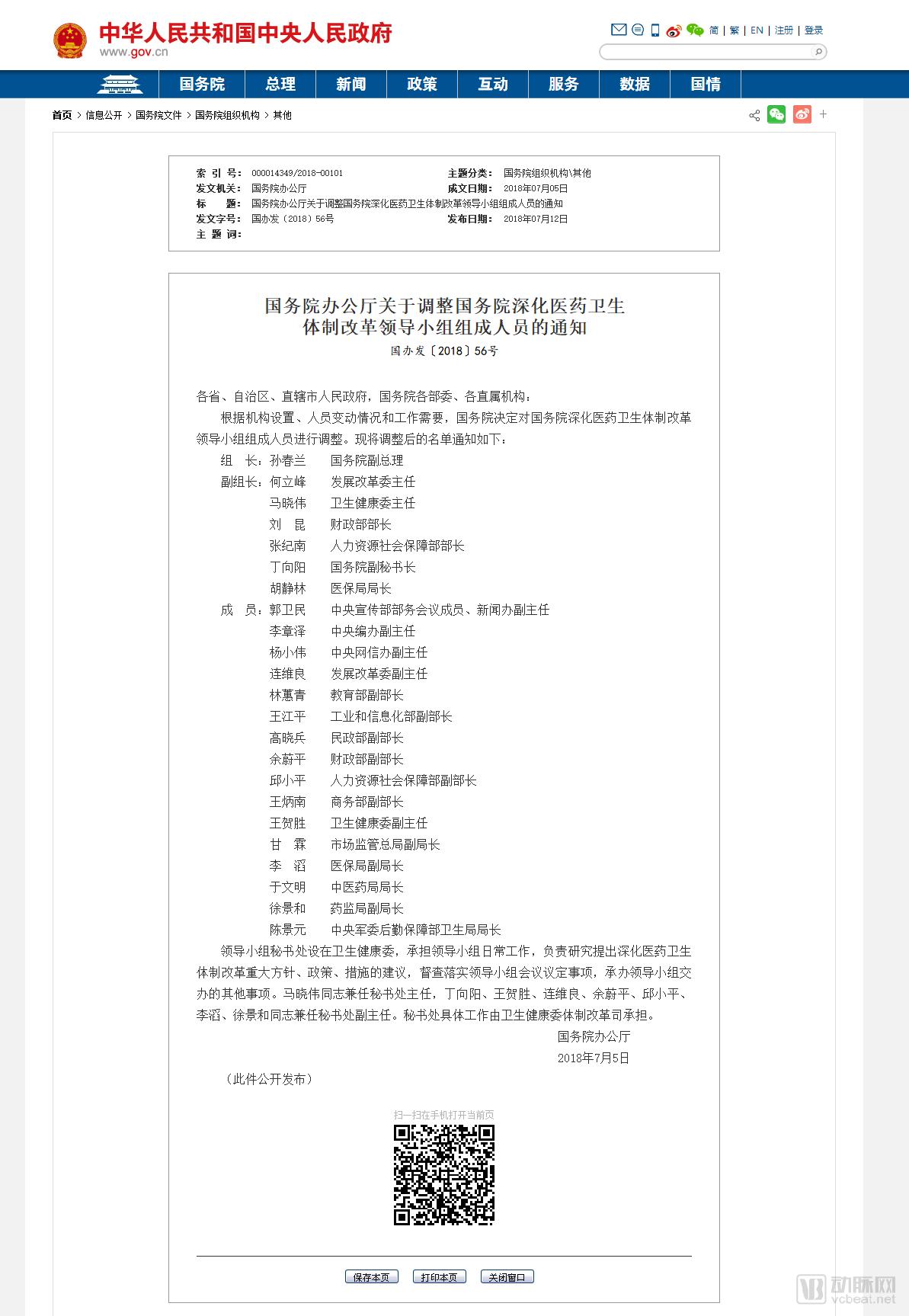
Yesterday, the General Office of the State Council issued the “Notice on Adjusting the Composition of the Leading Group for Deepening the Reform of the Medical and Health Care System under the State Council” (hereinafter referred to as the “Notice”). The “Notice” indicates that,Sun Chunlan, Vice Premier of the State Council, Appointed Head of the Leading Group for Deepening the Reform of the Medical and Healthcare System under the State Council (hereinafter referred to as the “Medical Reform Leading Group”)。He Lifeng, Director of the National Development and Reform Commission; Ma Xiaowei, Director of the National Health Commission; Liu Kun, Minister of Finance; Zhang Jinan, Minister of Human Resources and Social Security; Ding Xiangyang, Deputy Secretary-General of the State Council; and Hu Jinglin, Director of the National Healthcare Security Administration, serve as deputy heads.
As indicated in the “Notice,” the Secretariat of the Leading Group is housed within the National Health Commission, where it undertakes the day-to-day work of the Leading Group. It is responsible for studying and proposing recommendations on major guidelines, policies, and measures to deepen healthcare system reform; supervising and ensuring the implementation of decisions made at Leading Group meetings; and handling other matters assigned by the Leading Group.Comrade Ma Xiaowei concurrently serves as Director of the Secretariat. Comrades Ding Xiangyang, Wang Hesheng, Lian Weiliang, Yu Weiping, Qiu Xiaoping, Li Tao, and Xu Jinghe concurrently serve as Deputy Directors of the Secretariat. The specific work of the Secretariat is undertaken by the Department of System Reform of the National Health Commission.
What Changes Will Occur in the Healthcare Industry After the Establishment of This Term’s Healthcare Reform Leading Group?
The Office of the Healthcare Reform Commission, fully named the “Office of the Leading Group for Deepening the Reform of the Medical and Health Care System,” serves as the administrative body of the healthcare reform leading groups at all levels of government. Its primary responsibility is overall coordination, and it operates as a temporary entity. Established by the government, this office is set up under the healthcare reform leading groups of people’s governments at various levels. It is generally housed within the Development and Reform Commission (DRC), with its staff composed of personnel drawn from the DRC (which takes the lead), as well as from health bureaus, finance bureaus, human resources and social security bureaus, and other relevant departments. However, some localities have established permanent institutions instead. The State Council’s Office of the Healthcare Reform Commission implements an evaluation mechanism featuring monthly reports, quarterly assessments, and annual reviews.
The membership of the Healthcare Reform Leading Group has been changed twice, with each iteration of healthcare reform efforts exhibiting distinct characteristics. The details are as follows:
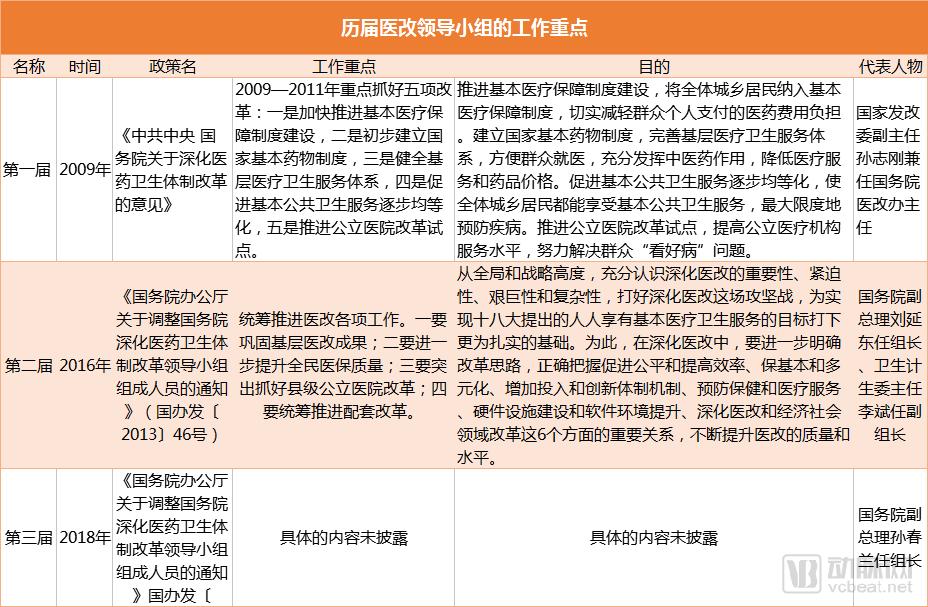
Although the work priorities of the Third Leading Group for Healthcare Reform have not been disclosed, insights can be gleaned from the past experiences of its leadership members. To this end, VCBeat has conducted an in-depth analysis focusing on Vice Premier Sun Chunlan, who serves as the group leader; Ma Xiaowei, Director of the National Health Commission, who serves as deputy group leader; and Hu Jinglin, Director of the National Healthcare Security Administration, who also serves as deputy group leader.
In April 2018, terms such as “Internet + Healthcare,” “Internet Hospitals,” “Chronic Disease Management,” and “Telemedicine” frequently appeared and gained official recognition, marking a new chapter for internet-based healthcare. That month, five policies related to “Internet + Healthcare” were successively issued, providing a significant boost to the internet healthcare industry.
During this period, Sun Chunlan, a member of the Political Bureau of the CPC Central Committee and Vice Premier of the State Council, also visited the remote expert outpatient clinic jointly operated by Yinchuan First People's Hospital and Haodf Online.According to relevant media reports,According to Xinhua News Agency, Vice Premier Sun Chunlan fully affirmed the achievements made in Zhejiang Province’s pilot program for comprehensive medical reform. She emphasized that all aspects of healthcare reform should be guided by the holistic concepts of “big health” and “comprehensive healthcare,” placing greater emphasis on prevention and substantially strengthening disease prevention and health promotion efforts. The active development of “Internet + Healthcare” should be pursued by expanding online services such as appointment scheduling, follow-up consultations for chronic diseases, and telemedicine, while reinforcing oversight of quality and data security to promote the co-construction, sharing, intelligence, and convenience of healthcare services.
On the same day as Vice Premier Sun Chunlan’s research visit, April 25, the State Council drafted the “Opinions on Promoting the Development of ‘Internet Plus Healthcare’,” which was released on April 28. The document explicitly states that the development of internet hospitals is permitted; online follow-up consultations for certain common and chronic diseases are allowed; and, upon reviewing patients’ medical records, physicians are permitted to issue online prescriptions for certain common and chronic diseases.
Following the release of new guidelines, the entire healthcare industry has accelerated its digital transformation, making online consultations an essential skill for physicians. In this context, doctors’ practices are no longer confined to physical hospitals. Each physician can establish a dedicated “online clinic” via open internet platforms, creating a new model of medical practice. This approach enables online and offline practice settings to complement each other, thereby improving healthcare efficiency and enhancing patient satisfaction.
According to Xinhua News Agency, from May 20 to 22, Sun Chunlan, a member of the Political Bureau of the Communist Party of China Central Committee and Vice Premier of the State Council, conducted research in Zhejiang Province. She emphasized the need to further advance comprehensive reforms of public hospitals, promote the development of “Internet Plus” healthcare and social medical services, and provide high-quality, efficient, and convenient health services to the public.
During this research process,Vice Premier Sun Chunlan also fully affirmed the achievements made in Zhejiang Province’s pilot program for comprehensive healthcare reform. She emphasized that all aspects of healthcare reform should be guided by the concept of “big health and holistic healthcare,” placing greater emphasis on prevention and substantially strengthening disease prevention and health promotion efforts. We should actively develop “Internet + Healthcare” services, expand online offerings such as appointment scheduling, follow-up consultations for chronic diseases, and telemedicine, while enhancing oversight of quality and data security to promote the co-construction, sharing, intelligence, and convenience of healthcare services.
Ma Xiaowei, born in 1959, is currently the second-ranking Deputy Director of the National Health and Family Planning Commission. He is responsible for planning and information, primary healthcare, maternal and child health, and family planning technical services, and serves as the liaison to the Chinese Medical Association.
Not only that, but Ma Xiaowei is also a “veteran” professionally trained in the healthcare sector, with 18 years of experience in national health administration. After graduating from the Department of Medicine at China Medical University in 1982, he successively served as an official in the Department of Science and Education and as a secretary in the General Office of the Ministry of Health; as Associate Researcher, Researcher, Vice President, President, and Party Secretary of the First Affiliated Hospital of China Medical University; as Vice President of China Medical University; and as Director and Party Group Secretary of the Liaoning Provincial Health Department. In October 2001, he was appointed Vice Minister of Health and member of the Party Leadership Group. In April 2013, he was appointed Deputy Director of the National Health and Family Planning Commission and member of its Party Leadership Group.
During the tenure of the Ministry of Health, Ma Xiaowei also accumulated many years of experience in medical practice and healthcare administration. Under the National Health and Family Planning Commission, Ma Xiaowei frequently assisted Li Bin or partnered with successive directors of the State Council’s Healthcare Reform Office, Sun Zhigang and Wang Hesheng, to interpret key issues in healthcare reform.
Among the many issues in healthcare reform, Ma Xiaowei places the greatest emphasis on tiered diagnosis and treatment. At the 2015 National Two Sessions, during a joint group meeting of medical and health sector members of the Chinese People's Political Consultative Conference (CPPCC), Ma Xiaowei stated that the key to implementing tiered diagnosis and treatment lies in initial consultations. Whether initial consultations can be widely adopted at the primary care level depends on whether primary care physicians can provide medical services that earn patients’ trust. “Whether ordinary people choose to seek care at the primary level hinges on the doctors themselves, not on financial considerations, nor can it be resolved through administrative orders. This is precisely where the challenge lies.”
In March 2017, Ma Xiaowei interpreted the “13th Five-Year Plan for Health and Wellness” at a press conference held by the State Council Information Office. He specifically highlighted the need to improve the integration of medical care and elderly care to address the social challenges of population aging, through measures such as implementing a tiered diagnosis and treatment system and strengthening primary healthcare services. “There is a pressing need for deep integration of medical and elderly care services, particularly within communities, households, and secondary hospitals. Therefore, it is essential to further enhance the capacity of primary health institutions in delivering both public health services and basic healthcare, ensuring that geriatric medicine practices are effectively implemented at the grassroots level.”
The implementation of tiered diagnosis and treatment relies on the leverage of medical insurance.As a policy architect shaping the healthcare service landscape, Ma Xiaowei has repeatedly called for “meticulous budgeting” of health insurance expenditures, emphasizing the importance of “cost containment” in public hospitals.
On the issue of critical illness medical security, which has received high attention from the state, Ma Xiaowei publicly stated in 2015 at a routine policy briefing of the State Council: It is not only the New Rural Cooperative Medical Scheme; public hospitals across China are also considering establishing a blacklist system for unreasonable growth in medical expenses, irrational drug use, and inappropriate medical practices, along with an accountability system.
In 2016, at the themed press conference of the Fourth Session of the 12th National People’s Congress, Ma Xiaowei further elaborated on the implementation pathway for tiered diagnosis and treatment: China would leverage regional medical centers as key anchors and prioritize key disciplines to address regional disparities, ensuring that “patients do not all flock to Beijing, Shanghai, and Guangzhou for care, as each region will have its own medical center”; strengthen county-level hospitals to bridge the urban-rural divide, enabling 90% of patients to receive treatment locally without traveling to cities; implement disease-specific triage by separating chronic, common, and frequently occurring diseases—including certain acute conditions—so that tertiary hospitals handle acute cases while primary and secondary facilities manage chronic ones, thereby achieving separation of acute and chronic care; and simultaneously resolve the fragmentation between different levels of care. “Given time, if we optimize the allocation of medical resources and ensure effective policy implementation, China’s healthcare delivery system will become orderly, the distribution of medical resources will be rational, and health insurance expenditures will be carefully managed and utilized with precision.”"Therefore, the implementation of the tiered diagnosis and treatment system will enable China to elevate its approach to addressing healthcare access and medical service delivery to a new level."
On June 19, Hu Jinglin, the newly appointed Director of the National Healthcare Security Administration, chose Sanming as his first destination for an official visit. During the trip, he inspected the Sanming Medical Management Center, the First Municipal Hospital, the Health Center in Gaoqiao Town, Shaxian County, and the Clinic in Xinqiao Village, and listened to reports on healthcare reform from Fujian Province and Sanming City.Hu Jinglin fully affirmed the achievements made in Fujian Province’s healthcare reform efforts. He pointed out that the Fujian Provincial Party Committee and Provincial Government have adhered to a people-centered approach to health, attached great importance to healthcare reform, strengthened top-level design, focused on institutional and mechanistic reforms, and demonstrated bold innovation and courage in breaking through barriers. Their work has provided valuable references for healthcare reform across China, particularly by offering a replicable and scalable “Fujian Model” in the area of medical insurance system reform.
Hu Jinglin called for earnest study of the Sanming experience, promotion of Fujian’s medical insurance reform model, full leverage of medical insurance as the leading engine of reform, advancement of the coordinated “three-medical” reforms in healthcare delivery, medical insurance, and pharmaceuticals, and acceleration of the establishment of a unified and efficient universal healthcare security system.
The “Sanming Healthcare Reform” was a key initiative vigorously promoted and overseen by Lou Jiwei, the former Minister of Finance. In 2013, leaders from the Ministry of Finance led a team to Sanming for field research, concluding that the Sanming healthcare reform offered valuable lessons worth emulating. Following instructions from then-Minister of Finance Lou Jiwei, a report was submitted to the State Council, thereby bringing the Sanming healthcare reform into the central government’s spotlight. This also paved the way for the subsequent visit to Sanming by Liu Yandong, the former Vice Premier.
Notably, during Hu Jinglin’s research visit to Sanming, he specifically highlighted the “promotion of the Fujian medical insurance reform model.”In Sanming, Fujian Province, the three basic social insurance programs have been placed under unified management, granting medical insurance absolute dominance over the procurement prices of pharmaceuticals in public hospitals.
In terms of drug procurement, Fujian Province has implemented transparent procurement.Its full name is “Joint Price-Capped Sunshine Procurement of Drugs Based on Medical Insurance Payment and Settlement Prices.” In February 2017, the Office of the Leading Group for Deepening Healthcare System Reform in Sanming City issued the well-known “Notice from the Office of the Fujian Provincial Medical Security Management Committee on Launching Joint Price-Capped Sunshine Procurement of Drugs Based on Medical Insurance Payment and Settlement Prices.”, replacing the results of Fujian Province’s previous round of centralized drug procurement (i.e., the 9th bid) with a joint price-capped, transparent drug procurement system based on medical insurance payment and settlement prices.The objective is to better implement the principle of “establishment based on needs, and procurement for utilization,” thereby creating room for raising medical service prices and increasing fund reimbursement ratios.
By choosing Sanming as the first stop on its visit, the National Healthcare Security Administration aims to comprehensively promote the “Sanming Model” of healthcare reform, demonstrating the central government’s resolve to drive forward healthcare reform.
Attached original image of the file: