

Tencent Debuts at CHIMA 2018, Unveils 'Three Key Principles' for Internet Hospital Development
From July 12 to 15, VCBeat (WeChat Official Account: vcbeat) participated in the “China Hospital Information Network Conference and China-International Medical Information Network Technology and Product Exhibition (CHIMA 2018),” hosted by the Professional Committee on Hospital Information Management of the Chinese Hospital Association. As a highly influential professional event in the field of hospital informatization, CHIMA 2018 attracted more than 5,000 professionals from China’s healthcare information industry, serving as an important barometer for the overall development of informatization in the healthcare sector.
At this conference, Tencent made its debut, showcasing a range of innovative achievements: Tencent Healthcare presented diversified digital health solutions, including full-cycle health services based on regional medical information interoperability, intelligent medical services powered by the Tencent Ruizhi AI engine, and healthcare big data visualization solutions. Meanwhile, multiple business units—including Tencent Smart Security, Tencent Cloud, WeCom, and Tencent Transcription—were also exhibited, bringing new perspectives and possibilities to healthcare informatization.
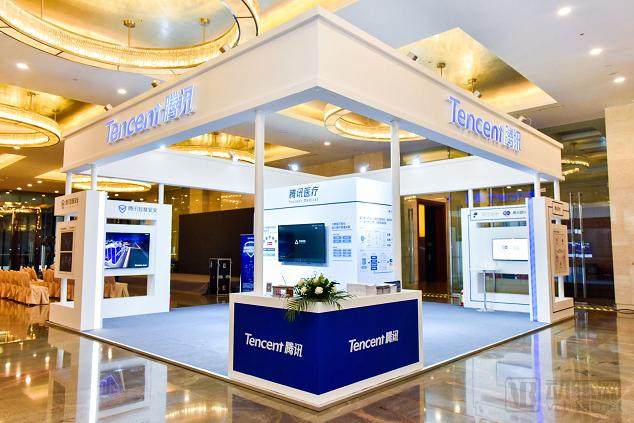
(Tencent’s Diversified Digital Healthcare Solutions Showcase)
During the conference, the recommended results for the “CHIMA 2018 Typical Cases of Hospital Internet Applications” were announced. Two cases implemented through Tencent’s medical healthcare collaborations—“Yichang City ‘Internet + Medical Health’ Phase I Project” and “Fudan University Shanghai Cancer Center: Patient Precision Service Platform Based on Electronic Visit Cards”—received recommendation awards and were showcased as outstanding cases during the on-site review at the conference.
At the conference, Wu Bo, Vice President of Tencent Healthcare, stated in his keynote speech that digital technology has become a crucial engine driving quality, efficiency, and momentum transformations in industrial development, thereby enhancing total factor productivity. In the new era of “Internet Plus,” Tencent serves as a digital assistant in healthcare, collaborating with industry partners to support medical institutions in their transition to internet hospitals and to build a new healthcare ecosystem.
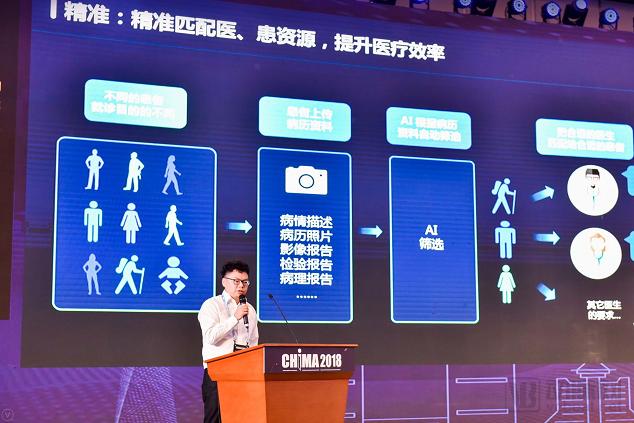
(Wu Bo, Vice President of Tencent Healthcare, Delivers Keynote Speech)
Tencent Empowers the Upgrade of Traditional Healthcare, Proposing “Three Key Words” for Internet Hospital Development
Keyword 1: Simplification – Streamlining healthcare processes, enhancing decision-making efficiency, and improving patient satisfaction with medical services. By simplifying patients’ care pathways, Tencent Health has built a comprehensive smart hospital ecosystem that leverages electronic health cards as an innovative medium to migrate offline procedures online, enabling data to do the running so patients need to make fewer trips. By simplifying physicians’ clinical workflows, AI-assisted diagnostic engines address cumbersome tasks, reduce repetitive workload for doctors, and improve both diagnostic efficiency and quality of care. By simplifying administrators’ decision-making pathways, big-data monitoring and trend analysis facilitate digital, visualized, and mobile healthcare management, ensuring evidence-based decisions and enhanced efficiency.
Keyword 2: Precision—Precisely matching medical resources, upgrading healthcare service scenarios, and improving medical efficiency. Powered by the “Tencent Ruizhi” medical AI engine, it accurately identifies and matches the needs of both doctors and patients during medical consultations. From intelligent triage covering general practice to precise appointment scheduling for severe diseases, it addresses resource mismatch issues and enhances the utilization efficiency of doctors and specialists. Extending from clinical care to broader health management, the AI engine facilitates precise health education and disease risk assessment, emphasizing that precision in treatment must be complemented by precision in preventive care.
Keyword 3: Connectivity—Linking fragmented healthcare data to achieve interoperability. The interoperability of big data is the foundation for healthcare’s transition toward precision and intelligence. By bridging information gaps, it facilitates cross-hospital medical care, integrates internal and external hospital services, and extends to broader health management, thereby connecting health management across an individual’s entire life cycle. This also creates expanding application possibilities for the development of internet hospitals. Leveraging its core connectivity capabilities, Tencent utilizes its scientifically intelligent WeChat ecosystem to integrate resources from Tencent Healthcare, Tencent Smart Security, Tencent Cloud, and WeCom. By establishing multi-scenario connectivity methods that link doctors, patients, hospitals, services, and devices, Tencent fosters collaboration and ecosystem co-construction within the healthcare industry, creating value for the future of healthcare.
Meanwhile, security assurance serves as the cornerstone of building internet hospitals. By leveraging Tencent Cloud’s extensive threat intelligence and 3D intelligent visualization technologies, Tencent Smart Security can now provide hospitals with an intuitive and precise, real-time overview of both known and unknown threat attacks detected across the entire network. This enables rapid identification of at-risk assets and threat sources, facilitating timely response and mitigation.
At the conference, Tencent, in collaboration with Health News, released the “2018 WeChat Application Trends Report on Improving Medical Services.” The report highlights that medical institutions’ use of WeChat for online appointment registration, report inquiries, and mobile payments has become a “killer app” for optimizing healthcare processes, holding significant potential to drive the upgrading of healthcare consumption demand. As a snapshot of the current integrated development of the internet and healthcare sectors, this report offers practical examples and reference evidence for policy-making and implementation bodies at all levels, research institutes, and relevant industry enterprises through an illustrative approach.
Looking ahead, Tencent will continue to integrate its internal resources and capabilities, while collaborating with industry partners to build a new ecosystem for smart healthcare.