

Can Over $1 Billion in AI-Driven R&D Investments Transform the Pharmaceutical Industry? A Review of Partnerships with Merck, Pfizer, and 40+ Global AI Drug Discovery Companies
While films and television series may prompt pharmaceutical manufacturers to reconsider pricing, influence import tariffs on drugs, and drive domestic health insurance reforms, they are powerless to accelerate the research and development of new drugs. The despair of waiting for life-saving medications is difficult for the general public to comprehend; only those directly involved can truly appreciate the profound anguish it entails.
According to a 2017 assessment, the cost of bringing a drug to market is as high as $3 billion, and the research and development (R&D) process takes at least five years. Typically, only one out of every ten drug candidates developed by a company successfully reaches the market. This high-cost, low-success-rate investment landscape hinders the R&D of new drugs and raises the barriers to entry for new drug development.
For years, numerous scholars have made relentless efforts to overcome the predicament in drug development, yet the pace of new drug discovery has remained sluggish. Now, the continuous advancement of AI technology appears to be ushering in a new direction for pharmaceutical R&D, potentially transforming this bleak landscape.
In recent years, numerous large pharmaceutical companies have introduced intelligence into their drug development pipelines through mergers and acquisitions, strategic partnerships, and other means. While a single company’s decision to collaborate may be incidental, the widespread action taken by many pharmaceutical firms is indicative of a broader trend.
Since the capabilities of artificial intelligence are heavily dependent on data quality, many large pharmaceutical companies can extract valuable information on effective compounds, viruses, and clinical trials from their vast databases. Organizing these precious data assets to generate new knowledge is one of the key drivers motivating them to urgently seek collaborations with technology companies.
In 2015, Merck & Co. partnered with Atomwise in the United States. Its pioneering AtomNet technology platform employs logical reasoning akin to that of human medicinal chemists, leveraging powerful deep learning algorithms and supercomputing tools to analyze millions of potential therapeutics daily, thereby accelerating the drug discovery and development process.It primarily focuses on predicting the efficacy and safety of new drugs.
In November 2016, BenevolentAI entered into a collaboration with Johnson & Johnson, under which Johnson & Johnson transferred certain experimental small-molecule compounds to BenevolentAI for new drug development.BenevolentAI’s technology platform leverages artificial intelligence to extract knowledge that can drive drug discovery from vast amounts of unstructured data, generating novel, testable hypotheses and thereby accelerating the drug development process.
In May 2017, according to a report on the GEN website, Sanofi and Exscientia entered into a collaboration and licensing deal with a potential value of €250 million (approximately $276 million).This transaction aims to develop bispecific small-molecule drugs targeting metabolic diseases.
In June 2017, Numerate officially signed an agreement with Takeda Pharmaceutical Company to utilize Numerate’s artificial intelligence (AI) technologySeeking Collaboration on Small-Molecule Drugs in Oncology, Gastroenterology, and Central Nervous System Disorders。
In July 2017, pharmaceutical giant GlaxoSmithKline announced a deal worth approximately $43 million with the UK-based AI company Exscientia.Exscientia will leverage its artificial intelligence platform to assist GlaxoSmithKline in the research and development of 10 drug candidates.
In 2017, AstraZeneca and Berg Health signed a collaboration agreement,Leveraging Berg’s AI Platform to Discover Novel Targets for Neurological Disorders Such as Parkinson’s Disease. Meanwhile, in 2018, AstraZeneca announced a collaboration with Alibaba to leverage artificial intelligence technologies for improving disease diagnosis and treatment. Internally, AstraZeneca is also attempting to develop an automated drug discovery platform.
Exscientia will be responsible for all compound design, and Sanofi will provide chemical synthesis.Furthermore, Sanofi retains the option to license “relevant compounds” and will bear the costs of future preclinical and clinical development. Exscientia will receive research funding for the identification of “target pairs” and priority candidate drugs, and will be eligible for future non-clinical, clinical, and sales-related milestone payments.
IBM Watson and Pfizer have entered into a new agreement to leverage the former’s supercomputing capabilities for cancer drug development. Pfizer will utilize Watson for Drug Discovery’s machine learning, natural language processing, and other cognitive reasoning capabilities to identify new drugs in immuno-oncology, as well as to develop combination therapy and patient selection strategies.
Starting from the drug development process, “AI + New Drug” can mainly improve the efficiency of new drug R&D from the following perspectives.
The largest number of companies focusing on “AI + new drug” applications are targeting biomarkers or therapeutic targets, which is also a key research area for major pharmaceutical companies. Taking Numedii as an example, researchers use AI to analyze hundreds of millions of standardized and annotated biological, pharmacological, and clinical data points to identify candidate drugs and biomarkers. Recent studies have shown that an antidepressant identified using NuMedii’s technology was effective in preclinical models of small cell lung cancer. Once a new indication is identified and validated in appropriate preclinical models, NuMedii further optimizes formulation and dosing regimens for the drug’s new use, thereby advancing the project into early-stage clinical trials.
Constructing novel drug molecules using AI presents certain challenges, as different companies have varying objectives in drug development. Some enterprises attempt to leverage AI technologies to identify chemical structures similar to a given drug but not covered by patents, thereby accelerating the research and development of generic drugs. In contrast, Insilico Medicine focuses on studying the structures of target biomacromolecules to guide drug molecule design. The company’s GANs platform employs two competing neural network models to generate new data distinct from real-world datasets, thereby training methods for designing novel molecular structures. This approach significantly reduces the time and cost associated with identifying potential drug candidates.
Such companies provide drug candidate prediction services to pharmaceutical firms, startups, and research institutions. Molplex has developed an AI technology platform, Optiplex, which extracts associations between diseases and compounds from big data to predict the efficacy and toxic side effects of potential drugs, thereby facilitating the selection of optimal drug candidates. In the United States, Atomwise once identified two compounds for Ebola virus treatment through simulation in just one week.
Drug discovery employs a variety of approaches, with its core lying in the application of NLP algorithms to scan vast chemical libraries, medical databases, and scientific papers published through conventional channels. This process aims to identify novel drugs, drug-gene interactions, and other therapy-related associations, thereby uncovering potential new drug molecules. By leveraging deep learning and natural language processing to understand and analyze extensive bioscientific information—including patents, genomic data, biomedical journals, and over 10,000 publications uploaded daily to databases—BenevolentAI has successfully secured a number of new drug candidates in clinical stages, along with exclusive licenses for related patents.
For single-structure, massive genomic datasets, AI can effectively mine valuable information—a task beyond human capability. Engine Biosciences leverages artificial intelligence to understand and test gene interactions, analyze the resulting data, decipher complex biological networks, evaluate therapies targeting these interactions, and perform analysis and prediction for precision medicine applications. Envisagenics uses AI to help researchers identify genes affected by erroneous alternative splicing, including those implicated in cancer and genetic disorders.
Watson is designed to help life scientists discover new drug targets and alternative therapeutics. It enables researchers to examine diverse datasets and uncover novel connections between drugs and diseases through dynamic visualization. By leveraging Watson’s supercomputing capabilities in the research and development of new anticancer drugs, vast amounts of publicly available data as well as proprietary company data are analyzed to continuously generate hypotheses about drug targets, yielding evidence-based results through real-time interaction. Its primary applications include the discovery of new drug targets in immuno-oncology, research on combination therapies, and the formulation of patient treatment strategies. IBM Watson Health and Pfizer have signed an agreement to accelerate the development of new anticancer drugs; existing compounds are currently in clinical trials for the treatment of Parkinson’s disease.
As the final stage of new drug development, clinical trials are relatively less challenging; however, accelerating the clinical trial process can likewise expedite the overall progress of new drug development. To this end, some AI companies have chosen clinical trials as a breakthrough point for optimized design. For instance, LinkDoc Technology leverages big data to integrate patient information, thereby accelerating the patient recruitment process in clinical trials.
If accelerating R&D is the torso of new drug development, then cost control is its blood.
New drug development is a lengthy, costly, and uncertain process. Thousands of compounds must undergo a series of validations, yet in the end, perhaps only one emerges as an effective therapeutic agent. According to statistics from the Tufts Center for the Study of Drug Development, the cost of developing each new drug is approximately $2.558 billion, with a timeline of roughly ten years, of which 6–7 years are devoted to clinical trials. Only 12% of drugs successfully pass clinical validation.
On the other hand, even drugs that have already entered the market will face competition from generics or new drugs launched by other companies. When Merck & Co. launched Keytruda in 2016 as a first-line treatment for a common type of lung cancer, it demonstrated significant efficacy, and its sales approximately doubled in 2017. However, Roche and AstraZeneca subsequently introduced their own immuno-oncology agents, posing severe challenges once again for Merck.
Any approach that accelerates new drug development can significantly stimulate the R&D market. Shortening the development cycle will save substantial R&D costs and accelerate product iteration, making the new drug market more susceptible to substitution and intensifying competition. Consumers stand to benefit, while companies no longer need to make all-or-nothing investments as they did in the past.
We can explore ways for AI to reduce the cost of new drug development throughout the entire drug R&D process.
There are 10 drug compounds when considering the parameters.60One possibility is that the current highest-throughput screening technology can screen 10 per day.6molecules. At this stage, artificial intelligence can screen molecules in various forms to accelerate the screening process.
Marwin Segler, an organic chemist and artificial intelligence researcher at the University of Münster in Germany, along with his colleagues, has developed a new AI tool that employs deep learning neural networks to ingest approximately 12.4 million known single-step organic chemical reactions. This capability enables the tool to predict viable chemical reactions for any given single step. By iteratively applying these neural networks to plan multi-step syntheses, the system deconstructs target molecules until it identifies readily available starting reagents. In this manner, AI accelerates the retrosynthetic analysis process, saving considerable time and, consequently, reducing costs significantly.
By analyzing vast amounts of data and literature, AI can significantly enhance the research and development of raw material synthesis. Optimized processes can reduce the number of subsequent experiments and, in some cases, lower raw material costs.
Following the acquisition of pharmacokinetic data, AI can more precisely guide clinical research, including the determination of dosing frequency and dosage in clinical practice.
Although researchers prioritize the speed of toxicology studies over cost, many AI companies can still reduce the number of experiments by predicting toxic side effects.
Different AI applications target different clinical phases, but their fundamental purpose is to shorten the clinical trial cycle, making AI-guided clinical design more objective and accurate. Some AI companies can use algorithms to identify patients with matching details from databases; this high matching accuracy reduces the duration of clinical testing, thereby lowering labor costs in clinical trials.
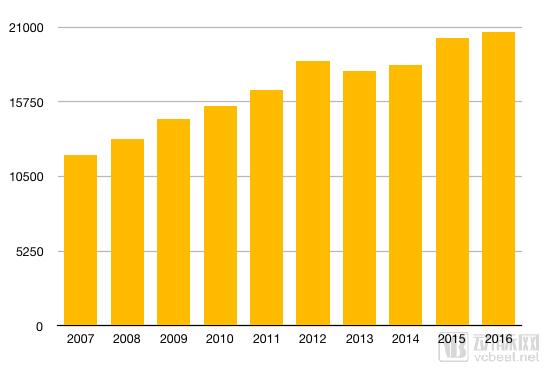
Number of Clinical Trials from 2007 to 2016
In VCBeat’s (WeChat ID: vcbeat) 2017 review of startups in “AI + New Drug Development,” XtalPi was the only relevant company from China. A year later, significant changes have occurred both domestically and internationally, and the landscape of “AI + New Drug Development” has been reshaped entirely, with startups now covering all the aforementioned areas.
Compared with 2017, four new companies—IntelliPharma, DeepIntel, AccutarBio, and LinkDoc Technology—emerged in China in 2018, leveraging AI technologies to deepen their involvement in drug R&D. Beyond those listed in the table, numerous other pharmaceutical companies are also developing targeted deep learning algorithms.
In terms of capital inflow, as of June 2017, the 14 “AI + New Drug” companies tracked by VCBeat had collectively secured $276.82 million in financing. By July 2018, new capital inflows exceeded $600 million, surpassing the total funding raised by the previous 14 companies and indicating explosive growth. The number of companies branded with the “AI + New Drug” label has reached more than 40. With the continuous advancement of artificial intelligence technologies, if initial investments yield positive results, capital will flow into the sector at a multiple-fold increase.
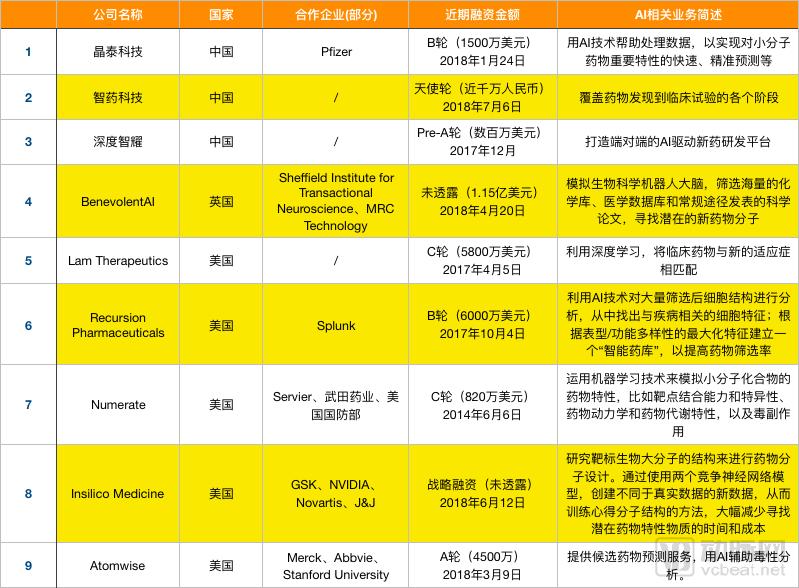
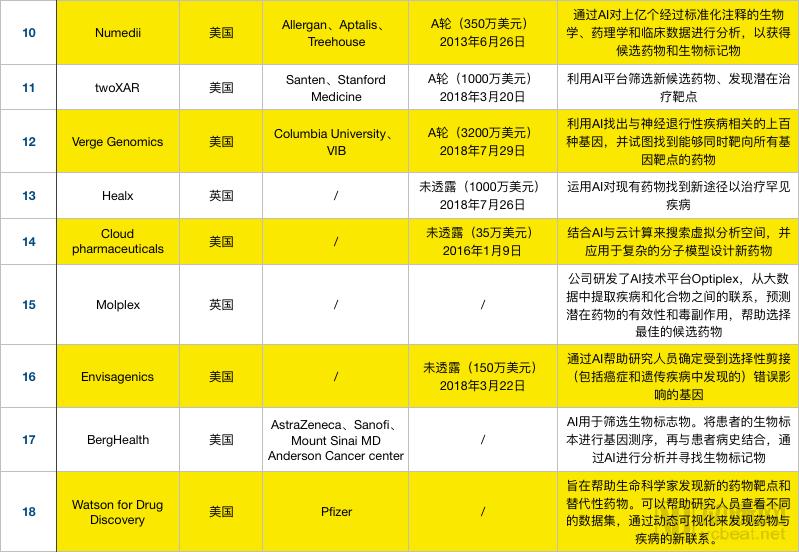
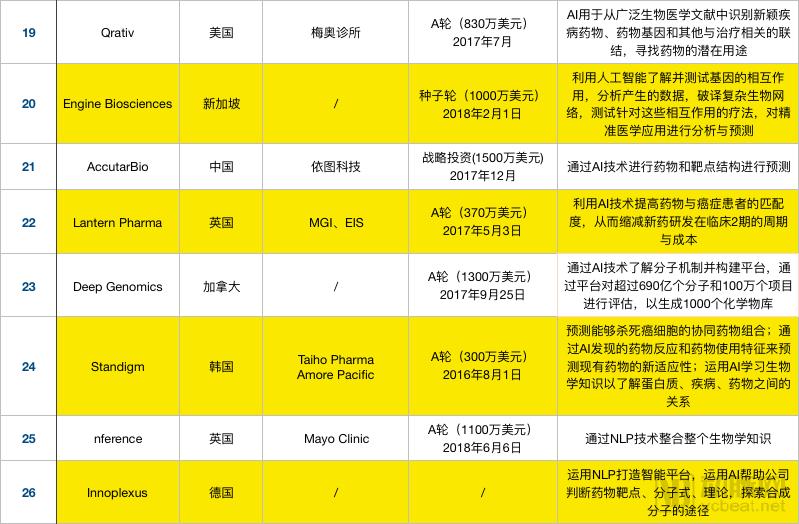
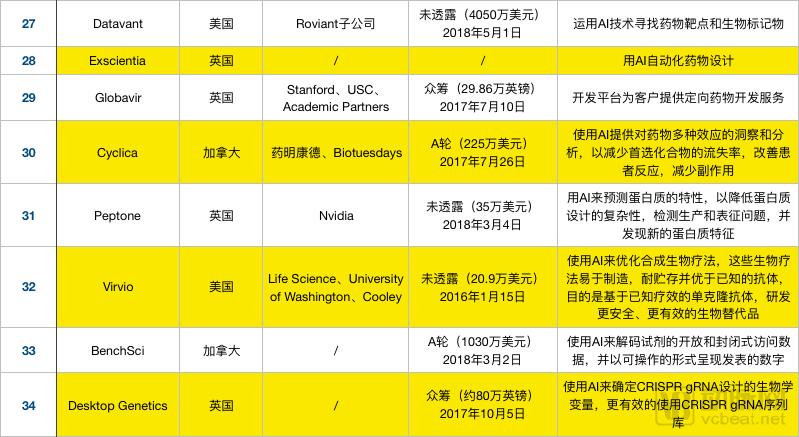
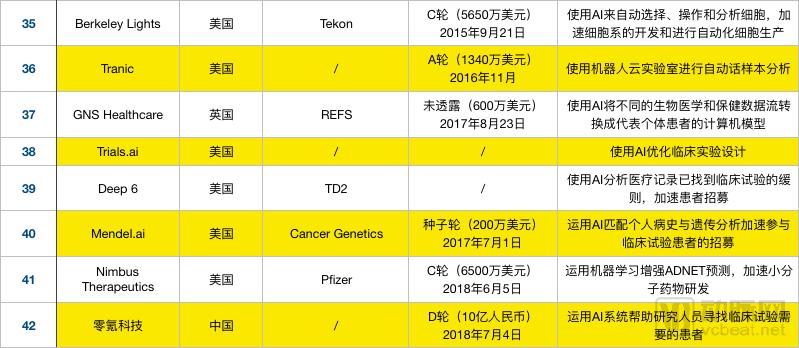
As shown in the table, based on the previous inventory (June 2017), a total of 22 companies secured new financing. Notably, Berkeley Lights raised $56.5 million in its Series C round, Datavant raised $40.5 million, Recursion Pharmaceuticals raised $60 million, Nimbus Therapeutics raised $65 million, and BenevolentAI secured the largest amount at $1.15 billion.
These AI-driven new drug companies are primarily distributed in the UK and the US, followed by China (5 companies) and Canada (3 companies), with one company each in Singapore, South Korea, and Germany.
XtalPi is the first AI company jointly invested by two tech giants, Google and Tencent, and also the first domestic AI-driven drug algorithm company to announce a strategic partnership with a top-tier global pharmaceutical company. By integrating quantum physics, artificial intelligence, and ultra-large-scale cloud computing, the company has achieved breakthrough capabilities in the rapid and accurate prediction of key properties of small-molecule drugs, possessing multiple industry-leading technologies in areas such as drug design and solid-form screening.
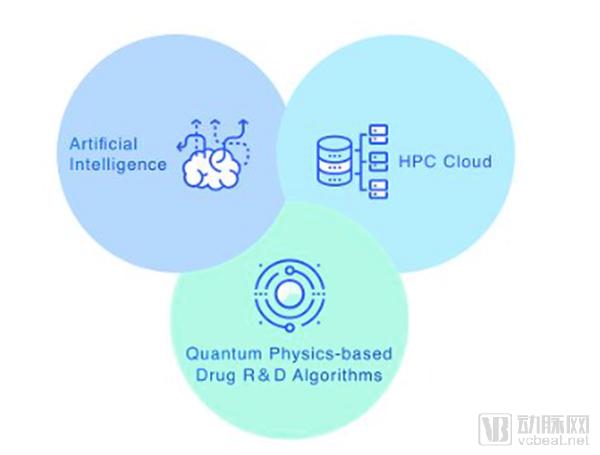
Specifically, XtalPi entered the field through drug crystallization prediction, applying its technology to computational modeling of drug development steps that have traditionally relied heavily on experimental trial and error. By leveraging highly precise and rapid algorithms to predict outcomes, XtalPi helps pharmaceutical companies improve R&D efficiency and success rates while reducing risks, ultimately accelerating the drug development process.
On July 25, DeepIntel announced the development of a new generation of AI-driven drug synthesis system. Codenamed “Bodhi” internally, the system has significantly enhanced chemists’ work efficiency by extensively learning from public patent and literature databases. Upon inputting a chemical structure, the system can instantly propose multiple optimized synthetic routes.
DeepGlint’s core team hails from the new drug R&D departments of multinational pharmaceutical companies and leading domestic internet enterprises. Its AI-driven early-stage R&D platform, integrated clinical research system, and post-marketing platform create a seamless end-to-end data flow, while its human-in-the-loop machine learning operations platform significantly enhances efficiency.
The company has successively launched product prototypes, including an AI-driven drug synthesis and manufacturing process big data optimization platform, an AI-powered early-stage R&D platform, an AI pharmacovigilance system, an AI regulatory submission system, an AI translation platform, and an AI post-marketing platform, serving more than 20 clients.
The company will continue to increase its R&D investment, incorporate reaction conditions and process parameters into system models, and conduct training and optimization. The AI-driven chemical synthesis system can be used not only for drug development but also widely in other synthetic fields such as daily chemicals, new materials, and energy.
Zhiyao Technology’s AI products under development cover all stages from drug discovery to clinical trials, aiming to systematically and holistically improve the success rate of new drug development by enhancing efficiency across each R&D link, thereby reducing R&D costs.
KangDock, a virtual drug screening and molecular docking tool developed by Zhiyao Tech, has achieved a prediction accuracy (AUC) of 93% on test datasets, nearly 4 percentage points higher than AtomNet, a comparable product from the U.S. unicorn company AtomWise. The application of this technology is expected to save the pharmaceutical industry hundreds of millions of dollars in R&D costs.
On July 6, Zhiyao Technology secured nearly RMB 10 million in angel-round investment from Qingsong Fund, which will accelerate its business development.
AccutarBio’s strategic focus is to leverage AI technology to assist in drug molecule design and enhance the accuracy and efficiency of drug screening. To date, AccutarBio has employed artificial intelligence methods for drug design based on protein crystallography data and has filed two patent applications in the United States. The next phase primarily involves building an AI algorithm platform; if this research progresses to clinical application, it will significantly shorten the early-stage high-throughput screening and preliminary selection phases of new drug development.
ZeroCrunch is a provider of big data solutions for oncology. Through its clinical data integration system, it helps hospitals and departments establish structured medical record databases, improving efficiency in diagnosis, follow-up, research, and other processes. It has also developed structured electronic medical records covering more than 3,000 diseases, assisting physicians in clinical research and decision-making.
Backed by extensive data, LinkDoc Technology can leverage its AI system to help physicians identify patients eligible for clinical trials, thereby accelerating new drug development starting from the clinical trial phase.
The participation of numerous companies may have provided a significant boost to public confidence, but Richard Meade, a neuroscientist at the University of Sheffield in the UK, warns: “We are not even capable of modeling a single cell. Our models are incomplete. In fact, even models of individual proteins remain incomplete, which means that science is not yet able to predict whether a drug molecule will make a compound that interacts with a specific protein more effective as a therapeutic agent.” Most known protein structures are determined in the crystalline state, where their conformations are fixed by networks of chemical bonds. In reality, proteins are flexible; while researchers can replicate their approximate structures, it is difficult to reproduce the chemical bonding patterns required to achieve the desired functional effects.
In December 2015, the Zuckerbergs founded the Chan Zuckerberg Initiative (CZI) and invested $3 billion in the organization, assembling a “dream team” to advance basic scientific research. The organization decided to support a foundational science project with the potential to disrupt the field of medicine in the future—the Human Cell Atlas (HCA). This project aims to comprehensively characterize every cell in the human body, including cell types, quantities, locations, relationships, and molecular composition, serving as a reference map to promote the development of biomedical science.
This project is also setting benchmarks for AI technology; we need a deeper understanding of cells at the molecular level to establish rules for AI computations.
Can AI Disrupt New Drug Development? The Few Successes Are Not Yet Enough to Form a Trend. However, One Year Is Too Short; a Bright Future Requires Patience from All Stakeholders.