

MICS: Empowering the Future of AI in Medical Imaging Through a Grassroots Academic Community
“In 2014, I returned to China two or three times a year. At that time, Ni Dong from Shenzhen University suggested that I organize a small workshop during my visits, inviting ten to twenty participants to share the latest advancements in the field with faculty and students at Shenzhen University. I proposed taking a broader view by organizing a national conference to support young professionals in this field, including early-career scholars who had recently returned to China.”
In a small 20-square-meter room, more than a dozen founders of the Medical Imaging Computing Seminar (MICS) gathered. These young scholars hailed from universities such as Shenzhen University, Shandong University, Southern Medical University, Shanghai Jiao Tong University, Nanjing University of Aeronautics and Astronautics, and Soochow University. The room fell silent as Professor Dinggang Shen spoke.
“During that period, many young Chinese students studying abroad were returning to China. They asked me whom they should connect with and collaborate with upon their return, as they lacked contacts in this field. I suggested establishing a community for young professionals in the field of medical image computing through conferences, where they could build networks, engage in interactive exchanges, and achieve professional growth.”
This is how the Medical Imaging Computing Seminar (MICS) came into being.
The 5th Young Scientists’ Symposium on Medical Image Computing (MICS 2018) was held at the Minggugong Campus of Nanjing University of Aeronautics and Astronautics on July 14–15, 2018. Professor Zhang Daoqiang from the College of Computer Science and Technology at Nanjing University of Aeronautics and Astronautics and Professor Dinggang Shen from the University of North Carolina at Chapel Hill in the United States jointly served as the co-chairs of the conference.
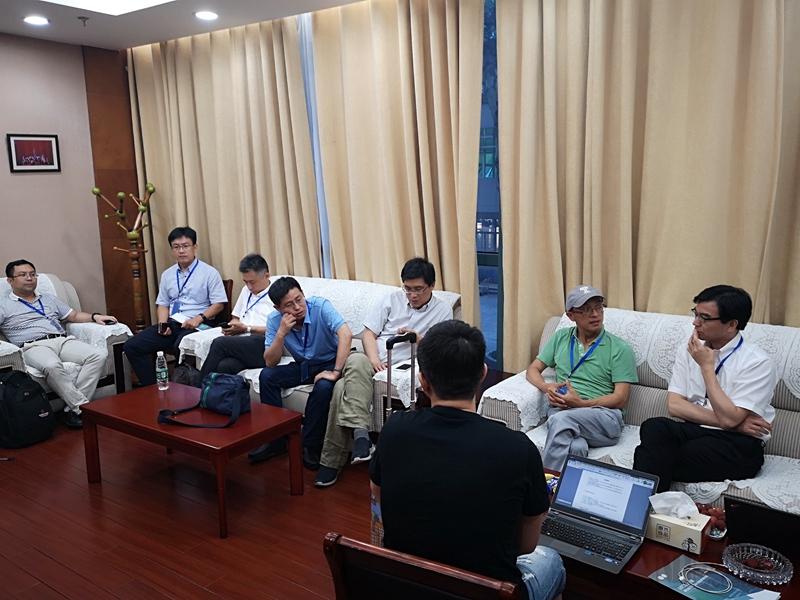
Professor Dinggang Shen (far right) with young scholars from MICS
Top Scientists Drive the Establishment of MICS
Waive Voting Rights and Let the Youth Decide the Development and Future of MICS
Dinggang Shen, IEEE Fellow, AIMBE Fellow, IAPR Fellow, Tenured Professor and Distinguished Professor at the University of North Carolina at Chapel Hill. Former Member of the Board of Directors (equivalent to Vice President) of the International Conference on Medical Image Computing and Computer-Assisted Intervention (MICCAI), Director of the Image Analysis and Information Center at the University of North Carolina, and Director of the Image Display, Enhancement, and Analysis Laboratory (IDEA Lab).
Professor Dinggang Shen has been engaged in research on medical image analysis and artificial intelligence for nearly 20 years. He has published nearly 400 papers in international journals, which have been cited more than 20,000 times. His H-index is 82 (as of July 15, 2018), and he holds multiple patents.
The team he leads is at the forefront of international development in intelligent medical imaging. Their research focuses on precision diagnosis and treatment based on large-scale medical data for conditions such as autism, Alzheimer’s disease, brain tumors, lung cancer, and breast cancer. Notably, their work on “multimodal-based diagnosis of Alzheimer’s disease” has achieved accuracy levels ranking among the best globally. Additionally, the HAMMER image registration method, developed within their research on “precise computation and diagnosis of brain structure,” received the 2006 IEEE Signal Processing Society Best Paper Award and has been widely cited by leading universities, research institutions, renowned hospitals, and high-tech companies worldwide.
Furthermore, the team he led has published the highest number of papers at MICCAI, the premier conference on medical image (intelligent) analysis—comparable in stature to CVPR and ICCV in the field of computer vision—for six consecutive years, with their contributions accounting for up to 8.8% of all accepted papers at its peak.
In the words of the media, Professor Shen Dinggang is an undisputed titan-level scientist in the field of medical image computing.
Since January 2018, Professor Dinggang Shen has concurrently served as Co-CEO of United Imaging Intelligence.
Sean Zhou, Co-CEO of United Imaging Intelligence and former global head of Siemens’ Computer-Aided Detection and Diagnosis division, who is widely regarded as the most influential leader in the international commercialization of medical imaging AI, once stated, “He [Professor Shen Dinggang] commands a vast army of students and wields unparalleled international influence.”
Professor Dinggang Shen relinquished his voting rights at the inception of MICS, empowering young scholars in the field to determine the development and future direction of MICS.
From 100 to 1,100 People: MICS
What Are the Internal Drivers Behind a Tenfold Expansion in Five Years?
The inaugural MICS was held at Shenzhen University in December 2014. According to Professor Ni Dong from the College of Biomedical Engineering, Faculty of Medicine, Shenzhen University, one of the initiators, “We initially expected only 10 to 20 participants, but nearly 100 people attended.”
Following its robust development in 2015 (Jinan), 2016 (Guangzhou), 2017 (Shanghai), and 2018 (Nanjing), MICS has rapidly become one of the most influential events in the field of medical image computation in China, with attendance growing from fewer than 100 participants in 2014 to 1,100 in 2018—a span of less than five years.
The rapid expansion of MICS is certainly attributable to the research and application of artificial intelligence technologies in China’s healthcare sector. According to data from Global Market Insights, drug discovery accounts for the largest share of the global medical AI market by application, representing 35%. The intelligent medical imaging market is the second-largest segment, projected to grow at a rate exceeding 40% and reach a scale of $2.5 billion by 2024, accounting for 25% of the market.
However, there are even more critical factors influencing an organization’s growth.
Professor Shen Dinggang stated, “The core of this forum is to provide a platform for academic exchange among young scholars, enabling them to make their voices heard.” According to the official website of the 5th MICS, MICS focuses on original research in the field of medical image computing from the past two years. It welcomes presentations of new theories, methods, and applications in medical image processing, computer vision, and artificial intelligence, as well as reports on breakthrough advances at the deep intersection of imaging with clinical and basic medicine.
According to statistics from VCBeat, the themes of the last two MICS conferences have covered multiple cutting-edge fields, including artificial intelligence algorithms, image segmentation, surgical pathways, disease mechanisms, neural networks, and medical assistance applications. The speakers included young scholars from more than 20 domestic universities, such as Shanghai Jiao Tong University, Tsinghua University, Northwestern Polytechnical University, Fudan University, University of Electronic Science and Technology of China, Sun Yat-sen University, Xi’an Jiaotong University, Shandong University, Shenzhen University, Soochow University, Hefei University of Technology, The Hong Kong Polytechnic University, Southwest University, Dalian University of Technology, Southeast University, Jiangnan University, Zhengzhou University, Shanghai University, Tianjin University, Beihang University, Nanjing University of Aeronautics and Astronautics, and Sichuan University, as well as from overseas institutions such as the University of North Carolina (UNC) and the University of Florida (UFL).
All speakers at MICS are young Chinese scholars who have published relevant research findings in top-tier journals or conferences in the field of medical image computing, both domestically and internationally, in recent years, and are currently engaged in related academic research. MICS adopts a direct invitation approach to involve these young researchers, which distinguishes it significantly from other academic conferences.
“First, MICS does not charge any registration fees; second, these young professionals cover their own travel and accommodation expenses for attending the conference, and MICS does not provide speaker honoraria,” said Professor Dinggang Shen.
As one of the initiators of MICS, Professor Ni Dong from Shenzhen University believes that the primary goal of MICS is to provide a platform for young scholars to voice their perspectives, and the second is to establish a relatively pure communication platform for young scholars, which represents the greatest value for all participants.
Regarding the changes in the last two editions of MICS, Professor Zhang Daoqiang from Nanjing University of Aeronautics and Astronautics and Researcher Wang Qian from Shanghai Jiao Tong University stated that the most significant development has been the invitation of experts from the medical field, particularly radiologists from hospitals, to participate in the conference and deliver presentations. This shift reflects a growing emphasis on the integration of medicine and engineering, aiming to identify the practical needs of healthcare professionals. For instance, MICS 2017 invited Director Yang Jian from the First Affiliated Hospital of Xi’an Jiaotong University and Director Zhang Longjiang from the General Hospital of Nanjing Military Region. MICS 2018 invited Director Liu Shiyuan from Shanghai Changzheng Hospital, Director Liang Changhong from Guangdong Provincial People’s Hospital, and Director Wang Xiaoying from the Department of Medical Imaging at Peking University First Hospital, among others.
Dr. Chen Xinjian, one of the founders of MICS, Chief Scientist of the Ministry of Science and Technology’s Young 973 Program, Distinguished Professor at the School of Electronic and Information Engineering of Soochow University, and Founder of Suzhou Bigway Medical Technology Co., Ltd., stated via VCBeat to all professionals in the medical innovation industry, “MICS 2019 will be held in Suzhou, with an expected attendance of over 1,500 participants. We welcome everyone to Suzhou next year.”
MICS has been attracting an increasing number of young professionals to join the medical imaging industry. Its academic exchanges are playing a pivotal role in guiding talent development and gradually driving the growth of the medical imaging sector.
“As the conference continues to grow in scale and influence, we hope to see more professionals from the business community join us, fostering collaboration among industry, academia, and research to jointly promote the development of the entire industry,” said Professor Dinggang Shen.
It was nearly seven o’clock when they left the small conference room. After a full day of meetings, Professor Shen Dinggang and the young members of MICS took advantage of this rare opportunity to continue discussing the future development and prospects of MICS.
Introduction to MICS
The Medical Imaging Computing Seminar (MICS), established in 2014, aims to provide an academic exchange platform for young Chinese scholars in the field of medical imaging, foster mutual understanding and friendship, and facilitate their integration into the broader academic research community. MICS focuses on original research in medical image computing from the past two years, welcoming presentations of new theories, methods, and applications in medical image processing, computer vision, and artificial intelligence, as well as reports on breakthrough advances at the deep intersection of imaging with clinical and basic medicine.