

Tasly Invests $20 Million in Australia's Mesoblast Limited to Enter Stem Cell Therapeutics Market
Following Haier Group’s RMB 11.6 billion investment—the largest single investment in China’s cell therapy sector—and CSPC Pharmaceutical Group’s RMB 2 billion foray into stem cell and immunotherapy, another listed company has entered the stem cell industry.
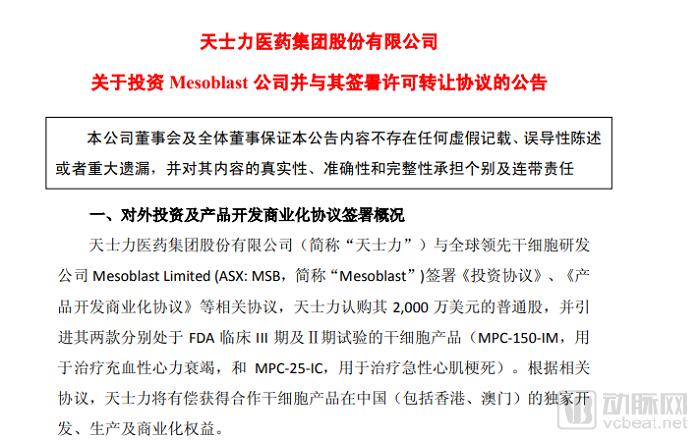
On the evening of July 17, 2018, Tasly (600535), a company listed on China’s A-share market, announced that it would sign an Investment Agreement, a Product Development and Commercialization Agreement, and other related agreements with Mesoblast Limited (ASX: MSB, “Mesoblast”), a global leader in stem cell research and development.
Under the agreement, Tasly will subscribe to USD 20 million worth of its common shares (approximately 14,464,259 shares) and introduce two stem cell products currently in Phase III and Phase II clinical trials with the U.S. Food and Drug Administration (FDA), respectively. Specifically, MPC-150-IM is indicated for the treatment of congestive heart failure, while MPC-25-IC is indicated for the treatment of acute myocardial infarction.
It is reported that Tasly will acquire, for consideration, the exclusive rights to develop, manufacture, and commercialize the collaborative stem cell products in China (including Hong Kong and Macau).
Mesoblast Limited, founded in 2004 and headquartered in Melbourne, Australia, is a globally leading biotechnology company developing cell-based regenerative therapy products.
The company was listed on the Australian Securities Exchange in 2004 and subsequently listed on the NASDAQ in the United States in 2015, issuing American Depositary Receipts.
Mesoblast has developed a series of clinically convenient allogeneic stem cell therapeutic products leveraging its proprietary “Mesenchymal Lineage Adult Stem Cell (MLC) and Mesenchymal Precursor Cell (MPC) adult stem cell technology platform.” These products are characterized by the absence of a need for tissue matching and no risk of rejection, enabling their ready use to address unmet clinical needs, including cardiovascular diseases, rheumatic and autoimmune disorders, metabolic diseases, degenerative conditions such as spinal disorders, and immune-related diseases associated with cancer and hematologic treatments.
Mesoblast currently has two out-licensed products on the market, with three additional products in Phase III clinical trials and multiple products undergoing Phase II clinical trials.
According to publicly disclosed information, Mesoblast’s major shareholders include investment firms such as M&G Investment, Capital Research and Management, and Thorney Investment, as well as Silviu Itescu, the founder and CEO of Mesoblast.
For the fiscal year ended June 30, 2017, Mesoblast reported total assets of US$655.7 million, total liabilities of US$138.9 million, and net assets of US$516.8 million; operating revenue was US$2.412 million, R&D expenditure was US$58.914 million, and net loss was US$76.815 million.
The finished stem cell product MPC-150-IM is part of the Mesoblast MPC cell line series (MPCs are precursor cells of the MLC cell line) and is a priority development candidate in the company’s pipeline. The Phase II clinical trial of this product for the treatment of end-stage congestive heart failure (Class IV CHF) has been completed. During the 12-month follow-up period, 85% of patients treated with MPC-150-IM were able to undergo one or more left ventricular assist device (LVAD) procedures (as further clinical treatment), compared with only 40% in the control group.
In December 2017, MPC-150-IM was granted Regenerative Medicine Advanced Therapy (RMAT) designation by the U.S. Food and Drug Administration (FDA), qualifying it for priority review under the 21st Century Cures Act. The project is scheduled to complete the analysis of 12-month endpoint efficacy data in the third quarter of 2018, and preparations for the marketing application are being accelerated.
Meanwhile, the Phase III clinical trial of this product for the treatment of moderate to advanced congestive heart failure (Class II/III CHF) in the United States completed its interim analysis in April 2017, as determined by an independent data monitoring committee (IDMC), and the indication scope of MPC-150-IM for heart failure will be further expanded.
MPC-25-IC, also a precursor cell of MLC, is currently being investigated for the indication of acute ST-segment elevation myocardial infarction (STEMI), with a Phase IIb clinical trial underway in Europe to evaluate its concurrent use with percutaneous coronary intervention (PCI).
Acute myocardial infarction is myocardial necrosis caused by acute and persistent ischemia and hypoxia of the coronary arteries. In recent years, the incidence of this disease has shown a significant upward trend in China.
Epidemiological surveys indicate that there are currently 2.5 million patients with myocardial infarction in China, with an incidence rate of acute coronary syndrome of 166.4 per 100,000 population. Reperfusion therapy is currently a critical treatment modality for acute ST-segment elevation myocardial infarction (STEMI); however, no stem cell products for the treatment of acute myocardial infarction have been launched on the market either domestically or internationally. Following its market launch, the MPC-25-IC product is expected to be used in conjunction with percutaneous coronary intervention (PCI) to reduce post-acute myocardial infarction syndrome.
This collaboration with Mesoblast has enabled Tasly to introduce cutting-edge international stem cell therapy technologies and expertise, while establishing a domestic R&D and manufacturing platform for stem cells. Furthermore, it undoubtedly broadens the company’s pipeline of cardiovascular and cerebrovascular therapeutic products, filling the gap in the application of stem cell products for the treatment of cardiovascular and cerebrovascular diseases.
It is understood that the $20 million in this transaction corresponds to the upfront payment for the technology license. After two products, each targeting different indications, obtain marketing approval from the China Food and Drug Administration (CFDA), Tasly will pay Mesoblast a development milestone fee of $25 million.
In addition, if Tasly commercializes the products in China, it will pay Mesoblast net sales milestone payments and a double-digit percentage royalty on net sales, based on the achievement of annual net sales targets.