

Unisound Completes C-Series Financing of RMB 1.3 Billion with Participation from Multiple State-Backed Funds
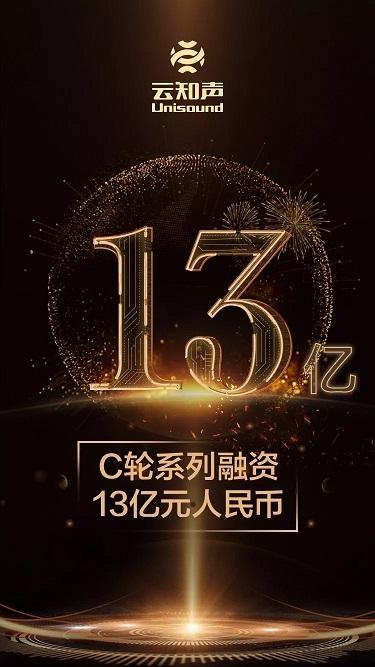
On July 19, VCBeat (WeChat official account: vcbeat) received news that Unisound, a leading domestic provider of IoT AI solutions, announced the completion of its C+ round financing amounting to RMB 600 million. This round was led by China Internet Investment Fund, with participation from CICC JiaCheng (affiliated with CICC) and China Construction Investment Capital (affiliated with CHTC Huake). Hanen Investment served as the exclusive financial advisor. With this closing, the total amount raised in Unisound’s Series C financing rounds has reached RMB 1.3 billion, setting a new record for the largest single-round financing in the voice technology sector.
All investors in Unisound’s latest Series C+ funding round are state-backed funds. The China Internet Investment Fund is an investment institution approved by the State Council and jointly initiated by the Cyberspace Administration of China and the Ministry of Finance. Its strategic investors include leading state-owned enterprises across various sectors, such as Industrial and Commercial Bank of China, Agricultural Bank of China, CITIC Guoan, China Post Life Insurance, China Mobile, China Unicom, and China Telecom, with a total planned fund size of RMB 100 billion. CICC Jiacheng is the earliest established and most important private equity investment platform of China International Capital Corporation (CICC), whose major shareholder is Central Huijin Investment Ltd. CSCEC Capital is a private equity fund management company under CSCEC Huake Investment Co., Ltd.
Huang Wei, Founder and CEO of Unisound, stated, “The collective entry of state-backed funds this time demonstrates the government’s high regard and strong support for the IoT and artificial intelligence industries, and further reflects market recognition of Unisound’s leading AI technologies and commercialization capabilities.” He pointed out that the Series C financing will be primarily used to increase investment in the research and development of key AI technologies and to strengthen talent pipeline development, seeking continuous breakthroughs in multimodal and cognitive technologies while exploring more vertical industries and service models to uncover new business growth drivers.
A representative from the China Internet Investment Fund (CIIF), a participant in this investment round, stated: “As a national-level investment institution initiated by the Cyberspace Administration of China and the Ministry of Finance, CIIF focuses on investing in outstanding enterprises with core technological advantages and strong commercialization capabilities in the internet sector. Unisound not only boasts leading technologies in artificial intelligence and AI chips but has also established first-mover advantages across multiple scenarios, including smart home, healthcare, and automotive applications. We hope that the capital injected in this round will fully unleash Unisound’s technological potential, accelerating the company’s data accumulation and chip iteration in the era of intelligent IoT, thereby leveraging internet technology to better serve the nation and its people.”
Unisound specializes in AIoT artificial intelligence services and is one of the few AI companies in the industry possessing a full-stack technology chain encompassing AI algorithms, computing power, and chip capabilities. Under its “Cloud-Edge-Chip” product ecosystem, Unisound’s leading AI technologies have been extensively applied across scenarios such as smart living (smart homes, in-vehicle systems, robots, etc.) and smart services (healthcare, education, judicial services, etc.), making it one of the best-commercialized AI enterprises in China.
In the smart home sector, Unisound successfully shipped its IVM modules in 2015, making it the only company in the industry to date that has achieved commercial deployment of its chips. Its client base covers leading home appliance manufacturers such as Gree, Midea, Changhong, and Vatti.
In the healthcare sector, Unisound pioneered the speech-based electronic medical record (EMR) solution in China. This solution has been deployed in nearly 100 leading hospitals, including Peking Union Medical College Hospital and Fujian Provincial Hospital. In late last year, Unisound jointly established a joint venture, Haoyi Intelligence, with Ping An Good Doctor to comprehensively expand its AI-powered healthcare services for mobile devices and home terminals. Furthermore, leveraging its strengths in speech recognition and big data technologies, Unisound has partnered with CEC Data, a national-level team in health and medical big data with extensive medical data resources, to jointly explore the existing medical speech market, develop new product categories, and create AI chips tailored for the healthcare industry.
In the automotive sector, Unisound has served nearly 100 solution providers and brand owners, empowering over 17 million end-user devices. In the education sector, Unisound collaborates with more than 80 clients, reaching a user base of over 30 million, with 180 million daily API calls; its market share in socialized spoken language assessment services consistently ranks first. Furthermore, Unisound has established partnerships with leading enterprises such as Ping An Group, China Minsheng Bank, JD.com, and 360, providing them with artificial intelligence services.
In terms of core AI capability output, Unisound’s supercomputing platform business has established a benchmark in artificial intelligence supercomputing with a performance of 10 exaflops (10^18 floating-point operations per second). It is currently building and operating a top-tier artificial intelligence supercomputing center in China for the Xiamen Municipal People’s Government. Cooperation with national and government entities is not limited to supercomputing platforms. In the future, collaboration between state-backed funds and Unisound will become more multidimensional and extensive across fields such as smart transportation, smart hospitals, and smart cities. Unisound aims to leverage the momentum of state-backed funds to further expand its business landscape, engage in richer and more diverse deep cooperation with national and government bodies, and contribute to the development of domestic intelligent IoT and artificial intelligence technologies.
Benefiting from its robust underlying technologies and continuous breakthroughs in business development, Unisound has maintained year-over-year revenue growth exceeding 100% for three consecutive years, with its 2018 revenue projected to reach 300% of the previous year’s level. In May 2018, Unisound successfully launched its first AI chip designed for the Internet of Things (IoT), named “Swallow,” marking the company’s entry into a new phase of rapid commercial expansion. Notably, at the chip launch event, Unisound announced progress in its collaboration with JD.com’s smart division. Leveraging their respective resources and strengths, the two parties will promote the application of AI chips in the smart home sector. Additionally, Unisound has partnered with a well-known Chinese automaker to advance the development and deployment of automotive-grade, pre-installed AI chips.
With the mass production and deployment of its self-developed AI chips, 2018 will undoubtedly mark a significant milestone in the development of Unisound. Following this Series C financing round, Unisound will continue to increase its investments in R&D and talent acquisition, actively build a comprehensive industrial chain ecosystem, and accelerate the transition of AI technologies from back-end systems to front-end applications.
Appendix: Overview of Unisound’s Financing Rounds
May 2012: Tens of millions of RMB in angel investment;
In June 2013, RMB 100 million in Series A financing;
December 2014, $50 million Series B financing;
August 2017: RMB 300 million in strategic financing;
In May 2018, a $100 million Series C financing round;
July 2018: RMB 600 million in Series C+ financing.