

Vir Biotechnology, Founded by ARCH Venture Partner Robert Nelsen, Files IPO Prospectus Highlighting Over $500M Raised for Infectious Disease Therapies Including HIV

Vir Biotechnology
Developer of Immunological Drugs
“Although there are billions of people in the world, everyone gets sick and is susceptible to infectious diseases,” said George Scangos, CEO of Vir Biotechnology, in an interview.
This is indeed the case. According to statistics from the World Health Organization (WHO), approximately 5% of the global population are chronic carriers of the hepatitis B virus (HBV), and nearly 25% of these carriers suffer from severe liver disease. Among them, 2 billion people have been infected with HBV, over 250 million are chronically infected, and approximately 1 million people die each year from HBV infection and related complications.
As of 2015, there were approximately 37 million people living with HIV worldwide, 2.1 million new HIV infections, and about 1.1 million deaths from HIV-related diseases. The African region has become the hardest-hit area for infections.
In a world where infectious diseases are ubiquitous, every individual who is susceptible to or already infected with an infectious disease represents a potential user of anti-infective therapeutics. The development of such medications is a highly complex and technically demanding endeavor.
Vir Biotechnology (hereinafter referred to as “Vir”), a California-based biotechnology company, is dedicated to its mission of “building a world free of infectious diseases.” It is a leader in this market.

Vir Biotechnology is a technology-driven biopharmaceutical company that integrates innovations in science, medicine, and technology to improve the treatment of serious infectious diseases and patient care.

Vir Biotechnology was founded by Robert Nelsen, founder of the prominent venture capital firm ARCH Venture Partners. The company’s initial round of financing involved participation from ARCH Venture Partners, the Bill & Melinda Gates Foundation, Altitude Life Science Ventures, and Alta Partners. The Bill & Melinda Gates Foundation and ARCH Venture Partners contributed $150 million in seed funding.
In addition to the aforementioned Series A financing, Vir’s investors also include SoftBank, Temasek, Baillie Gifford, the Alaska Permanent Fund, as well as certain individuals, family offices, and institutions. To date, the company has raised over $500 million.
At the end of 2016, George Scangos stepped down as CEO of Biogen, with industry insiders closely watching where he would continue his career in the biotechnology sector.
George Scangos stated that he was attracted by the “huge medical demand” in the market for severe infectious diseases.
“I cannot miss the opportunity to lead Vir. The global demand for infectious disease treatments is enormous, and effective treatment and prevention of infectious diseases are critically important to public health. The success of new technologies will mean alleviating the suffering of many people,” said George Scangos, CEO of Vir. “We need a company to pursue more effective and innovative therapies. Vir is that company, and I am delighted to take on this leadership role.”
In January 2017, he became the Chief Executive Officer of Vir Biotechnology, Inc. For Vir, the arrival of George Scangos was a significant boost.
Dr. George Scangos served as Chairman of PrPHA from March 2016 to January 2017. He is a member of the Board of Directors of the Global Alliance for TB Drug Development, a member of the Board of Trustees of the Museum of Science in Boston and the Biomedical Science Careers Program, and a member of the National Advisory Council of the University of California, Davis, School of Medicine.
In addition to Dr. George Scangos, Vir’s leadership team includes Chief Financial Officer Howard Horn, Chief Technology Officer Michael Kamarck, Chief Business Officer Jay Parrish, Chief Operating Officer Alpna Seth, Senior Vice President of Program Development Brian Kelley, Senior Vice President of RNA Technology Dr. Christian Mandl, and Senior Vice President of Clinical Development Dr. Phil Pang.
Board Composition:

In addition to its extensive leadership team, Vir also has numerous renowned scientific advisors in the biomedical field:

Among the most challenging infectious diseases worldwide are highly contagious illnesses such as HIV/AIDS, SARS, pathogenic avian influenza, and tuberculosis. Each outbreak triggers public panic, driven by fears over the diseases’ high transmissibility and lack of containment, as well as the absence of effective treatment options.
"In the treatment of these highly infectious diseases, either no therapeutic regimen exists, or existing standard regimens are inadequate."
Vir is attempting to adopt a new technology—manipulating the interaction between pathogens and hosts—to combat highly infectious viruses. The company has adopted a multi-pronged, multi-platform approach to applying these breakthroughs, including the development of therapies that induce and modulate therapeutic immune responses.
“Vir’s new technology has rapidly advanced from the laboratory to clinical application. While treatments for HIV and hepatitis C have already achieved success, we still need to make efforts beyond these two fields,” said Scangos. “Meanwhile, we are leveraging multiple compounds to pursue additional therapeutic options.”
The company is currently focused on addressing unmet needs in the treatment of serious infectious diseases, including: (1) chronic infectious diseases, such as hepatitis B, tuberculosis, and HIV/AIDS; (2) respiratory diseases, including influenza, respiratory syncytial virus (RSV), and human metapneumovirus (hMPV); and (3) acquired infections.
Vir combines cutting-edge innovative technologies with leading scientific expertise to address the world’s most challenging infectious diseases, for which current therapeutic options are insufficient. Guided by rigorous science, Vir meets the diverse needs of the medical community.
On October 18, 2017, Vir Biotechnology, Inc. announced collaborations with three prominent biotechnology companies on new initiatives targeting highly infectious diseases, signing agreements for the development of novel drugs and therapeutic regimens to treat severe infectious diseases.
Furthermore, Vir has partnered with four leading academic research institutions—Stanford University, Harvard University, Oregon Health & Science University, and the Fred Hutchinson Cancer Research Center—to jointly contribute to building a world free of infectious diseases.
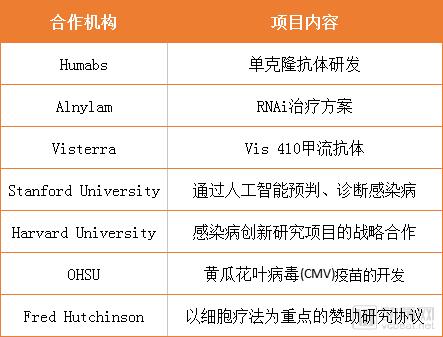
Here, we mention three companies: Humabs, Alnylam, and Visterra.
Humabs: Monoclonal Antibody R&D
In October 2017, Vir acquired Humabs BioMed SA, a Swiss company whose proprietary technology enables the rapid isolation and development of antibodies naturally selected by the human immune system. The company is currently dedicated to developing fully human monoclonal antibodies for the treatment of severe infectious diseases.
This acquisition of Humabs by Vir has brought 15 candidate antibodies for infectious diseases, among which those targeting HBV, RSV (Respiratory Syncytial Virus), MPV (Human Papillomavirus), and Zika virus have entered the preclinical trial stage, while the antibody against Dengue virus is in the engineering phase.
Alnylam: RNAi Therapeutic Solutions
RNA interference (RNAi) refers to the phenomenon in which double-stranded RNA (dsRNA) corresponding to messenger RNA (mRNA) is introduced into cells, leading to specific degradation of the mRNA and thereby preventing expression of the corresponding gene. RNAi-based therapeutic strategies leverage this specific gene silencing for gene therapy of infectious diseases and malignant tumors.
Alnylam is a leader in the field of RNAi therapeutics. Its collaboration with Vir has advanced the development of RNAi therapies for highly contagious diseases.
The agreement between Alnylam and Vir includes five RNAi therapeutic programs for treating highly contagious diseases, including the use of ALN-HBV02 for HBV treatment. Additionally, Alnylam will develop RNAi products for four additional infectious disease targets selected by Vir, and Vir will choose any one of these products for further development.
George Scangos stated, “We are delighted to partner with Alnylam Pharmaceuticals and apply new technologies to the treatment of infectious diseases, such as hepatitis B, for which there is substantial global demand. This effort bears directly on the health of all humanity.” “This collaboration represents a critical step toward curing infectious diseases.”
Visterra: Vis 410 Influenza A Antibody
Vir has also entered into an exclusive research collaboration agreement with Visterra to co-develop six antibodies for the treatment of infectious diseases, including Vis410, an antibody currently in Phase II clinical trials for the treatment of influenza A. Furthermore, the two parties will leverage Visterra’s technology to develop three additional antibodies targeting influenza, respiratory syncytial virus (RSV), and fungal infections. Should these programs proceed, Vir will pay Visterra $1 billion in development costs.
Vir has established collaborations with four other academic institutions: an agreement with Stanford University on AI-driven predictive diagnosis of infectious diseases; a strategic partnership with Harvard University on innovative research projects for infectious diseases; a collaboration with Oregon Health & Science University on the development of a Cucumber Mosaic Virus (CMV) vaccine; and a sponsored research agreement with Fred Hutchinson Cancer Center focused on cell therapies.
It is worth noting that Vir has established a non-profit system closely aligned with the academic community. In the world’s poorest regions, where infectious diseases often have the most severe impact, Vir serves as a capable partner, providing infectious disease treatments to anyone in need around the globe.
Scangos stated that Vir’s newly developed drugs for treating infectious diseases can be sold in countries that can afford them. In countries unable to pay for these medications, the Bill & Melinda Gates Foundation, other investors in Vir, and certain partners will also provide assistance.