

Three Ministries Release the 'Directory of Promoted Smart Health and Elderly Care Products and Services', Featuring 115 Items from 90 Enterprises

Andon Health
Developer and Manufacturer of Health-related Electronic Products and Smart Hardware
VCBeat learned from the website of the Ministry of Civil Affairs that the Catalogue for the Promotion of Smart Health and Elderly Care Products and Services (hereinafter referred to as the “Catalogue”), formulated by the Ministry of Industry and Information Technology, the Ministry of Civil Affairs, and the National Health Commission, was released for public consultation on the 23rd, with the consultation period running from July 23 to July 27.
The initiative began soliciting projects on November 17, 2017, and spanned eight months, identifying the “vanguard” of smart elderly care. The Catalogue comprises two categories—elderly care products and elderly care services—covering 56 intelligent health and elderly care products from 33 enterprises, as well as 59 smart health and elderly care services provided by 57 enterprises.
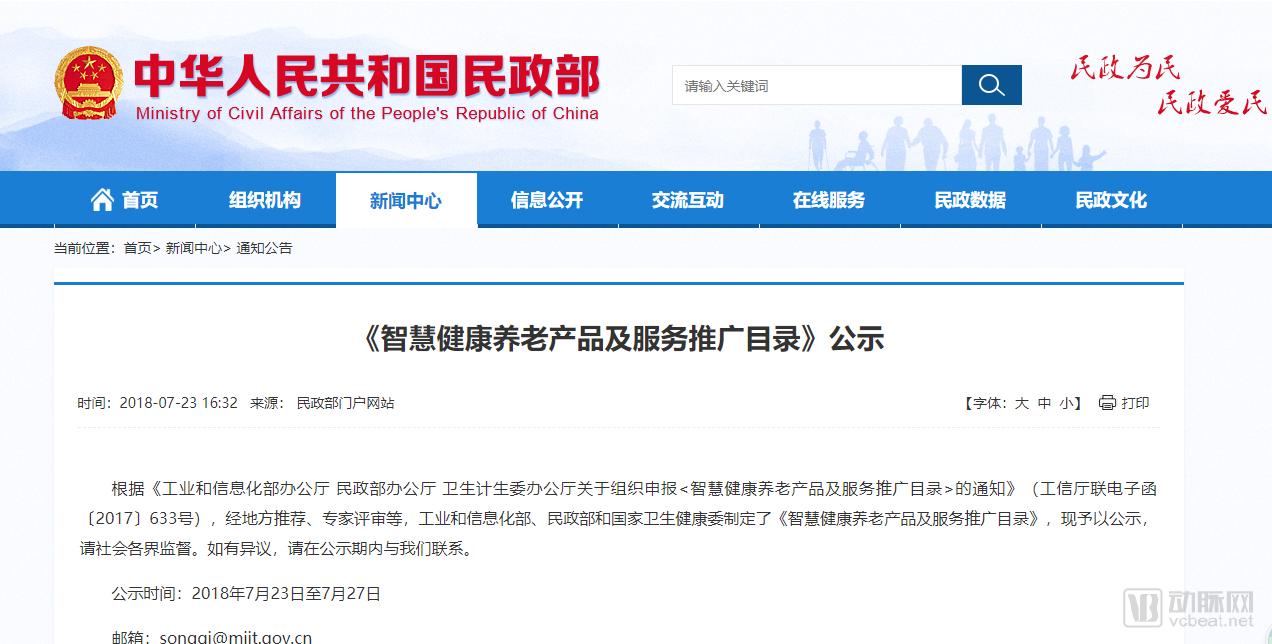
In the notice issued last November on organizing the application for the “Catalogue for the Promotion of Smart Health and Elderly Care Products and Services” (hereinafter referred to as the “Notice”), the following definitions were provided for smart health and elderly care products and smart health and elderly care services:
Smart Health and Elderly Care Products
Smart health and elderly care products are new types of intelligent terminal devices that closely integrate information technology, featuring significant intelligence and connectivity, as well as health and elderly care service capabilities. They mainly include five major categories: wearable devices for health management, portable health monitoring devices, self-service health screening devices, smart elderly care monitoring devices, and home service robots.
Smart Health and Elderly Care Services
Smart health and elderly care services refer to a new model of health and elderly care services provided to the public by fully leveraging information technology, intelligent health and elderly care products, and innovative business models. These services primarily encompass six major categories: chronic disease management services, home-based health and elderly care services, personalized health management services, internet-based health consultation services, daily living care services, and informatization services for elderly care institutions.
Furthermore, it clearly specifies the requirements for applicants, with three points warranting our attention:
1. Possess a comprehensive product sales or service network, a sound quality management system, and strong after-sales service capabilities;
2. The annual revenue from smart health and elderly care-related businesses of product manufacturing enterprises in 2016 shall be no less than RMB 8 million, or the number of products placed on the market shall be no less than 10,000 units; the annual revenue from smart health and elderly care-related businesses of service provision enterprises in 2016 shall be no less than RMB 6 million, or the number of people served shall be no less than 5,000;
3. The product shall be a finalized, mass-produced product with technological advancement, compliant with relevant national, industrial, or association standards, and widely adopted; the service shall be a mature service already promoted in the market.
In other words, for the market, the product and service enterprises selected this time have a certain scale in the field of elderly care,Enterprises with relatively fixed and stable service models,or its existing core business has matured, enabling the provision of elderly care services and products.
In addition to traditional elderly care enterprises and “Internet + Elderly Care” or “Internet + Care” providers, we can observe that a wide range of companies have entered the elderly care services sector. These include listed IT firms such as Neusoft Xikang and Wanda Information, recent IPO candidate and internet giant Xiaomi, internet healthcare unicorn WeDoctor, and telecommunications companies like China Mobile. Furthermore, large corporations in the medical device and home appliance industries are also marketing products suitable for home-based elderly care.
Furthermore, for the shortlisted products, three incentive measures are considered the most significant benefits:
1. Encourage government funds at all levels and social capital related to smart health and elderly care to prioritize support for products, services, and their associated enterprises listed in the Catalogue;
2. Encourage civil affairs, health and family planning, and other user departments in various regions to give priority support to products and services listed in the Catalog during procurement and selection for smart health and elderly care projects;
3. Intensify publicity and promotion efforts for the Catalogue, leveraging official websites of relevant departments, news media such as television, newspapers, and online platforms, as well as holding press conferences and industry forums, to expand the influence of the included products and services.
Incentive measures are particularly crucial for enterprises. These three points demonstrate the government’s support for smart elderly care projects, indicating that procurement by the civil affairs, health, and social work systems may favor companies listed in the Catalog. Furthermore, products and services included in the Catalog will be promoted from the perspective of “relevant departments,” which undoubtedly serves as an authoritative endorsement for these enterprises.
A defining characteristic of elderly care is its strong public attribute. Whether subsequent incentive measures will help enterprises establish a B-to-G (Business-to-Government) business model remains to be seen. Nevertheless, it is undeniable that the government’s support for smart elderly care is steadfast and robust, which may have instilled a degree of confidence in the elderly care industry—a sector that has historically attracted less attention from social capital.
Appendix: Products and Services Listed in the “Catalogue for the Promotion of Smart Health and Elderly Care Products and Services”
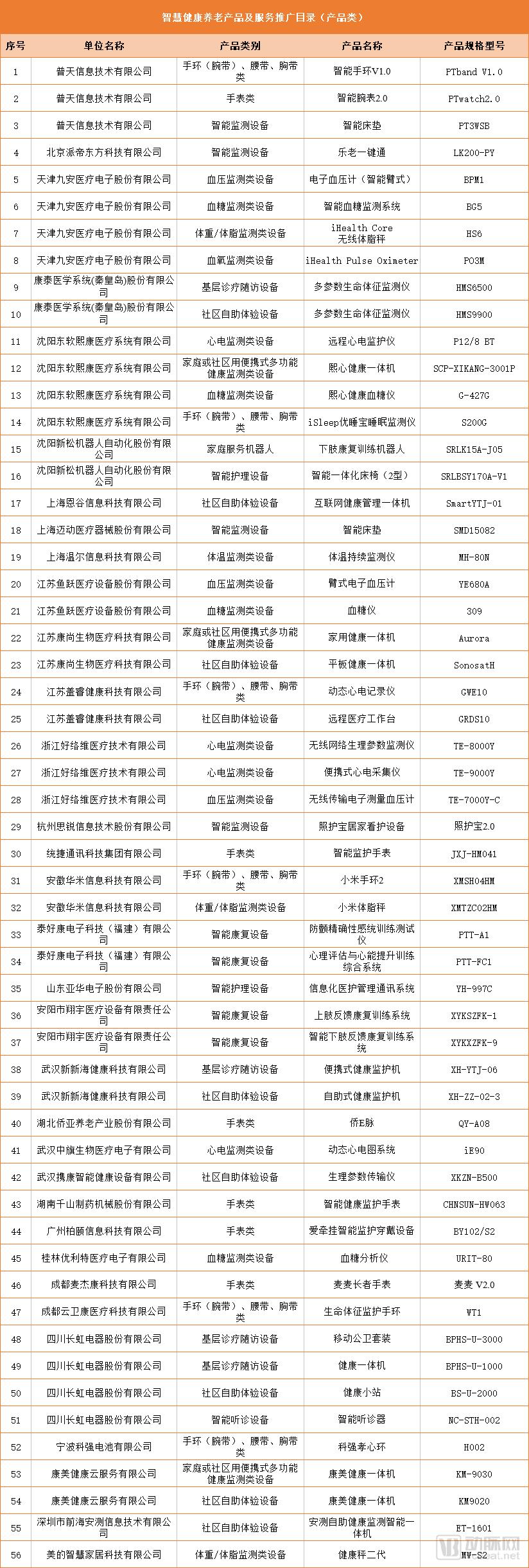
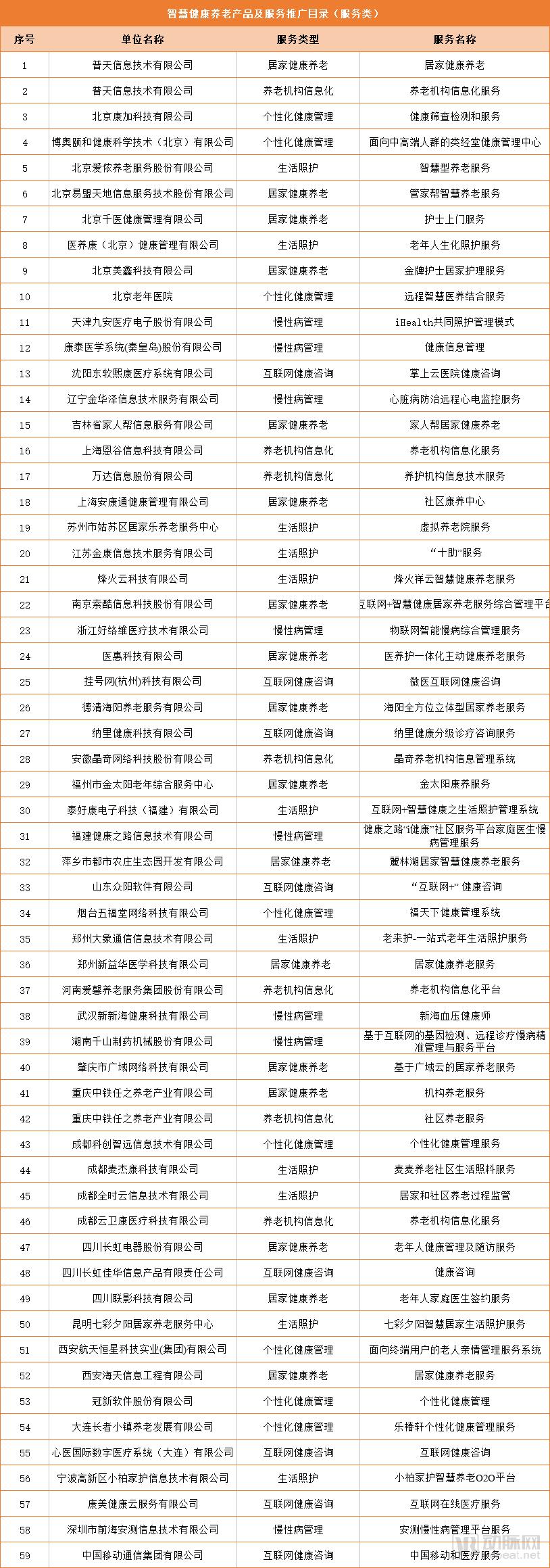
Source:
Official Website of the Ministry of Civil Affairshttp://www.mca.gov.cn/article/xw/tzgg/201807/20180700010248.shtml