

Pharma Giants' Digital Pivot: Six Strategic Shifts Reshaping Drug Development and Patient Engagement
Technology has brought boundless wealth to the pharmaceutical industry, fostering its unprecedented prosperity.
Digital technologies, represented by artificial intelligence, machine learning, big data, and mobile health, are reshaping the pharmaceutical industry, bringing a new look to the sector. VCBeat has recently launched a special feature on “Digital Transformation in the Pharmaceutical Industry,” providing a comprehensive analysis of the technology-driven industrial changes.Click here for the special feature。
There is a paradox in the animal kingdom: elephants are actually afraid of ants. Although elephants have thick, rough skin, ants can crawl into their trunks and irritate the delicate nerve endings, causing excruciating pain and leaving the elephants helpless.
Elephants and ants are akin to traditional pharmaceutical giants and startups. The pharmaceutical industry is rapidly entering the digital age, with emerging technology companies entering the market, forcing incumbent firms to adapt in R&D, sales, and operations. Although these pharmaceutical giants are massive, they also cast larger shadows.
Amid the gradual consolidation across consumer goods, pharmaceuticals, and medical devices, coupled with evolving regulatory policies, each shift demands the full attention of traditional pharmaceutical companies. Moreover, drugs that once held monopolistic positions are now facing challenges from the “patent cliff” and emerging therapies such as gene therapy.
However, its massive scale may instead pose the risk of becoming unwieldy.TraditionalAmid rapid change, pharmaceutical giants are scrambling to adapt. After all, no one wants to become the next Nokia of the pharma industry.
In the field of new drug development, Exscientia alone has secured collaborations with Sanofi and GSK worth over $300 million. In terms of capital inflow, according to statistics from VCBeat, the 14 “AI + New Drug” companies collectively raised $276.82 million in financing by June 2017. By July 2018, newly injected funds had exceeded $600 million.
Traditional pharmaceutical companies are also eyeing emerging players; earlier this year, Roche acquired Flatiron Health, an oncology big data company, for $1.9 billion. While no one can predict the future of the pharmaceutical industry, it is universally acknowledged that inaction is a sure path to failure.
In the realm of digital marketing, over the past five to six years, more than 1,000 pharmaceutical companies have created tens of thousands of WeChat accounts and mobile applications tailored to specific medical departments, diseases, and target physicians. Despite investing billions in these efforts, the results have been lackluster. The revenue structure of digital marketing platforms further underscores the emphasis pharmaceutical companies place on digital transformation. According to WebMD’s annual report, its revenue in 2016 amounted to $705 million, with advertising and sponsorship income totaling approximately $560 million, accounting for around 80% of total revenue. The primary source of this advertising and sponsorship income is pharmaceutical companies.
Although many uncertainties remain, Econsultancy has summarized six major trends shaping the pharmaceutical industry based on current development trajectories. VCBeat (WeChat ID: vcbeat) has compiled and reported on these findings.
Improvements in patient medical experience have brought about significant changes in the healthcare industry and represent the area most tangibly perceived by consumers. Traditional care pathways have become outdated and rigid, ripe for disruption. From the perspective of healthcare providers, there remains substantial room to enhance patient engagement and care experience across consultation, diagnosis, treatment selection, and disease management.
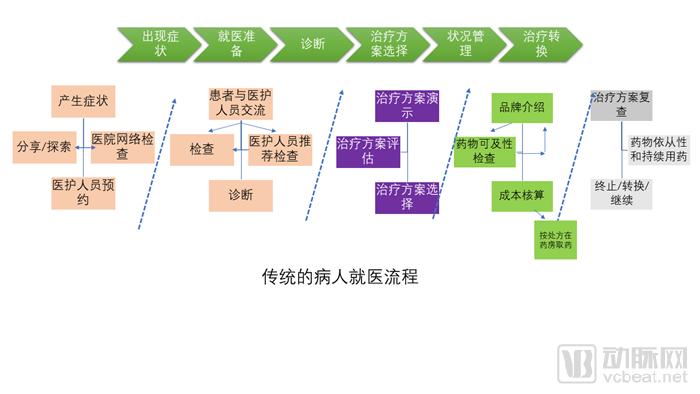
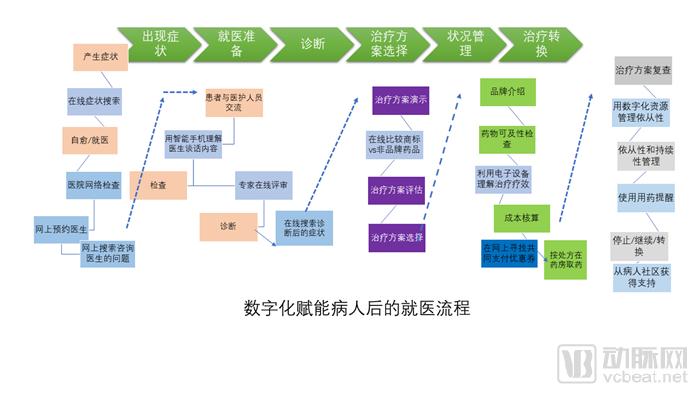
Blue sections indicate newly added medical consultation procedures.
Patient portals, applications, and online communities are becoming increasingly prevalent. The continuous updates and iterations of these technologies will help improve the customer experience.
According to Accenture’s 2016 survey on patient support services, “Growing Opportunities for Pharmaceutical Companies in Patient Services,” 95% of pharmaceutical companies were projected to invest in patient engagement technologies by 2018. Patient services will become the standard for securing user support, rather than a niche add-on.
Novartis has integrated Proteus Biomedical’s patented Ingestible Event Marker (IEM) microchip technology into tablets. Upon ingestion, gastric acid in the stomach activates the chip, which then transmits data on heart rate, body temperature, and physical activity to a Bluetooth-enabled skin patch. The patch subsequently relays this information to the Electronic Medical Record (EMR) system, enabling physicians to remotely monitor patients’ physiological data.
In March of this year, Novartis announced a collaboration with Pear Therapeutics, a company specializing in digital therapeutics, to develop treatments for multiple sclerosis and Alzheimer’s disease. Pear Therapeutics has FDA-approved digital therapeutic products; its product ReSET™ is an app used in combination with medication to treat opioid use disorder.
When discussing collaborations with digital therapeutics companies, Joris Van Dam, Head of Digital Therapeutics at Novartis, stated: “In the field of multiple sclerosis (MS), we have spoken with many patients living with MS. Beyond the symptom burden caused by the disease itself, they endure significant psychological distress, including depression, anxiety, fatigue, and cognitive impairment. A fragmented, symptomatic approach that merely addresses individual issues as they arise cannot truly heal patients. Therefore, we must provide not only the best medications but also the most comprehensive treatment regimens.”
Clearly, while medications are crucial for treating many diseases, there is more for patients and physicians to consider, ranging from patient education and lifestyle recommendations to emotional support. Although pharmaceutical companies have long engaged with end consumers, digital technologies are ultimately expected to enable greater scale.
AstraZeneca’s daily coaching service for heart disease patients serves as an example. This service combines digital content with one-on-one coaching and is delivered in partnership with Vida, a HIPAA-compliant app.
This application helps patients manage stress, find information, understand care, and consult with coaches. Novartis has adopted similar practices in its HF social network.
Furthermore, AstraZeneca launched its app as early as 2016.AZhelpsHelping Patients Manage Their Medications. AZhelps is a free app launched by AstraZeneca on the U.S. iOS App Store and Google Play Store. Through the app’s medication tracking features, patients can set medication reminders, view trends in their medication history, monitor adherence to their treatment regimen over time, set refill reminders, and order refilled medications via mobile from designated pharmacies.
Similar to Johnson & Johnson’s Care4Today app, AZhelps is also applicable to medications not manufactured by AstraZeneca. Other features provided by AZhelps, such as patient medical education, are more focused on the AstraZeneca brand. The app also includes a call button feature that allows users to contact the AstraZeneca Information Center. Educational content within the app is sourced from third parties, including The New York Times and the Mayo Clinic.
Of course, the ultimate goal is to encourage pharmaceutical companies to focus more on outcomes-based solutions that foster deep collaboration between these companies, patients, and third-party platforms. To achieve this objective, they must not only assist in delivering comprehensive patient care in this manner but also advocate for integrated treatment approaches, regardless of whether they manufacture the drugs themselves.
Providing this type of customer experience may represent a significant shift; however, pharmaceutical companies have been acknowledging the internet’s impact on patient perceptions and behaviors for over a decade.
Consumers are more motivated to seek out the best treatments and the most affordable prices, while pharmaceutical companies must deliver the best outcomes-based solutions. In fact, some companies are partnering with third-party technology firms to ensure an unbiased presence in the market.
In the movie *Big Hero 6*, Baymax provides personalized care and enhanced diagnostics for humans. Since wearable devices entered the market, continuous health monitoring has ceased to be novel. The widespread adoption of mobile smartphones has also enabled reliable access to patient data in real-world settings.
A widely publicized example of digital medicine is the ingestible sensor developed by Proteus Digital Health. In 2012, the company’s drug sensor system received FDA approval; this system can be used to monitor patient adherence to medication regimens.
When a patient takes the pill, it dissolves in the stomach and generates a small voltage (through the combination of trace amounts of magnesium and copper). This voltage is then detected by sensors on the body (adhered to the arm), which transmit the information (time of medication intake) to a smartphone app and subsequently to the physician.
Proteus has already tested this system with antipsychotics and antihypertensives. We can anticipate that in the future, a range of patient data will be securely transmitted to physicians, which will mean less time spent on diagnosis (or more accurate diagnoses) and more time dedicated to personalized treatment.
The aggregation and analysis of patient data may represent a major frontier in the digital innovation of pharmaceutical companies, with early signs already emerging. IBM’s Watson Health Cloud platform, established in 2015 through collaborations with Apple, Johnson & Johnson, and Medtronic, provides analytical services to healthcare professionals.
Data analyzed by Watson Health Cloud originates from personal devices, connected medical devices, implants, and other sensors, supporting clinical decision-making and reducing misdiagnosis. Consumers may be incentivized to use services such as Apple HealthKit in pursuit of value and optimal treatment.
Pharmaceutical companies must stay aligned in this area, particularly in demonstrating the value of their drugs. Governments and health insurance payers can also leverage more patient data to determine reimbursement decisions.
However, it is worth noting that a large amount of additional data is not necessarily a panacea. Fully quantified selfhood raises numerous ethical and privacy concerns—issues that will continue to be debated as Watson builds its knowledge base in genomics, clinical, and exogenous data.
In traditional marketing approaches, private medical professionals or healthcare providers typically must meet with multiple representatives from the same pharmaceutical company. While this is understandable given the specialized expertise required for each therapeutic area, busy healthcare professionals may require more flexible solutions from a customer perspective.
Pharmaceutical companies are increasingly leveraging digital technologies—both customer-facing and back-office—to deliver these services. Customer Relationship Management (CRM) systems enable the aggregation, standardization, and holistic representation of customer data. Digital communication channels provide access to samples and resources for healthcare professionals and patients.
SKURA is a technology company that provides digital sales support for the life sciences industry. Its goal, much like customer relationship management (CRM) systems in many other sectors, is to “deliver personalized messages to customers through the right channels at the right time, thereby increasing revenue and reducing costs.”
Digital sales assistance and marketing are now imperative. Relevant technologies can more effectively identify target patients for pharmaceutical companies. Patient-finding technologies like Vencore Health Analytics combine clinical knowledge with big data, enabling pharmaceutical companies to identify potential patients who may be suffering from diseases that are difficult to diagnose.
This is similar to the Watson solution discussed above, utilizing health records and genomics. Such data analysis will not only ultimately improve treatment outcomes but also inevitably enhance medical efficiency.
According to an earlier survey conducted by Strategy&, the consulting arm of PwC, which polled more than 150 pharmaceutical executives across Europe and the United States, 90% of pharmaceutical companies have extensively rolled out or piloted digital tools as one of their marketing channels to deliver information and services related to diseases, products, cutting-edge academic technologies, and medical education.
In China, pharmaceutical companies prioritize the size and engagement level of physician communities when selecting third-party marketing platforms. For instance, DXY, which originated as a physician community platform offering features such as professional communication, access to medical literature, and educational resources, has amassed a large base of physician users and pioneered digital marketing collaborations with pharmaceutical firms.
Xingshulin has adopted physician-oriented tools as its entry point. Its core products, Bingli Jia (Medical Record Folder) and Yi Koudai (Doctor’s Pocket), cater to physicians’ needs for electronic medical records (EMRs) and medical reference databases, thereby accumulating a substantial base of physician users. Building on this foundation, the company has developed additional products and services such as Cloud Academy, Cloud Ward, and Private Doctor, resulting in a more diverse product portfolio and creating more touchpoints for digital marketing collaborations with pharmaceutical companies. Xingshulin’s pharmaceutical partners include Sanofi, Pfizer, AstraZeneca, and Livzon Pharmaceutical Group, with cooperation spanning academic information promotion, patient management, and other areas.
In a recent article on CRM, marketing automation, and data management, the author introduced the concept of XRM (“Anything” Relationship Management). CRM is not merely about boosting sales through customer-facing technologies or analytics. Numerous factors must also be taken into account in pharmaceutical manufacturing.
Customer Relationship Management (CRM) projects aim to help businesses cultivate customer sentiment and loyalty, rather than merely facilitating transactional interactions. This focus on retention (maintaining communication with customers) yields a higher return on investment than simply pursuing an ever-growing number of novel sales prospects.
CRM enables the analysis and management of customer interactions with sales, marketing, and service departments, ultimately shaping the customer lifecycle and, more broadly, organizational processes.
By applying real-time technologies to clinical trials, R&D capabilities can be enhanced, and the supply chain can benefit from improved sales and operations planning. This will lead to better productivity, inventory levels, and service levels.
In the digital transformation of any industry, supply chain digitization is a common theme. While it may present certain challenges for pharmaceutical manufacturers, it is an essential step to meet the expectations of all stakeholders.
In the life sciences sector, companies are grappling with mounting pricing pressures, an impending “patent cliff,” and heightened regulatory scrutiny, all of which have led to increasingly complex business models. Consequently, pharmaceutical companies are moving away from traditional face-to-face interactions driven by sales representatives, gradually adopting a model in which multiple teams deliver compliant information and content through diverse channels to multi-layered stakeholders, including hospitals, healthcare networks, physicians, pharmacies, and other key decision-makers.
Veeva Multichannel CRM: Achieve timely and effective omnichannel communication with customers through the seamless integration of five applications, reducing sales costs for pharmaceutical companies and increasing sales success rates. Compared to traditional general-purpose CRM solutions, it offers a more user-friendly experience by deeply integrating into the entire process of pharmaceutical company-customer communication and feedback.
Veeva Systems provides cloud computing services to the global life sciences industry. Founded in 2007, Veeva Systems now has more than 400 partners. Its customer base encompasses pharmaceutical and biotechnology companies, medical device manufacturers, contract sales organizations (CSOs), and contract research organizations (CROs), ranging from small firms to some of the world’s largest pharmaceutical companies, such as Bayer, Boehringer Ingelheim, Eli Lilly and Company, Gilead Sciences, Merck, and Novartis. Veeva is committed to delivering cloud-based solutions for the life sciences industry, aiming to help life sciences enterprises achieve their most critical strategic objectives, including accelerating time-to-market with greater efficiency, promoting and selling products more effectively, and ensuring compliance with government regulations.
Last year, Novartis, Pfizer, Allergan, AstraZeneca, Biogen, and GlaxoSmithKline partnered with cloud computing company Veeva Systems to make it easier for healthcare professionals to access drug-related information. The partners are creating a single sign-on portal for healthcare professionals to access all online content, eliminating the need to enter different usernames for each company.
The proliferation of health analytics solutions also impacts drug development. Manufacturers will gain access to more real-world data, which will undoubtedly facilitate a better understanding of drug mechanisms.
Dr. Amy Abernethy of Flatiron Health told McKinsey, “I want to know what adverse events have occurred before others tell me. Through continuous monitoring, you will detect many signals; you need to learn how to manage these signals and report them to the Food and Drug Administration. But this is not an excuse for evasion; this is how drug development works in the 21st century.”
Abernethy further stated that this means clinical informaticians must ultimately become business leaders in the pharmaceutical industry, as they help companies cope with the loss of dominance in controlling product information.
Therefore, drug discovery will not only be increasingly aided by digital technologies (for predicting successful drugs) but can also be applied to broader monitoring of drug utilization.
Multinational biopharmaceutical company Bristol Myers Squibb uses PathAI’s platform to analyze pathological samples and understand patient responses to medications. PathAI focuses on an AI-powered pathology impact analysis platform and is developing deep learning algorithms for disease detection and diagnosis. It aims to assist pathologists in analyzing tissue and fluid samples in the laboratory, enabling them to diagnose diseases more accurately and efficiently.
Major pharmaceutical giants are actively leveraging applied data in drug development. Roche is utilizing GNS Healthcare’s machine learning platform to identify new cancer treatment pathways and targets, as well as diagnostic criteria within treatment regimens. GNS’s technology transforms vast and diverse streams of patient data into mechanistic computational models, uncovering novel pathways, targets, and diagnostic markers, thereby potentially leading to new therapies better tailored to individual patients.
GlaxoSmithKline (GSK) has partnered with Exscientia to explore new drug development. Based in Scotland, Exscientia is a startup focused on applying artificial intelligence (AI) to drug discovery. The company’s drug discovery platform leverages big data and machine learning techniques to automatically design millions of small-molecule compounds targeting specific biological targets based on existing drug development data, and then screens these compounds according to efficacy, selectivity, ADME (absorption, distribution, metabolism, and excretion), and other criteria. Under this collaboration, Exscientia’s AI-driven drug discovery platform will be combined with GSK’s pharmaceutical expertise to develop innovative small-molecule drugs for ten disease targets of interest to GSK.
Sanofi has also partnered with Exscientia to leverage AI for the discovery of drugs to treat diabetes and its related complications.
// The author of this article, Ben Davis, is a staff writer at Econsultancy, an agency specializing in providing marketing strategy services to enterprises, with a research focus on the digital transformation of traditional businesses. VCBeat has expanded and compiled this translation based on his article.