

Merck's Keytruda Approved in China for Advanced Malignant Melanoma
VCBeat (WeChat ID: vcbeat) has learned thatOn July 25, 2018, the marketing application for Merck & Co.’s PD-1 monoclonal antibody Keytruda (JXSS1800002) was officially approved by the National Medical Products Administration of China, making it the second PD-1/PD-L1 monoclonal antibody to be formally launched in China after Bristol-Myers Squibb’s Opdivo. It is indicated for advanced malignant melanoma.
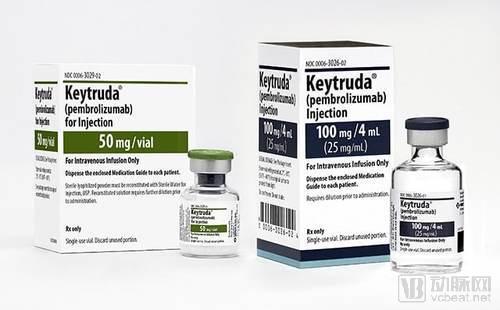
Image source: indiamart
Keytruda, known in Chinese as “pembrolizumab,” is referred to as “K drug” within the cancer patient community. Together with O drug (Opdivo), it represents one of the two most prominent anticancer agents; both share highly similar mechanisms of action and belong to the class of PD-1 inhibitors.
Keytruda is primarily indicated for locally advanced or metastatic melanoma that has progressed following first-line therapy, and it is currently the only PD-1 inhibitor approved in China for this patient population.Opdivo is primarily used for the second-line treatment of non-small cell lung cancer and was approved for marketing in China on June 15 this year.
As Merck & Co.’s “star product,” Keytruda has attracted significant attention since its approval for market launch in 2014.. This blockbuster cancer immunotherapy has demonstrated promising efficacy across multiple malignancies and is approved for the comprehensive treatment of melanoma, head and neck cancer, non-small cell lung cancer, classical Hodgkin lymphoma, bladder cancer, and gastric cancer.
On February 11, 2018, the marketing application for Keytruda was accepted by the National Medical Products Administration (NMPA) under acceptance number JXSS1800002. The drug received approval in less than six months from submission, setting a new record for the fastest approval of an imported anti-tumor biologic in China.Overall, Opdivo took 226 days from submission to approval, while Keytruda took 164 days. This indicates that with a clear regulatory pathway for PD-1 inhibitors, the market approval process in China is accelerating.
Keytruda’s launch in China primarily targets advanced malignant melanoma. Melanoma is a type of malignant tumor originating from melanocytes, commonly found on the skin, but also occurring in mucous membranes, the uvea of the eye, and other sites. Among skin cancers, melanoma has the highest degree of malignancy and is prone to distant metastasis. Once distant metastasis occurs, the overall 5-year survival rate for patients is only around 5%.
Fortunately, patients with melanoma were among the first to benefit from immunotherapy. Many of the initial cohort of patients in the United States who received immunotherapeutic agents have survived for more than 10 years, becoming “super survivors.” The most renowned case is that of former U.S. President Jimmy Carter, who was diagnosed with melanoma at the age of 90. Through a combination regimen involving pembrolizumab (Keytruda), radiation therapy, and surgery, Mr. Carter’s cancer was ultimately cured.
Fewer than 10,000 new cases of melanoma are diagnosed annually in China, classifying it as a rare tumor type. Nevertheless, the approval of Keytruda for marketing in China has brought new hope to many cancer patients in the country. With significantly superior objective response rates and overall survival compared with chemotherapy, Keytruda represents a major breakthrough in the treatment of malignant melanoma in China over the past four decades.
Moreover, the potential of Keytruda extends far beyond the treatment of melanoma. In terms of the number of approved indications worldwide, Keytruda is currently the most broadly indicated immunotherapy for advanced cancers. It has been approved in more than 80 countries, covering over 12 indications across nine cancer types, including melanoma, non-small cell lung cancer, head and neck cancer, Hodgkin lymphoma, bladder cancer, cervical cancer, gastric cancer, and B-cell lymphoma.
Keytruda’s most significant advantage lies in its indication for lung cancer, the most prevalent cancer type in China. Keytruda has already secured two first-line treatment indications for non-small cell lung cancer (NSCLC). On October 2, 2015, the FDA approved Keytruda as a monotherapy for first-line treatment of metastatic NSCLC with PD-L1 expression levels ≥50% and without EGFR or ALK gene mutations, based on data from the KEYNOTE-024 study. On May 10, 2017, the FDA approved Keytruda in combination with chemotherapy (pemetrexed plus carboplatin) for first-line treatment of metastatic non-squamous NSCLC, based on data from the KEYNOTE-021 study.
On July 2, 2018, the FDA granted priority review to the supplemental application for Keytruda in combination with chemotherapy (carboplatin plus paclitaxel or nab-paclitaxel) as first-line treatment for metastatic squamous non-small cell lung cancer (NSCLC), with a PDUFA target action date of October 30, 2018. If this supplemental application is approved, Keytruda is poised to become the standard first-line therapy for all NSCLC patients, regardless of PD-L1 expression levels. It is reported that patient enrollment for its relevant clinical trials in China has been completed, and positive results are anticipated.
In terms of pricing, according to the PD-1 drug information provided by Thailand International Hospital Singapore, the current prices are as follows: Opdivo (100 mg) costs approximately RMB 13,925; Opdivo (40 mg) costs approximately RMB 5,869; and Keytruda (100 mg) costs approximately RMB 25,420. The high cost remains prohibitive for most patients.
However, as the domestic environment for new drug R&D continues to improve, competition in China’s PD-1 antibody market has become exceptionally fierce, with numerous high-quality innovative pharmaceutical companies emerging. On April 10, Innovent Biologics resubmitted its New Drug Application (NDA) for IBI-308 (sintilimab), a PD-1/PD-L1 antibody drug. The application was accepted by the CFDA (China Food and Drug Administration) on April 19 and included in the priority review program on April 23. According to its prospectus, Innovent Biologics plans to launch sintilimab in 2019 if approved by the CFDA, with an estimated annual price of RMB 100,000. Other key players include Hengrui Medicine, BeiGene, Genor Biopharma, Livzon Monoclonal Antibody, and WuXi AppTec.
With the successive market launches of Opdivo and Keytruda, and the rapidly intensifying competition in the domestic PD-1 antibody market, it is hoped that the prices of anticancer drugs will decrease further to benefit more cancer patients.
References: BioExplorer, PharmaCube, Pineapple Factor