

Tencent Miying Launches Breast Tumor Screening AI System and Joins 'Love Lung Program' Public Welfare Initiative
On July 26, the 2018 “Internet Plus” Digital Economy China Tour · Guangdong Summit was held in Guangzhou. A reporter from VCBeat (WeChat ID: vcbeat) attended the conference and presents the following report.
At the Medical AI Forum, Tencent officially launched its breast tumor screening AI system under its AI medical solution, “Tencent Miying.” Tencent also announced that “Tencent Miying” would join the “Love Lung Project,” a public welfare medical initiative. During the conference, the renowned medical publishing company AME Publishing Company announced a partnership with Tencent to officially launch the inaugural “Global Medical AI Research Essay Competition.”
Guests including Liao Xinbo, former Inspector of the Guangdong Provincial Health and Family Planning Commission; Yun Danping, Director of the High-Tech Development and Industrialization Division of the Guangdong Provincial Department of Science and Technology; Wang Jianzhong, Deputy Director of the Healthcare Reform Office of the Shenzhen Municipal Health and Family Planning Commission; He Jianxing, President of the First Affiliated Hospital of Guangzhou Medical University; Chen Guangyu, Vice President of Tencent; and Wang Daoyuan, Publisher of AME Publishing Company, attended the summit and delivered speeches on the innovative development of “AI + Healthcare.”
Tencent’s AI medical solution, “Tencent Miying,” has officially launched an AI system for breast tumor screening, marking the first time in China that artificial intelligence has been used to differentiate between benign and malignant breast tumors and automatically generate Breast Imaging Reporting and Data System (BI-RADS) classification reports.
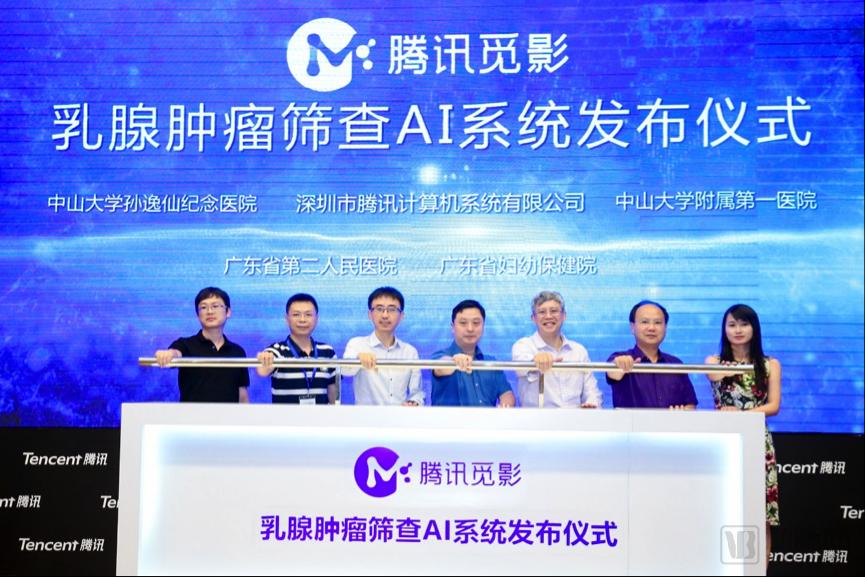
Tencent Miying Launches AI System for Breast Tumor Screening
It is reported that the “Tencent Miying” AI system for breast tumor screening was jointly developed by Tencent, The First Affiliated Hospital of Sun Yat-sen University, Sun Yat-sen Memorial Hospital of Sun Yat-sen University, Guangdong Provincial Hospital of Chinese Medicine, Guangdong Women and Children’s Hospital, Guangdong Second Provincial General Hospital, and other leading medical institutions. The system has currently entered clinical pilot trials at Guangdong Second Provincial General Hospital and more than 10 other Grade A tertiary hospitals across China. The launch of this system will help clinicians detect breast tumors more accurately and efficiently, improve the diagnostic capabilities of primary care hospitals for early-stage breast cancer, and enable patients to access medical services characterized by early screening, early diagnosis, and early treatment.
Based on large-scale, non-homologous, multi-center testing and statistical analysis, the "Tencent Miying" AI system for breast tumor screening achieved sensitivities of 99% and 90.2% in detecting breast calcifications and malignant masses, respectively. Its sensitivity and specificity for differentiating between benign and malignant breast tumors were 87% and 96%, respectively. This indicates that artificial intelligence technology holds promise as a valuable clinical assistant in early breast cancer screening, helping physicians detect breast cancer more accurately and efficiently.
Furthermore, Tencent announced that “Tencent Miying” has officially joined the “Love Lung Initiative,” a public-welfare medical project. He Jianxing, President of the First Affiliated Hospital of Guangzhou Medical University, and Chen Guangyu jointly launched the initiative to promote early screening, diagnosis, and treatment for patients with early-stage lung cancer, thereby contributing to the Healthy China strategy.
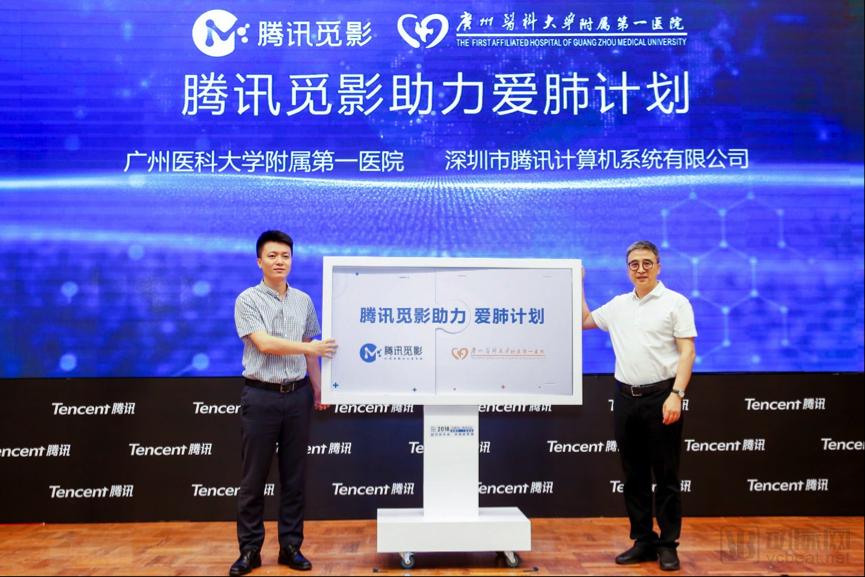
Tencent Miying Supports the “Love Lung Project”
“Lung Care Initiative” is a public welfare early-stage lung cancer screening program launched by the Guangzhou Charity Federation, Guangdong Mingyi Medical Charity Foundation, the First Affiliated Hospital of Guangzhou Medical University, and the Guangzhou Institute of Respiratory Diseases, providing free public welfare screenings to individuals aged 50 and above who are recipients of minimum living allowance, low-income assistance, or the “Five Guarantees” support.
Early-stage lung cancer often manifests as pulmonary nodules, and computed tomography (CT) is currently one of the most common methods for evaluating these nodules. However, a single CT scan typically generates more than 200 image slices, making manual interpretation time-consuming and labor-intensive. “Tencent Miying” leverages computer vision and deep learning technologies to assist physicians in image interpretation through AI-powered medical image analysis. It can precisely locate small pulmonary nodules larger than 3 mm, achieving a sensitivity of 85% and a specificity of up to 90% in differentiating between benign and malignant nodules.
Following its collaboration with the “Love Lung Project,” Tencent Miying’s early lung cancer screening capabilities are expected to assist participating hospitals in screening high-risk populations, thereby improving diagnostic accuracy and efficiency while alleviating physicians’ workload in image interpretation.
Meanwhile, Tencent has partnered with the renowned medical publisher AME Publishing Company to officially launch the inaugural “Global Medical AI Research Essay Competition.” The initiative aims to promote the implementation and adoption of AI technologies in healthcare by encouraging physicians to share exemplary AI usage experiences, focusing on practical application scenarios such as AI-assisted decision-making for disease prediction and data analysis.
It is reported that the competition will select outstanding medical AI research papers for publication in either the Journal of Medical Artificial Intelligence (JMAI), a journal co-sponsored by AME and Tencent, or Annals of Translational Medicine (ATM), an SCI-indexed journal under AME. This initiative aims to facilitate global peer learning and exchange, advance disease treatment technologies, and ultimately benefit patient health.
Among them, the Journal of Medical Artificial Intelligence (JMAI) is the second international English-language academic journal in the field of artificial intelligence. It focuses on interdisciplinary perspectives on medical AI, publishing articles on new research and innovative ideas from the field, with the aim of showcasing the latest advancements to researchers.
At the conference, Tencent Vice President Chen Guangyu emphasized that in the future, Tencent will further innovate its “AI + Healthcare” development model, actively embrace openness, and collaborate with all stakeholders in the medical community to build an AI medicine partnership ecosystem. This effort aims to promote balanced development of medical services across China and make greater contributions to the “Healthy China” strategy.