

Lingke Internet Hospital Leverages Big Data to Advance 'Internet + Healthcare' in Collaboration with Yinchuan Health Commission
On July 27, the Advanced Symposium on Big Data-Driven Development of “Internet + Healthcare” was held in Yinchuan. At the event, LinkDoc Technology signed a strategic cooperation agreement with the Yinchuan Big Data Management Service Bureau, paving the way for in-depth collaboration in the field of medical big data.
Meanwhile, Yinchuan LinkDoc Internet Hospital signed strategic cooperation agreements with the Yinchuan Municipal Health and Family Planning Commission and Aiyi Chuandi Remote Technology to introduce expert resources to Yinchuan, and entered into an agreement with Yinchuan First People’s Hospital on information technology infrastructure related to “Internet + Healthcare.” The signing parties aim to promote the healthy development of China’s healthcare industry by supporting Yinchuan in establishing a national Internet hospital hub and a National Health and Medical Big Data Center.
 ZeroKr Technology Signs Strategic Cooperation Agreement with Yinchuan Big Data Management Service Bureau

Yinchuan LinkDoc Internet Hospital, Yinchuan Municipal Health and Family Planning Commission, and iCare Sign Strategic Cooperation Agreement
 Yinchuan LinkDoc Internet Hospital Signs Strategic Cooperation Agreement with Yinchuan First People's Hospital
Since proposing the construction of a smart city in 2013, Yinchuan has prioritized the layout of “Internet Plus,” actively advancing the development of Smart Yinchuan. Leveraging its big data center as a foundation, the city has vigorously cultivated the “Internet Plus Healthcare” industry.
As the first unicorn enterprise in China’s medical big data and artificial intelligence sector, LinkDoc Technology has remained dedicated to leveraging technologies such as big data and AI to establish an intelligent data processing system. It is committed to transforming data into the foundational infrastructure of China’s new healthcare ecosystem, thereby driving transformation in the healthcare and pharmaceutical industries.
The signing of these three strategic cooperation agreements, closely following the recent “Internet + Healthcare: Convenient and Beneficial Services for the Public” policy initiatives, has officially ushered in a new round of implementation and practical exploration of internet-based healthcare in Yinchuan.
Policy Benefits, Regulation First
Policy serves as the fundamental guarantee for the development of an industry. For the internet healthcare sector, April 28, 2018, was a date of exceptional significance, as the General Office of the State Council officially released the “Guiding Opinions on Promoting the Development of ‘Internet + Healthcare,’” ushering in long-awaited new prospects for internet healthcare.
Big data, which is closely related to internet healthcare, entered a year of standardization in 2018 after experiencing four stages: the emergence of the concept, top-level design, policy refinement, and industry incubation.
Against the backdrop of favorable policies, internet healthcare is continuously unlocking the supply potential of high-quality medical resources, making medical services more accessible. Despite the promising outlook, Professor Sun Dongdong from the Law School of Peking University points out that risks associated with “Internet + Healthcare” at both the national policy/regulatory and supervisory levels cannot be overlooked. “Clear policies coupled with a lack of specific legislation can easily lead to a series of problems. The urgent priority is to start from the ground up, progressing from the formulation of technical standards to institutional rules and regulations, and finally to administrative laws.”
Ma Yuan, Deputy Director of the Enterprise Research Institute at the Development Research Center of the State Council, also believes that the entire internet healthcare industry suffers from inadequate regulatory follow-up. This stems partly from concerns that internet hospitals could disrupt physical hospitals, as well as from apprehensions about the difficulties in effective regulation.
As a national hub for internet healthcare, Yinchuan did not initially possess obvious advantages in developing this sector. Wang Chuan, Director of the Yinchuan Big Data Management and Service Bureau, stated that this “low starting point” compelled Yinchuan to innovate in both policy frameworks and regulatory measures, thereby forging a path for internet healthcare development with distinct Yinchuan characteristics.
During this period, Yinchuan established China’s first internet hospital base, launched the country’s first regulatory platform for internet hospitals, explored the introduction of commercial health insurance, and formed a closed-loop industry chain integrating “medical care,” “pharmaceuticals,” and “insurance.” These initiatives have achieved significant results.
In fact, the full-process recordability and traceability of online diagnosis and treatment provide better conditions for innovation in regulatory systems. Once regulation is effectively implemented, internet healthcare can even be more efficient, higher in quality, and more controllable in safety than traditional models.
Innovative Technologies Drive the Implementation of Internet Healthcare Models
Regarding internet healthcare, Lu Qingjun, Director of the National Health Commission’s Telemedicine Management and Training Center, believes that current internet healthcare is at risk of being overhyped, with issues such as “prioritizing equipment over applications” and a lack of top-level design and established mechanisms and models.
Meanwhile, he emphasized that internet thinking must be integrated with the realities of healthcare. Healthcare is not a commodity and is not determined by market forces; rather, it is governed by relevant policies formulated by the government. As a service model, telemedicine complements and synergizes with internet-based healthcare, facilitating the practical implementation of internet healthcare services.
Big data, AI, and cloud computing are key drivers propelling the future evolution of internet-based diagnosis and treatment toward “internet-enabled health promotion and medical consultation,” serving as both foundational resources and accelerators. Furthermore, in the process of implementing the “Internet + Healthcare” policy, the exploration and application of data-driven internet healthcare models will emerge as a new force and an integral component of the entire healthcare supply system.
LinkDoc Technology is a typical technology-driven enterprise. Leveraging its years of data processing capabilities and high-quality data assets, LinkDoc has innovatively applied big data to the practical implementation of internet healthcare models, achieving remarkable results.
Due to the inherent difficulty and complexity of treating tumors, coupled with the relative concentration of current medical resources, cancer patients in China predominantly seek care at key Grade 3A hospitals in first-tier cities such as Beijing, Shanghai, and Guangzhou (as shown in the figure below). With advancements in healthcare, the survival period for tumor patients is continuously extending. This necessitates that patients receive not only professional treatment within hospitals but also specialized and meticulous rehabilitation and convalescent care after discharge.

Migration Map of Cancer Patients Seeking Medical Care in China
In 2016, an authoritative study presented at the ASCO Lung Cancer Special Session demonstrated that patients who received timely, regular, and precise post-discharge rehabilitation guidance via the internet had a 26% higher survival rate than those who received untimely and irregular guidance through traditional methods.
Therefore, if cancer patients and their families can receive timely, regular, and precise rehabilitation care and guidance, patient survival rates will be significantly improved.
To this end, LinkDoc has launched an internet hospital centered on precision diagnosis, treatment, and rehabilitation, leveraging its proprietary oncology big data.
ZeroK Internet Hospital, leveraging its proprietary big data platform and resource advantages, has developed a unique, big data-driven, patient-centered system for precision diagnosis, treatment, and rehabilitation.
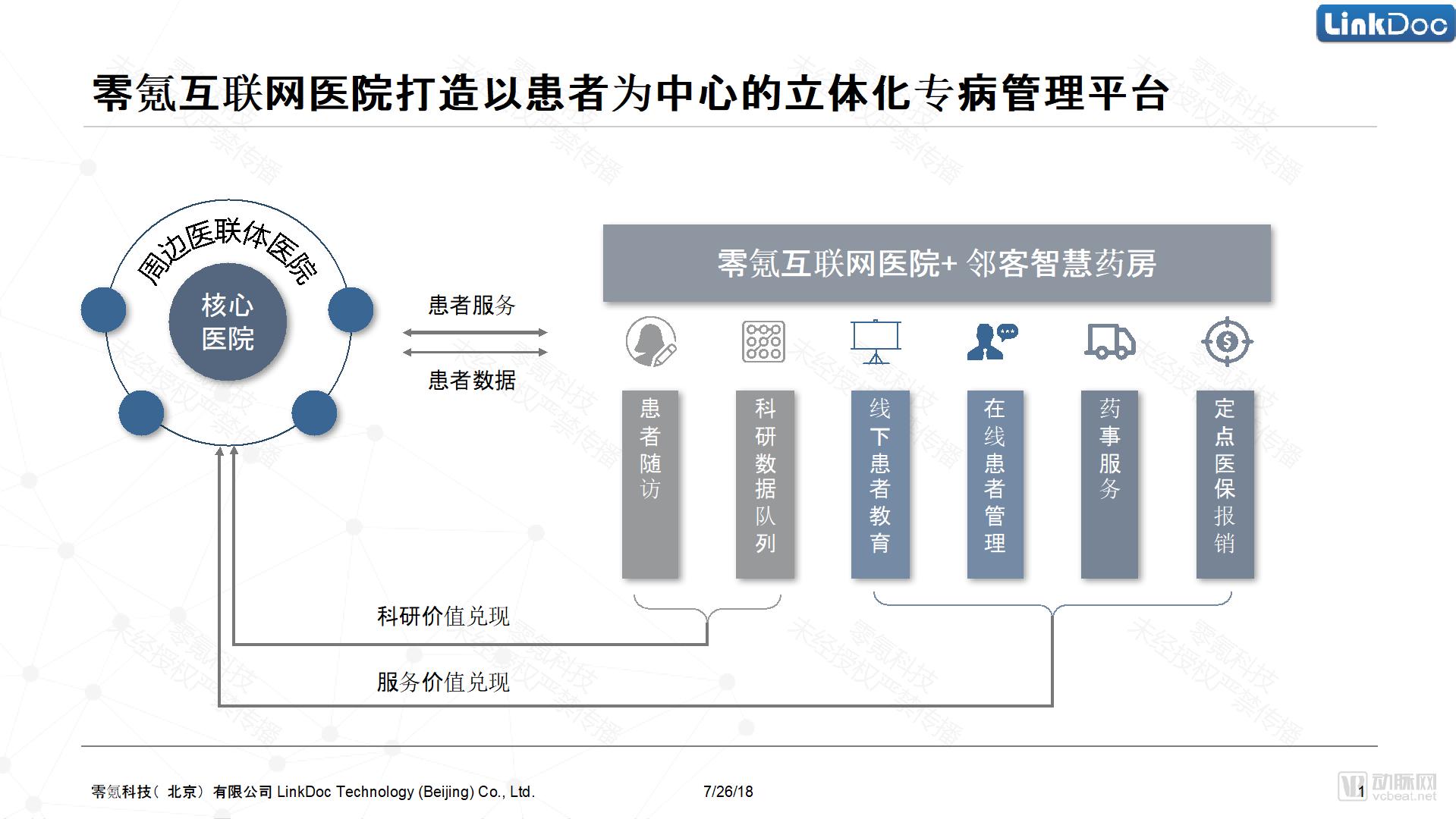
Lingke Internet Hospital has established a patient-centric medical and rehabilitation service model. Its comprehensive service system is structured into three phases: patient acquisition, basic services, and advanced services. This framework guides patients from initial traffic sources through trust-building via basic services, ultimately achieving commercial conversion through advanced services, thereby ensuring the scalability and sustainability of the overall business.
Ding Lihua, COO of LinkDoc Technology, introduced that Yinchuan LinkDoc Internet Hospital, as one of the first institutions to obtain a national internet hospital license, has leveraged LinkDoc’s proprietary big data platform and resource advantages to explore a patient-centered precision diagnosis, treatment, and rehabilitation service system. This has given rise to the “LinkDoc Model,” which encompasses a comprehensive suite of services ranging from cancer science popularization and precise patient education to convenient online clinical consultations, one-stop professional pharmaceutical care, intelligent and multi-dimensional follow-up services, and specialized adverse event management. Moving forward, this model will continue to be refined and validated by the market.
Moreover, the successful implementation of internet-based healthcare relies not only on technological drivers but also critically on the payment role of medical insurance.
Wang Yan, Research Director at the China Insurance and Pension Research Center of Tsinghua University’s PBC School of Finance, stated that the advent of an aging population has posed new challenges to healthcare financing. Currently, basic medical insurance is under significant pressure, while commercial health insurance coverage remains low. To develop commercial health insurance, it is necessary to overcome issues such as its weak bargaining power with healthcare institutions, unreasonable product design, and severe homogenization. Establishing an integrated model of insurance and medical services, and leveraging big data analytics to provide management recommendations, will represent a new pathway for the future development of commercial health insurance.