

Florence, the Fastest-Growing Clinical Trial Platform, Files IPO Prospectus Exploring Blockchain Integration in Clinical Research
According to a research report by Grand View Research, the global EDC market is projected to reach $1.16 billion by 2025. Given that the average development cycle for new drugs exceeds ten years, pharmaceutical companies and CROs place greater value on the ability of EDC systems to shorten decision-making timeframes, thereby accelerating drug development, rather than merely on cost savings.
Furthermore, with the advent of the era of precision medicine, where drugs target very specific diseases or those identified by genetic markers, the complexity of clinical trials has increased threefold. Without automated software, conducting clinical trials would be virtually impossible. To date, Electronic Data Capture (EDC) systems have seen the most robust development in North America, with an adoption rate as high as 90% among clinical research institutions abroad. This is primarily due to the higher level of awareness regarding EDC systems and the stringent regulatory standards for clinical data management in the United States.
Major players have already entered the market, such as Oracle, which competes fiercely with Medidata Solutions, and PPD’s BioClinica. Although the market is substantial, capturing a share of it is akin to snatching food from a tiger’s mouth.
Florence has managed to capture attention in the EDC market primarily by riding the wave of blockchain hype, and secondarily by already having 2,000 clinical trial sites on its platform. Florence completed its first round of financing in 2016, raising $1.7 million.
Founded in 2014, Florence partners with innovative clinical trial sites to eliminate delays in site-based clinical trial operations through user-friendly and adaptable software. The demand for electronic data capture is substantial; while other healthcare sectors are moving toward integrated digital workflows, clinical trials have remained stagnant, still relying on binders and fragmented electronic systems.
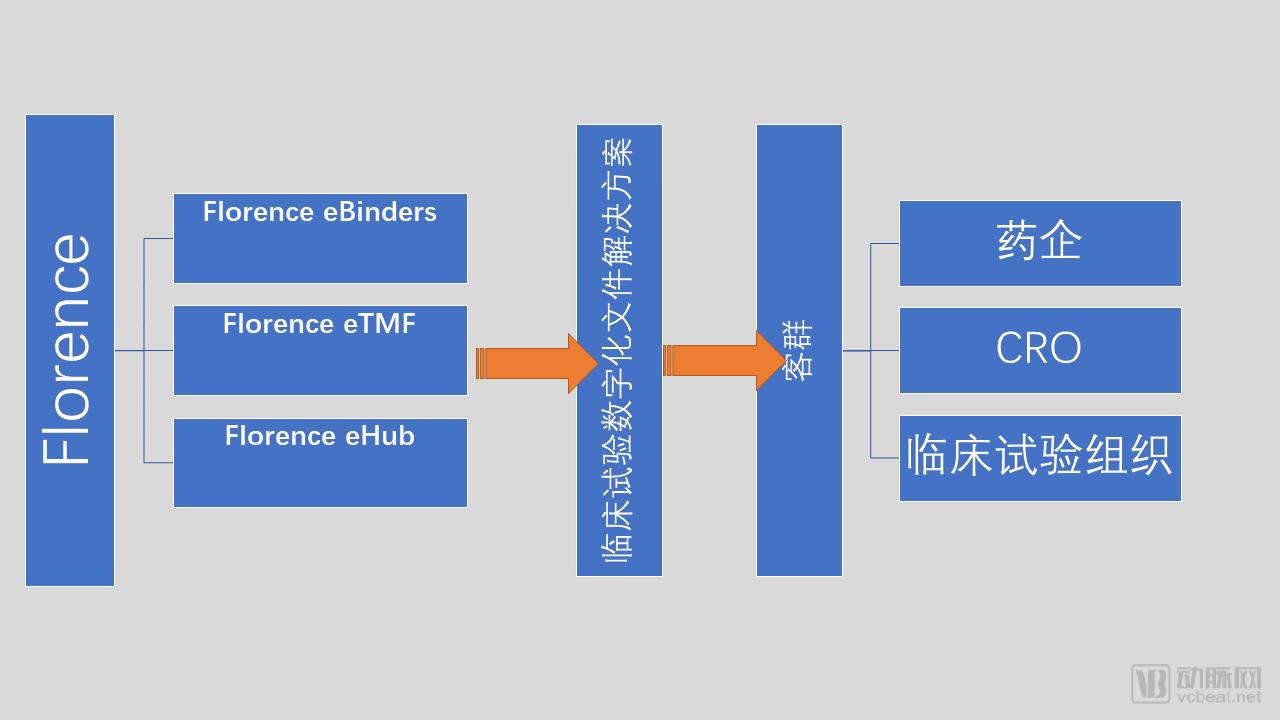
The company’s product portfolio primarily includes Florence eBinders, Florence eTMF, and Florence eHub. Florence eBinders accelerates clinical trial workflows through leading digital management solutions, digital resource management solutions, and contract management solutions. It eliminates the need to send mail and emails to clinical trial sites, as well as the need to create clinical trial documents and protocols.
Adoption of eRegulatory and eSource solutions progressed slowly in 2015 and 2016, as major clinical trial sites waited to see whether the technology would deliver a proven return on investment. As the positive impact of early adopters’ use of Electronic Data Capture (EDC) systems became increasingly evident, the industry began to take action. In 2017, the number of clinical trial sites using Florence grew by nearly 300%.
Clinical research organizations that have fully adopted Florence’s eBinders have reported a 20% average acceleration in study startup times and a 40% reduction in document cycle times—enabling clinical trial sites to expand their study capacity without increasing operational staff. These data are sourced from Florence’s official website, and clinical trials currently using the Florence system span more than 600 major therapeutic areas.
For pharmaceutical companies and clinical trial sites using Florence eHub, Florence’s solutions bridge the gap between clinical research organizations and pharmaceutical enterprises, reducing study startup times by up to 25 days. This efficiency can save millions of dollars and accelerate the market launch of new drugs or devices, ultimately saving lives.
In the field of new drug development, which typically takes more than 10 years and costs over $1 billion, the greatest value that EDC can provide lies in reducing the development cycle. Furthermore, sponsors can minimize compliance risks by establishing permanent digital connections with their investigative sites, enabling immediate measurement and response to compliance issues.
In April 2018, Florence announced that over 2,000 clinical trial sites were using Florence’s eBinders to accelerate clinical trial research, while also leveraging eRegulatory and eSource.
Last year, Florence announced a partnership with blockchain asset custody firm Verady to develop healthcare blockchain applications aimed at advancing medical and clinical research. Verady’s application programming interface (API) will provide an easy-to-use, standardized Representational State Transfer (REST) interface, abstracting away the complexities of blockchain technology for Florence’s customers. The partnership will collaborate with several pharmaceutical companies to develop open-source blockchain applications for managing patient and clinical trial data.
Florence is the fastest-growing workflow tool in clinical research, managing patient and trial data for thousands of clinical researchers and trial sponsors. The technology developed by Verady makes asset-backed transactions via blockchain easier and more secure.
Florence CTO Andre Garcia stated in a press release, “The Florence-Verady collaboration enables clinical research organizations and pharmaceutical companies to exercise greater control over patient data via blockchain. Patient and clinical trial data managed through the Verady API allow research teams to leverage vast amounts of patient data while respecting patients’ rights.”
The ability to consolidate vast amounts of information without compromising privacy, security, or transparency represents a significant leap forward that will help streamline the collection, storage, and submission of clinical data. This can substantially reduce the resources required to manage clinical trials. Imagine a scenario in which researchers conducting one clinical trial have access only to specific health data relevant to their study, while another group of researchers accesses a distinct set of data pertinent to a separate trial. Clinical trial sites can verify that the data originates from their enrolled participants, while subjects (and their physicians) can view all their medical record data derived from office visits, wearable devices, and patient-reported outcomes. All of this can be achieved without sacrificing patient privacy.
IBM conducted a survey predicting that by 2020, the majority of healthcare executives would make significant investments in blockchain technology. Among the eight major blockchain-in-healthcare application scenarios summarized in the “Healthcare Blockchain Industry Report” released this March by VCBeat’s VBInsight, one is clinical trials.
An article published in the Journal of Health Economics in 2016 reported that pharmaceutical companies spent over a decade and $2.6 billion to bring a single drug to market. This demonstrates that the costs, efforts, and time required for drug development are difficult to quantify. A significant portion of these costs stems from overly complex multi-institutional administrative and clinical trial management issues. Leveraging blockchain technology can facilitate the review and management of experimental data derived from multiple trial sites and patients, thereby reducing the costs associated with multicenter clinical trials.

Florence Founder Ryan Jones
Florence’s CEO and founder, Ryan Jones, graduated from Dartmouth College and holds an MBA from the University of California, Berkeley. Prior to joining Florence, Ryan served as President of Pubget, a research platform serving clinicians at more than 600 hospitals and research institutions worldwide, which was acquired by the Copyright Clearance Center.
Ryan joined Pubget from Microsoft’s Enterprise Search Group, where his primary achievement was helping websites leverage search technology to make information understandable and accessible. Prior to Microsoft, Ryan analyzed enterprise software investments at the venture capital firm Commonwealth Capital Ventures and developed technology market strategies at the Yankee Group. His presentations have been cited by The New York Times, The Wall Street Journal, and Harvard Business School Press.
Co-founder Andres Garcia previously served as a product manager at VMware AirWatch, which is dedicated to providing enterprise mobility management solutions. A graduate of the University of Cantabria, Andres Garcia spent ten years working at AGCO Corporation. He is passionate about leveraging technology to solve everyday problems.
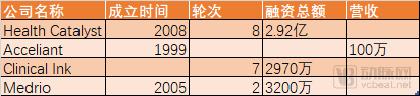
Data source: Crunchbase. Unit: USD
Health Catalyst
Health Catalyst is addressing healthcare data warehouse challenges for some of the top medical systems in the United States. The company has raised a total of $292 million across eight rounds of financing.
As the transition from paper-based to electronic records accelerates, organizing health data, understanding it, and completing documentation promptly have become significant challenges. Catalyst helps organize, standardize, and link data from diverse systems. Leveraging robust metadata capabilities, users—including those without technical expertise—can easily search and retrieve this information.
This enables you to leverage your data for complex operational, financial, clinical, and research reporting needs—empowering you to rapidly deliver the answers everyone seeks.
Acceliant
Acceliant provides eClinical trial solutions to global CROs, pharmaceutical companies, and medical device manufacturers.
Acceliant provides real-time, integrated clinical trial solutions for life sciences companies, CROs, and pharmaceutical firms, offering tools and expertise to facilitate informed decision-making. Its eClinical suite enables users to build studies, design electronic Case Report Forms (eCRFs), capture data from multiple sources via Electronic Data Capture (EDC), collect data directly from patients through electronic Patient-Reported Outcomes (ePRO), and manage other clinical data management functions. The company currently generates approximately $10 million in revenue.
In February this year, Acceliant announced a partnership with the clinical research organization ClinneX Partner to accelerate clinical trial research. Through this collaboration, ClinneX will leverage Acceliant’s enhanced capabilities—such as multi-trial management, randomization, role-based access control (RBAC), drug supply management, SDTM, medical coding, document management systems, and eCRF development—while optimizing its clinical data management products.
Clinical Ink
Develop electronic document recording software for capturing source data on mobile devices during clinical trials. Clinical Ink provides eSource solutions for the clinical trial industry. It offers an electronic source solution, SureSource, which allows users to record annotations, explanations, and source data verification on protocol-specific eSource documents, while capturing data required by the protocol. The company also provides an Electronic Source Record (ESR) to deliver cleaner data for clinical trials. Additionally, it offers hosting services. Founded in 2006, Clinical Ink is headquartered in Winston-Salem, North Carolina.
After seven rounds of financing, Clinical Ink has raised a total of $29.7 million.
Clinical Ink provides real-time access to complete, high-quality data. SureSource captures both source data and eCRF study data, significantly reducing the errors and time delays associated with traditional EDC and paper-based source processes. Using SureSource during patient visits prevents data errors and ensures that sites always adhere to the latest protocol, providing real-time access to high-quality study data.
SureSource enables clinicians to capture study data easily and effectively during patient visits. To emulate the simplicity of paper, SureSource utilizes electronic tablets, eliminating the time and cost burden associated with transcribing paper source documents into an Electronic Data Capture (EDC) system later. Independent survey data consistently shows that over 90% of sites prefer SureSource to paper documentation because it enhances site efficiency—helping to improve protocol adherence and reduce errors.
BioClinica, Inc.
BioClinica is a global leader in providing integrated, technology-enabled clinical trial management services. BioClinica supports pharmaceutical and medical device innovation with imaging core laboratories, internet-based image transmission, electronic data capture, interactive voice and web response systems, clinical trial management, and clinical supply chain design and optimization solutions. Its services maximize efficiency and manageability across all stages of the clinical trial process. With over 20 years of experience and more than 2,000 successful trials, BioClinica has supported the clinical development of numerous new drugs through to final approval. The company operates state-of-the-art, compliant imaging core laboratories on two continents and provides eClinical and data management services to clients across the United States, Europe, and Asia. Annual revenue is approximately $201.8 million.
Medrio
Medrio provides advanced Electronic Data Capture (EDC) and eClinical tools for complex clinical trials. Built on a unified platform, Medrio delivers faster, more cost-effective, and streamlined solutions compared to its competitors. Since 2005, Medrio has been developing a true SaaS solution for data management in clinical trials. Headquartered in San Francisco, California, Medrio empowers users with control through its intelligent, forward-thinking, and ecosystem-driven products.
The EDC market holds significant potential for future development. Driven by technological advancements in eClinical solutions, the market is experiencing rapid growth, which is expected to create future growth opportunities for the industry. Furthermore, increased awareness of EDC solutions is anticipated to stimulate demand in the near term. In addition, government organizations such as the Agency for Healthcare Research and Quality (AHRQ) and the Office of the National Coordinator for Health Information Technology (ONC) are promoting the adoption of electronic systems for data management. These factors are poised to drive the adoption of EDC systems among pharmaceutical companies.
Grand View Research's research report identifies several major trends in the future development of the EDC market:
1. As large pharmaceutical companies increasingly adopt the software, this segment is expected to witness lucrative growth.
2. The cloud computing segment is expected to achieve the fastest growth, as it enables remote data access and provides greater storage capacity.
3. Driven by the rising R&D expenditures of pharmaceutical companies in new drug development, the Phase I clinical trial stage is projected to register the fastest compound annual growth rate (CAGR) during the forecast period.
4. CROs accounted for the largest revenue share in EDC systems, driven by rising demand from key players in the medical device industry.
5. The EDC system market in the Asia-Pacific region is projected to exhibit the highest growth rate, driven by the presence of numerous outsourcing companies offering cost-effective eClinical solutions.
6. The market is facing intense competition, as numerous organizations offer technologically efficient solutions for clinical data management. Companies are adopting strategies such as mergers and acquisitions, new product development, and distribution channel expansion to gain a competitive advantage.