

Becoming a HIT Disruptor? Alibaba's DingTalk Deserves More Time
In April, as the excitement from CHINC was just beginning to fade, Ye Shi urged the Alibaba DingTalk team to start preparations for the CHIMA conference in July. “Ye Shi” is merely his nickname; his real name is Wang Hongshuai, a veteran of the internet industry. Five years ago, he joined Alibaba and inadvertently entered the healthcare sector. At that time, nearly all hospitals across China kept their information systems on closed intranets, completely isolated from the internet. Interconnectivity was nothing more than a slogan within the industry.
Sudden entrants often lack a foundation of trust, and Alibaba was no exception. During that period, Ye Shi repeatedly deliberated with a certain hospital on plans to integrate their internal and external networks. After more than ten attempts, they finally secured approval from the Director of the Information Department, security experts, and the vice president in charge. However, at the hospital’s executive meeting, the proposal was vetoed by the hospital president with a single vote, on the grounds that it was “unsafe!” Thus, Alibaba’s healthcare initiative got off to a start under extremely difficult circumstances.
Faced with misunderstanding and resistance, Ye Shi resolutely assumed the role of Head of the Healthcare Industry for the DingTalk Business Unit in 2016, marking the beginning of DingTalk’s journey in the healthcare sector. At the 2018 CHIMA Summit, which gathered numerous health IT vendors, a casual glance across various company booths would reveal the presence of DingTalk. Within just two years, its “Future Hospital Initiative” had already begun to show significant promise.
What is DingTalk?
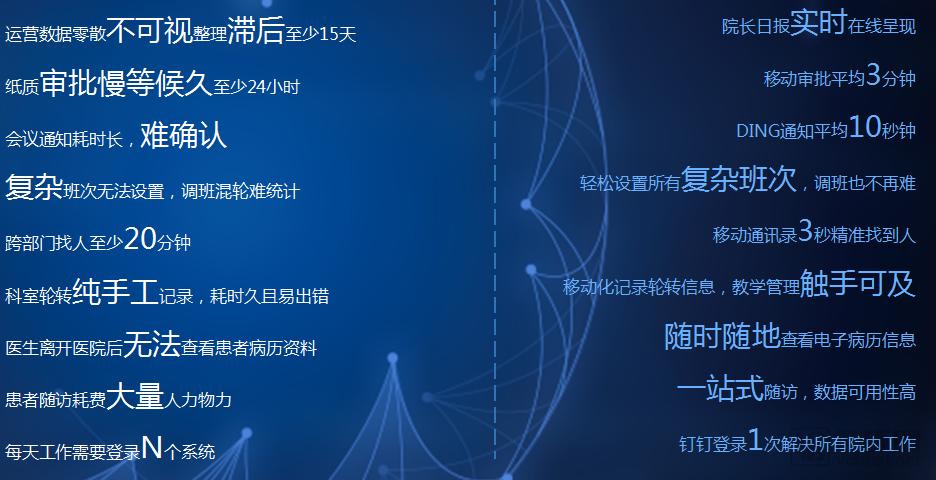
This slide is sourced from Alibaba DingTalk’s product introduction. After two years of quiet dedication, Ye Shi and his team identified nine major pain points in hospital information systems and built DingTalk’s proprietary model around them. “One platform, a unified gateway, enabling efficient, convenient, and secure handling of all hospital operations—infusing warmth into hospital work and ensuring every individual’s efforts are recognized…” Ye Shi and Alibaba DingTalk aim to create an entirely new way of working for hospitals.
What is DingTalk?
Definitions of DingTalk vary across the industry. Some consider DingTalk an OA (Office Automation) system, but it differs significantly from traditional OA solutions. The most well-known in the industry is the OA system under Hongfan.
After more than a decade of refinement, Hongfan iOffice.net has evolved from initially meeting hospitals’ administrative office needs (traditional OA) to integrating regulatory requirements from health authorities and numerous industry-specific applications, becoming the hospital integrated business management platform with the largest number of case implementations. In comparison, DingTalk is more akin to a communication and collaboration platform centered on organizational structure, with its OA features being more lightweight and configurable.
Some people view DingTalk as a chat tool similar to WeChat, yet there are differences between the two. WeChat is a social platform centered on individual nature, whereas DingTalk is designed around organizational dynamics. Compared to the former, DingTalk places greater emphasis on efficiency, collaboration, and security.
Therefore, DingTalk always offers features not found in WeChat, such as read/unread receipts, various conference calls, video meetings, and live streaming. It enables hospital internal groups and departmental groups to synchronize with the organizational structure, ensuring that all group members are current employees and safeguarding the security of internal communications within the hospital.
Some also view DingTalk as akin to the Apple App Store, given that its application center hosts over 200 apps. However, the key difference lies in their positioning: one is purely consumer-oriented (to C), while the other is business-oriented (to B). DingTalk serves not only as a platform but also empowers other Independent Software Vendors (ISVs) serving hospitals with its internet product philosophy, ensuring consistency in performance and user experience.
Thus, whenever Ye Shi spoke about DingTalk, he urged people not to define the product through traditional lenses. In his view, DingTalk is a fully innovative, independently owned enterprise-grade internet product with proprietary intellectual property rights. Even on a global scale, it is difficult to find any comparable counterpart.
Future Hospital Plan
In the first half of 2018, Alibaba DingTalk officially launched the “Future Hospital Initiative.” Ye Shi’s inner voice told him, “This will be a highly disruptive innovation in the history of Health Information Technology (HIT).”
In traditional HIT project construction, enterprises spend the majority of their time on sales and promotion, followed by phases such as on-site assessment, implementation, development, and acceptance with final payment. Driven by a software-sales-oriented model, subsequent services like upgrades and iterations are handled passively by these enterprises. Ye Shi has heard hospital administrators mention this situation more than once.
On one occasion, a hospital procured a Hospital Information System (HIS), during which the software vendor’s sales representative visited the hospital three times. Given the high level of importance attached to the project, the hospital director and department heads presented requirements spanning more than ten pages. The seasoned sales manager responded fluently to the leadership’s inquiries. However, after the bidding process concluded and technical personnel were deployed on-site for implementation, the hospital was shocked to discover that there had been virtually no handover between the various departments of the vendor company throughout the entire implementation process. Moreover, there was often a vast disparity between the sales and product teams’ understanding of user needs.
The essence of the internet lies in the relentless pursuit of product excellence and authentic user experience. Ye Shi aims to bring this consumer-grade dedication to user experience, typically seen in B2C internet companies, to the B2B sector. He is convinced that sales-driven models are destined to become obsolete, and that next-generation enterprise internet SaaS products will ultimately revolutionize the healthcare industry.
Enterprise-grade SaaS means that DingTalk’s sales model relies on free or low-cost annual subscriptions, rather than one-time transactions. Hospitals can try the product before paying, and migration costs are virtually zero.
“We are not in the business of selling software; rather, we aim to ensure that hospitals can truly leverage our products effectively. To this end, we assign dedicated specialists to work closely with hospital management and various departments, providing hands-on training to demonstrate the value DingTalk brings to each individual,” said Ye Shi.
Xu Jie, Director of the IT Center at the Second Affiliated Hospital of Zhejiang University School of Medicine, is also one of the many advocates of DingTalk. At the CHIMA Summit, he summarized the four major issues existing in current healthcare information technology products:
1. The cycle is slow, with delivery times potentially stretching from several months to even a year. Corporate services are reactive; unless hospitals explicitly raise demands, companies will not proactively address issues.
2. High costs. Health IT vendors often assign dedicated teams or project managers to address hospital requirements. However, each request submitted by a hospital undergoes cost assessment, and issues are resolved only after payment is received. Even for simple interface integrations, health IT companies may impose charges under various pretexts.
3. Staff Turnover. The most prevalent challenge in hospital IT projects is the instability of vendor teams. For instance, a single project may see four different project managers assigned from initiation to completion. Development staff are also prone to turnover; large IT firms drive up labor costs for IT professionals in major cities such as Beijing, Shanghai, Guangzhou, and Shenzhen. Without sufficient funding, enterprises struggle to retain talent.
4. Uncontrolled Requirements. Since hospital projects are often team-based, customized products, enterprises may rapidly implement hospital requirements in software versions to ensure quick delivery. Due to tight schedules, projects are rushed into launch and acceptance, which can lead to potential issues in later-stage operations and maintenance.
In Xu Jie’s view, hospitals have long been silently enduring the status quo, creating a vicious cycle. Healthcare informatization should embrace internet thinking, and the industry needs an open, shared, unified portal platform capable of truly fulfilling the expectation of migrating hospitals’ internet-based needs to mobile platforms. DingTalk is precisely such a platform product.
Western Assistance Program
“Coordination and sharing of information is an inevitable challenge for modern enterprises, hospitals, and healthcare service systems today. The primary reason why hospitals in western China lag behind those in coastal regions was inconvenient transportation. Now that transportation issues have been resolved, poor information flow has become a new persistent obstacle hindering development in the west,” said Wang Youcai, former Deputy Director of the Statistical Information Center of the National Health and Family Planning Commission and Chairman of CHIMA, at the 2018 CHIMA Summit.
In response, Alibaba DingTalk launched the “DingTalk Future Hospital Product and Western Region Hospital Assistance Program.” This initiative aims to help assisted hospitals in western Chinese cities obtain the DingTalk mobile office platform and a suite of mobile applications—including Medical Management Cloud, scheduling management, and daily dean’s reports—free of charge, through pro bono lectures, centralized training, and free deployment of mobile applications, thereby enhancing management efficiency and informatization capabilities.
It is understood that the DingTalk Future Hospital product suite and the Western Region Hospital Assistance Program include outstanding applications available on the DingTalk platform, such as “Lianfan Scheduling” provided by Hangzhou Lianfan, “Medical Management Cloud” provided by Shanghai Wanhu, and “Management Daily Report” provided by Guangzhou Yibo. These solutions cover various aspects of daily hospital operations and management, including staff scheduling, document workflow, meeting management, and management reporting.
In the future, DingTalk’s Future Hospital product will be prioritized for hospitals in western China. In addition to being offered free of charge, a series of initiatives and arrangements will be implemented, including offline free clinics, academic lectures, practical deployment of DingTalk’s free applications, and centralized training. The first pilot cities for the Western Hospital Assistance Program are Ningxia and Guizhou.
Achievements of Tongren City
Located in western Guizhou Province, Tongren City, with a total population of 4.406 million, is renowned as the “Eastern Gateway of Guizhou.” Yang Weiquan, Director of the Tongren Municipal Health and Family Planning Commission in Guizhou Province, was first introduced to DingTalk in 2016. With his support, it took less than two weeks for DingTalk to be implemented and rolled out across the city’s entire healthcare system.
Today, nearly a thousand healthcare institutions in Tongren City are using DingTalk. According to Yang Weiquan, locating personnel across departments used to take at least 20 minutes; now, it can be done precisely in just three seconds. “DingTalk has facilitated our work and improved our efficiency, allowing us more time to think about and conduct research.”
In 2017, Tongren City established 18 county-level medical communities. The Tongren Municipal Health and Family Planning Commission integrated county-level hospitals, township health centers, and village clinics to form these medical communities, achieving unified administrative management, personnel management, financial management, operational management, performance evaluation, and procurement.
In terms of two-way referrals, patients with common diseases are typically diagnosed and treated at township health centers. If their condition is severe, they are referred to the lead hospital for treatment; once their condition stabilizes, eligible patients are promptly referred back down to the township health centers. The lead hospital collaborates with provincial and municipal hospitals through mechanisms such as medical consortia. This complex two-way referral process is also facilitated by DingTalk.
According to Yang Weiquan, Tongren City has established an online center at county-level hospitals and set up offline personnel management offices. By creating DingTalk referral work groups, the city has achieved fully online communication throughout the entire process, enabling efficient, eco-friendly, and traceable report management. Precise report analysis has significantly enhanced patients’ sense of gain in accessing medical care.
Previously, home visits by family doctors involved a heavy workload and yielded limited effectiveness. During follow-ups, doctors primarily relied on paper records, which prevented team members from sharing information. With the adoption of DingTalk, doctors can now enable residents requiring follow-up care to record their data via mobile devices. Team members can also share this data and integrate it into the resident’s follow-up records, thereby facilitating performance evaluation.
Tongren People’s Hospital in Guizhou Province, a century-old institution nestled in the mountainous region, has relocated to a new campus. Vice President Li Chen expressed his hope that, alongside hardware upgrades, the hospital’s informatization could catch up with the levels seen in eastern and central China. “In the past, obtaining approval for any matter was cumbersome: I had to sign off after the department head, and then the president had to sign as well. With the introduction of DingTalk, the approval process has been significantly optimized.”
DingTalk’s group chat feature is the most frequently used function by Director Li. Since messages are visible to all members, any message posted in a DingTalk group cannot be ignored by others. According to Director Li, many hospital staff now appreciate DingTalk’s attendance tracking system, as it reflects physicians’ workloads and ensures that leadership can recognize everyone’s hard work.
Cloud-Based Ecosystem
As Director Xu Jie stated, what does the future of healthcare informatics hold? Judging by current industry development trends, the migration of various business systems to the cloud is poised to reshape the existing ecosystem. All hospital information technology products, whether deployed on private or public clouds, can achieve seamless interoperability and data exchange. For hospitals, when adopting an application, there is no need to worry about its underlying cloud infrastructure; the user experience is paramount. All requirements will be met instantly through interconnected systems. Delivering an exceptional user experience will become a shared pursuit of Alibaba DingTalk and its ecosystem partners.