

Quartet Health: Building a Mental Health Cloud Platform from Primary Care EHRs with Backing from the Kennedy Family

Quartet Health
Mental Health Service Platform Operator
As we come to realize that the brain is nearly the most complex entity in the known universe, a hundred-billion-dollar market spanning from physical health to mental well-being awaits exploration.
Amid the mental health needs of 250 million people, VCBeat has recently launched a special series on the Mental Health Industry, examining challenges and opportunities from enterprises to markets, and from China to overseas. IWe will conduct a comprehensive scan of this field.If you are in this industry, feel free to engage with the author; for media coverage inquiries, please contact VCBeat directly.
“Many people may not realize that common physical symptoms such as dry mouth, abdominal bloating, diarrhea, palpitations, and even headaches may be underlying manifestations of depression.”
——Haodf Online · Liu Chen
Professionally, the most commonly used tool for assessing depressive disorders is the Hamilton Depression Rating Scale (HAMD). Somatic symptoms account for more than one-third of the items in the HAMD.MedicallyThis condition is referred to as “associated symptoms.” The three common types of associated symptoms in depression are pain, gastrointestinal symptoms, and fatigue.

Somatic symptoms are typically the initial manifestation of depression. When presenting their condition to physicians, patients with depression often emphasize physical manifestations while overlooking emotional and cognitive impairments. Statistics indicate that nearly 90% of depressed patients consequently fail to receive appropriate treatment.
If comorbid symptoms could be addressed through integrated diagnosis and treatment, overall healthcare costs would be reduced by more than 30%. In modern medical practice, the integration of treatment for comorbid symptoms is hindered not only by patients’ subjective preferences but also by the skewed allocation of medical resources, which has kept psychotherapy in a relatively subordinate position. Taking the United States as an example, prior to 2014, insurance reimbursement benefits for somatic treatments and psychotherapy were unequal; patients’ out-of-pocket expenses for psychotherapy could be more than ten times those for somatic treatments.
According to Milliman, the U.S. healthcare system incurs an additional $26 billion to $48 billion in costs annually for this issue. It was not until 2014, when the United States enacted the Mental Health and Addiction Equity Act (hereinafter referred to as the “Equity Act”), which granted mental health services the same health insurance reimbursement rights as physical health services, that this situation began to improve.
Furthermore, in the United States, the majority of antidepressant prescriptions are issued by primary care physicians in general practice. These clinicians receive very limited training in psychotherapy, rendering them inadequately equipped to serve as the first line of defense for mental health. This situation objectively leads to a significant reduction in the efficiency and effectiveness of integrated treatment.
Also in 2014, Arun Gupta, a former senior advisor at the big data company Palantir Technologies, sought to leverage technological approaches to address the inefficiencies of integrated mind-body therapy.

Image from Quartet Health Twitter
Gupta also serves as a partner at a private equity firm specializing in healthcare investments. He has stated that anything related to healthcare is time-consuming and labor-intensive, and mastering the right approach is paramount. Since then, Gupta and his founded company, Quartet Health, have aptly demonstrated this principle. As of press time, Quartet Health has completed its Series C financing round and boasts the fastest growth rate among digital behavioral health companies. Next, VCBeat (WeChat ID: vcbeat) will analyze media reports and public information from Quartet Health’s official website to identify the “right approach” that has enabled Quartet Health to rapidly expand its market presence.

Data Source: Crunchbase and Public Information
Quartet Health has a clear mission: to improve the efficiency of integrated treatment for comorbid conditions. Its entry point is even more clearly defined—the electronic health record (EHR) databases of primary care physicians. Since its founding in 2014, Quartet Health has completed three rounds of financing within three years, raising nearly $100 million, without any major adjustments to its business logic.
Specifically, Quartet Health partners with health insurers and healthcare providers to build a cloud-based health platform that integrates primary care physicians’ clinical data. The platform employs artificial intelligence algorithms to identify patients’ mental health issues and matches them with appropriate mental health specialists based on objective treatment needs. Once integrated into the platform, primary care physicians can directly consult behavioral health service providers regarding patient-related issues, fostering a collaborative team-based approach that effectively enables integrated care.
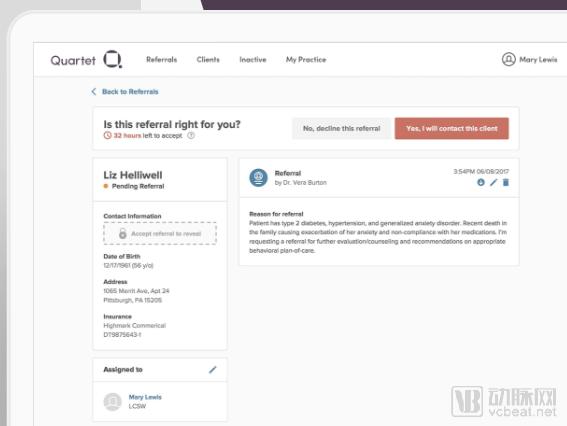
Image source: Quartet Health official website
After entering the market through general practitioners, Quartet Health did not opt for a heavy medical operations model. In the United States, mental health service providers are broadly categorized into three groups: counselors, clinical psychologists, and psychiatrists. Among these, psychiatrists bear the responsibility for intensive psychiatric care and represent a critical area of severe resource scarcity. Gupta believes that the shortage of psychiatrists is a macro-level issue; simply integrating the limited available psychiatric resources into its platform would not improve healthcare efficiency. Consequently, Quartet Health has focused its primary efforts on teleconsultation, health management, and online cognitive behavioral therapy (CBT).
Quartet Health’s unique strategic positioning necessitates a B2B business model, wherein the company does not charge patients, primary care physicians, or mental health specialists directly, but instead sells its services to healthcare institutions and health insurers.
General practitioners and mental health specialists practicing within medical institutions or health insurance frameworks that have a partnership with Quartet Health are authorized to access all patient data on the cloud platform, including personal information such as gender, age, and family medical history, as well as clinical information such as symptoms and past medical history. Notably, Quartet Health fully respects patients’ ownership of their electronic medical record data; patients may choose whether to disclose their personal data and can review their medical records at any time.
Currently, Quartet Health’s B2B client network has reached cities such as Boston, New Jersey, Seattle, New Orleans, Pittsburgh, and Sacramento, directly accessing user data from local healthcare institutions or health insurers.Serving Millions of Patients。
Despite being an internet company, Quartet Health’s services were not nationwide. In 2014, Quartet Health partnered with Steward Health and Lahey Health to enter the Boston market, securing its first city. Subsequently, Quartet Health adopted a “B-side partnership + city-level market” strategy to gradually establish a leading position across China. In each of Quartet Health’s funding rounds, Gupta has consistently highlighted “further expansion into city-level markets” as a key component of its future strategy.
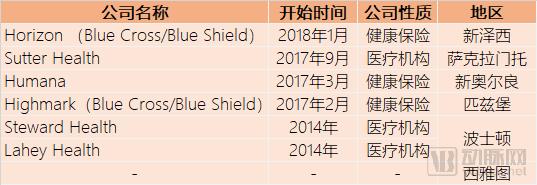
Data Source: Public information, compiled by VCBeat
Currently, Quartet Health has over 160 official team members, a scale that is already quite large for an internet startup. After organizing the information, VCBeat found that Quartet Health’s team has expanded rapidly but maintains high quality. Overall, the Quartet Health team can be divided into two lines: technology and healthcare. The technology line is centered around the previously mentioned founder, Arun Gupta, and brings together top engineers and data scientists from companies such as Amazon, eClinicalWorks, and Bridgewater Associates.
The healthcare division is centered around co-founder Steve Shulman, bringing together business leaders from Blue Cross Blue Shield, commercial health insurance companies, and healthcare institutions. Shulman previously served as the CEO of Magellan Health.
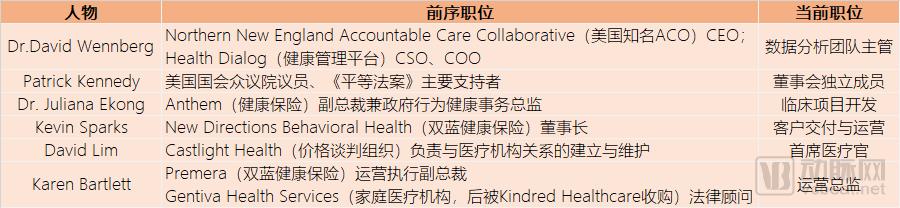
Data source: Public information, compiled by VCBeat
Notably, in October 2015, Patrick Kennedy announced that he had joined Quartet Health as an independent board member. A grandnephew of former U.S. President John F. Kennedy, Patrick Kennedy is the only member of the Kennedy family who has remained active in American politics after the successive assassinations of President Kennedy and his two brothers in the 1960s. Previously a U.S. Representative, he has long been a staunch advocate for mental health and has undertaken extensive work in this area. The Mental Health Parity Act mentioned at the beginning of this article was ultimately passed with his strong support. Although the legislation was first introduced in 2008, it faced repeated opposition due to concerns that it would increase costs for the health insurance system. It was only after six years of relentless advocacy by Patrick Kennedy that the act was enacted.
Patrick Kennedy’s arrival has undoubtedly injected political vitality into Quartet Health. A review of Quartet Health’s expansion trajectory since 2015 reveals that the company, which had been relatively quiet in Boston for nearly three years, significantly accelerated its push into other city markets after Kennedy joined. As a pure B2B enterprise, Quartet Health has embedded its business model within the healthcare and health insurance systems; securing political endorsement has effectively provided it with a shortcut to growth.
Having reached this point, we have deconstructed Quartet Health from three perspectives: user needs, business model, and team management. We believe that the above constitutes what Gupta calls the “right way.” How far Quartet Health will go on this right path in the future remains to be seen.
Related Links to the Mental Health + Case Series Special Topics:
Selected Reports on the Mental Health Industry:
【AI + Mental Health】Widespread Anxiety: Can AI-Driven Cognitive Behavioral Therapy Help?