

Orchard Therapeutics Files IPO Prospectus Highlighting Breakthrough Ex Vivo Gene Therapies for Rare Diseases Including ADA-SCID
The film *Bubble Boy* tells the story of Jimmy, a boy who was told from childhood that he suffered from an immune deficiency and had always lived in a specially sterilized “bubble house.” In order to embrace his beloved girl, Croy, he bravely burst out of his “bubble” at her wedding, only to surprisingly discover that he did not actually have the disease, ultimately living happily ever after with Croy.
While cinema portrays art, reality reveals cruelty. Jimmy’s real-life counterpart was an American boy named David Vetter, a true “bubble boy” who lived for 12 years in a sterile isolation chamber and died in 1984 from complications following a bone marrow transplant.

David Vetter suffered from severe combined immunodeficiency (ADA-SCID) since childhood, a disease caused by a defective ADA gene that leads to the absence of proteins essential for white blood cell production. This condition results in insufficient white blood cell production, leaving patients unable to fight off bacterial infections and requiring them to live their entire lives in sterile "bubble rooms."
When it comes to immunodeficiency diseases, people most commonly think of well-known conditions such as AIDS (Acquired Immunodeficiency Syndrome). However, patients with Adenosine Deaminase Severe Combined Immunodeficiency (ADA-SCID) account for less than 1% of the global population. In other words, this is a rare disease, meaning that biopharmaceutical companies developing drugs for such conditions face not only a limited sales market but also a scarcity of reference precedents for orphan drug development.
David Vetter ultimately died from complications of a bone marrow transplant (infection resulting from the patient’s immune system attacking non-self stem cells). If the provided stem cells were the patient’s own, would this eliminate the occurrence of bone marrow transplant complications?
Following this approach, Orchard Therapeutics has developed a novel gene therapy to treat such rare diseases.
Orchard Therapeutics is a biotechnology company that employs gene therapy to treat rare diseases. Founded in September 2015, the company is headquartered in the United Kingdom and the United States.
Orchard Therapeutics’ core technology is autologous ex vivo gene therapy, which primarily involves three steps:
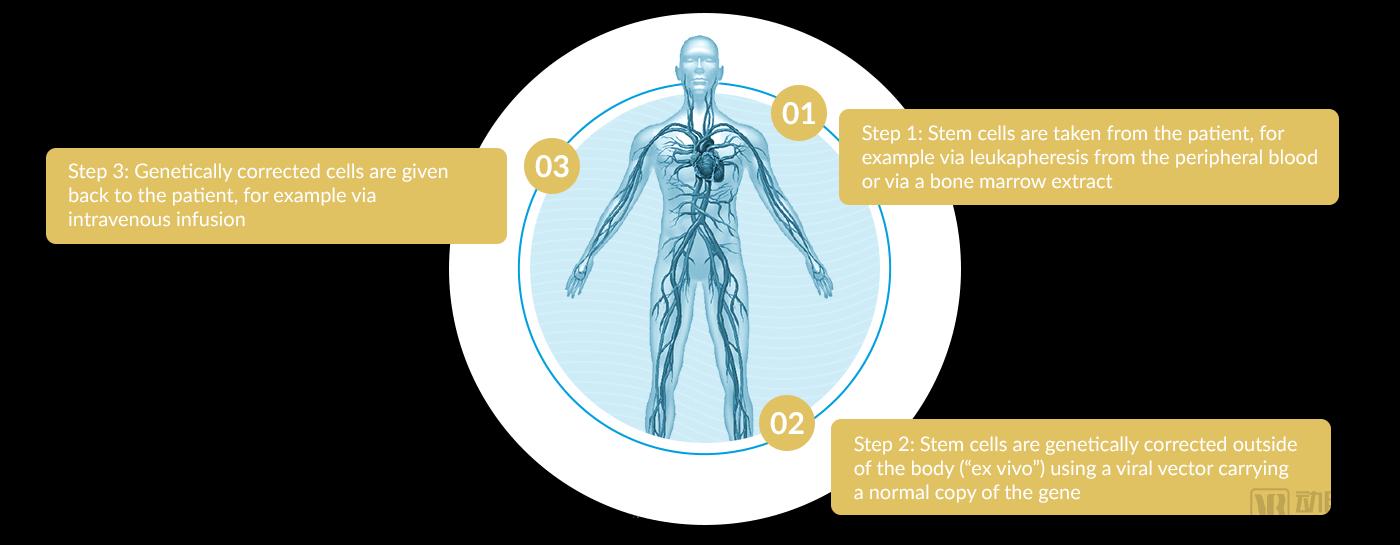 Image from the Orchard Therapeutics official website
First, hematopoietic stem cells are extracted from the patient’s body, typically from bone marrow. Subsequently, the harvested stem cells undergo ex vivo genetic modification: the aberrant gene responsible for the rare disease is identified, and a lentiviral vector carrying the corresponding normal gene is used to transduce the stem cells, thereby correcting the defective gene. Finally, the genetically modified stem cells are transplanted back into the patient via intravenous infusion or other appropriate methods.
The greatest advantage of this therapy lies in the fact that the stem cell donor and recipient are the same individual—the administered stem cells are derived from the patient themselves, eliminating the need to identify a third-party donor. This approach avoids immune rejection triggered by allogeneic donors and precludes the occurrence of related complications.
In addition to adenosine deaminase-deficient severe combined immunodeficiency (ADA-SCID), Orchard Therapeutics is also conducting drug development for three other categories of rare diseases. The main ones include:
① Primary immunodeficiency diseases, including severe combined immunodeficiency (ADA-SCID), Wiskott-Aldrich syndrome (WAS), and X-linked chronic granulomatous disease (X-CGD);
② Hereditary metabolic diseases: including metachromatic leukodystrophy (MLD), mucopolysaccharidosis type IIIA (MPS-IIIA), and mucopolysaccharidosis type IIIB (MPS-IIIB);
③ Blood disorders, primarily referring to β-thalassemia.
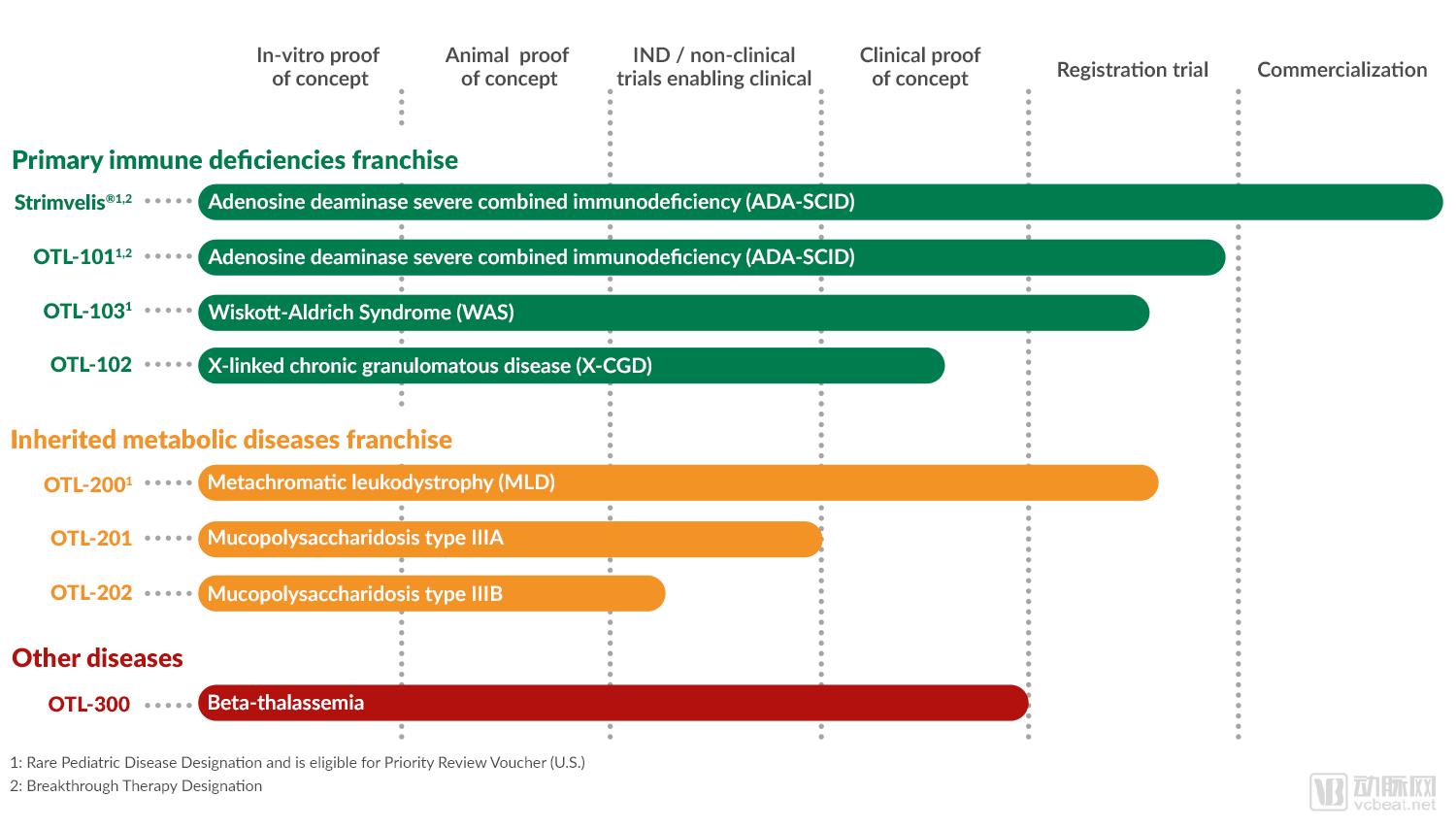
Image from the Orchard Therapeutics official website
Strimvelis®, a gene therapy for the treatment of severe combined immunodeficiency due to adenosine deaminase deficiency (ADA-SCID), received EMA approval in 2016. It is the second gene therapy approved for marketing in the European Union, following Glybera.
According to data from BLOOD, all 18 patients with ADA-SCID who received treatment with Strimvelis® have survived in good health since the drug’s market launch.
In addition to the gene therapy Strimvelis®, Orchard Therapeutics has three other drugs that have completed clinical trials and are awaiting regulatory approval. These three drugs are OTL-200 for the treatment of metachromatic leukodystrophy (MLD), OTL-103 for the treatment of Wiskott-Aldrich syndrome (WAS), and OTL-101 for the treatment of adenosine deaminase severe combined immunodeficiency (ADA-SCID).
Meanwhile, OTL-102 for the treatment of X-linked chronic granulomatous disease (X-CGD) and OTL-300 for the treatment of β-thalassemia are also in the late stages of clinical trials.
Mark Rothera, CEO of Orchard Therapeutics, is a Cambridge University graduate and former Chief Commercial Officer at PTC Therapeutics, with 28 years of experience in the pharmaceutical industry. He has dedicated his career to treating rare diseases and has developed seven orphan drugs.
The company’s leadership team also includes Dr. Stewart Craig, Chief Manufacturing Officer, who has led the development and manufacturing of neural stem cells, effector T cells, and other cell types. Bobby Gaspar, Chief Scientific Officer, has spearheaded multiple clinical trials that successfully corrected defective genes.
In addition, the company has John Cerio, SVP and Director of Human Resources; Chief Medical Officer Andrea Spezzi; Chief Regulatory Officer Anne Dupraz-Poiseau; Chief Commercial Officer Jason Meyenburg; and Frank Thomas, Chief Financial Officer and Chief Business Officer.
Board Composition:

Scientific Advisor:

Orchard Therapeutics, established less than three years ago, has successively entered into agreements with three renowned biopharmaceutical companies—Oxford BioMedica, the French company Généthon, and GlaxoSmithKline (GSK)—to co-develop novel therapies for rare diseases. It has also partnered with two biotechnology service providers, PCT Cell Therapy and PharmaCell, which will provide GMP-compliant manufacturing services to Orchard Therapeutics.
In addition, Orchard Therapeutics has formed strategic alliances with two leading academic research institutions: the University of California, Los Angeles (UCLA) and the University of Manchester, to jointly develop gene therapies for specific rare diseases.
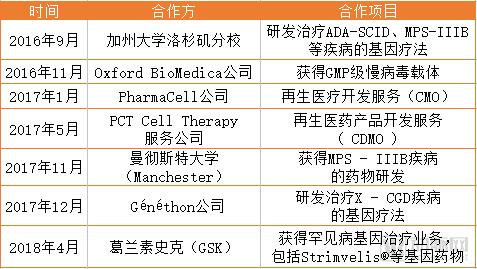
In 2018, the collaboration between Orchard Therapeutics and GlaxoSmithKline (GSK) drew significant industry attention.
Through this collaboration, Orchard Therapeutics acquired a portfolio of rare disease programs from GSK, including the Strimvelis® gene therapy for adenosine deaminase severe combined immunodeficiency (ADA-SCID), two late-stage clinical programs for Wiskott-Aldrich syndrome (WAS) and metachromatic leukodystrophy (MLD), and one clinical program for beta-thalassemia.
Meanwhile, Orchard Therapeutics will assume all obligations arising from GSK’s collaborations with Ospedale San Raffaele, MolMed, and Fondazione Telethon in the field of rare diseases.
To facilitate the smooth transition of GSK’s rare disease business to Orchard Therapeutics and mitigate the impact of a mid-process change in ownership on certain projects, both parties agreed on a “transition period.” During this period, GSK would continue to carry out activities for certain projects until the end of 2018.
“This collaboration with GSK expands Orchard’s scope in primary immunodeficiencies and inherited metabolic disorders, bringing us additional franchise rights,” said Mark Rothera, Chief Executive Officer of Orchard Therapeutics.
GlaxoSmithKline (GSK) acquired a 19.9% stake in Orchard Therapeutics and secured a seat on the board of directors of Orchard Therapeutics through this collaboration.
GSK stated that it will shift its research focus to the field of oncology therapeutics.
Orchard Therapeutics’ autologous stem cell ex vivo gene therapy relies on lentiviral vectors to deliver functional genes into patients’ stem cells. Orchard Therapeutics has entered into separate agreements with Oxford BioMedica and Généthon regarding lentiviral vectors.
Oxford BioMedica
Oxford BioMedica is a leading cell and gene therapy company dedicated to developing treatments for serious diseases. The company has established a leading lentiviral vector delivery platform.
On November 29, 2016, Oxford BioMedica partnered with Orchard Therapeutics to manufacture GMP-grade clinical lentiviral vectors and provide development services for Orchard Therapeutics. Furthermore, Orchard Therapeutics retains exclusive intellectual property rights for all projects under this collaboration.
Under this collaboration, Oxford BioMedica has acquired a 1.95% equity stake in Orchard Therapeutics, and both parties will share the profits generated by the collaborative products.
Généthon
Généthon is a French non-profit research and development organization dedicated to researching muscular dystrophy and developing gene therapy-based drugs. It has ongoing projects in the fields of neuromuscular disorders, hematology, the immune system, and liver diseases.
Orchard Therapeutics has entered into a collaboration with Généthon, securing an exclusive license for the G1XCGD lentiviral vector. Additionally, Orchard Therapeutics has obtained clinical trial data on the G1XCGD lentiviral vector from Généthon in the United States and Europe. These data will be used to evaluate the efficacy of G1XCGD lentiviral vector-mediated autologous transplantation of CD34+ cells (highly glycosylated type I transmembrane glycoproteins) in curing X-linked chronic granulomatous disease (X-CGD).
This project has received support from the European FP7 Health Programme Committee.
Notably, this collaboration also includes the G1XCGD lentiviral vector production pipeline, with Généthon, AFM-Téléthon, and the Sociétés de Projets Industriels (SPI) all engaged in large-scale manufacturing of G1XCGD for Orchard Therapeutics.
Orchard Therapeutics completed its Series A financing round in May 2016, raising €21 million. In December 2017, the company closed its Series B financing round, securing $110 million. The Series B round was co-led by Baillie Gifford and ORI, with participation from Temasek, Cowen Healthcare Investments, Longside Juda Capital, Pavilion Capital, RTW Investments, Agent Capital, 4BIO Partners, F-Prime Capital, and the UCL Technology Fund.
Orchard Therapeutics stated that it would utilize these funds to advance additional clinical programs, including the global rollout of OTL-101. Currently in clinical development for the treatment of adenosine deaminase-deficient severe combined immunodeficiency (ADA-SCID), this therapeutic agent has been granted Breakthrough Therapy designation by the FDA. The company also plans to strengthen its infrastructure and expand its business activities.