

How a Health Tech Company Created a Smart Body Fat Scale That Even IT Guys Can't Quit
For a long time, my perception of body weight was as follows:
First, there’s little worth paying attention to. I believe body weight is merely a number with limited significance. If one must associate it with something, it would be the Body Mass Index (BMI), which is used to assess obesity and determine whether one’s weight falls within the standard range.
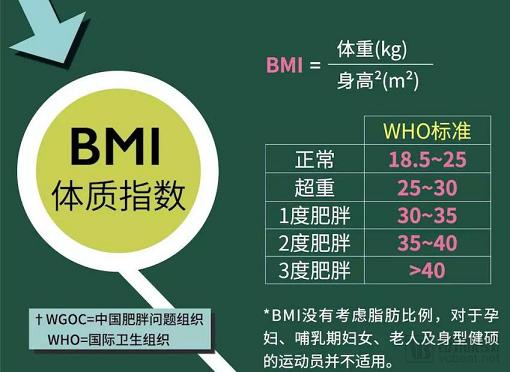
Figure 1: BMI Index
Second, there’s little to worry about. Although I don’t have a six-pack, I’m not pot-bellied either. I believe my healthy lifestyle and dietary habits have kept my weight within a stable range, with minimal fluctuations.

At the beginning of the year, my wife redeemed a smart body fat scale using her credit card points that were about to expire, and then sent me the product link.
Seeing the word “smart” in the product title, I couldn’t help but chuckle to myself: these days, everything seems to jump on the bandwagon by slapping the “smart” label on it.
It’s just a scale. From the weighing scales at pharmacy entrances in our childhood, to later household digital scales, and medical examination scales in hospitals—no matter how they have evolved, the fundamental principle remains unchanged. So, where lies the “smart” element this time?

Figure 2: The Ubiquitous Term “Smart”
A few days later, I received the package and couldn’t wait to open it. Inside was an ordinary-looking black weighing scale.

Figure 3: An Apparently Ordinary Smart Body Fat Scale
I installed the mobile app as instructed and stepped onto the scale. Subsequently, a measurement report that somewhat surprised me was generated on my phone.
I used to think that stepping on the scale merely measured body weight. To my surprise, the report presented nine core physiological metrics, each annotated with its position within the reference range and critical warning thresholds, providing a clear overview of my overall physical condition. I had believed my health was in good shape, but it seems this was merely a subjective illusion. Only when my physical status was objectively displayed across multiple dimensions did I realize there is still substantial room for improvement.
In particular, the three warnings and one area of special concern highlighted in the report not only hit the mark but also provide scientific explanations and recommendations, making them truly convincing.
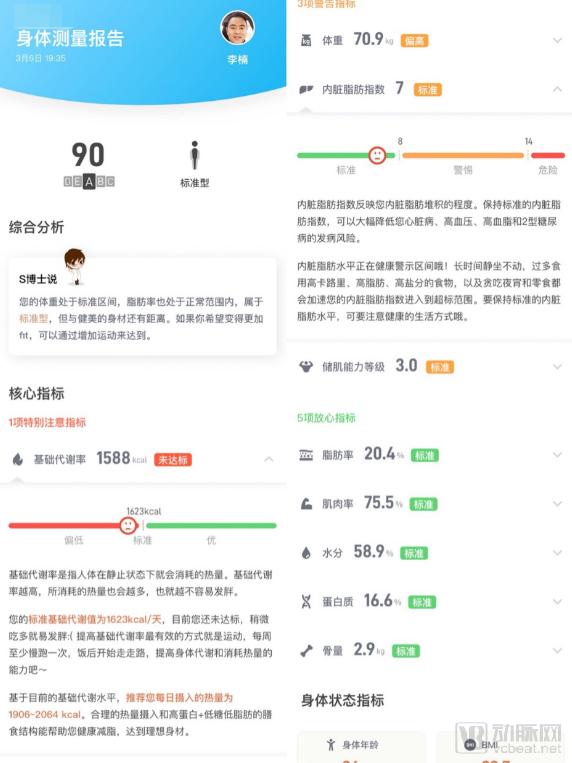
Figure 4: Report Obtained from the First Weigh-in
Given that this is not a product review, the product introduction ends here. What I truly wish to convey are the reflections surrounding this product and the phenomena behind it:
Let’s start with a set of data: From my first weigh-in on March 6, 2018, to December 31, 2018, exactly 300 days elapsed. During this period, I stepped on the scale a total of 117 times, averaging once every 2.5 days. (Note: Data sourced from the annual health report generated by the official mobile application.)
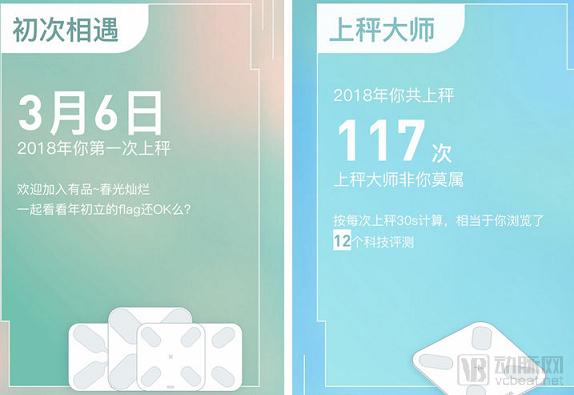
Figure 5: Weighing Data for 2018
This data came as somewhat of a surprise to me; I hadn’t realized I had stepped on the scale so many times. I believe this is also the kind of data entrepreneurs hope to see, as it demonstrates, from one perspective, that this health management product has maintained strong user engagement and sustained relevance in the hands of its users.
Now, the question arises:
I am passionate about sports, health-conscious, and an early-adopting tech enthusiast. People like me are arguably the ideal target users for health management services.
Before I started using a body fat scale, I had tried many health-related products. Adorned with the high-tech allure of wearables and health management, as well as fashionable concepts, they flocked into my life only to be quickly sidelined by me after their brief moment in the spotlight.
Nowadays, the vast majority of them are gathering dust in drawers. The only smartwatch still in use serves merely for phone and message notifications.
As for health management features such as heart rate monitoring and sleep tracking, they have long become superfluous—ignored and dispensable. I only open the mobile app occasionally to check if there is new firmware available for upgrade.
Upon closer examination, many health management programs are designed in isolation, failing to strike a balance between user burden and benefit. On one hand, they assign users numerous tasks, often involving frequent, manual data entry. On the other hand, the conclusions and recommendations provided are generic and formulaic.
Why did sleek, cool wearable products fall flat for me, while a non-wearable, lukewarm body fat scale unexpectedly captured my mind and got me “addicted,” even without any external incentives?
I have summarized the following points:
First, the entry point is well chosen.
Body weight is a metric that is particularly well-suited as an entry point for health management at the current stage.
First, body weight is inherently easy to understand, measure, and interpret, making it highly accessible. This practicality minimizes the learning curve for users and appeals to the broadest possible audience.
Secondly, while body weight is easy to change, it is difficult to reach the target standard. Its recurring nature provides ample room for maneuver in health management.
Finally, body weight is a “non-urgent” health indicator. The initial breakthrough in health management will undoubtedly occur in the more fault-tolerant peripheral areas of health, rather than in core metrics (such as heart rate).
Second, the ecosystem is well-developed.
I have two insights regarding the product ecosystem:
First, ecosystems are not defined by size. The vast ocean is an ecosystem, and so is a trickling stream.
Secondly, regardless of how the ecosystem evolves, its commonality lies in serving a group of people and sustaining a community.
Based on the above two points, I believe that body fat scales from various brands, with weight as their entry point, offer several valuable lessons and references for ecosystem development.
We do not aim for scale or comprehensiveness; instead, we focus exclusively on weight management, delving deeply into the health and body image needs of niche populations represented by individuals like myself.
Smart body fat scales have developed a comprehensive physical assessment system comprising nearly 30 metrics derived from body weight. Each weigh-in generates a highly multidimensional personal health profile. Every effort or lapse made after stepping off the scale yields distinct feedback and recommendations upon the next weigh-in, creating a reinforcing cycle that users find engaging and sustainable.

Figure 6: Metrics Measurable by Body Fat Scales
Such a design not only effectively answers the three essential questions in health management: “Who am I? Where am I? What should I do?” (See the end of the first article for details.), it is more akin to an endless game. After completing the main story, there are side quests; after clearing those, there are trophies to earn. As long as one is willing, there is always room for improvement. This is also a key reason why the product maintains such a long shelf life.
When it comes to game completion, one naturally thinks of gamification design principles.
I love playing games and also agree with the aforementioned philosophy. Theoretically, gamification design principles are well-suited for many health management products and scenarios, as health management typically involves long-term engagement, during which users are prone to churn and product activity levels tend to decline.
However, it is advisable to apply theories flexibly in practice. All things have their limits; the key lies in striking the right balance.
Some developers, in an effort to align with gamification design, adopt a “formulaic” mindset that fragments and deconstructs established user habits, deliberately forcing them to fit gamified patterns. I disagree with this approach, as it imposes unnecessary time and learning costs on users while delivering even less value in return.
For another example, deliberate user incentive mechanisms artificially raise the cost of departure. Ultimately, users still leave because they are overwhelmed by the nuisance. In fact, excessive incentives constitute a form of harm as well.
I have always maintained a clear perspective: in many cases, products fail to meet expectations because of excessive self-interest. The focus is solely on creating blockbuster hits, with little regard for providing users a peaceful and undisturbed experience.
In contrast, the design of body fat scales, despite exhibiting clear traces of gamification (such as well-defined goals and timely feedback), remains overall restrained, striving to respect user habits and preferences.
For instance, the homepage features a clean and minimalist design. The information feed, organized along a timeline, displays only content of interest to users, such as measurement data and bodily trend analysis. While social networking concepts are reflected in the bottom navigation bar, there are no proactive push notifications or prompts, nor are there friend recommendations. Even paid services and the official store are tucked away in inconspicuous secondary menus.
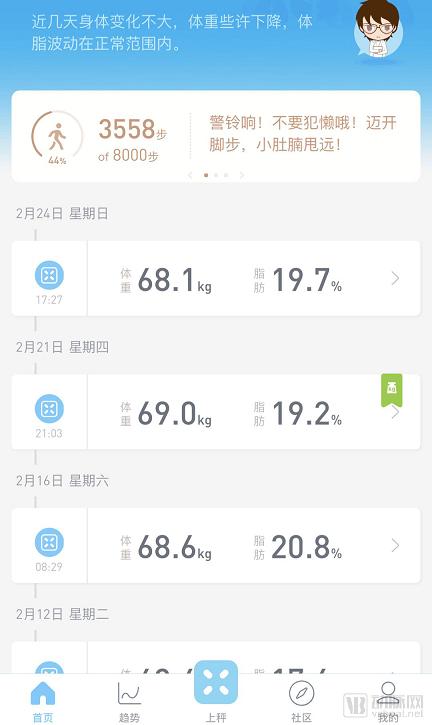
Figure 7: Home Page of the Official App for Body Fat Scale
This restraint inevitably brings to mind the tagline featured on WeChat’s cover after its redesign: “It exists because you see it.”
At this point, some may ask: If body fat scales are so restrained, how can they sustain a business?
A Personal Perspective: Establish a Foundation with Reasonable Pricing Strategies, and Create Highlights with Value-Added Services Designed Around Pain Points.
Most body fat scales are priced at around 100 yuan, posing no significant purchase barrier for either individual consumers or households. Sales data from major e-commerce platforms show that the sales volume of body fat scales is on par with that of fitness bands in the same price range.
In terms of value-added services, taking the body fat scale I purchased as an example, the primary source is the figure below. Compared with the time cost of going to the gym, annual gym memberships costing thousands of yuan, and personal training sessions priced at hundreds of yuan each, this O2O private training camp model effectively addresses the pain points of its core target users—young professional women.

Figure 7: Value-Added Services for Body Fat Scales
There are many products and solutions marketed with health management as their selling point, but few have achieved scale, built an ecosystem, and established a mature business model to become blockbuster hits. In this regard, smart body fat scales have taken the lead.
It should be noted that most body fat scales currently available on the market utilize Bioelectrical Impedance Analysis (BIA). This method operates on the assumption that the body consists primarily of two components: muscle and fat. Muscle, having a high water content, is conductive, whereas fat, with its low water content, is non-conductive, resulting in different resistivity for each tissue. Based on this principle, a fixed current is applied, and the impedance value—reflecting the ease or difficulty of current passage—is measured and incorporated into empirical formulas to estimate the body’s fat and muscle content.
As the underlying principles of body fat scales reveal, measurement errors are inevitable at this stage. I have also observed numerous media outlets conducting comparative reviews of these devices’ inaccuracies, and even subjecting them to harsh criticism.
In fact, the industry urgently needs compact and well-designed products like body fat scales to raise awareness about physical health management and educate people on the dangers of excessive body fat. This awakening and transformation are akin to shifting from the empirical practice of “rising at cockcrow and returning at sunset” to scientific planning based on clock time. Although clocks may have inaccuracies and errors, the current priority in health management is to awaken and educate users; thus, temporary technological immaturity is tolerable.
We hope that health management companies will develop more specialized products, leveraging appropriate entry points and thoughtful product design to earn user trust, thereby accompanying users and fostering proactive health awareness.
"A Small Step on the Scale, A Giant Leap for Health."