

Interview with United Imaging Intelligence Executives: Building a Universal Platform for Medical AI
During the 2018 MICS conference, Professor Dinggang Shen and Dr. Xiang Zhou, Co-CEOs of United Imaging Intelligence (Shanghai United Imaging Intelligence Medical Technology Co., Ltd.), along with Dr. Yiqiang Zhan, COO, engaged in discussions with Yuanfeng Bi, COO of VCBeat, on topics including AI education and new products from United Imaging Intelligence. VCBeat (WeChat Official Account: vcbeat) has compiled these insights and shares them here.
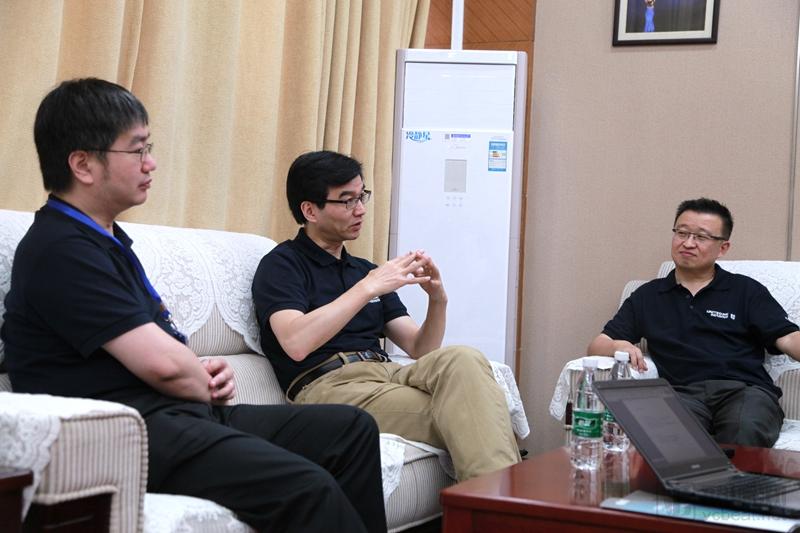
Shen Dinggang (center) and Zhou Xiang (right), Co-CEOs of United Imaging Intelligence
United Imaging Intelligence COO Zhan Yiqiang (left) is interviewed by VCBeat
VCBeat: This year, United Imaging Healthcare released thirteen AI products. After conducting a detailed analysis and comparison of these products, we found that some are designed for specific diseases, such as intelligent screening for pulmonary nodules and breast cancer; others target specific organs or anatomical regions, such as bone and joint injuries; and still others serve as tools for clinical workflows, such as differential subtraction imaging and intelligent dynamic fusion. How does United Imaging Intelligence plan its product portfolio?
Shen Dinggang: What we aim to achieve is full-stack artificial intelligence, meaning the application of AI at every possible stage of imaging, diagnosis, treatment, and prognosis. However, this does not imply using AI throughout the entire process; rather, it is applied to specific segments. This requires long-term collaboration with physicians to understand their pain points. Then, we identify AI-driven solutions tailored to address these pain points. For instance, in medical imaging, differential subtraction techniques can help physicians more clearly identify the location of lesions. Since this is a problem that AI can solve, we focus our efforts on addressing it.
VCBeat: Does United Imaging Intelligence have a division of labor in this regard?
Yan Yiqiang: At United Imaging Intelligence, we have a clear division of labor. We have two Chief Marketing Officers (CMOs) who steer our development direction based on market demands. Through their research, if certain areas are identified as having significant commercial potential, they are prioritized from a demand perspective. Additionally, there is a strategic sequence from a technical standpoint. Engineers sometimes pursue highly challenging projects they are particularly passionate about. During implementation, if we discover that certain modules within these projects are highly beneficial to other initiatives, we encourage further research and development in those areas. For example, when traveling from Shanghai to Beijing, one might pass through Shandong Province. If I believe Qingdao offers more value or satisfaction than Jinan, I would choose the route via Qingdao. Similarly, in technical implementation, there are various intermediate milestones. We do not focus solely on the final endpoint; achieving these intermediate milestones also provides substantial benefits. This process essentially transforms technically challenging problems (“high-hanging fruit”) into more manageable ones (“low-hanging fruit”).
Zhou Xiang: We might now be asking, “When will this product be ready?” But a year from now, our question may shift to, “How many AI products can we release this month?” The focus of our considerations will transition from whether we can innovate to how rapidly we can innovate. To achieve this, we must prepare numerous general-purpose modules for parallel execution.
VCBeat: In which field is United Imaging Intelligence’s killer app most likely to emerge? What might it be?
Zhou Xiang: Currently, the most high-profile killer applications of artificial intelligence are emerging in the consumer sector, with autonomous driving technology being the most prominent. This market is massive, as every adult has the potential to use this technology on a daily basis. The healthcare sector, however, is different. Automated detection of pulmonary nodules is a notable project within the field of AI for medical imaging, but the general population does not routinely screen for pulmonary nodules, nor do they undergo such screenings on a daily basis. Consequently, its target audience is relatively limited. In summary, the healthcare sector is highly specialized, with each disease having its own diagnostic methods. Therefore, the scale of any single application is unlikely to reach the “killer app” magnitude seen in autonomous driving.
This is why we are building a platform and developing full-stack, full-spectrum AI products. “Full-stack” refers to the application of artificial intelligence across the entire healthcare workflow, while “full-spectrum” denotes its application across a wide range of disease conditions, comprehensively covering pulmonary nodules, colorectal polyps, as well as the brain, heart, liver, blood vessels, and trachea. Only by collaborating with physicians and other companies can we scale this endeavor; otherwise, it will be difficult for medical AI to achieve economies of scale and attain substantial commercial success.
VCBeat: Can the platform be understood as a system like MATLAB?
Shen Dinggang: Yes, what we do is akin to stacking many foundational modules together; combining these modules constitutes an application. And this application requires a platform to operate.
VCBeat: So, is United Imaging Intelligence in a collaborative relationship with all other companies that develop applications?
Shen Dinggang: We are not in competition with one another, because the medical field is too complex for us to cover all disease types. Our partner companies can address these conditions one by one. We hope that both doctors and technical professionals can easily leverage our platform to accomplish their desired tasks.
VCBeat: On June 27, 2018, the launch ceremony for the United Imaging Intelligence Joint AI Research and Development Center was held at ShanghaiTech University. In what areas will this center conduct future explorations? Who are the collaborative partners, and what are the models and scope of collaboration? Do the three of you have specific divisions of responsibility?
Shen Dinggang: The situation in China is as follows. Physicians believe that artificial intelligence can assist them with a wide range of tasks, and researchers are capable of developing numerous medical applications for clinicians. However, the high barrier to entry in medicine, compared to other industries, creates significant obstacles during the integration process. Therefore, we have invited hospital experts to United Imaging Intelligence’s research base to jointly discuss this matter.
We not only provide a platform but also facilitate robust interaction between physicians and researchers to jointly elevate their professional capabilities. For instance, if a researcher is interested in brain diseases and a neurologist has a relevant project, we will match the two parties. Under the guidance of UIH Intelligent scientists, they will collaboratively explore the integration of artificial intelligence and medicine in this field.
We anticipate a minimum commitment of three months of full-time work. This arrangement allows physicians to expand their knowledge and improve efficiency, while enabling technical staff to gain in-depth understanding of clinical workflows and physicians’ actual needs, thereby refining AI applications.
We can cultivate a large pool of talent in the field of medical imaging and artificial intelligence. While the company will benefit, more importantly, these professionals can disseminate their acquired knowledge to benefit a broader audience, thereby driving the growth of the entire industry.
VCBeat: This full-time model might be more readily accepted by students in science and engineering disciplines or young scholars, but will hospital physicians resist undergoing three months of full-time training?
Zhou Xiang: This center does not aim to provide training for physicians at the level of hospital department directors; rather, it seeks to help them understand our philosophy that “radiologists and pathologists who are proficient in AI will lead advancements in their respective fields in the future.” We ask department directors, “Who is your successor, or even the next-generation leader you are grooming? Who will become a pioneer in the field of medical AI?” We invite such individuals to join our program for targeted development. Typically, it takes three to five years, or even longer, for such a candidate to assume a directorship. A three-month full-time training program represents a minimal investment, yet it will prove highly beneficial to their professional growth and entire career trajectory.
Certainly, the key lies in how hospitals and physicians perceive the importance of learning AI. If a physician considers their current daily routine to be the top priority, they will naturally resist training. However, if an individual is reflective and committed to continuous self-improvement, viewing AI as the most critical component of their career, they will find that three months of study can lead to significant professional growth—especially for young physicians.
VCBeat: What curriculum will be offered during these three months?
Shen Dinggang: Physicians should come with specific questions, and our team will help them find solutions. For instance, a physician may have previously collected extensive data but failed to obtain the desired results, taking many detours without being able to assess whether their approach was correct. In such cases, we provide targeted assistance based on the specific data available. This is also a process of collaborative growth: physicians learn that their problems can be addressed using AI, enabling them to save considerable time when encountering similar issues in the future; meanwhile, researchers gain insights into physicians’ needs regarding these types of problems through the process of helping them find solutions.
VCBeat: Does United Imaging Intelligence have a specific goal in this regard? For example, how many physicians does it aim to train?
Zhan Yiqiang: As this is a nascent venture with no precedent, we cannot scale up aggressively at the outset; instead, we must remain agile and make adjustments based on evolving circumstances. While we have considered strategies for scaling, our core focus remains on product development, ensuring that we do not lose sight of our priorities.
Zhou Xiang: Our platform can be described as public-welfare oriented, though not entirely so. Why is that? We have developed a suite of modular algorithms and made them openly accessible to all, which serves a public good—much like the Apollo Program. At the same time, widespread adoption of our platform benefits us as well. Ultimately, we aim to drive collective advancement across the entire field. If our modules are widely adopted, any issues will be rapidly identified and reported, enabling us to implement timely updates. This iterative process ensures that our matured modules can more accurately address future challenges.
Pre-built modules can also create business opportunities, such as charging commercial users a licensing fee for accessing advanced platform features. However, we will proceed with great caution in this regard, as we seek win-win outcomes. Therefore, we have an aspiration for this hub: to build it into China’s largest medical imaging AI platform. This platform will encompass not only algorithmic modules but also various networking relationships—among engineers, between researchers and healthcare professionals, and among physicians themselves. The process of knowledge exchange often gives rise to novel innovations that did not previously exist. We aim to allow this exchange to flourish organically, fostering an ecosystem. Achieving this is undoubtedly challenging, and we are still in the early stages.