

Xin Zhi Ai: A 'Small but Exquisite' Psychotherapy Practice Thriving Amid the Digital Storm with Deep, Specialized Case Consultations
As we come to realize that the brain is nearly the most complex entity in the known universe, a multi-billion-dollar market spanning from physical health to mental well-being awaits exploration.
Amid the mental health needs of 250 million people, VCBeat has recently launched a special series on the Mental Health Industry, examining challenges and opportunities that coexist—from enterprises to markets, and from China to overseas. IWe will conduct a comprehensive scan of this field.If you are in this industry, feel free to engage with the author; for media coverage inquiries, please contact VCBeat directly.
At the beginning of the 20th century, psychological counselors emerged as a profession in developed countries. Today, most developed nations have established relatively comprehensive psychological counseling systems, with the United States being a prime example. Statistics show that there is one psychological counselor for every 1,000 Americans, and many American families even retain private psychologists. In 2014, with the passage of the Mental Health and Addiction Equity Act by the U.S. Congress, psychological counseling services were included in the scope of medical insurance reimbursement.
In China, the psychological counseling industry has a brief history of just over ten years. In April 2001, the Ministry of Labor officially introduced the National Occupational Standards for Psychological Counselors (Trial), marking the first inclusion of “Psychological Counselor” in the Chinese Classification of Occupations. In July 2002, the National Vocational Qualification program for Psychological Counselors was formally launched, with nationwide unified certification examinations held twice a year. The national vocational qualification assessment for psychological counselors is divided into three levels: Level III corresponds to Assistant Psychological Counselor, Level II to Psychological Counselor, and Level I to Senior Psychological Counselor.
Currently, constrained by the relatively underdeveloped state of psychological counseling in China, Level 2 Psychological Counselor represents the highest professional certification level. As of 2017, more than one million individuals nationwide had obtained Level 2 or Level 3 Psychological Counseling certificates; however, relevant surveys indicate that only approximately 2%–3% of them are competent to provide professional psychological counseling services. In terms of academic discipline development, over 380 higher education institutions across China offer psychology programs, encompassing various specialized subfields of psychology. These programs produce more than 20,000 graduates annually, yet only slightly over 100 graduates specializing in clinical psychology actually engage in psychological counseling practice.
The vast majority of individuals with a background in psychological counseling are unable to secure jobs in their field. A key reason for this is the weak foundation of China’s psychological counseling industry, where regulatory frameworks and professional standards have yet to be systematically established. As Chen Kehan stated, “Finding employment as a psychological counselor is, in fact, very difficult.”
In 2011, Chen Kehan, a counselor who had just resigned from the psychology department of a Grade A tertiary hospital in Beijing, experienced this difficulty firsthand. She aspired to be a pure psychological counselor, focusing exclusively on meticulous case analysis. However, Chen’s ambitions were insufficient to melt the entrenched ice of the psychological counseling market at that time. Going to work at a school? That would merely mean following routine practices in a different setting. Joining a private practice? It was nearly impossible to find a compatible team. Left with few options, Chen attempted to establish her own psychological counseling studio.

Chen Kehan, Founder of Heart’s Love. Photo provided by Heart’s Love.
Over the past seven years since its founding, Chen Kehan has consistently upheld the ritualistic integrity of psychological counseling and the professional rigor of case analysis. During this period, the number of counselors at Xin Zhi Ai Psychological Counseling Center has grown from three to eight. Each counselor adheres to a strict limit of no more than seven clients per day and refrains from working overtime beyond regular hours, yet they have collectively completed over 13,500 in-depth psychological counseling cases. Recently, VCBeat (WeChat ID: vcbeat) conducted an exclusive interview with Chen Kehan, founder of Xin Zhi Ai, to discuss how the organization has established itself as a “slow brand” in an era defined by speed.
Chen Kehan is a practice-oriented psychological counselor. Psychological counseling is divided into many schools based on theoretical frameworks and technical methods, among which psychoanalysis, humanism, behaviorism, Gestalt therapy, cognitive therapy, and family systems therapy are the six most widely followed schools. The practice-oriented school to which Chen Kehan belongs is the seventh school derived from these six major schools. In Chen Kehan’s view, the practical approach of practice-oriented psychological counselors is similar to that of clinical psychology, as opposed to the academic school focused on writing and theorizing.
“Just as in performing a surgical operation, the hands-on psychological counselor acts as the lead surgeon; determining how to proceed and where to make the incisions requires both theoretical knowledge and practical experience.” The hallmark of hands-on psychological counseling is the flexible application of theories and techniques from various schools of thought according to the needs of individual cases, which undoubtedly places exceptionally high demands on the professional competence of psychological counselors.
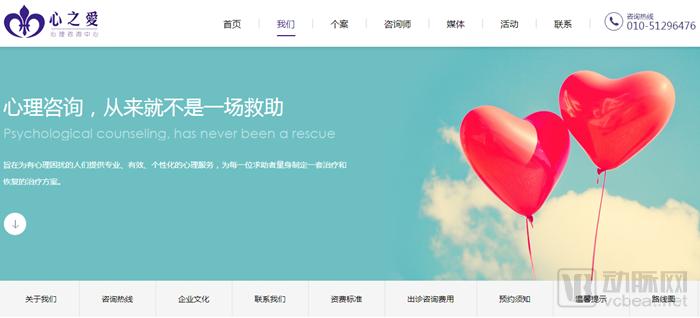
Home - Heart of Love Official Website
Unlike offline psychological counseling centers and internet-based counseling platforms, which often boast millions of registered users and thousands of affiliated counselors, the “small but beautiful” business model means that the founder’s personal characteristics are imprinted on the counseling style of the entire studio. The homepage of Xin Zhi Ai (Love of Heart) features the statement: “Psychological counseling is never an act of rescue.” Chen Kehan believes that “rescue” implies that the rescuer holds a more dominant position, and such distorted interpersonal dynamics are detrimental to recovery from psychological issues. Therefore, she consistently refers to her clients as “visitors.”
Counselors at Heart’s Love serve as companions to their clients. Along this shared journey, they alternate between the roles of listener and guide, and at times may even assume specific roles within the scenarios that have contributed to the client’s psychological distress. The counselor’s mission is to help clients emerge from their inner predicaments, transforming external “rescue” into self-driven “self-help.”
It is no easy feat to be a qualified “fellow traveler,” and Chen Kehan has always held exacting standards for what constitutes “qualified.”
Rigorously Selected Psychological Counselors
All counselors at Heart of Love hold the National Vocational Qualification Level 2 Certificate, with facility standards aligned to the highest benchmarks. Furthermore, every affiliated counselor must have undergone systematic offline professional training in psychological counseling, accumulated over 500 hours of case consultation experience, and successfully completed a six-month probationary period at Heart of Love.
Chen Kehan candidly admits that the greatest challenge Heart of Love has faced since its inception is the severe scarcity of high-quality psychological counselors. In reality, obtaining professional certification marks only the beginning of a counselor’s long journey of learning; to maintain effective counseling practices, counselors must engage in continuous education. Consequently, most individuals give up along the way. However, Chen Kehan refuses to lower her hiring standards. A small pool does not mean no pool at all. Thus, over the past seven years, while the number of clients has grown exponentially, the team of psychological counselors has expanded modestly from just three to eight members.
Strictly Control Visitor Procedures
The standard pathway for clients seeking services at Heart of Love involves telephone reservation, bidirectional preliminary assessment, selection of a counselor, and long-term counseling. The first two stages of this standard pathway are conducted by assistant counselors. Upon receiving a reservation request, the assistant counselor first determines whether to accept the appointment. Since psychological counselors do not have prescribing privileges, Heart of Love refers clients with severe mental disorders—such as neuroses or psychoses requiring medication—to hospitals. Once the reservation is accepted, clients are required to complete a series of forms to provide their personal information and psychological status.
Subsequently, the assistant counselor matches the client with a suitable psychological counselor based on the information provided and presents detailed matching recommendations to the client for their selection. Once a counselor is chosen, consultation sessions can be scheduled, typically occurring 1–2 times per week over a period of six months or longer.
To ensure the objectivity and scientific rigor of the client intake process, Heart’s Love trains assistant counselors to respond to different clients in a standardized manner, while also establishing strict guidelines governing communication boundaries among assistant counselors, counselors, and clients.
Strict Adherence to a Regular Daily Schedule
At Heart's Love, psychological counselors work from 9:00 AM to 9:00 PM, seeing no more than seven clients per day, with no overtime.
Chen Kehan believes that if counselors are exhausted from responding to any questions raised by clients at any time, it will disrupt the counseling process and fail to achieve ideal outcomes. In cases where clients experience sudden psychological issues outside of the counselor’s working hours, assistant counselors act as first responders, providing timely support while documenting the client’s psychological changes and reporting them back to the primary counselor. Chen Kehan has always been committed to delivering highly professional psychological counseling services.
According to Chen Kehan, Xin Zhi Ai primarily addresses four major categories of psychological issues. Among its clients, approximately 30% are individuals with neurotic disorders, including depression, anxiety, and obsessive-compulsive disorder; adolescents account for about 30%; consultations related to marital and emotional issues as well as family conflicts make up around 30%; and those seeking guidance on occupational stress and workplace interpersonal relationships constitute roughly 10%. In recent years, the proportion of consultations for the fourth category has shown an upward trend. Additionally, a growing number of entrepreneurs have become regular clients of Xin Zhi Ai.
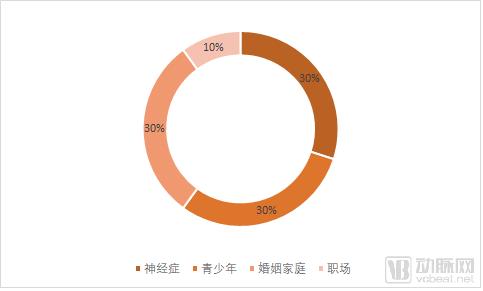
Types of Psychological Issues Among Clients at Heart Love
Source: Provided by Xinzhiai; Chart by VCBeat
At Heart’s Love, counselors do not apply a preset template to clients; instead, each case is addressed with a personalized plan tailored to the client’s specific circumstances. “Changes in the types of psychological issues also reflect shifts in the social mindset.”
Chen Kehan entered the field early and has been deeply engaged in psychological counseling for 16 years. In her view, the most significant change in the psychological counseling industry over these 16 years has been the rise of internet-based mental health platforms in recent years. The disruptive nature of internet technology has left many traditional players across various industries feeling anxious. The incursion of online psychology platforms such as JianDanXinLi (Simple Psychology), YiXinLi (One Psychology), and YiDianLing has further squeezed the already limited survival space for private psychological counseling practices.
When it comes to the internet, Chen Kehan couldn’t help but smile. “It has indeed been our most vexing issue over the past two years.” The unprecedented convenience and immediacy offered by “Internet + Mental Health” have truly posed significant challenges for professionals like Chen. On one hand, the internet has captured the majority of user resources; on the other, it has attracted many outstanding psychological counselors.
However, will the internet completely disrupt psychological counseling offices?Chen Kehan’s answer was in the negative: “Their strengths are precisely their weaknesses.”
Chen Kehan believes that genuine psychological counseling is a highly ritualized professional practice. This sense of ritual is reflected in the stability of the counseling framework and the counselor’s full engagement—two areas where traditional counseling offices excel, but which internet-based mental health platforms lack. At Xin Zhi Ai, a stable counseling framework is a fundamental requirement, with counselors consistently conducting sessions in familiar settings. Beyond stability lies a tranquil environment; Chen Kehan points out that only in quiet, private spaces can clients maximally lower their psychological defenses and receive psychological guidance most effectively.
Furthermore, clients of Heart Love are not provided with the contact information of their counselors, thereby maintaining a boundary between clients and counselors to ensure that counselors can fully devote themselves during formal counseling sessions.

The Setup of Xinzhiai Psychological Counseling Room. Image provided by Xinzhiai
“Disrupting psychological counseling with the Internet is, in fact, a deviation from the essence of psychological counseling.” Chen Kehan’s viewpoint appears sharp at first glance, yet upon closer reflection, it holds considerable merit. In industries such as retail and food service, which were among the earliest to undergo digital transformation, the post-internet return to physical presence—manifested through new retail models—has sparked a second wave of innovation. This demonstrates that brick-and-mortar establishments still retain significant value even in the digital age. How the psychological counseling industry will be reimagined in the future remains to be seen.
In Chen Kehan’s view, the psychological counseling industry will see expansion along two distinct trajectories: online and offline. Online psychological counseling will continue to develop standardized practices to meet users’ demand for convenience, while offline psychological counseling will compete on professionalism, making significant strides in the market for in-depth, long-term therapy.
“Xin Zhi Ai has spent seven years validating that an极致 offline psychological counseling model is viable.” When recounting her entrepreneurial journey, Chen Kehan described it with the word “lucky.” Initially, Chen Kehan viewed Xin Zhi Ai merely as a career adventure, noting that there “seemed to be no other choice.” However, from the very beginning, Xin Zhi Ai operated under a corporate structure, allowing Chen Kehan and her team of counselors to devote themselves fully to individual cases. Looking back after seven years, Chen Kehan believes that the initial decision to adopt a corporate operational model was one of Xin Zhi Ai’s strokes of luck.
At the time, Beijing’s psychological counseling market was largely dominated by a few major practitioners, whose common characteristic was their affiliation with universities. Xin Zhi Ai was small in scale and not affiliated with any institution. “We had to fight hard for each individual case,” said Chen Kehan. Surprisingly, Xin Zhi Ai never experienced a shortage of clients. As cases accumulated, the firm built a strong reputation among consumers with higher spending power, attracting many clients who came specifically due to its renown, thereby establishing a stable client base. Relying on professional expertise to secure cases and build reputation was the second stroke of luck for Xin Zhi Ai.
In the future, Chen Kehan plans to replicate the “luck” of Xin Zhi Ai. She intends to open more psychological counseling centers using the market-validated “small and beautiful” model. Each center will continue to be staffed with only four counselors, and each counselor will see no more than seven clients per day, maintaining their commitment to delivering case consultations with the utmost professionalism.
Currently, Xinzhiai is seeking its first round of financing since its inception.
Mental Health + Case Series: Related Links
Selected Reports on the Mental Health Industry:
【AI + Mental Health】Widespread Anxiety: Can AI-Driven Cognitive Behavioral Therapy Help?