

Pfizer's Digital Transformation: Pioneering AI-Driven Drug Discovery and Healthcare Big Data Integration
Technology has brought boundless wealth to the pharmaceutical industry, fostering its remarkable prosperity.
Digital technologies, represented by artificial intelligence, machine learning, big data, and mobile health, are reshaping the pharmaceutical industry, bringing it a new look. VCBeat has recently launched a special feature on “Digital Transformation in the Pharmaceutical Industry,” providing a comprehensive analysis of the technology-driven industrial changes.Click here for the special feature.
“At Pfizer, every clinical trial, every product launch, and every patient interaction brings us closer to becoming the world’s premier innovative biopharmaceutical company.” — Ian C. Read, CEO of Pfizer
Pfizer, the venerable “global powerhouse” in pharmaceuticals, has maintained its enduring success by embracing innovation—a strategy it continues to uphold in the current wave of digital transformation.
VCBeat has observed that Pfizer is exploring digital innovation across its entire business workflow through in-house development, partnerships, and investments. These initiatives encompass AI-driven drug discovery, electronic data capture, clinical data management, digital marketing, patient empowerment, and digital supply chain solutions. From concept to implementation, Pfizer offers new strategic insights for digital innovation within large pharmaceutical companies.
In The Nature of Technology, W. Brian Arthur wrote: “Technology has brought us comfortable lives and boundless wealth, and has driven economic prosperity.” In short, our world has been transformed by technology. This statement applies equally to the pharmaceutical industry: technology has generated immense wealth for the sector and fueled its remarkable prosperity.
The foundation of the pharmaceutical industry lies in the successful commercialization of specific drugs or therapies. Drug discovery is a core function for pharmaceutical companies, while other critical stages—including clinical research, marketing, and patient services—also significantly impact their revenue generation from the market.
Why We Believe Digital Technology Is Reshaping the Pharmaceutical Industry: It Exhibits the Following Characteristics:
1. New technologies, represented by AI, have improved the efficiency of drug discovery, reducing the time required for drug screening from years to weeks;
2. Data acquisition and mining technologies, represented by electronic data capture (EDC) and electronic health records (EHR), can enhance pharmaceutical companies’ utilization of clinical research and post-marketing data, providing data-driven insights for related processes;
3. The popularity of physician communities and digital tools for doctors has enabled pharmaceutical companies to reach physicians in a low-cost, high-efficiency, and broad-coverage manner, thereby influencing their prescribing behavior;
4. Patients’ participation in the diagnosis and treatment process via internet platforms has fostered greater proactivity during therapy, presenting a new challenge that pharmaceutical companies must address.
From a temporal perspective, the present moment marks a period of concentrated surge in the digital transformation of pharmaceutical companies. First, although digital technologies have been quite popular over the past two decades, they have only recently been prioritized as an integrated solution. Second, mature case studies have provided reference models for the application of digital technologies or tools in the pharmaceutical industry, enabling the widespread replication of proven best practices.
Application of Digital Tools in the Pharmaceutical Industry
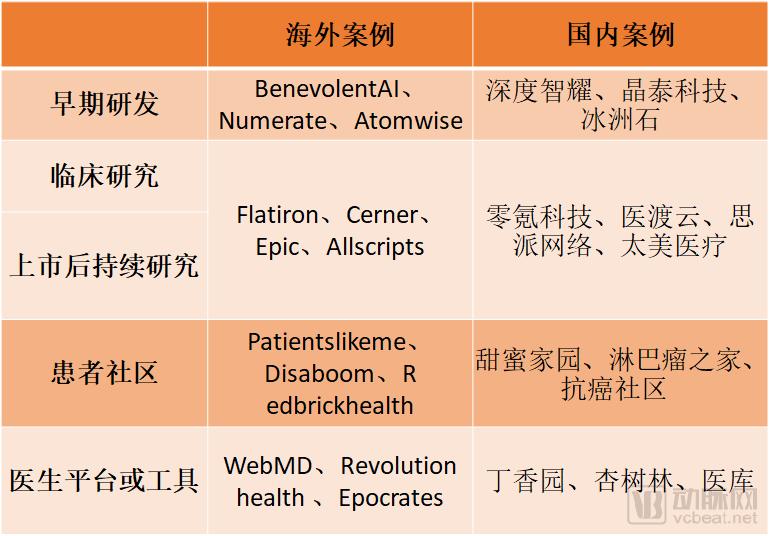
As a well-established pharmaceutical company, Pfizer has demonstrated great enthusiasm for digital transformation, exploring initiatives in AI-driven drug discovery, big data, digital marketing, and patient services.
Pfizer Digital Innovation Overview
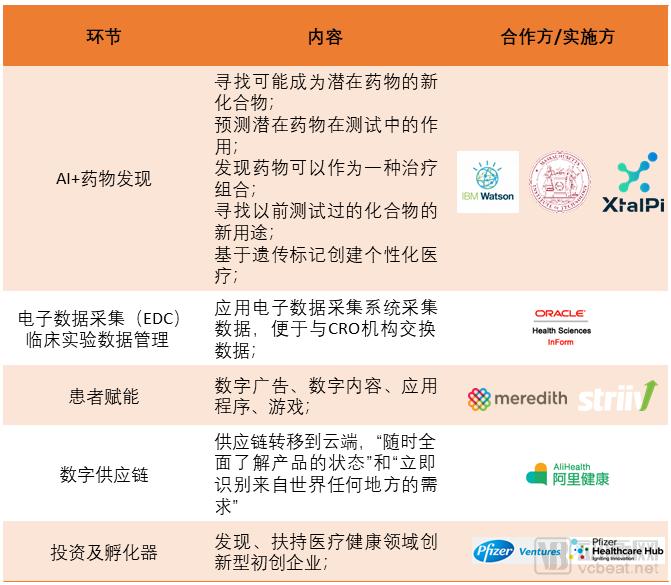
Analysis of the Reasons Behind Pfizer’s Digital Innovation
We can analyze the drivers behind Pfizer’s digital innovation from both internal and external perspectives. As previously mentioned, the pharmaceutical industry has been undergoing a digital transformation in recent years; as a company with an innovative DNA, Pfizer is naturally not lagging behind.
From an internal perspective, digital innovation can enhance the efficiency of Pfizer’s drug R&D, clinical research, marketing, and brand building, thereby accelerating the commercialization of drugs. This represents an investment in the “future.”
Secondly, digital innovation does not require substantial capital investment. For Pfizer, with annual revenues in the tens of billions of dollars, spending on digital innovation will not shake its foundations. Securing future growth opportunities at a relatively low cost makes this a highly cost-effective investment.
Furthermore, Pfizer’s digital innovation initiatives have not been without results. By collaborating with various technology service providers, the company has revamped its legacy processes and achieved notable progress in AI-driven drug discovery, clinical data management, and patient empowerment.
Next, let’s take a look at another set of data:
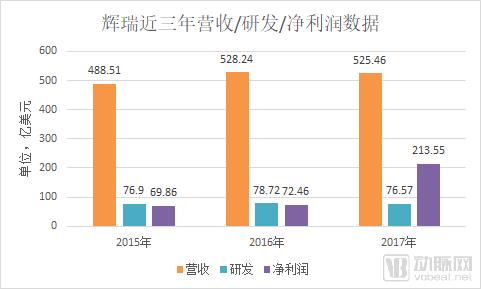
Data source: Pfizer Annual Report; Graphic by VCBeat
*The surge in net profit in 2017 stemmed from the Tax Cuts and Jobs Act (TCJA)
The data indicate that Pfizer is in a period of stable development, both in terms of revenue and R&D investment. It is precisely this stability that creates opportunities for digital innovation. Supported by its robust business performance, Pfizer has both the capability and the willingness to undertake digital innovation initiatives that will benefit its future operations.
Pfizer’s digital innovation initiatives will continue. For a century-old pharmaceutical giant, digital innovation injects vitality and energy into the organization—perhaps this is precisely why Pfizer has proactively embraced digital transformation.
Before delving into Pfizer’s journey of digital innovation, let us briefly review the company’s history.
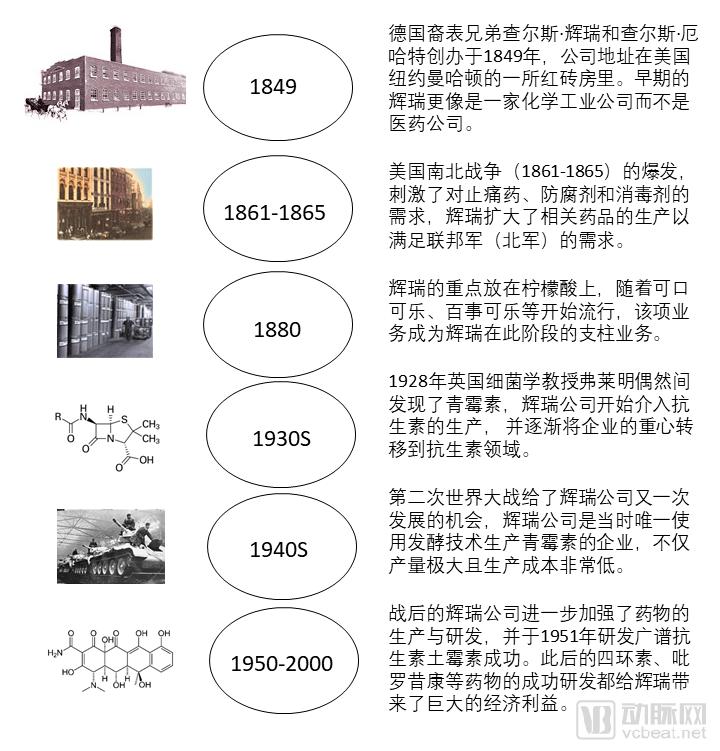
In 1998, sildenafil (Viagra), developed by Pfizer, was launched and achieved unprecedented success. Buoyed by the enormous commercial success of Viagra, Pfizer subsequently acquired Warner-Lambert for $93 billion and Pharmacia for $60 billion, becoming the largest pharmaceutical manufacturer in the United States.
Since the turn of the 21st century, Pfizer has further focused on its prescription drug business, gradually spinning off, selling, or taking public those businesses with lower relevance to its core pharmaceutical operations, including medical devices, animal health, and consumer healthcare products. For instance, in 2013, Zoetis, Pfizer’s animal health subsidiary, was spun off and listed publicly; it now has a market capitalization approaching $45 billion.
Marketing prowess is one of the key factors enabling Pfizer to maintain its competitive edge. Pfizer has expanded brand awareness and captured incremental market growth through advertising in professional journals, increasing the frequency of interactions with physicians, and providing medical education for patients. The most widely discussed case is the competition between Pfizer’s Lipitor and Merck & Co.’s Zocor. Although Zocor was initially the dominant new drug, Pfizer’s strategic marketing campaigns ultimately propelled Lipitor to the top position among cholesterol-lowering medications.
In addition, targeted acquisitions have been one of Pfizer’s most significant strengths. Through a series of acquisitions, Pfizer sequentially secured blockbuster drugs such as Lipitor, Celebrex, and Bextra, which not only effectively supplemented its product portfolio but also laid the foundation for sustained expansion. Data show that since 2000, acquired products have contributed more than 40% of Pfizer’s revenue.
Of course, sustained high R&D investment is also a key characteristic of Pfizer. According to Statista data, Pfizer’s cumulative R&D spending from 2006 to 2017 reached $96.8 billion. In 2017 alone, its R&D expenditure amounted to $7.657 billion, representing 14.57% of its sales revenue.
It can be summarized that during Pfizer’s first 100 years, the key to success lay in adjusting its business operations in response to strong market demand; after entering the “golden age” of drug discovery, the combination of marketing, acquisitions, and R&D became Pfizer’s “three-pronged strategy” for sustaining long-term competitiveness.
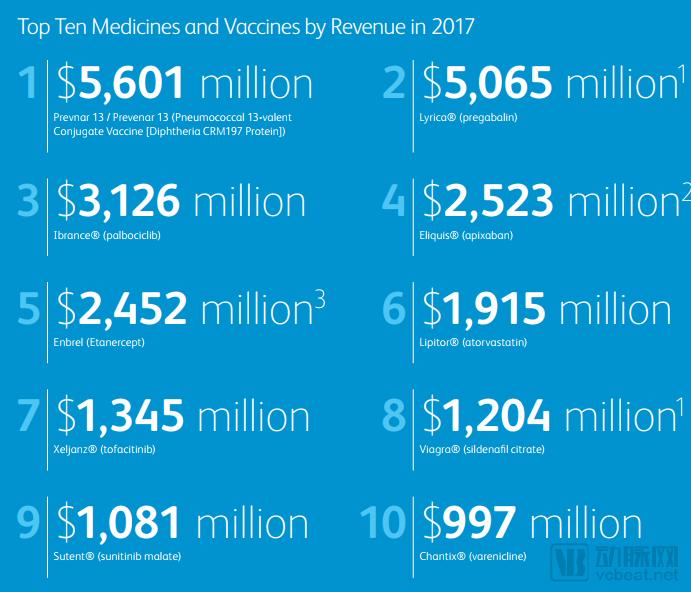
In 2017, Pfizer had 10 drugs that reached “blockbuster” status—achieving annual sales of $1 billion or more—including Prevnar 13 (pneumococcal vaccine, $5.601 billion), Lyrica (analgesic, $5.065 billion), and Ibrance (breast cancer, $3.126 billion).
Pfizer's Top 10 Drugs by Sales in 2017
Pharmaceutical companies are applying artificial intelligence and machine learning to drug discovery because the process is becoming increasingly “difficult” and “expensive.” Data from the Pharmaceutical Research and Manufacturers of America (PhRMA) show that it takes at least ten years to bring a drug from initial discovery to market, with approximately six to seven years devoted to clinical trials. Fewer than 12% of drugs entering clinical trials ultimately gain approval.
According to data from the Tufts Center for the Study of Drug Development, the average cost of developing and obtaining approval for a new drug is $2.558 billion. This figure is based on an estimated average direct cost of $1.395 billion and a time cost of $1.163 billion (the expected returns forgone by investors during the drug development period).
So some large pharmaceutical companies are trying to use AI:
l Identify new compounds with the potential to become drug candidates;
l Predict the role of potential drugs in testing;
l Discover that drugs can serve as a therapeutic combination;
l Identify new uses for previously tested compounds;
l Develop personalized medicine based on genetic markers;
This list of major pharmaceutical companies includes Pfizer, Roche, Novartis, Bayer, and others.
In December 2016, IBM announced that Pfizer would be among the first companies to leverage the Watson for Drug Discovery platform. This collaboration, focused on cancer treatment, aims to “help scientific researchers identify new drug targets and alternative drug indications.” Watson for Drug Discovery has already aggregated data from 25 million Medline abstracts and one million medical journal articles—a task that would require 200–300 human researchers a full year to complete.
Watson for Drug Discovery enables users to analyze “private data, such as laboratory reports,” and provides researchers with the ability to identify potential relationships between different datasets through “dynamic visualization.”
Albert Bourla, President of Pfizer Innovative Health, stated that the optimal approach to enabling the body to combat tumors is to combine certain drugs to stimulate the immune system. However, given the virtually infinite number of possible combinations, the greatest challenge lies in identifying methods to narrow down the options and predict which combinations may be more effective. Leveraging Watson, which has been trained on historical data, we are working to predict novel drug combinations.
In April 2018, Pfizer participated in a £1 billion ($1.4 billion) artificial intelligence investment initiative led by the UK government, with the funds designated to support technical research into AI applications across various industries.
In May 2018, Pfizer joined the MIT Machine Learning for Pharmaceutical Discovery and Synthesis Consortium. In the same month, Pfizer announced plans to expand its collaboration with Chinese tech startup XtalPi (Jingtai Technology) to develop an artificial intelligence platform for modeling small-molecule drugs as part of its discovery and development efforts. The project will combine quantum mechanics and machine learning to help predict the pharmaceutical properties of various molecular compounds.
In June 2016, Pfizer partnered with Oracle to adopt its Oracle Health Sciences InForm cloud service and Oracle Siebel Clinical Trial Management and Monitoring cloud service from the Oracle clinical trial suite.
Oracle’s cloud-based clinical trial module will help Pfizer share data with its contract research organizations (CROs)—Icon ($ICLR), Parexel ($PRXL), and PPD.
“Clinical teams will be able to access research data through Oracle’s cloud platform services, eliminating the need to exchange data back and forth with CROs, thereby saving time and reducing the cost of clinical studies,” said Rob Goodwin, Vice President at Pfizer, at the time.
In fact, it is very common for large pharmaceutical companies to apply EDC and clinical trial management information tools. The providers of this service include Oracle, Medidata, Veeva, etc. Medidata's clients include Boehringer and Bristol-Myers, while Veeva's clients include GSK, Bayer, Novartis, etc.
In its 2017 annual report, Pfizer stated that it was striving to improve patient engagement and provide better resources and information. These initiatives included:
l Stakeholder Engagement (Stakeholder Incentivization);
l Transforming How We Tackle Non-Communicable Diseases (NCDs);
l Supporting the Needs of Cancer Patients in the Community (Addressing the Needs of Cancer Patients in the Community);
l Empowering People to Take Health and Wellness into Their Own Hands (Enabling Individuals to Manage Their Own Health);
l Transforming Our Approach to Clinical Trials;
The specific details of the above initiatives include Pfizer launching its first digital advertising campaign targeted at U.S. patients in 2017, to help those in need understand how to access its medications; meanwhile, Pfizer partnered with Meredith (a digital content producer) to promote healthy living concepts through online articles, videos, and other content formats.
In April 2017, Pfizer partnered with two universities and Striiv, a wearable device company, to launch Hemocraft, an educational game for patients with hemophilia.tmand the wrist-worn wearable device HemMobile® Striiv® Wearable. HemocrafttmPatients can receive diagnostic and treatment recommendations through gamified interactions, while HemMobile® tracks daily activity levels and monitors heart rate to provide optimized clinical guidance.
In August 2017, Pfizer launched the “Pfizer Oncology Together” program to help patients using Pfizer’s cancer medications access treatment resources, emotional support, and financial assistance. As a complementary component, the program also includes a mobile application called “LivingWith.”
Pfizer stated that with advancements in treatment technologies, cancer survival rates will significantly improve, and many patients will live with the disease for extended periods. Therefore, providing long-term care for cancer patients should become an integral part of treatment.
Pfizer also operates a program called RxPathways, which is designed to help patients better understand diagnostic and treatment options as well as medication information, while facilitating access to drug supplies. The program also has a public welfare component, allowing patients to submit applications to obtain medications at reduced costs or free of charge.
With the advancement of cloud computing and big data technologies, it has become increasingly feasible to achieve end-to-end tracking and complex analytics across the supply chain, from initial testing to patient use. As generic drugs capture greater market share and regulatory requirements evolve, pharmaceutical companies are beginning to drive digital innovation within their supply chains.
Pfizer initially migrated its supply chain to the cloud in 2012, and in 2015, it launched a more sophisticated supply chain network. In its annual report, Pfizer stated that a digital supply chain enables “comprehensive, real-time visibility into product status” and “immediate identification of demand from anywhere in the world,” allowing the company to rapidly alert optimal manufacturing facilities to produce goods to meet such demand and ensure on-time delivery. This initiative is one of Pfizer’s strategic plans for the next five years.
A typical example occurred in March 2018, when Pfizer partnered with AliHealth to explore new pathways for “Internet + Traceability.” Leveraging the “one item, one code” concept of the “Code for Assurance” platform and internet-based traceability technologies, the collaboration aimed to help pharmaceutical companies establish end-to-end drug traceability systems, thereby safeguarding public medication safety.
Meanwhile, Pfizer aims to enter the e-commerce sector for prescription drugs, a domain previously restricted to paper prescriptions issued directly from physicians’ offices but now increasingly being replaced by online prescribing, ordering, and delivery. E-commerce for prescription medications will provide a more direct and cost-effective channel for drug distribution within the supply chain, while also enabling more granular service data for demand forecasting and other analytics.
In mid-July 2018, Pfizer announced a restructuring of its organization, dividing its business into Innovative Medicines, Established Medicines, and Consumer Healthcare. This move will enable Pfizer to focus on its innovative medicines business to better respond to market changes.
Pfizer has internally promoted the cultural philosophy of “Dare To Try.” The original intention of this initiative is to empower Pfizer’s more than 100,000 employees to fully leverage their creative thinking, think like entrepreneurs, challenge conventions, and take ownership. This philosophy has become an integral part of Pfizer’s corporate culture.
We believe that the concept of “Dare To Try” also aptly describes Pfizer’s efforts in digital transformation. This pharmaceutical giant has played an active role in the industry’s digital transformation, piloting digital innovation concepts and tools across nearly all aspects of its business operations.
Pfizer’s digital transformation offers three replicable takeaways:
l Embed the concept of innovation internally, cultivate an innovative DNA, and make innovation an integral part of corporate culture;
l Rapidly identify areas suitable for digital innovation and assess their feasibility;
l Partner with established service providers—such as IBM and Oracle—to pay for innovative services.
Certainly, in addition to digital innovation, Pfizer has also undertaken numerous innovative initiatives in other areas, including:
Real-World Data and Research
Collect medical and non-medical information through technology and partners, and generate actionable diagnostic, treatment, and rehabilitation recommendations by analyzing the data;
Analytics-Driven Services
Provide personalized care services by analyzing existing service models and partnership relationships;
Precision Diagnosis and Treatment
Utilizing novel testing equipment and sensors for the diagnosis, monitoring, and management of healthcare services;
Healthcare Decision Support Tools
Web- or mobile-based tools that provide information to physicians and patients for the diagnosis, monitoring, and management of healthcare.
Open Innovation Platform
Collaborate with researchers, suppliers, customers, and patients to develop new solutions.
While actively pursuing internal innovation, Pfizer has also launched a healthcare startup incubation program. Named the Pfizer Healthcare Hub, the initiative was established in London in 2017 with the aim of helping startups scale their products and advance business development. This competition offered three startups the opportunity to win a £50,000 prize. In 2017, digital health companies Cera, Give Vision, and Echo emerged as the winners.
In Decisive Moments in History, the Austrian writer Stefan Zweig wrote that in the great moments when destiny strikes, all the civic virtues—caution, obedience, diligence, and prudence—are of no avail; it demands only genius and forges it into an immortal figure. Destiny scornfully shuts its doors on the timid, choosing instead to lift the brave high with passionate arms, carrying them to the heaven reserved for heroes.
Digital Innovation Sweeps the Pharmaceutical Industry: Will Pfizer Become the Hero of This Era Again?