

BeiGene Lists on HKEX Following Nasdaq Debut, Becoming Second Unprofitable Biotech to Join Hong Kong Bourse
On August 8, 2018, the Hong Kong Stock Exchange welcomed another biotechnology company following Ascletis Pharma. Six days after announcing its initial public offering in Hong Kong, BeiGene officially listed on the Hong Kong Stock Exchange.
Image from BeiGene's official website
It is understood that BeiGene will conduct its initial public offering in Hong Kong and a global equity offering of 65,600,000 ordinary shares, with a par value of $0.0001 per share (the “Shares”), at an offering price of HK$108 per share. Based on the fixed exchange rate of US$1 to HK$7.8478, the public offering price is equivalent to US$13.76 per Share, or US$178.90 per American Depositary Share (ADS).
This was actually BeiGene’s second bell-ringing ceremony. The company had already listed in the United States and successfully gone public on the NASDAQ as early as 2016, becoming the first Chinese biotechnology enterprise to be dual-listed on both the NASDAQ and the Hong Kong Stock Exchange.
BeiGene was founded in 2010 and is a commercial-stage biotechnology company focused on the development and commercialization of innovative molecularly targeted and immuno-oncology therapies for the treatment of cancer. The company employs more than 1,300 people worldwide, including over 650 scientists and clinical medicine experts in China, the United States, Australia, and Switzerland.
In addition, they have offices in Beijing and Shanghai, China; Cambridge, Massachusetts; Fort Lee, New Jersey; Emeryville and San Mateo, California, USA; and Basel, Switzerland. They have established a research and development center in Beijing, production bases in the major cities of Suzhou and Guangzhou, and a commercial operations center in Shanghai.
Over the past eight years, BeiGene has evolved into a fully integrated global biotechnology company, with a portfolio comprising six internally discovered, clinical-stage drug candidates, including three in late-stage clinical development.
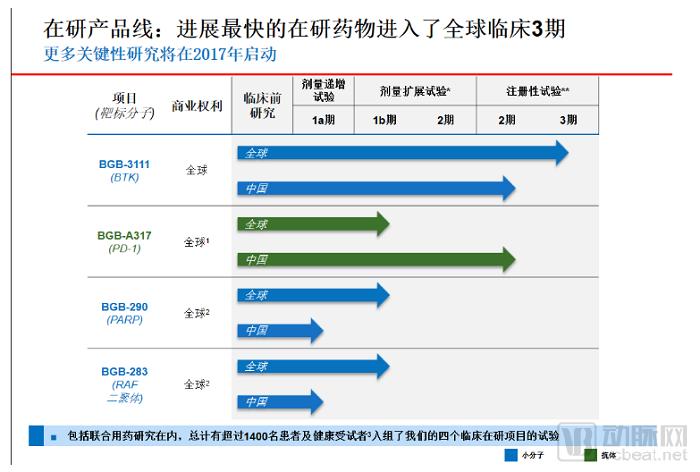
Image from the official website of BeiGene
Among these, zanubrutinib is an investigational small-molecule BTK inhibitor. Registrational clinical trials evaluating zanubrutinib as monotherapy and in combination with other therapeutic modalities for various types of lymphoma are being extensively conducted globally and in China.
Tislelizumab is an investigational humanized monoclonal antibody targeting the immune checkpoint receptor PD-1. Its registrational clinical trials are currently underway in China. Meanwhile, the company also plans to conduct global registrational clinical trials evaluating tislelizumab as a monotherapy and in combination with other therapeutic modalities for various solid tumors and hematologic malignancies.
Pamiparib is an investigational small-molecule inhibitor targeting PARP1 and PARP2, with its potential efficacy as a monotherapy and in combination regimens for various solid tumors currently under evaluation. Pamiparib (BGB-290) is currently in pivotal clinical trials in China and is expected to enter late-stage clinical development globally in the near future.
In terms of business collaboration, BeiGene has maintained a close partnership with the pharmaceutical giant Celgene.
In 2017, BeiGene entered into a strategic collaboration with Celgene, granting Celgene exclusive rights to develop and commercialize tislelizumab (BGB-A317) for solid tumors in the United States, Europe, Japan, and other regions outside Asia. BeiGene retained the rights to develop and commercialize tislelizumab for solid tumors in Asia (excluding Japan), as well as global rights for the treatment of hematologic malignancies and for internal combination therapies.
In return, BeiGene obtained exclusive rights to Celgene’s approved drugs in China—Abraxane® (paclitaxel for injection, albumin-bound), Revlimid®, and Vidaza®—and took over its commercial operations team in the country.
This enabled BeiGene to begin generating product sales revenue from September 2017, laying the foundation for the future commercial launch of its independently developed drug candidates and drugs planned for in-licensing.
Following this relisting, BeiGene plans to use the proceeds from the offering to fund clinical trials, prepare regulatory filings, and launch and commercialize its core candidate products (zanubrutinib, tislelizumab, and pamiparib), so as to continuously expand its portfolio in oncology and other potential therapeutic areas, as well as for working capital, expanding internal capabilities, and general corporate purposes.
As of press time, BeiGene’s share price on the Hong Kong Stock Exchange fell by 2.31%, while its stock on the Nasdaq continued its positive momentum, rising by 1.53%. Recall the post-IPO share price trend of Ascletis Pharma; neither of these two biotech companies met initial market expectations after their listings in Hong Kong.
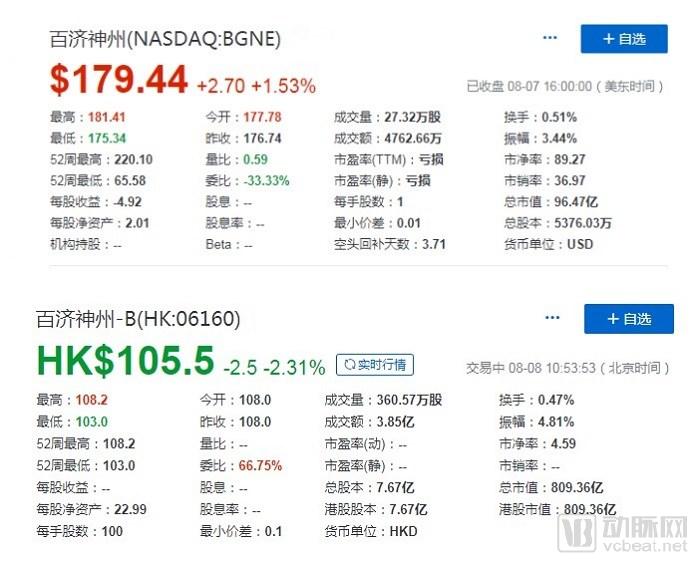
Image from Xueqiu
However, it took decades for the Nasdaq to evolve from its inception to today’s prosperity. BeiGene’s decision to list on the Hong Kong Stock Exchange after its Nasdaq debut, along with the surge of unicorn companies seeking listings in Hong Kong, underscores the market’s enduring optimism toward this venue.