

Soyoung Releases 2018 Medical Aesthetics Industry White Paper: Market Size Expected to Reach RMB 22.45 Billion, with Intimate Plastic Surgery as the Fastest-Growing Segment

Since 2015, SoYoung has released an annual White Paper on the Medical Aesthetics Industry to summarize development trends in the sector and increase public awareness of this emerging field. By 2018, the report had been published for four consecutive years.
VCBeat (WeChat: vcbeat) has learned that this year’s white paper was released on August 8 at the headquarters of So-Young in Beijing. Zhu Meiru, Secretary-General of the Chinese Association of Plastics and Aesthetics, and Wu Xiaochen, a renowned figure in the plastic surgery community, attended the launch event, which drew dozens of media professionals from both China and abroad.
“SoYoung 2018 White Paper on the Medical Aesthetics Industry” retrieved online data from SoYoung’s backend covering 35 million users, sampled 1 million order records, and conducted a comparative analysis across a three-year timeframe. Offline, it involved visits and surveys of 138 medical aesthetics institutions, while also reviewing and citing public data from third-party organizations such as the International Society of Aesthetic Plastic Surgery (ISAPS), Deloitte, and Analysys.
The “SoYoung 2018 White Paper on the Medical Aesthetics Industry” reveals seven major development trends in China’s medical aesthetics sector, namely:
First, ChinaThe Medical Aesthetics Market Size May Reach 224.5 Billion Yuan, representing a year-on-year growth rate of 27.57%. Compared with South Korea, there is still sixfold room for growth, which implies that hundreds of millions of consumers will engage in medical aesthetics spending in the future. Over the next decade, China’s trillion-yuan medical aesthetics market will gradually unfold;
Second, the currentChina has nearly 20 million consumers of medical aesthetics services., among every 100 Chinese medical aesthetics consumers, 64 are post-90s and 19 are post-00s. The post-90s generation has become the absolute mainstay of cosmetic surgery, while the post-00s generation is demonstrating an even stronger momentum in initiating medical aesthetics consumption. Taking the proportion of Chinese medical aesthetics consumers aged under 19 as an example, it was 15.44% in 2017 and 18.81% in 2018;
Third, consumer data indicate that medical aesthetics has become part of the daily lives of the post-90s generation. From graduation and job hunting to dating, marriage, and childbearing, individuals are turning to aesthetic procedures to embrace life’s transitions with enhanced appearance and confidence. Data from the past two years suggest that this trend is beginning to extend to the post-00s generation, making medical aesthetics a lifestyle choice for them as well—a trajectory that SoYoung predicts will intensify in the coming years.
Fourth,The proportion of male medical aesthetics consumers in China is 11.12%., slightly lower than the international average of 13.8%. Although men constitute a smaller demographic, they are more willing to spend generously; the average transaction value for male aesthetic medicine consumers is RMB 7,025, which is 2.75 times that of women. Men worldwide who prioritize their appearance are investing heavily in hair-related treatments.
Fifth, big data on consumer procedure selection reveals that Chinese and global aesthetic medicine consumers share common beauty standards: smooth and radiant skin, well-defined facial contours, large eyes with double eyelids, augmented breasts, a slim waist, long legs, a high and elongated hairline, and abundant hair.
Sixth,Among the fastest-growing medical aesthetic procedures, China’s intimate plastic surgery sector ranks first in growth rate.. Medical aesthetics itself represents a form of consumption upgrade, while intimate plastic surgery constitutes an advanced tier within this upgrade;
Seventh, the average online price of medical aesthetic procedures has decreased by 29% over the past three years, primarily because medical aesthetic apps have made transactions more transparent and open.
Wu Xiaochen, a prominent influencer on SoYoung, recently stated in a Tencent-produced talk show featuring conversations with strangers: “We often joke in conversation, saying, ‘Look, this face is like a fully furnished apartment, this one is luxury-renovated, and that one is just a bare shell.’ That’s how we describe women’s faces.”
The conversation later went viral under the title “Spending 4 Million Yuan on Plastic Surgery Over 15 Years.” After the program aired, Wu Xiaochen’s image of intelligence, rationality, and confidence revealed to the public a lesser-known side behind the beautiful faces of women who have undergone plastic surgery.
Wu Xiaochen is a phenomenon; standing alongside her is China’s current aesthetic medicine consumer base of nearly 20 million. They are confident, autonomous, courageous, and self-assured.
According to the So-Young 2018 White Paper on the Medical Aesthetics Industry, out of every 100 Chinese medical aesthetics consumers, 64 are born in the 1990s and 19 in the 2000s. Those born in the 1990s have become the absolute mainstay of cosmetic surgery, while those born in the 2000s are demonstrating even stronger momentum in medical aesthetics consumption than their 1990s counterparts. The primary driver for these consumers to undergo procedures is self-gratification; cosmetic enhancements help them move past previous traumas and, through acquired beauty, build a more confident and self-loving sense of self.
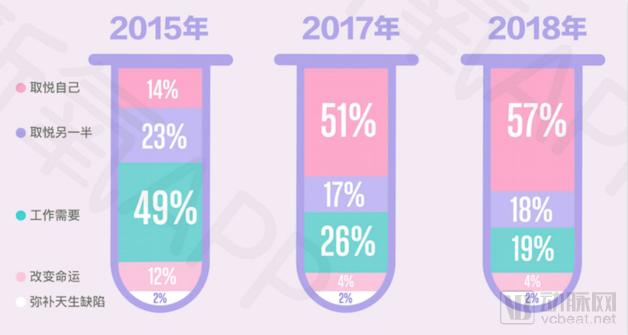
Consumer Aesthetic Surgery Objectives
So, what is beauty? The SoYoung Encyclopedia has included a total of 393 medical aesthetic procedures, covering nearly all parts of the body from head to toe, including skin, fat, and bones. Based on big data analysis of consumer procedure selections, Chinese and global medical aesthetic consumers share common standards for beauty: smooth and radiant skin, well-defined contours, large eyes with double eyelids, augmented breasts, a slim waist, long legs, a high and elongated hairline, and ample hair volume.
Specifically in China, people across different regions are making varied efforts to align with the aforementioned standards; for instance, residents of Hangzhou are keen on treating hair loss, those in Guangzhou seek to avoid flatness (e.g., in facial contours), Shenyang locals favor facial contouring surgery, and Tibetans pursue skin whitening.
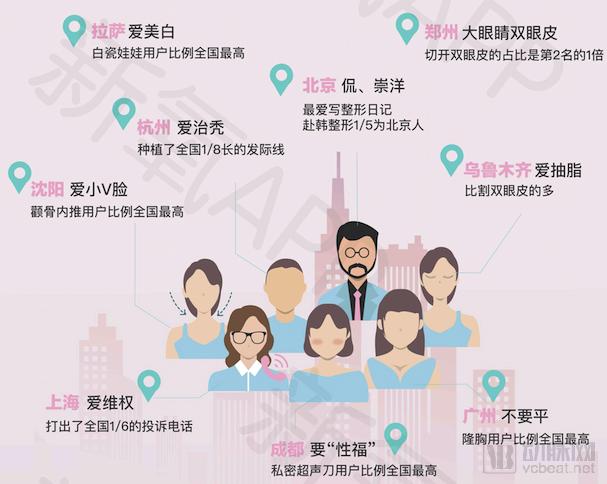
Regional Preferences in Medical Aesthetics Consumption in China
Judging from consumer data, medical aesthetics has become an integral part of the daily lives of the post-90s generation. From graduation and job hunting to dating, marriage, and parenthood, individuals are turning to aesthetic procedures to embrace life’s transitions with enhanced confidence and well-being.
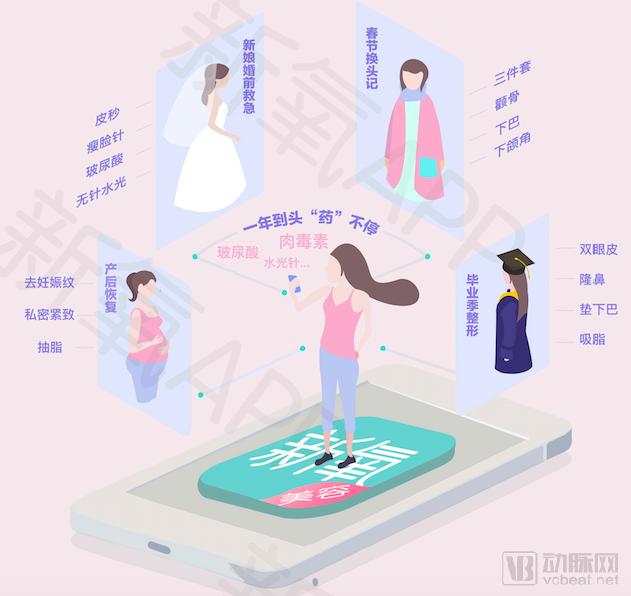
Chinese Medical Aesthetics Consumers' Treatment Preferences
Based on consumer data from the past two years, the trend of medical aesthetics becoming a daily lifestyle for the post-00s generation is already emerging. SoYoung predicts this trend will intensify, driven by the post-00s’ strong willingness to enhance their appearance through non-congenital means, alongside advancing technology and increasingly open social attitudes. Data shows that the proportion of young consumers in the medical aesthetics market is increasing year by year. For instance, among Chinese medical aesthetics consumers, those aged 19 and under accounted for 15.44% in 2017 and 18.81% in 2018.
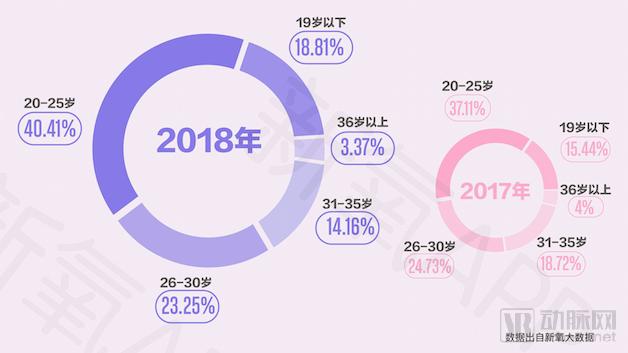
Age Distribution of Medical Aesthetics Consumers in China
Change Has Arrived: How Should We Respond? Jin Xing, CEO of SoYoung, stated that the average age of medical aesthetics consumers in China is 10 years younger than that in the United States. Their aesthetic and consumption perspectives are not yet fully mature, thus necessitating proper education on medical aesthetics. For instance, SoYoung’s official WeChat account reached 120 million users in 2017, promoting the values of “rational cosmetic procedures, safe beauty enhancement, and holistic self-improvement” to potential consumers.
SoYoung projects that China’s medical aesthetics market will reach RMB 224.5 billion in 2018, representing a year-on-year growth rate of 27.57%. Compared with South Korea, there is still sixfold room for growth, which means that hundreds of millions of people will consume medical aesthetic services in the future. Over the next decade, China’s trillion-yuan medical aesthetics market will gradually unfold.
Founded in 2013, So-Young’s platforms—the So-Young App and So-Young Website—recorded 114 million unique visitors in 2017. In the same year, So-Young’s online gross merchandise volume (GMV) exceeded RMB 6 billion, representing a 300% year-on-year increase, thereby establishing a comprehensive database of medical aesthetics consumption.