

Can Tencent-Backed Healthcare Star 'Penguin Almond' Break Through to Monetization?
On the evening of August 8, news of the merger between Penguin Doctors and Xingren Doctors, sparked by an internal letter from Xingren Doctors, rapidly circulated across WeChat Moments and various WeChat groups.
Subsequently, in an effort to verify the authenticity of the information, investment institutions associated with the enterprise and relevant stakeholders from both companies were subjected to intense scrutiny, in hopes of obtaining a reasonable explanation or reconstructing the merger process.According to a representative from Penguin Doctor, within three hours of the news breaking, phone calls and WeChat messages poured in nonstop, underscoring the high level of public interest in the announcement.
After VCBeat (WeChat ID: vcbeat) reporters promptly contacted both companies and confirmed the authenticity of the news, it was announced that on August 9, Penguin Doctor and Xingren Doctor signed a strategic merger agreement. The two parties will combine their strengths in platforms, resources, and technology to create synergies. Following the merger, the new group company will be collectively known as “Penguin Xingren,” while the existing platforms of “Penguin Doctor” and “Xingren Doctor” will continue to operate under their original names.
The post-merger management team has also been integrated, with Wang Shirui, founder of Penguin Doctor, serving as Chief Executive Officer; Martin, founder of Almond Doctor, serving as President; and Xu Lin serving as Chief Operating Officer of the new company. Penguin Almond will establish an integrated online-to-offline comprehensive health service system, committed to leveraging technology to make high-quality health and medical services accessible to all.
Why has Penguin Almond attracted significant attention? What were the reasons behind the merger of the two parties? How will they develop post-merger? How will the teams integrate? What are the future plans?With these questions in mind, VCBeat interviewed industry insiders and key figures from both companies, aiming to obtain relatively comprehensive answers.
According to a key figure from the Xingren Doctor team, preparations for this merger began several months ago, with the deal finalized recently. The leak of this news was entirely unexpected.
It’s akin to when Lu Han suddenly announced his relationship with Guan Xiaotong on Weibo, causing the platform’s backend servers to crash multiple times. While mergers in the business world do not wield such massive influence, they still stir considerable public curiosity.
This incident quickly spread across WeChat Moments. Upon investigation, we found that Penguin Almond exhibits the following factors:
First, the enterprises involved in this merger includePenguin Doctor and Xingren Doctor. Both are star startup projects that have secured funding frequently.Let us first review the financing histories of Penguin Doctor and Almond Doctor:
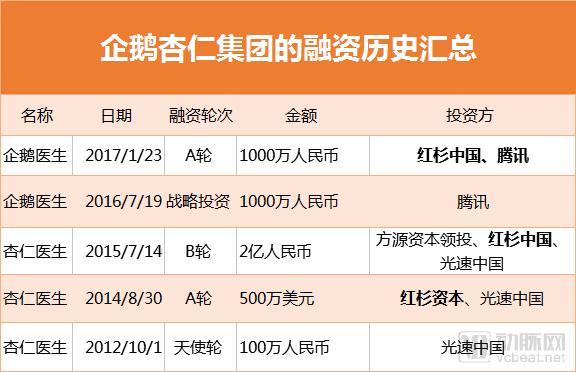
As shown in the chart, the merged Penguin Almond,The previous total financing amount exceeded RMB 250 million.。
Meanwhile, the founders of both companies are star entrepreneurs.One is Wang Shirui, and the other is Dr. Martin.Wang Shirui concurrently oversees Medlinker and Penguin Doctor.He graduated from the West China School of Stomatology, Sichuan University, and served as a visiting scholar at Harvard University. Upon returning to China, he founded Medlinker and established Penguin Doctor in May 2016. In February 2016, he was named to Forbes Asia’s “30 Under 30” list of entrepreneurs; in December 2016, he was selected for Fortune (Chinese Edition)’s list of “40 Business Elites Under 40 in China for 2016.”
Dr. Martin, Who Oversees Almond Doctor, He is an Australian-Chinese, a former military doctor in the United Nations Peacekeeping Forces, and a general practitioner in Australia. He serves as the founder and CEO of Almond Doctor. Dr. Martin has over eighteen years of experience in the medical field, including clinical practice, hospital management, and medical informatics.
Second,Penguin DoctorIn June 2016, it was jointly established by Tencent, Medlinker, Gaw Capital, and Sequoia Capital.Can be described as Tencent’s “core” forces. Any company associated with or invested in by Tencent is under intense scrutiny for its every move.Moreover, its CEO is Wang Shirui, the founder and CEO of Medlinker.
Penguin Doctor has built a customer-centric health management service system through its diverse product lines, including consumer-facing online services, institutional information management systems, offline intelligent hardware testing terminals, and general practice Penguin Doctor clinics.
On April 20, 2017, the Medical Sub-forum of the 2017 China “Internet+” Digital Economy Summit, hosted by Tencent,Wang Shirui delivered a keynote speech titled “How General Practice Clinics Can Realize Value: An Exploration of the ‘Online Hospital + Offline Clinic’ Model,”VCBeat provided comprehensive coverage of the event. The articles not only garnered high view counts but also received high praise from healthcare professionals. One reader commented:“Penguin Doctor’s business model is so exciting and refreshing; this is the kind of healthcare I want to deliver.”
Third, all three projects are internet healthcare initiatives, inherently benefiting from the high visibility and popularity of the internet healthcare sector.For a long time, the internet healthcare model,Although it has attracted significant capital attention, its profitability model remains a persistent weakness.
Therefore, the development paths of most internet healthcare enterprises,From a purely online model, it has gradually expanded offline, penetrating core healthcare scenarios and exploring monetization pathways.Even Penguin Doctor, backed by Tencent’s powerful DNA, has yet to find a viable monetization model; any developments concerning the company send ripples through the internet healthcare startup community.
So, why were Penguin Doctor and Almond Doctor able to successfully merge? One is a core team directly under Tencent, and the other is a star startup team. After the merger, there will inevitably be some changes brought to the original companies.
Wang Shirui told VCBeat, “Penguin and Almond have many areas of synergy; this merger is a perfect integration of two outstanding teams who share the same vision and possess complementary strengths.”
For example, in terms of business model construction, Penguin Doctor has always focused on providing high-quality, safe, and full-process health management services for individuals and families. Currently, it has established 23 Penguin Doctor clinics in Beijing, Chengdu, and Shenzhen. It is expected to open 300 directly-operated clinics, connect with 3,000 alliance clinics, and deploy 30,000 shared health monitoring terminals within the next three years.
In Wang Shirui’s vision, clinics remain the offline entry point; in addition to building proprietary clinics, a high-quality clinic alliance should also be established.The high-quality clinic alliance system, selected according to Penguin Clinic’s standards, scales up the clinic entry point and effectively expands user coverage. Regarding clinic scale, Wang Shirui stated that Penguin Doctor would not open clinics one by one on its own; instead, it collaborates with clinics by providing them with systems and management services, thereby becoming part of a clinic alliance. To this endCreating an Entry Point for Health Services—— Shared Clinic.Create user health data access portals and provide the most convenient entry points for health services by deploying shared testing devices.
This is very similar to the current approach of Xingren Doctor.A core figure at Xingren Doctor stated,“In light of this, our two platforms have complementary business models, which facilitated our merger.“During our negotiations, we also expressed strong endorsement of the partnership. In fact, success in the healthcare sector requires a synergistic integration of capital, brand strength, and platform capabilities. We hope that, with the robust support of a powerful platform like Tencent, Penguin Almond will achieve more rapid growth.”
VCBeat, in reviewing the past, has found it not difficult to discover thatPenguin Doctor and Xingren Doctor not only share a similar pace of development but also have a common investor—Sequoia Capital.
A core tenet of Sequoia Capital’s investment philosophy is its emphasis on “track” strategy, which involves making multiple investments within the same sector. For instance, the 2015 merger of Meituan and Dianping was facilitated by Sequoia Capital.At the time, Wang Xing, founder of Meituan, stated,Sequoia has always been a steadfast investor in Meituan,Meituan and Dianping merged, with Sequoia Capital, as the most significant investor on both sides, playing a highly active role.By analogy, does the emergence of Penguin Almond lead us to wonder whether Sequoia Capital also played an active role?
In terms of development, Xingren Doctor and Penguin Doctor both engaged in rapid market expansion in 2018, continuously extending their reach outward.
First, let us look at Penguin Doctor. Between May and June 2018, there were four major corporate events involving public announcements.
On May 17, a strategic cooperation agreement was signed with Hong Kong’s EC Healthcare Group Limited. The two parties will join forces to open multiple general practice clinics in Hong Kong, introducing Penguin Doctor’s “smart clinic medical closed-loop model” to the Hong Kong healthcare market;
On May 29, a partnership was established with Shangmei Group to empower commercial real estate with healthcare services;
On June 1, a strategic cooperation agreement was signed with Gemdale Corporation. Leveraging the complementary strengths of both parties, this partnership will unfold deep, multi-channel strategic collaboration across smart health communities, commercial complexes, elderly care communities, and shared hospitals, jointly developing China’s consumer healthcare and wellness market;
On June 30, Wang Shirui delivered a well-received talk titled “We Hope Future Health Management, Including the Allocation of Medical Resources, Will Be as Simple as Possible.”
Almond Doctor has successively partnered with various organizations, including Babytree, Nestlé, Zhang Qiang Doctor Group, and Woyi Doctor Group.
It is worth mentioning that the Zhang Qiang Doctor Group signed an agreement with Xingren Clinic for both Guangzhou and Shenzhen in a single transaction.The collaboration involves the establishment of a Venous Disease Center by Dr. Zhang Qiang’s Doctor Group at Xingren Clinic. Xingren Clinic will provide medical facilities, basic equipment, and patient operations support. Furthermore, both parties will join forces to create innovative healthcare services across multiple areas, including hardware services, clinic operations, and patient management.
It is evident that both parties maintained a similar pace in their expansion during the early stages. Therefore, the merged entity, Penguin Almond, not only benefits from mutual resource complementarity but may also achieve seamless operational synergy.
In terms of corporate culture, both parties share an open, collaborative, and win-win mindset., and has repeatedly conveyed this stance to industry insiders in public settings.
In terms of positioning, it builds platforms and serves as a connector. According to Wang Shirui’s previous views, the “connector” encompasses three aspects:
First, the integration of online and offline channels.Connect internet-based users with clinics, integrate online and offline resources, adopt a WeWork-style model for physicians, and provide health services.
Second is the connection between offline and offline.Tencent has substantial online traffic, and in the future, all internet partners beyond Tencent itself will be able to refer patients they wish to manage to offline management platforms for care coordination.
Third, the connection between tiered diagnosis and treatment systems and medical consortia.In addition to visiting clinics, patients may seek care at tertiary hospitals on a very infrequent basis, or even opt for overseas medical services. As a connector, Penguin Doctor provides initial screening and tiered diagnosis and treatment services, facilitating two-way referrals within traditional medical consortia. To date, it has received invitations from nearly a dozen tertiary hospitals.
Specifically, Penguin Doctor integrates six key areas: information, services, products, data, technology, and finance.
1. Connection Information.Provide C-end user members with grouped medical and health information and health solution content; provide content sections for media companies;
2. Connect to the service.Provide health management services, build a medical service chain, and innovate healthcare delivery. Services include home-based care, online consultations, and clinic-based care.
3. Connect the product.Including smart wearable devices, pharmaceuticals, and health foods. Penguin Doctor engages in the processes of importing medications from overseas and facilitating overseas medication purchases, thereby necessitating connectivity with pharmaceuticals, health supplements, and related products.
4. Connect to data.Including hospital data, clinic data, and personal data.
5. Connection Technology.Current AI is still in the early stages of on-site data acquisition, performing basic data cleaning and structuring, and identifying application scenarios. However, within five years, there will undoubtedly be robust solutions for effective scenario implementation.
6. Connected Finance.By integrating insurance product resources, we have launched HMO-style cost-containment medical insurance financial solutions tailored to Penguin Doctor’s customer base. In terms of medical finance solutions, Penguin Doctor also provides patients with mutual aid services and medical installment payment options, alleviating short-term financial strain.
Xingren Doctor is positioned to serve physicians by providing a comprehensive personal practice platform.
In 2014, Xingren Doctor launched the first SaaS/CRM studio platform for physicians. At that time, while many others were still offering platforms for appointment registration, outpatient services, and social networking, Xingren Doctor had already amassed 430,000 real-name verified physicians.
In 2016, Xingren Doctor pioneered the WeWork-style shared outpatient clinic model. The “WeWork operating model” refers to a business arrangement in which Xingren Doctor handles all complex tasks—including site selection, design and renovation, equipment procurement, license applications, and staff recruitment—to establish and fully equip a standardized outpatient clinic, as well as to undertake its ongoing maintenance and management. Physicians then practice at multiple sites directly within these facilities, with medical service revenues shared between the physicians and Xingren Doctor.
In 2017, Xingren Doctor partnered with physicians to establish four comprehensive outpatient clinics in Shanghai, Guangzhou, Chengdu, and Shenzhen.
In a sense, the platform of Xingren Doctor also possesses "connectivity" attributes. It connects doctors on one end and patients on the other, providing more convenient medical services for both parties.
Mu Yifei, Executive Director of Tencent Investment, stated: “Tencent has long engaged in extensive reflection and exploration on how to leverage internet technologies and platforms to enhance the quality and accessibility of healthcare services across the entire industry, thereby promoting equitable, inclusive, and convenient medical care. The merger between Penguin Doctor and Almond Doctor represents a powerful combination of online and offline healthcare service operational capabilities. We look forward to leveraging Tencent’s large-scale platform support and resource integration to connect the public with reliable health and medical resources through more innovative and efficient means, truly making high-quality healthcare accessible to all.”
In summary, the merger between Penguin Doctor and Almond Doctor can be described as a “union” of shared values. Although it may appear to outsiders as a “whirlwind marriage,” “marrying for love” is a beautiful thing.
According to Wang Shirui's response,“I have known Dr. Martin and Xu Lin for a long time, and we have always had great rapport. We share highly aligned perspectives on the development vision of internet healthcare and the broader health industry. Moreover, their team is exceptionally down-to-earth. I believe that to truly excel in the health sector, we need partners like Xingren to go further together.””
He further added,“Following the merger, we will leverage the respective strengths of both teams to coordinate efforts across online and offline channels, thereby accelerating the development of our comprehensive health service ecosystem.”
The online and offline comprehensive health service system mentioned here can be referenced against his previous vision, as shown in the figure:
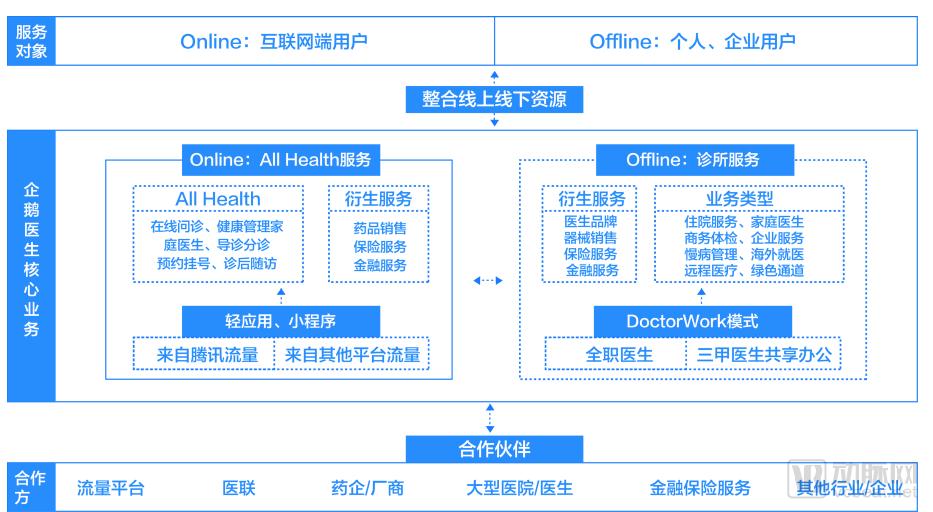
(Image source: A slide shared by Wang Shirui at the Healthcare Sub-forum of the 2017 China “Internet+” Digital Economy Summit, hosted by Tencent)
On June 30, 2018, Wang Shirui redefined the general practice model of Penguin Clinic, aiming to provide users with comprehensive and heartfelt care throughout their healthcare journey. According to him, the clinic is capable of diagnosing and treating 80% of common daily ailments, offering one-stop medical services through a “specialty-focused, generalist-supported” approach.
In this process, each user is matched with a “family doctor” available 24/7 to provide care throughout their entire life cycle, from birth to death. The family doctor proactively helps prevent potential health issues by identifying underlying risks through in-depth data analysis and continuous tracking. By leveraging data monitoring and routine clinical assessments conducted at clinics, we can anticipate health problems that may arise in the future.
At this stage, Penguin Clinic is no longer just a clinic; it has evolved into a health-focused space and connector. Meanwhile, we will seek out the best partners worldwide across services, finance, information, technology, and data, inviting everyone to collaborate in bridging online platforms with offline health platforms.
The establishment of Penguin Almond signifies the emergence of the initial framework for Tencent’s healthcare sector. According to data from VCBeat, by the end of 2017, Tencent had invested in a total of 35 healthcare companies, with total investments exceeding RMB 20 billion.
In fact, Wang Shirui has mentioned more than once in his public speeches the need to establish more clinics and capture offline entry points.It is evident that Tencent has allocated substantial funds to establish clinics in this sector. However, after operating this model for a period, it was found to be progressing at a slow pace, thereby necessitating the acquisition of other targets. Currently, however, there are limited acquisition targets available on the market.
In his speech at the end of December 2017, Wang Shirui mentioned that Penguin Doctors initially aimed to follow the “Starbucks” model, i.e., establishing 100 clinics in China based on the template of certain high-end overseas clinics.However, after calculating the costs, he realized that time had become the single largest cost factor in the entire endeavor. A comparison between opening 100 clinics over five years and achieving market entry within six months revealed that the five-year approach consumed six times more resources than the six-month one. He believed that rather than expanding gradually, it would be better to make a substantial upfront investment: allocating RMB 1 billion to establish 300 clinics within two years.
During the initial phase of operations at its three clinics, Penguin Doctor was also testing the maximum cost threshold. Wang Shirui believes that,Scaling is the essence of Penguin Doctor’s business model. While it is feasible for Penguin Doctor to operate five to ten high-quality clinics with floor areas ranging from 1,000 to 5,000 square meters, focusing solely on clinic operations over a five-year period would be unnecessary.
Tencent’s strategy in the healthcare sector is to build a “connector.” If Penguin Doctor were to establish clinics, it would certainly do so at the largest possible scale, as this aligns closely with Tencent’s overarching strategic framework.Therefore, in its later-stage planning, Wang Shirui presented a set of figures: Penguin Doctor plans to rapidly expand its primarily offline entry points by self-building 300 clinics, establishing a clinic alliance with a scale of 3,000 members, and deploying 30,000 shared testing devices.
As of June 30, 2018, Wang Shirui had planned to open 100 clinics across China; however, only 35 have been established in the country, with operations not yet fully rolled out. This falls far short of the target of building 300 self-operated clinics.
Penguin Doctor has a strong DNA for internet-based healthcare. Although its initial strategy followed an online-plus-offline model, the internet healthcare sector still faces a significant challenge today: how to align revenue with the massive infrastructure investments required. In this context, integrating online and offline services has emerged as a relatively viable path, making the acquisition of medical assets and revenue generation an inevitable step.
Following the merger, Penguin Almond will become China’s largest platform for physicians’ multi-site practice. The combination of Penguin Doctor’s strategy with Almond Doctor’s execution and operational plans will enable Penguin Almond to rapidly expand its clinic coverage.
Data from Xingren Doctor shows that in the fourth month after the official opening of its Shenzhen outpatient clinic, 168 surgeries were performed, generating RMB 1.08 million in revenue and achieving break-even.
Its success is mainly reflected in two aspects: the establishment and operation of clinics.In terms of establishment, the facility was jointly funded by physicians and clinics, demonstrating physicians’ strong trust in Xingren.In most cases, healthcare institutions pay physicians; we have yet to see other platforms where physicians are willing to pay institutions. When we launched the partner clinic recruitment campaign, we raised RMB 15.96 million from 257 partner physicians within 30 days online.
From an operational perspective, doctors exhibit high stickiness to the Xingren platform.In 2018, a total of 888 surgeries were performed on the Xingren Doctor platform, reflecting physicians’ satisfaction with outpatient services and their willingness to frequently conduct surgeries in outpatient settings.
Following the groundwork laid in 2016 and 2017, Almond Clinic experienced explosive growth in 2018. Today, Almond has evolved into an integrated online-to-offline (O2O) platform for physician practice. From the Almond Doctor App to Almond Clinic, Almond provides physicians with a comprehensive medical ecosystem encompassing online consultations, follow-up management, Western medicine, traditional Chinese medicine, laboratory and diagnostic testing, and offline clinic services, thereby creating a closed-loop system throughout the entire clinical practice process.
To date, 430,000 physicians have established online practices on the Xingren Platform; follow-up services have assisted 8.8 million post-consultation patients, 10,745 patients have been treated through Xingren’s offline shared outpatient clinics, and 3,329 surgeries have been performed, enabling independent medical practice.
Meanwhile, the Xingren Clinic model is highly replicable,Each facility occupies approximately 1,000 square meters and includes 10–12 consultation rooms, one treatment room, two day-surgery centers, and multiple functional areas. Equipped with international-standard medical devices, a professional healthcare management team, and high-standard service protocols, the facilities also provide warm, comfortable, and patient-centered care.Currently, Xingren has established five outpatient centers in Guangzhou, Shenzhen, Shanghai, Chengdu, and Shenyang.
Clinics also require physicians after opening.Currently, the Xingren Doctor platform has 430,000 doctors with real-name authentication. Xingren Clinic is a high-quality multi-site practice clinic built by Xingren Group in accordance with international standards. It boasts a nationwide network of Internet-enabled open medical centers and ambulatory surgery centers. Integrated with an Internet-based doctor-patient communication and follow-up platform, it has provided high-quality online-offline integrated medical services to 8 million patients.
Martin, founder of Xingren Doctor, stated: “Over the past few years, our team’s concerted efforts have pioneered a path to help physicians realize their dreams of independent practice and enable patients to access high-quality medical resources in a comfortable setting. We have validated the business model of shared healthcare and achieved synergy between online and offline services.”“The merged Penguin Almond will be ‘people’-centric—encompassing the general public, physicians, and the entire team—which is the very raison d’être of our platform. Since its inception, Penguin Doctors has been a highly regarded industry partner with distinct competitive advantages, sharing our commitment to jointly improving healthcare. We have been impressed by the creativity and execution capabilities of their team. With both parties now coming together, the future holds infinite possibilities.”
“Xingren Doctor is a pioneer in internet healthcare, having advanced steadily and pragmatically over the years. The two teams have highly complementary styles, and we believe this integration will generate remarkable synergies, providing strong impetus for the transformation and development of China’s broader health industry,” said Wang Shirui. “Following the merger, the two companies will achieve high-level synergy and complementarity across online and offline channels, as well as between doctors and patients, rapidly establishing a high-quality health service system capable of reaching major cities and populations nationwide.”
The merger of two high-profile companies is bound to inject new vitality into the current landscape of the internet healthcare industry.““At this early stage, with companies still small and the market vast, we hope that industry peers can grow together and jointly drive transformation in China’s healthcare sector.”Wang Shirui stated, “This market is far from reaching the stage of zero-sum competition; how to work together to reshape the relationship between patients and healthcare is the common goal of industry peers.”Martin also stated, “Following the merger, Penguin Almond will continue to leverage technology, commerce, platforms, and branding to further strengthen its core business, propelling Penguin Almond’s healthcare strategy to a new level.”
From the preceding brief analysis, it is evident that this merger has indeed brought benefits to all parties involved. However, a review of historical mergers in the business world reveals that a prolonged period of adjustment and integration invariably follows such combinations. We hope that the two teams of Penguin Almond will undergo a shorter integration phase, remain true to their original mission amid future challenges and obstacles, support one another, and rapidly grow into a leading enterprise in the industry, thereby setting a clear direction for those who follow. As stated in the internal letter from Almond Doctor: “Let us keep our eyes on the stars while keeping our feet firmly on the ground. Let us set forth.”