

Novartis Digital Innovation Insights: The Real 'Pharma God' – A Pioneer in AI, Big Data, and Digital Therapeutics
Technology has brought boundless wealth to the pharmaceutical industry, fostering its remarkable prosperity.
This issue’s digital innovation case study features Novartis, a “young” company formed from the merger of three Swiss chemical giants. It combines the experience and substantial resources of a century-old enterprise with the innovative DNA and execution capabilities of a startup.
Over the past two decades, Novartis has gained global renown for its innovative pharmaceuticals and strategic mergers and acquisitions, achieving remarkable commercial success. Meanwhile, it is important to recognize that digital innovation has also been a key focus of its exploration—spanning digital transformation of internal management, commercial data insights, AI-driven drug discovery, and patient empowerment through digital tools. Novartis has consistently remained at the forefront of digital innovation.
The history of Novartis is a history of mergers and acquisitions. In 1996, the Swiss chemical giants Ciba-Geigy and Sandoz merged to form a new company renamed Novartis (derived from the Latin word for “new technologies”). Tracing further back, Ciba, Geigy, and Sandoz each had histories spanning more than a century, with overlapping core businesses that included dyes, textiles, chemical products, and pharmaceuticals.
Historically, to counter competition from American and German chemical companies, Ciba, Geigy, and Sandoz briefly formed an alliance in 1918, establishing Basel Ltd. This entity dissolved in the 1950s, after which Ciba and Geigy merged in 1971. Ultimately, in 1996, all three companies reunited.
Novartis Development History
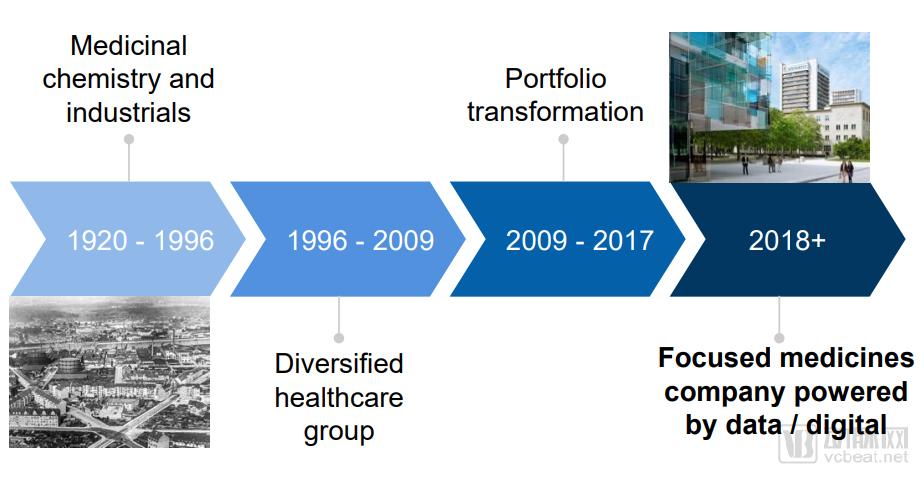
Image source: Novartis Annual Report
In 2000, Novartis was listed on the New York Stock Exchange. To further focus on its pharmaceutical business, Novartis spun off its agrochemicals and seeds company, Syngenta, in 2000. Over the next two years, Novartis also divested its food and beverages division and consolidated its generics business into a standalone unit named Sandoz.
Following the 2014–2015 restructuring, Novartis’s operations are currently divided into three segments: Innovative Medicines, Alcon (Eye Care), and Sandoz (Generic Medicines). The Innovative Medicines division is further subdivided into Novartis Oncology and Novartis Pharmaceuticals.
According to Novartis’ 2017 annual report, the company’s full-year revenue amounted to $49.109 billion (+1%), including $33.025 billion from its Innovative Medicines division (+1%), $6.024 billion from Alcon (-4%), and $10.060 billion from Sandoz (-1%).
Novartis has sustained high growth for many years due to a multitude of factors, including the solid foundation laid by several pre-merger companies, continuous acquisitions that brought in high-quality assets, its generics business, specialized product management, and product upgrades and transformations.
At the time of the merger, Novartis was already a chemical and pharmaceutical giant with sales of CHF 36.2 billion, total assets of CHF 58 billion, and cash and cash equivalents of CHF 19 billion. This ample capital laid the foundation for Novartis’s continued expansion.
More importantly, Novartis has demonstrated a sustained ability to launch “blockbuster” drugs, including Valsartan (launched in 1997), Imatinib (Gleevec, launched in 2001), and later introductions such as Gilenya (Fingolimod) and Cosentyx (Secukinumab).
These products have generated substantial market returns for Novartis. Valsartan and Glibenclamide alone have achieved cumulative sales exceeding $100 billion. Furthermore, according to Novartis’s official website, nearly 30 blockbuster new drugs are currently in Phase III clinical trials, and more than 10 new drugs have entered the approval stage.
Licensing (product agency) is another major hallmark of Novartis. According to Novartis’s annual report, its portfolio of licensed blockbuster products includes everolimus (Afinitor/Votubia), ofatumumab (Arzerra), deferasirox (Exjade and Jadenu), and panobinostat (Farydak), among others. These products generate billions of dollars in annual revenue for Novartis. Additionally, product improvements and drug repurposing have also yielded substantial returns for the company.
Another interesting point is that Novartis remains a shareholder of the pharmaceutical giant Roche, receiving substantial investment income from Roche annually. This income amounted to $464 million in 2016 and $456 million in 2017.
Novartis believes that digital technology is transforming the healthcare industry, impacting the entire spectrum from drug development to clinical care delivered by physicians. For instance, the application of sensors is helping researchers and doctors collect more patient feedback on treatments, thereby enabling more precise therapeutic interventions.
On the other hand, population aging and the rising incidence of chronic diseases and cancer have imposed higher demands on healthcare services, thereby placing significant strain on health systems. These factors will further accelerate the adoption of digital technologies in the healthcare sector, delivering improved medical services to patients and society at large. A key strategy for Novartis is to drive digital transformation and solidify its position in the healthcare industry.
Novartis believes that the application of digital technologies will play a significant role in drug innovation, disease diagnosis, pharmaceutical research, addressing population aging, and supporting healthcare services. First, the emergence of digital technologies as therapeutic adjuncts is beginning to transform traditional medical paradigms. For instance, mobile applications designed to treat substance use disorders and help patients with diabetes manage their conditions have received approval from the U.S. Food and Drug Administration (FDA). By combining conventional medications with digital tools that encourage healthy behaviors, these innovations hold promise for enhancing the quality of care and treatment outcomes for patients.
Secondly, digital technology is transforming the way physicians diagnose and treat diseases. For instance, an increasing array of sensor technologies is assisting researchers and clinicians in collecting data on patients’ health status and their responses to interventions. By integrating statistical methods with artificial intelligence, these technologies enable the mining of medical data to provide diagnostic and therapeutic recommendations.
More importantly, digital technology is transforming the way drugs are developed. The integration of data and artificial intelligence enables complex biological simulations, tools that the FDA has recognized as alternatives to preclinical animal studies for assessing the toxicity of potential new drugs. As these digital tools become more widespread, they can shorten research timelines and increase the likelihood that experimental drugs will be safe and effective.
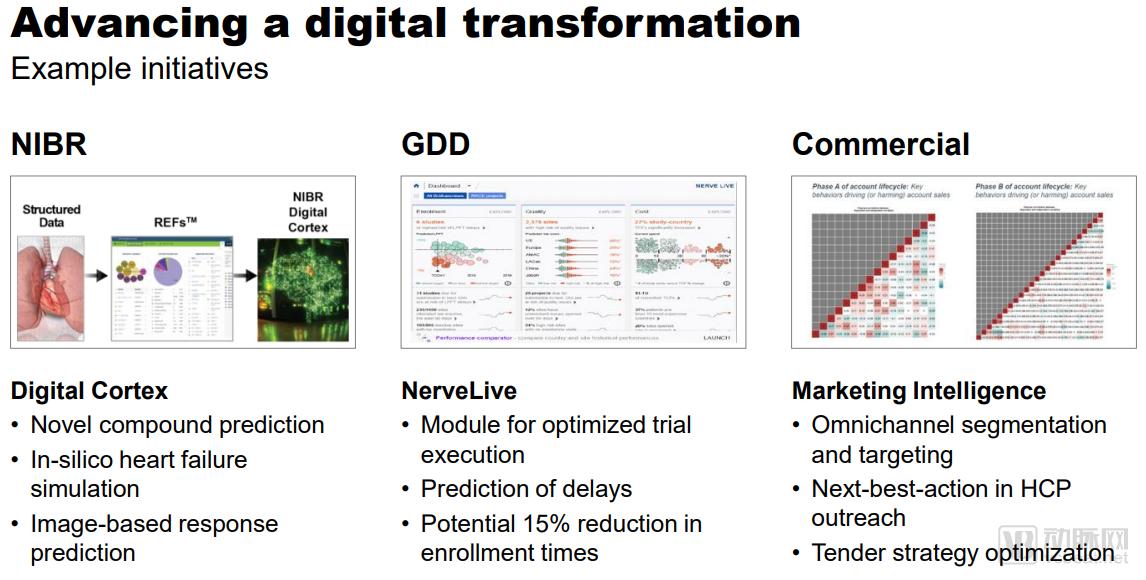
In its annual report, Novartis stated that driving a digital transformation is a key strategy. “We are exploring new ways to harness the power of digital technologies across all aspects of our business—including R&D, sales, and operations—to enhance cost-effectiveness and efficiency. Particular emphasis is placed on advanced analytics. Artificial intelligence and other technologies can help us extract insights from vast amounts of data derived from clinical trials, our daily interactions with physicians, and other sources.”
Novartis Digital Transformation Strategy
Source: Novartis Annual Report
Below, we will see how Novartis applies digital tools and concepts across all stages.
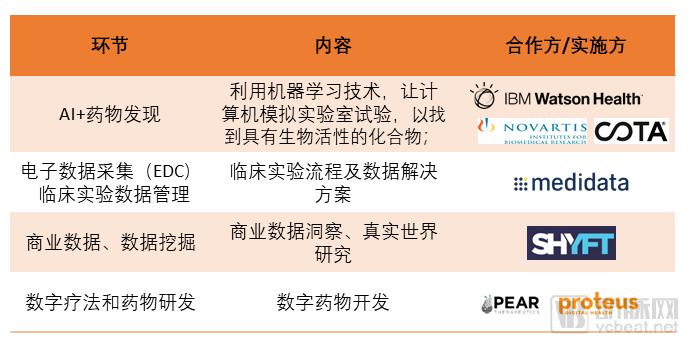
Novartis’ Digital Innovation Across All Stages
Graphic by VCBeat
Novartis is leveraging machine learning technologies to enable computers to simulate laboratory experiments, with 20 projects currently underway, aiming to improve drug design while reducing the time and resources required.
In an article published in May 2018, Novartis stated that its scientists had recently pioneered advances in a specialized type of machine learning known as deep learning, which mimics how the eyes and brain process visual images. Our eyes perceive light in varying shades, and tightly coordinated neural networks convert these patterns into the colors and shapes we associate with familiar objects, faces, and other organisms in our surrounding environment. Drawing inspiration from nature, the Novartis team simulated this same approach and trained computerized neuronal networks to recognize subtle changes induced by experimental compounds in cells.
The team initially employed supervised deep learning methods, which required training the system to recognize specific treatment-induced effects, such as changes in cell morphology or protein activity, before it could identify these effects. They trained the neural network by presenting images of cells treated with compounds known to act through specific mechanisms, enabling it to learn visual patterns associated with different drug mechanisms of action. Subsequently, they evaluated the model using images of cells treated with more than 100 compounds of unknown mechanism. This study was published in Bioinformatics.
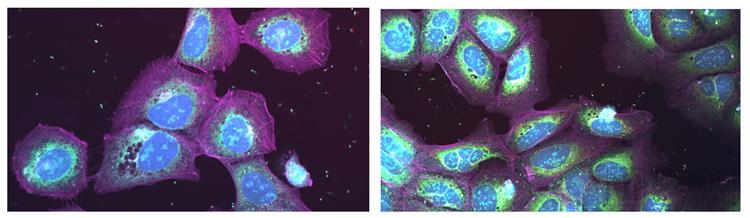
Machine learning algorithms learn to recognize subtle differences in how cells respond to different drugs. Left: Treatment with a drug induces pore formation within the cells. Right: Treatment with a different drug results in distinct cellular images. Image courtesy of Mark Bray / Novartis.
William Godinez, Head of the Infectious Diseases Laboratory at NIBR, stated, “This demonstrates the potential for systems to evolve from analyzing digital images to achieving a biological understanding of how drugs exert their effects within cells, with prediction accuracy approaching 100%.”
A time-consuming aspect of drug discovery is testing how compounds react to diseased cell samples, a process that typically requires meticulous analysis of each sample to identify bioactive compounds. To accelerate the screening process, the team is employing machine learning algorithms for image recognition to rapidly predict which untested compounds may warrant further investigation.
They started with 3,000 compounds, but the ultimate goal is to expand the use of machine learning to screen approximately 1.5 million compounds in Novartis’s compound library.
Machine learning algorithms can also be used to classify various types of medical images during clinical trials and match the features of this data with patient responses to treatment. These algorithms may then have the potential to predict future patients’ responses to experimental therapies, providing researchers with information to help them focus compound testing on the most beneficial patient populations.
In addition to independent innovation, Novartis entered into a partnership with IBM Watson Health in June 2017 to leverage artificial intelligence technology for improving breast cancer treatment regimens. Several months earlier, Novartis had also engaged in a similar collaboration with Cota Healthcare.
Notably, Novartis’ substantial investment in AI-driven drug discovery is closely tied to Vasant Narasimhan, who assumed the role of CEO this February. Born in 1976 and a graduate of Harvard Medical School, he is a strong advocate for emerging technologies. During his tenure as Head of Global Drug Development and Chief Medical Officer at Novartis, he spearheaded the application of machine learning and artificial intelligence to the company’s drug development processes and historical data mining.
This initiative has been carried forward under the leadership of Achim Plueckebaum, Global Head of IT for Drug Development at Novartis. He and his team have designed a new system for Novartis’s Global Drug Development (GDD) division and migrated the legacy information systems, data, and management processes to the new platform within 18–24 months.
Plueckebaum referred to this plan as “open-heart surgery,” with the internal codename STRIDE—Systematic Transformation Initiative for Development Excellence. The system’s intended functionalities include a submission and document management system, a new research portal, a new high-performance computing environment, and a new Clinical Trial Management System (CTMS), among others. These systems are designed to intercommunicate, facilitating seamless data access and retrieval.
Following the completion of STRIDE, two new initiatives are set to launch: Nerve Live and 42. Nerve Live is a predictive analytics platform that applies analytical and machine learning algorithms to clinical trial operations; Novartis is collaborating with the U.S.-based machine learning company QuantumBlack to refine this platform. The concept behind “42” is derived from *The Hitchhiker’s Guide to the Galaxy*, referring to the creation of a dataset designed to provide solutions for complex and rare diseases.
In late July, Novartis announced a collaboration with SHYFT, a subsidiary of Medidata. The partnership primarily encompasses two key components:
l STRATA data platform, used to aggregate and manage an increasing number of third-party and proprietary commercial data sources;
l The LUMEN Insights Platform extracts value from historical data to guide business activities.
Novartis’s partnership with SHYFT expands its existing collaboration with Medidata, a leading provider of digital solutions and tools for clinical trial management. With the addition of SHYFT’s market data, Novartis’s efficient utilization of data extends from the clinical domain to the commercial market.
In March this year, Novartis partnered with Pear Therapeutics to develop novel prescription digital therapeutics—software applications designed to effectively treat diseases and improve patient clinical outcomes.
This collaboration primarily encompasses three key areas:
Novartis and Pear Therapeutics Collaborate on Prescription Digital Therapeutic for the Treatment of Schizophrenia and Multiple Sclerosis
The collaboration combines Novartis’ leadership in biomedical research and clinical development with Pear’s expertise in digital therapeutics;
Novartis continues to leverage emerging digital technologies to strengthen R&D and deliver better treatments for patients.
Novartis had already invested in Pear Therapeutics during its Series A and B financing rounds. Pear Therapeutics also stated that Novartis has closely followed its progress from the outset, and the collaboration between the two companies has proceeded very smoothly.
Pear Therapeutics’ most mature product to date is ReSET™. ReSET™ is the first FDA-cleared digital therapeutic for the treatment of substance use disorder (SUD), designed to help patients regain control over addiction. It serves as an adjunctive therapy in the treatment of dependencies on stimulants, cannabis, cocaine, or alcohol. Although it has received FDA clearance, it has not yet been commercialized and remains under further evaluation.
In fact, as early as 2013, Novartis invested in a similar company—Proteus Digital Health—which developed an FDA-approved sensor that can be embedded in pills to track patients’ medication adherence and thereby inform the development of treatments for bipolar disorder and schizophrenia.
In August 2017, Novartis announced the appointment of Bertrand Bodson as its Chief Digital Officer. In this role, Mr. Bodson will be responsible for formulating and executing a company-wide digital transformation strategy, including initiatives to enhance the use of data in drug discovery and development, foster collaboration with patients, physicians, and other stakeholders, and automate business processes.
Bodson previously held positions at companies such as EMI Music and Sainsbury’s Argos. During his tenure, he successfully transformed Sainsbury’s Argos from a traditional retailer into the third-largest online retailer in the UK. The establishment of the Chief Digital Officer role underscores Novartis’s determination and execution capability in pursuing digital transformation.
The “magic” of innovative drug companies is actually quite simple: identify a new drug and rapidly commercialize it. The most critical factors are the speed at which new drugs are discovered and the capability to commercialize them.
Driven by emerging technologies such as biotechnology, gene editing, and artificial intelligence, the approaches to discovering new compounds and achieving commercialization are undergoing significant transformation. Novartis aims to adapt to this shift and maintain its leading position in the healthcare sector. Digital transformation has become a strategic priority for Novartis, with this philosophy deeply integrated into various aspects of its operations, including research and development, clinical trials, and patient services, poised to yield substantial results.