

Enlitic Files IPO Prospectus to Revolutionize Medical Imaging with Deep Learning AI

Enlitic
Provider of Intelligent Medical Diagnostic Technology

“The World Economic Forum estimates that it will take at least 300 years to train enough healthcare professionals to meet the current medical needs of developing countries,” said Jeremy Howard, Founder and CEO of Enlitic.
As artificial intelligence (AI) gains increasing momentum both domestically and internationally, its applications in the healthcare sector are flourishing. To address the critical shortage of medical resources, Howard leveraged AI to create a powerful clinical assistant for physicians, giving rise to Enlitic.
According to VCBeat (WeChat ID: vcbeat), Enlitic is dedicated to leveraging cutting-edge technologies such as artificial intelligence and machine learning to assist in medical diagnosis. The company employs state-of-the-art deep learning algorithms to mine vast amounts of healthcare data, including medical images, diagnostic reports, and clinical trials, thereby enabling rapid, accurate, and practical health diagnostics.
As a technology company from San Francisco, California, USA, Enlitic was ranked 35th (2015) and 14th (2016), respectively, among the world’s top artificial intelligence companies by MIT Technology Review.
What Does Enlitic Primarily Do?
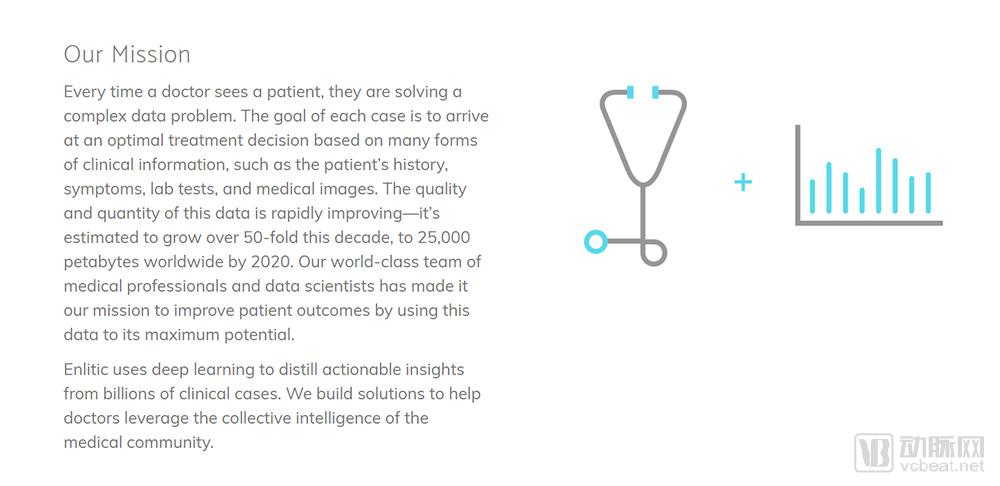
Currently, Enlitic is primarily used for disease diagnosis in radiology. Compared with traditional methods, Enlitic offers faster, more accurate, and less costly diagnoses.
For example, when a patient undergoes a lung CT scan, Enlitic analyzes the scan to estimate the likelihood of lung cancer and identifies treatment approaches and outcomes for patients with similar conditions. Physicians can use Enlitic’s comparative analysis to determine whether a biopsy is warranted. If a biopsy is indicated, it can provide more accurate information, significantly reducing the risk of misdiagnosis. If a biopsy is not necessary, Enlitic helps patients avoid substantial costs and alleviates their anxiety.
Enlitic draws from a wide variety of data sources, including medical imaging such as CT scans and MRIs, as well as clinical records, pathology or radiology reports, laboratory data, patient-reported outcomes, and more.
In October 2015, Enlitic secured $10 million in Series A funding from Capitol Health, a leading Australian provider of diagnostic imaging services. Enlitic committed to providing deep learning technology to Capitol Health to improve patient prognosis predictions, thereby supporting its primary objectives of expanding into Asia and increasing profit margins. Including the $2 million seed angel financing completed in October 2014, Enlitic has raised a total of $15 million.
In November 2016, Enlitic publicly demonstrated its chest X-ray analysis product at its booth for the first time. This product efficiently screens for multiple pathological conditions, helping radiologists make accurate diagnoses more quickly while reducing errors. Additionally, the company’s new lung cancer screening solution, powered by a 3D deep learning engine, performs detection and differentiation of pulmonary nodules, thereby preventing unnecessary biopsies.
In April 2017, Enlitic and the Chinese medical AI technology company Yipai Intelligence officially established the “Yipai Medical Intelligence Research Institute,” forging a deep partnership with plans to achieve breakthroughs in areas such as AI-assisted diagnosis of medical imaging. The institute will focus primarily on the acquisition and analysis of medical imaging data, including CT, MRI, PET, pathology slides, fundus photographs, and ultrasound.
“What we do is provide radiologists with tools to improve their work efficiency,” said CEO Howard. Enlitic’s software helps radiologists save time primarily by surfacing relevant prior studies, performing detections, highlighting key regions in images, and summarizing cases from patients with similar conditions.
Jeremy Howard, Founder of “Can’t Sit Still,” Dedicated to Exploring Deep Learning
Jeremy Howard, founder and CEO of Enlitic, is a household name among professionals in the fields of artificial intelligence and big data.
He is the Founder and CEO of three technology companies: Enlitic, Optimal Decisions Group, and FastMail. He previously served as President and Chief Scientist at Kaggle, a big data competition platform. As the youngest faculty member at Singularity University in the United States, he was also a Global Young Leader who delivered a keynote speech at the 2014 Davos Forum. Meanwhile, his TED Talk has garnered nearly 2 million views.
Optimal Decisions Group (ODG) is a company that develops advanced analytical methods and software applications for the insurance industry. ODG primarily focuses on predictive modeling, multi-year simulations, and model optimization for insurance companies in the United States, the United Kingdom, and Australia. Its products and services are used for targeted marketing, underwriting, pricing, collections, and claims management. In February 2008, the information services company ChoicePoint acquired ODG. This transaction aimed to create additional value for customers by combining ODG’s pricing optimization capabilities with ChoicePoint’s data services.
During his tenure at ODG, Howard founded FastMail. Explaining the motivation behind establishing the company, Howard stated, “I was disappointed with the email service products available at the time.” He aimed to build FastMail into a successful global business.
FastMail, based in Melbourne, Australia, primarily provides paid email services for individuals and businesses. In April 2010, the company was acquired by Opera. In September 2013, FastMail announced its separation from Opera to become an independently held private company. To this day, FastMail remains one of the most popular IMAP email services internationally, with its primary servers located in New York City and Amsterdam. FastMail operates dozens of service domains.
In October 2011, Howard joined Kaggle, a predictive modeling and analytics platform, serving as its Chairman and Chief Scientist. Researchers from various companies post datasets to compete with over 100,000 data scientists worldwide, aiming to develop the best predictive models. As Kaggle’s technical and strategic advisor, Howard was responsible for core software development, data collection, and delivering media presentations related to the product. According to VCBeat (WeChat ID: vcbeat), he was also the company’s first angel investor.
In addition, Howard was named a Young Global Leader by the World Economic Forum in 2013. The Young Global Leaders community is a diverse group comprising heads of state, executives from Fortune 500 companies, Nobel laureates, Oscar winners, UN Goodwill Ambassadors, social entrepreneurs, and other distinguished individuals. This cohort includes 121 young leaders under the age of 40 from various sectors worldwide, all dedicated to shaping the future of the globe. After founding Enlitic, Howard delivered a speech on “Machine Work” at the 2014 Davos Forum.
In December of the same year, Jeremy Howard was invited by TED to deliver a keynote speech titled “The wonderful and terrifying implications of computers that can learn.” He offered a unique perspective on deep learning: “Deep learning is an algorithm heavily inspired by the brain, with no theoretical limitations. The more data and computational time you provide, the better the results deep learning can achieve.”
Since May 2016, to make deep learning technology more accessible and widely applied, Howard has also founded a technical sharing platform called fast.ai. The platform not only provides free video tutorials on deep learning (such as “Practical Deep Learning for Coders,” taught by Howard himself) but also directly assists practitioners and users in developing simple and efficient software products. Through his series of courses, Howard aims to share with a broad audience the methods that have been truly used and proven effective in engineering practice, rather than merely presenting theoretical definitions and formulas.
Howard stated in an interview, “Based on my R&D experience at Enlitic, I believe that deep learning technology holds significant potential for the future of healthcare. Most importantly, research in this area can save patients’ lives and reduce healthcare costs in developing countries, which will require substantial effort from us.”
Enhancing the Efficiency and Accuracy of Imaging Diagnosis
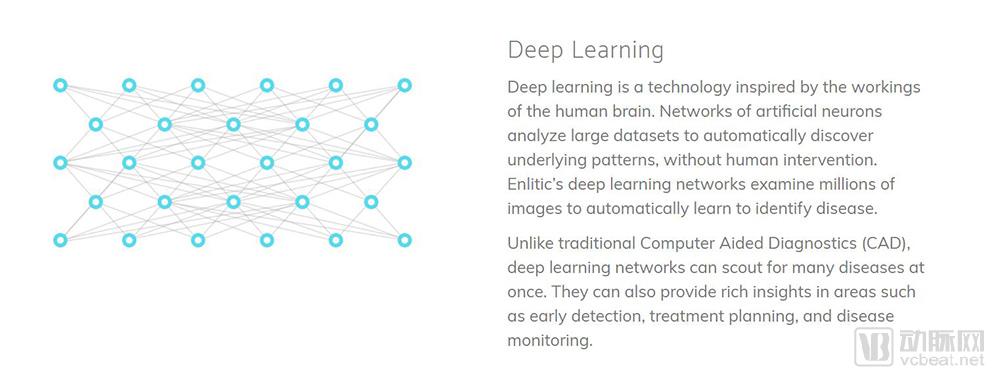
Enlitic collaborates extensively with partners and data sources, focusing on the development of state-of-the-art clinical decision support products. Its deep learning technology encompasses a wide range of unstructured medical data, including radiology and pathology images, laboratory results (such as blood tests and electrocardiograms), genomics, patient medical histories, and electronic health records (EHRs). Enlitic firmly believes that cross-domain engagement and extensive expertise in healthcare can deliver deeper insights and greater accuracy for every patient.
Enlitic’s solutions promise seamless integration with existing medical systems, enabling their radiology applications to connect with third-party image viewers and archive systems.
Patient Triage System
Over 300 million diagnostic radiology images are acquired annually in the United States alone. As demand for diagnostic services grows, healthcare providers must also enhance their efficiency and accuracy.
Enlitic’s patient triage system can scan patient records to extract multiple clinical data points and determine disease priority levels. The system then automatically routes each patient to the most appropriate physician within its network. Studies have shown that Enlitic’s technology can interpret medical images in milliseconds, which is 10,000 times faster than a typical radiologist.
Screening Protocol
Enlitic states that its screening solution can rapidly analyze cases, highlight suspicious findings, and help physicians work efficiently while managing patient volumes. Among cancers, lung cancer is one of the most difficult to diagnose in medical imaging. Once diagnosed at an advanced stage, 80%–90% of patients will die. However, if detected early, patient survival rates increase tenfold.
Enlitic was the first to apply deep learning to chest CT images for the automated detection of lung nodules, achieving a detection accuracy 50% higher than that of a panel of thoracic radiologists. Enlitic reported a false-negative rate of 0%, compared with 7% for human experts. Furthermore, Enlitic can assess and grade the risk of these nodules progressing to malignancy.
The public can access Enlitic’s test results, and the Lung Image Database Consortium (LIDC), established by the National Institutes of Health (NIH), has acknowledged the transparency of Enlitic’s detection results.
Real-Time Clinical Support
The National Institute of Medicine estimates that diagnostic errors affect nearly 12 million Americans each year. Enlitic believes that providing physicians with more accurate and effective decision support tools can significantly reduce this number.
The company’s real-time clinical support solution provides specialized workflow guidance, helping physicians interpret challenging cases with greater confidence. For example, Enlitic has achieved breakthrough progress in fracture detection; its deep learning technology can detect minute fractures as small as 0.01% on X-ray images while maintaining high accuracy.
For radiologists, fractures are a common condition, yet reliable diagnostic methods have long been lacking. Misdiagnosis not only leads to improper bone healing but also leaves patients with lifelong skeletal alignment issues. Traditional bone CT images range in resolution from 44×4 to 4,000×4,000 pixels, significantly limiting the application of computer vision technologies.
In contrast, Enlitic achieved an AUC of 0.97 in “fracture detection” (AUC is a common metric for evaluating the accuracy of predictive modeling), whereas top radiologists typically achieve an AUC of 0.85, and traditional computer vision methods yield an AUC of 0.71. With high precision, Enlitic performs fracture diagnosis at remarkable speed, processing thousands of CT scans in less time than it takes a human physician to interpret a single CT scan.
Furthermore, to mitigate the error rates associated with radiology, Enlitic’s retrospective analysis system enables physicians to rapidly review large volumes of historical cases, examine detailed information, and evaluate clinical presentations. As a valuable tool in medical diagnosis, retrospective analysis facilitates applications in clinical trials and drug development.
“Since Roentgen’s X-rays were applied to medicine, we have never seen such a significant advancement in radiology,” said Rodney Sappington, Vice President of Radiology at Enlitic.
Jeremy Howard's Vision for Tech-Enabled Healthcare
As data science continues to evolve toward automated analysis, Howard believes that the biggest obstacle facing Enlitic is the lack of comprehensive datasets. He stated, “Only by leveraging such large-scale, complete datasets can we build precise deep learning models that provide diagnostic and treatment recommendations based on actual clinical outcomes, rather than offering simple, preliminary diagnostic guesses.”
Howard believes, “In fact, I hope that in the coming years, the role of data scientists will become increasingly diminished, while data science becomes integrated into a broader range of professions, such as medical specialists, lawyers, and logistics managers. Therefore, I think data scientists should understand how an industry creates value, how different industries collaborate, and what the internal organizational structure of an industry looks like. Most importantly, data scientists should find ways to rigorously test the impact of their work in relevant domains and collaborate with domain experts to enhance their influence through various means.”
Seamlessly integrating data applications with deep learning technology has always been Howard’s requirement and goal for Enlitic’s future. “We don’t know how long it will take for deep learning to surpass human performance. But based on current developments, every time I see someone attempting to use deep learning technology to address a specific problem they face, they seem to achieve success.”