

Redefining Physician Training with AI: DXY and iFLYTEK Forge Strategic Alliance to Transform Medical Education and Patient Care
As people enjoy the conveniences brought by technology, every product born from technological iterations and upgrades captures public attention. Examples include the advent of computers, the emergence of smartphones, and the rise of artificial intelligence.
Taking artificial intelligence (AI) in the healthcare industry as an example, it has been highly sought after by capital investors, institutions, and entrepreneurs since its inception. The "2017 Report on the Medical Big Data and Artificial Intelligence Industry," released by VCBeat in 2017, noted that the application of AI in the healthcare sector offers distinct benefits to physicians, medical institutions, patients, and enterprises alike.
On August 13, DXY, a value connector in the healthcare sector, and iFlytek, China’s largest artificial intelligence company, signed a strategic cooperation agreement in Shanghai. The event was attended on-site by Zhang Jin, CEO of DXY; Zhang Wei, Vice President of DXY and Head of the Corporate Cooperation Division; Lu Xiaoliang, Executive President of iFlytek Medical; Liu Yang, Vice President of iFlytek Medical; and more than 150 guests from pharmaceutical companies, medical device manufacturers, media outlets, and other sectors.
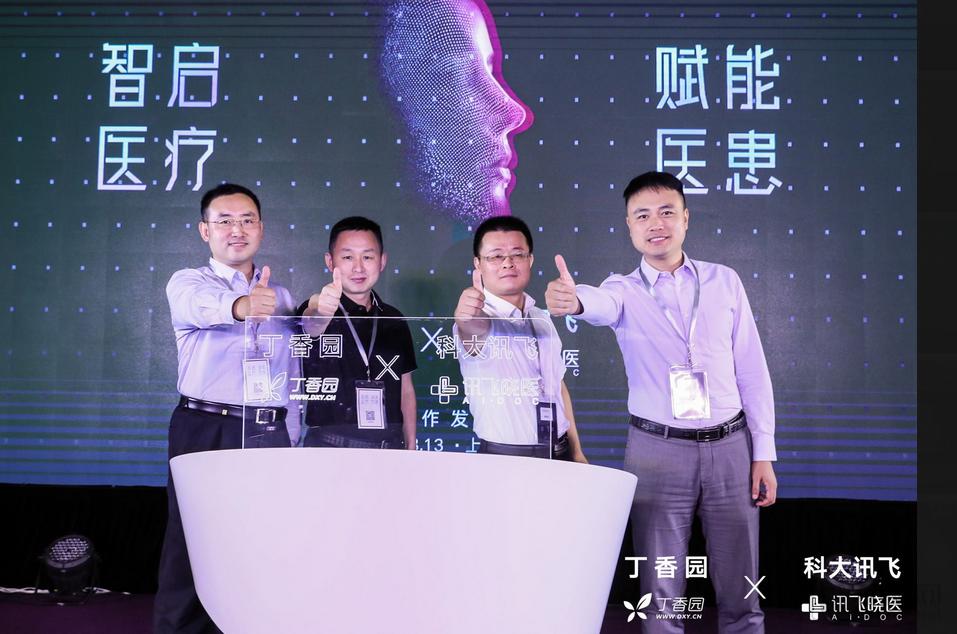
The theme of this press conference is "Intelligence Initiates Healthcare · Empowering Doctors and Patients,"This initiative aims to leverage cross-industry collaboration between both parties, integrating DXY’s extensive digital healthcare resources, iFlytek Healthcare’s globally leading artificial intelligence technologies, and their mature industry experience and business model design capabilities. By capitalizing on their respective strengths, the partnership seeks to fuse medical content, products, and AI technology, fostering synergistic development to create a comprehensive management service model tailored for physicians and patients. This collaboration represents a strategic alliance between a key value connector in the healthcare sector and China’s leading AI company, marking an exploration of new paradigms for the application and advancement of smart healthcare.
Since its inception, DXY has connected hospitals, physicians, researchers, patients, biopharmaceutical companies, and insurers through a professional and authoritative content-sharing platform, extensive and comprehensive data accumulation, and standardized, high-quality medical services. It reaches tens of millions of general users and boasts 5.5 million professional users, including 2 million physicians. Currently, DXY Clinics have been established in Hangzhou and Fuzhou, with plans to expand to more cities.
iFlytek is a leading intelligent interaction technology service platform in China, providing artificial intelligence capabilities such as speech synthesis, speech recognition, semantic understanding, optical character recognition (OCR), facial recognition, and voiceprint recognition, along with AIUI human-computer interaction solutions, smart hardware, and IoT solutions. By offering diverse integration methods and stable services, iFlytek enables developers’ products to hear and speak, see and recognize, and understand and think.
Zhang Wei stated that his previous lack of familiarity with iFlytek stemmed from the company’s strong association with voice technology. Since iFlytek began developing speech synthesis and speech recognition technologies in 1999, it has held a clear competitive advantage over other rivals. “Recently, during our partnership discussions, we discovered that they are also engaged in artificial intelligence product development, spanning speech, imaging, natural language processing, and translation technologies. They are arguably among the most technologically advanced companies in both industry and academia.”
In fact, iFlytek has also made in-depth strides in the healthcare sector.According to Lu Xiaoliang, iFlytek Healthcare’s current product portfolio is divided into three major categories: the first relates to intelligent voice technology; the second to image recognition; and the third to natural language understanding. How have these solutions been implemented in practice?
Specifically, the implementation of intelligent voice interaction shows promising prospects, primarily applied in chronic disease management to facilitate interventions on chronic disease management platforms. Collaborations have also been established with pharmaceutical companies and Dingxiang Yuan.
Next is image recognition, though there are relatively few medical imaging projects in China. Applications primarily focus on two areas: one is at the technical level, starting with pulmonary nodules, which holds limited clinical value; the other is whether it can pre-diagnose the interpretation fees charged by human physicians for reading scans. Starting from Anhui Province, where iFlytek is headquartered, discussions have also been held with local Health and Family Planning Commissions. If this fee structure can be clearly defined, it will pave the way for a commercial closed loop once the model matures in the future.
Finally, there is natural language processing-based diagnosis. Through this technical solution for assisted diagnosis, general practitioners are empowered to promote tiered diagnosis and treatment, redirecting patients from large hospitals to primary care providers. This helps address the shortcomings of primary care institutions, namely insufficient medical staff and limited diagnostic and therapeutic capabilities. Relatively speaking, assisted diagnosis presents greater challenges, but it is undoubtedly a future trend.
Regarding disease selection, Zhang Wei revealed that the chosen condition must have a large patient population, well-defined diagnostic and treatment pathways, and standardized processes for information collection and clinical management. Dermatology fits these criteria precisely, as skin diseases affect a broad population and allow for preliminary diagnosis through visual inspection."Voice input is required during the diagnostic process, and iFlytek excels in this area. Given our prior collaborative foundation, this partnership was a natural progression."
In the upcoming collaboration, both parties will integrate their advantageous resources in the healthcare sector to enhance the efficiency of doctor-patient services through AI technology. According to the agreement, the specific cooperation model will be implemented in three phases: integration of basic functionalities, deepening of doctor-patient services, and implementation of the business model.
Phase I: Integration of Basic Functions.At this level, both parties have achieved initial collaborative results: DXY Broadcast Café—a professional learning and interaction platform for mid-to-senior-level physicians—has integrated with iFlytek’s speech recognition capabilities. This enables users to locate relevant content within DXY Broadcast Café, such as articles, courseware, and videos, through voice queries, thereby making information access simpler and more efficient for physicians. Through this collaboration, the two parties have refined and established an efficient model of team synergy, laying a solid foundation for the future integration of additional medical content, tools, and platforms with AI technologies.
Phase II: Deepening Doctor-Patient Services.Both parties will establish deep integration across multiple application areas, extending their collaboration throughout the entire integrated doctor-patient service chain, encompassing four key aspects: physician education, doctor-doctor interaction, doctor-patient interaction, and patient management. DXY will provide data, content, products, platforms, and medical support, while iFlytek will deliver artificial intelligence technology solutions and technical support.
Phase III: Implementation of the Business Model.Both parties will collaborate to build a large-scale commercial ecosystem. Leveraging the integrated doctor-patient service platform established by DXY and iFlytek, they will onboard third-party partners such as enterprises, experts, and physicians. Underpinning this entire value chain is a business model designed to operate with precision for target populations, empowering multiple stakeholders and creating shared value.
Leveraging their respective strengths, the two parties will commence their future collaboration with short-term projects and progressively deepen their cooperation through medium- to long-term initiatives. Throughout this process, both sides will actively collaborate by sharing strategic insights, aligning operational mechanisms, and integrating resources, thereby jointly leading the development of the medical artificial intelligence industry.
This collaboration enables DXY’s millions of users to enjoy the following benefits:
1. Voice Search: Instantly locate relevant content such as articles, courseware, and videos, making information access simpler;
Second is big data analytics: every piece of academic content is tagged with relevance labels, enabling more personalized healthcare communication;
Third, intelligent interaction: Humanized AI assistance and caring question-and-answer exchanges make doctor-patient interactions more considerate.
Data shows that there are currently 144 statistically trackable medical AI-related companies in China, with penetration across various scenarios in the healthcare sector. The medical AI market is expected to reach a scale of RMB 20 billion in 2018. Behind these impressive figures, however, lies a reality troubling industry players: medical AI remains in a state akin to “blind men touching an elephant,” having yet to identify a viable profitability model. Can the collaboration between DXY and iFlytek break this constraint?
DXY, with its years of deep industry expertise, believes that building a comprehensive integrated doctor-patient service platform requires four indispensable key steps: physician education, doctor-doctor interaction, doctor-patient interaction, and patient management. On this foundation, if AI technologies are leveraged to empower physicians and serve patients, the integration of doctor-patient services can be achieved more rapidly and effectively.
“As the first company in the industry to propose and implement the ‘integrated doctor-patient’ model and services, DXY has accumulated extensive practical experience. Partnering with a high-quality partner like iFlytek is of great significance,” said Zhang Wei, Vice President of DXY and Head of the Corporate Cooperation Division. “A complete medical AI solution must encompass five key elements: clinical scenarios, authoritative expertise, data, algorithms, and a win-win business model.” This aligns closely with the logic underlying iFlytek’s three core pillars for artificial intelligence development: core technologies, big data, and industry experts.
First, the scenario.Whether for imaging-based auxiliary diagnosis or the acquisition of medical information, specific scenario-based requirements must be met;
Next is authoritative data.A high-quality, trustworthy, and authoritative data system serves as the core foundation for the development of artificial intelligence; absolute authority and accuracy constitute the most fundamental distinction between medical AI and other forms of AI.
Algorithms are the foundation for implementing all patterns; without algorithms, patterns cannot be realized.
The most important thing is to have a win-win development model., only in this way can the entire AI ecosystem become sustainable.
Zhang Wei revealed that, in addition to possessing vast resources of experts and medical content data, DXY also has the capability to connect various stakeholders in the healthcare sector, along with top-tier business model design and operational promotion capabilities. As early as 2016, DXY collaborated with multiple partners to launch “Smart Skin,” China’s first AI-assisted diagnostic and treatment system in the field of dermatology, which became the first large-scale AI application oriented toward clinical practice in China’s dermatology sector. “Through this collaboration with iFLYTEK, we aim to leverage the experience and insights accumulated during this process to create a multi-party win-win ecosystem within the medical AI industry.”
In this regard, Lu Xiaoliang spoke highly of the collaboration with DXY.“The development of artificial intelligence in the healthcare industry holds vast prospects. However, the wide variety of diseases and the complexity of human anatomy impose higher professional demands on medical AI. As a leading healthcare platform and a premier artificial intelligence company, respectively, DXY and iFlytek can achieve complementary advantages through their partnership. I am confident that our collaboration will pioneer new frontiers for the practical implementation of smart healthcare applications.”
iFlytek Medical deeply integrates intelligent voice and artificial intelligence technologies with the healthcare industry, expanding into the new blue ocean of “AI + Healthcare.”In August last year, iFlytek established China’s first smart hospital, with initial results now becoming evident. “Intelligent Medical Assistant” became the world’s first artificial intelligence to pass the clinical comprehensive written examination of the National Medical Licensing Examination with a score of 456 points. It is now being applied in grassroots communities, where it has been widely praised for making healthcare more accessible and beneficial to the public.
iFlytek Healthcare is committed to building a "Dream Team" of "Physicians + Artificial Intelligence."Empower physicians with average competency to perform tasks typically handled by highly competent colleagues, while freeing top-tier physicians from routine, repetitive tasks better suited for less experienced practitioners. By leveraging artificial intelligence to automate 80% of administrative work, doctors can focus on delivering high-quality medical care. This approach aligns closely with many of DXY’s core philosophies.
So, what zero-to-one breakthroughs will DXY and iFlytek achieve in the future? In the era of Healthcare + AI, what changes will occur for doctors and patients? How will healthcare companies upgrade their business models and create new strategies?
Zhang Wei stated that there would also be collaboration in physician education and patient management. To some extent, this redefines the product of physician training.
Meanwhile, Lu Xiaoliang believes that “The partnership between iFlytek and DXY holds immense potential. Currently, it is only making initial forays into voice recognition applications, but more extensive technological collaborations are expected in the future."Partners will also join pharmaceutical companies, making them the most important third party in this collaboration. The key is to validate this model first."