

Hinge Health Secures $26M Series B Funding to Digitally Treat Chronic Musculoskeletal Pain and Cut Employer Healthcare Costs by 50%

Hinge Health
Provider of Digital Treatment Solutions for Chronic Diseases
VCBeat (WeChat: vcbeat)It has been reported that on August 9, 2018, Hinge Health, a digital health startup headquartered in San Francisco, California, completed a $26 million Series B financing round. The round was led by Insight Venture Partners, with participation from Atomico, the lead investor in its Series A round. To date, the company has raised a total of $36 million.
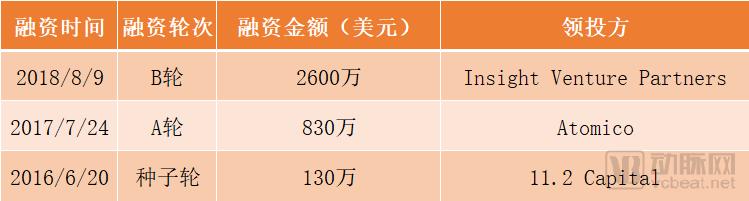
Hinge Health’s Historical Financing Rounds (Source: Crunchbase)
Hinge Health was founded in 2015 by CEO Daniel Perez and COO Gabriel Mecklenburg to develop software, hardware, and services that enable companies to manage their employees’ musculoskeletal (MSK) pain conditions.
The company initially focused on providing technologies to combat chronic back pain and joint pain. Its product suite includes two sensor-equipped bandages with motion sensors, a tablet preloaded with Hinge Health software for watching rehabilitation instructional videos, as well as braces, a carrying case, and charging devices.
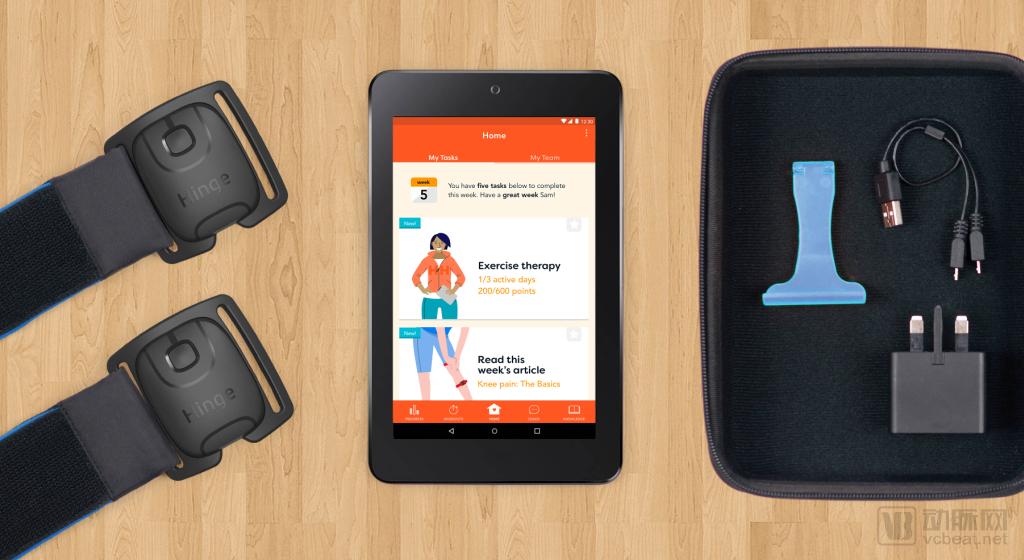
However, Hinge Health does not merely provide employers with a bundle of hardware. The company also offers coach-led programs that first address the underlying issues contributing to musculoskeletal conditions. Through its digital program, Hinge Health enables users to overcome chronic musculoskeletal pain without the need for medication or surgery.
Hinge Health currently treats cervical spondylosis, lumbar musculoskeletal disorders, and chronic knee conditions. Patients input their symptoms on a tablet to receive preliminary rehabilitation guidance and wear sensor-equipped bands on the corresponding body parts as instructed.
During patient use, Hinge Health establishes a quantifiable model based on data returned from sensor-enabled bandages, facilitating patient recovery through education, physical therapy, and behavioral support. Furthermore, its core technology platform provides long-term management and tracking of patients’ physical recovery progress, optimizing phased rehabilitation protocols in accordance with recommendations from professional medical institutions.
Historical data indicate that chronic musculoskeletal pain is one of the highest cost drivers in employer-sponsored health plans, with annual total expenditures for low back pain alone reaching approximately $100 billion in the United States.
Clinical evidence indicates that guided exercise therapy and lifestyle modifications are often more effective than medication or surgery. Eighty percent of patients do not receive evidence-based care. Clinical studies have shown that two-thirds of back and joint surgeries can be avoided through consistent exercise therapy and lifestyle changes.
Most importantly, patients with chronic pain often use opioids, or painkillers, to alleviate their symptoms; however, opioids are not a long-term solution for chronic pain. Many patients suffering from back or joint pain are receiving excessive prescriptions.
For this type of chronic pain, data from Hinge Health indicates that it can reduce costs by half. Using Hinge Health reduces pain levels by 70% and decreases the incidence of surgery by 63%.
Hinge Health provides remote guidance to users based on best-practice care guidelines from expert organizations such as the American College of Physicians and the American Pain Society.
Rehabilitation therapy demands a high degree of scientific rigor in treatment guidance, and Hinge Health also incurs substantial costs in digital maintenance. If the product were launched directly to the consumer market, ordinary users would likely find it unaffordable—resulting in a situation where a quality product fails to sell, while those in need cannot access it.
Therefore, in terms of its business model, Hinge Health does not directly target individual consumers (C-end); instead, it primarily serves corporate employers, adopting a B2B2C model.
Hinge Health is responsible for the research, development, and production of its products but does not sell them directly to consumers. Instead, it delivers its solutions to users through corporate healthcare plans. Currently, U.S. residents and their families can access Hinge Health’s full suite of products at no cost or at a reduced price through health insurance coverage, enabling long-term rehabilitation training. The company currently serves nearly 40 corporate clients and multiple health plans.
Daniel Perez believes that science-based care plans enable patients to alleviate back and joint pain. This requires substantial investment and partners committed to long-term collaboration. Hinge Health’s high-quality approach to chronic pain management combines technology-supported exercise therapy, behavioral health, and education.
According to VentureBeat, Hinge Health’s financing suggests that employer-centric healthcare platforms have reached maturity, are attracting significant attention from the capital markets, and are securing investment.
For example, San Mateo-based Lumity secured $19 million to provide data-driven recommendations for corporate wellness programs, while Vida Health raised $18 million to connect individuals with chronic conditions to health coaches.
Furthermore, trends can also be observed from the moves of major companies. In February this year, Fitbit, a global consumer wearables giant, acquired Twine Health to promote employee healthcare and coaching. Enterprise-centric healthcare services are gradually gaining popularity worldwide.