

Veeva: The Microsoft Office of Life Sciences Seeks Its Next Growth Engine Amid IPO Filing
Technology has bestowed boundless wealth upon the pharmaceutical industry, fostering its remarkable prosperity.
Veeva is a veritable leader in SaaS platforms for the life sciences industry. Since its founding in 2007, Veeva’s clientele has included nearly all of the top 20 pharmaceutical companies, with revenues reaching $685.6 million in 2017.
In the SaaS platform market, already dominated by giants such as Oracle, Microsoft, and Salesforce, Veeva has carved out a niche in the vertical sector of life sciences. Within ten years of its establishment, it has surpassed a $10 billion market capitalization, serving as a model for startups in China. By leveraging technological barriers to entry, Veeva has deeply cultivated the life sciences industry, which is characterized by high standards and stringent requirements.
In the life sciences sector, a field characterized by high barriers to entry, Veeva is akin to being at the calm eye of a tornado.

Veeva's Historical Revenue Data (Source: Veeva Financial Reports)
Around 2007, SaaS platforms entered the cloud computing era. Also around 2007, both domestic and international SaaS markets experienced a surge in activity. Alibaba entered the software market, while companies such as Microsoft and Oracle actively expanded their presence in the SaaS sector. During this period, the most prominent company was Salesforce.com, which billed itself as the “end of software.”
It was also at this time, just as the game was beginning, that players started to diverge. In 2007, a former Salesforce executive left the company to found Veeva, a cloud-based SaaS platform focused on the life sciences industry. Over the next decade, Veeva achieved remarkable success, with its market capitalization surpassing $10 billion and its client roster including all of the top 20 pharmaceutical giants.
By 2014, as the domestic market in China began shifting toward vertical sectors and developing B2B-focused niche markets, Veeva had already been specializing in the life sciences industry for seven years.
Veeva provides services to the pharmaceutical industry covering the entire lifecycle from research and development (R&D) to sales and pharmacovigilance. Adopting its SaaS platform not only enhances operational efficiency but has also become imperative in the context of digital transformation. Although the healthcare sector faces high entry barriers and has lagged behind other industries in digital adoption, the current tide of change is beginning to reshape even the most resistant markets.
New drug development is becoming increasingly challenging, with a dwindling pool of compounds available for developing new drugs, yet the average timeline for new drug development exceeds ten years. The application of digital tools can save substantial time. Moreover, as clinical trials grow in complexity, they can no longer be managed through traditional paper-based documentation and administrative processes. Given the vast amounts of data involved in clinical trials, the adoption of informatized workflows has become inevitable. From a regulatory perspective, the FDA is implementing a comprehensive package of clinical trial reforms. Drug clinical trials are becoming more complex, exemplified by the use of umbrella trials and basket trials in new drug development.
In terms of marketing, with policy changes, the traditional pharmaceutical representative model is facing increasingly severe compliance pressures. A report from PwC Strategy& points out that digital emerging promotion models are gradually being valued and adopted by pharmaceutical companies. With the rise of mobile healthcare, the traditional pharmaceutical representative model has shown limitations in reaching a larger target audience. In the past, the business focus of large pharmaceutical companies was concentrated on hospitals in first-tier cities. However, as the tiered diagnosis and treatment policy is gradually promoted, the traditional model of pharmaceutical representatives' visits and offline academic conferences has shown limitations in covering the grassroots market.
Veeva’s growth trajectory also reveals that its first product was designed for the 450,000 sales representatives in the pharmaceutical industry. Following the launch of the iPad in 2010, Veeva’s business truly took off. Suddenly, 95% of pharmaceutical sales representatives were using iPads, and Veeva’s cloud-based CRM software, tailored specifically for the pharmaceutical industry, proved highly compatible with both the devices and the representatives’ workflows.
To sweep through the top 20 companies and remain unshaken at the eye of the storm, one must possess the capability to break down barriers.
Veeva, founded in 2007, is a leading provider of cloud services for the life sciences and pharmaceutical industries, dedicated to building cloud-based solutions for life sciences companies. Currently, Veeva’s products cover processes ranging from clinical trial R&D, quality control, sales, to regulatory compliance within pharmaceutical companies.
Veeva’s development can be divided into several key milestones. Initially, Veeva relied on its founder’s former employer, Salesforce, to provide CRM products. Salesforce is a global leading provider of CRM software services. At that time, traditional CRM vendors had not migrated to the cloud, with data stored locally on customers’ machines, resulting in data silos, massive data accumulation, inability to share data, and low efficiency.
Veeva’s CRM, launched in 2007, helps pharmaceutical sales representatives organize drug data to better engage with physicians. This CRM currently holds approximately 80% of the market share and is now part of Veeva Commercial Cloud.
In the second phase, Veeva began to expand its product line, launching multiple products such as Veeva Network, Veeva OpenData, and Veeva Vault.
Veeva currently serves industries including pharmaceutical and biotechnology companies, animal health, and consumer health and medical devices. However, its current business offerings in China do not include medical devices and diagnostic tools. Veeva is now integrating its core products, primarily offering the Commercial Cloud Platform and Veeva Vault. Following the development of its CRM solutions, Veeva Vault, which provides R&D solutions for the life sciences industry, has become another promising growth driver.
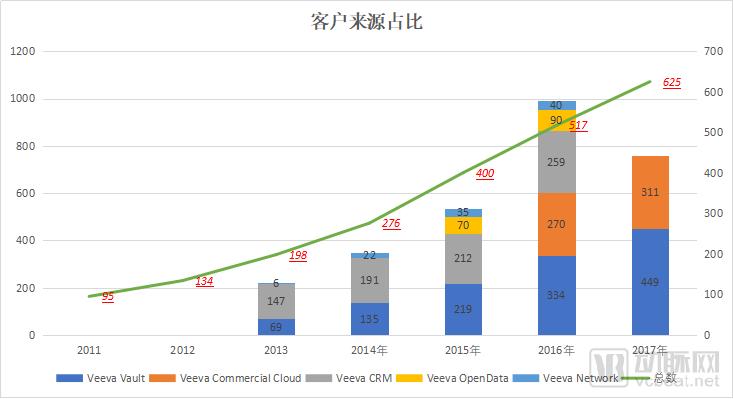
Data sourced from Veeva’s annual financial reports; graphic by VCBeat.
Veeva’s annual financial reports also reveal that in its early years, the company primarily acquired customers through Veeva CRM, which attracted a substantial client base. However, Veeva identified greater potential in its Veeva Vault platform. The data confirm that Veeva Vault has lived up to these expectations, becoming the primary driver of customer growth since 2015. As for its traditional CRM offerings, Veeva has chosen to integrate them into its newer product, Veeva Commercial Cloud.
Currently, in Veeva’s 2017 annual report, the main products were consolidated into two major offerings: Veeva Commercial Cloud and Veeva Vault.
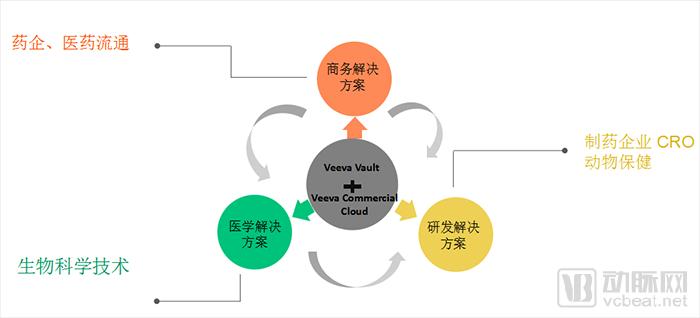
Veeva Business Model Diagram | VCBeat
Veeva Commercial Cloud helps companies market and sell their products more effectively. At the core of Veeva Commercial Cloud is Veeva’s patented multichannel customer relationship management (CRM) application, which enables pharmaceutical and biotechnology companies to target and support sales and marketing efforts directed at physicians, other healthcare professionals, and healthcare organizations through multiple channels, including face-to-face interactions, email, and online platforms. Veeva Commercial Cloud meets the rigorous commercial business processes and strict compliance requirements of the life sciences industry. The system can be used offline across multiple devices.
Veeva Vault is a cloud-based enterprise content management platform that provides customers with a unified suite of applications across commercial functions—including medical, sales, and marketing—as well as key R&D functions, including clinical, regulatory, and quality. Veeva Vault consists of 13 commercial applications and the proprietary Veeva Vault platform. It offers a unified suite of content-centric and data-centric applications on a single cloud platform to help customers eliminate internal system silos and streamline end-to-end business processes. Veeva Vault can be deployed as an integrated solution across multiple applications, enabling customers to manage all critical documents and related data within a single global system.
Veeva built its foundation on CRM, but growth from its Commercial Cloud has begun to slow as the company has achieved near-total penetration across the industry. The primary driver of its sustained growth is now Veeva Vault. For the full fiscal year 2018, Veeva projected a 15% subscription growth rate for the Commercial Cloud and a 50% subscription growth rate for Vault, which accounted for 40% of third-quarter revenue.
Veeva’s development path has expanded from CRM to encompass the entire data ecosystem of the life sciences industry. It provides solutions spanning new drug R&D, clinical trials, pharmaceutical sales, and internal management, enabling end-to-end process management and creating a closed-loop product ecosystem. Veeva is often referred to as the “Microsoft Office” of the life sciences industry.
If there is no viable competitor in clinical data management,Veeva Vault is poised to become the Microsoft Office of the life sciences and pharmaceutical industry.As the adoption of clinical management information systems continues to grow, the value these products deliver to customers is increasingly significant.
Currently, Veeva serves over 600 clients, including leading global pharmaceutical companies and emerging biopharmaceutical firms such as AstraZeneca, Pfizer, Merck, Novartis, Eli Lilly, and Amgen. According to its financial reports from 2016 to 2018, no single client accounted for more than 10% of its revenue.
Unlike the typical founders in the healthcare industry, who often boast elite credentials from top-tier universities and extensive experience at major corporations, Veeva’s founder, Peter Gassner, does not have an impressive academic background. He could be described as someone who loves working but not schooling. Prior to founding Veeva, Peter had accumulated over 20 years of experience in the software industry.
In 2010, Veeva founder Peter was named to the PharmaVOICE 100, recognized as one of the 100 most influential people in the life sciences industry.

Veeva Founder Peter Gassner
When Peter P. Gassner founded Veeva, he was already 43 years old. While many of his peers were experiencing a midlife crisis, he resolved his by becoming a billionaire.
From a young age, Peter P. Gassner was restless; during high school, he had no intention of attending college at all. It was only after his teachers encouraged him to take some introductory college-level computer science courses that he began to show interest in higher education. However, even after enrolling in university, he still did not enjoy the college experience. It was during an internship at IBM that his passion for computing led him to decide to complete his degree. Due to his outstanding performance in mathematics, Gassner successfully secured a position at IBM immediately upon graduation. He later went on to work at PeopleTools and Salesforce.
During his nine-year tenure at PeopleTools, Peter P. Gassner led a professional team of 450, providing comprehensive support for the PeopleSoft technology platform across development, strategy, marketing, and customer service. Throughout this period, PeopleTools was widely recognized as the premier application platform in the industry.
Regarding the reasons for leaving PeopleTools, Peter P. Gassner stated, “Some people are innovative by nature, but if they are placed in a field that lacks innovation, they become frustrated. Many others share this sentiment.”
Prior to founding Veeva Systems, Peter served as Senior Vice President of Technology at Salesforce, where he was fully responsible for the development and management of the Salesforce platform. His responsibilities encompassed product development, marketing, and technical partnerships. During his tenure, Salesforce.com went public and became the world’s most successful SaaS platform, leveraging cutting-edge technology applications.
After Salesforce went public, Peter P. Gassner experienced an unprecedented midlife crisis. He worked extremely hard but struggled to understand the purpose behind his efforts. Since high school, Gassner had recognized himself as someone who genuinely loved working. Driven by this passion, he refused to compromise with his work or allow it to become mundane. Consequently, he embarked on his own entrepreneurial journey, becoming a billionaire within just ten years.
When selecting a niche for their new venture, Peter P. Gassner aimed to develop cloud computing tools for a specialized segment. As one of his co-founders had connections in the pharmaceutical industry, they decided to build a Customer Engagement Management (CEM) tool on the Salesforce platform.
Veeva’s current management team is highly diverse. Most members are graduates of prestigious universities and bring extensive industry experience. For example, Ms. Zhang Chunyi, Head of Veeva China, graduated from Peking University and spent 12 years at Oracle Corporation, where she held positions such as Director of Product Management and Senior Development Manager.
According to Veeva’s financial reports, although Veeva continues to maintain strong performance, its growth rate has begun to slow gradually as an increasing number of large pharmaceutical companies are captured by various competitors in the market. Veeva is actively expanding and cultivating additional growth engines. External analysts predict that Veeva’s next growth driver may come from expansion into other industries; however, the CEO appears to be taking a cautious stance on this matter.
Three Core Business Pillars to Drive Future Growth. The first pillar is Veeva’s existing CRM customer base. Veeva boasts a substantial core of CRM clients, and as part of its growth strategy, the company aims to cross-sell additional Commercial Cloud services to this large installed base after integrating its other products with CRM into the Commercial Cloud platform. These add-on modules help sales and marketing teams stay aligned, share information, and maintain compliance. This segment represents the slower-growing portion of Veeva’s business. The modest growth pace is attributable not only to external factors but also to internal product limitations; specifically, Veeva still has room for improvement in its offerings for practice monitoring and alerting, as well as marketing territory alignment.
Veeva’s fastest growth in the future is likely to come from its Development Cloud, which the company states is still in its early stages but addresses a potential market of approximately $4 billion. The core product offered by the Development Cloud is the Vault Clinical Trial Management System, which has begun to gain favor among pharmaceutical company clients.
In addition to the CTMS management system, Veeva’s product suite also includes software for document management, quality management, and tracking interactions with regulatory agencies. The company’s latest announcement is a new safety module that will help pharmaceutical companies track all treatment-related adverse events.
The third major source of future growth is expansion beyond the life sciences industry. Veeva is working to enhance its quality management suite to sell to customers producing products other than pharmaceuticals, such as those in the consumer goods, manufacturing, and chemical industries. The company expects this business to add $1 billion to its total addressable market, though this estimate may be conservative. Returns will not materialize in 2018, and likely not in 2019 either, but Veeva is laying the groundwork for significant future expansion.
In its financial report, Veeva did not attribute its recent growth to expansion into other industries; instead, it highlighted the launch of Veeva Nitro, a data warehouse purpose-built for the commercial aspects of life sciences. Veeva Nitro eliminates the time and effort required to develop and maintain custom data warehouses through an out-of-the-box cloud solution that continuously improves over time. With Veeva Nitro, the industry now has a robust commercial data foundation for business intelligence (BI) and artificial intelligence (AI).
In foreign markets, well-developed internet infrastructure has fostered a higher willingness among life sciences companies to pay for services, resulting in significant industry barriers. However, after years of growth, Veeva now faces the challenge of market saturation. Given the substantial market potential in emerging countries, Veeva cannot afford to miss out and is accelerating its localization and on-the-ground implementation efforts.
Currently, China’s cloud computing market accounts for only 5% of the global total, a figure that is highly disproportionate to the country’s population size, commercial scale, and share of global GDP. In the public cloud sector, China lags behind the United States by at least five years; while the U.S. cloud market has entered a mature stage, China remains in its initial expansion phase. The Chinese cloud computing market is expected to maintain rapid growth from 2017 to 2020, reaching a market size of RMB 136.6 billion by 2020, with IaaS and SaaS serving as the primary growth drivers. (Data source: Gartner)
In digital marketing, the original business model must undergo a compliance-driven transformation due to the implementation of the Two-Invoice System and the prohibition of physician kickbacks.
Since entering the Chinese market in 2016, Veeva has been advancing its localization and implementation efforts. In 2017, Veeva launched a product specifically developed for the Chinese market—Veeva CRM Approved WeChat. Leveraging the functional features of WeChat, this solution enables sales representatives to send compliant content to target physicians via WeChat Service Accounts and track content engagement. These insights guide representatives in optimizing subsequent communications with physicians, thereby establishing WeChat as a secure and effective channel for interaction between pharmaceutical companies and healthcare professionals.
Once a pharmaceutical company selects a SaaS platform, switching to another vendor requires migrating large volumes of data, resulting in high conversion costs. Therefore, Veeva has consistently maintained a high customer retention rate.
Veeva topped Fortune’s “Future 50” list in 2017, with its innovation and corporate vitality highly regarded by external observers. This is also reflected in the company’s strategy: after establishing a solid foothold in the life sciences SaaS platform market, Veeva did not rush to expand but instead adopted a more prudent technology upgrade strategy, remaining committed to delivering the most comprehensive product offerings. Leveraging the technological advantages it has relied on since its inception, Veeva has built core competitiveness through high industry barriers. However, Veeva will face increasing competition and localization challenges in the future, particularly as it seeks to grow its customer base among small and medium-sized enterprises.