

CVS Health and Teladoc Launch Video-Based Telehealth Service Through CVS App
VCBeat (WeChat ID: vcbeat) has learned that U.S. retailer CVS announced on August 9 the launch of a video consultation feature with physicians on its mobile app, enabling patients to consult with doctors via their smartphones.
CVS Health’s MinuteClinic will offer virtual healthcare visits to patients seeking treatment for minor illnesses and conditions such as colds, flu, or skin disorders. This feature is launched through a partnership between CVS and Teladoc.
In the services launched by CVS and Teladoc, patients are required to complete a health questionnaire, after which the system matches them with a licensed physician in their state of residence.
In accordance with CVS requirements, a certified care provider matched to the patient will review relevant information based on the individual’s medical history prior to the consultation. During the telemedicine visit, the physician will evaluate the condition, determine the treatment plan, and issue prescriptions to the pharmacy of the patient’s choice.
If patients require further follow-up diagnosis, recommendations will also be provided. Video consultations are available 24/7 at a price of $59, currently payable by credit or debit card, with insurance coverage potentially available in the future. This telehealth product is sold in nine U.S. states and is expected to be rolled out nationwide by the end of 2018.
“We are pleased to offer patients this innovative care option,” said Dr. Troyen A. Brennan, Executive Vice President and Chief Medical Officer of CVS Health, in a statement. “At CVS Health, we are committed to delivering high-quality care when and where patients need it, at prices they can afford. With this new telehealth service, patients now have the option to seek more convenient care.”
“Teladoc CEO Jason Gorevic said in a statement, ‘This is an exciting advancement as we continue to drive the development of virtual healthcare services. CVS Health is expanding its healthcare model to include video visits, providing patients with more care options, and Teladoc is proud to partner with them on this initiative.’”
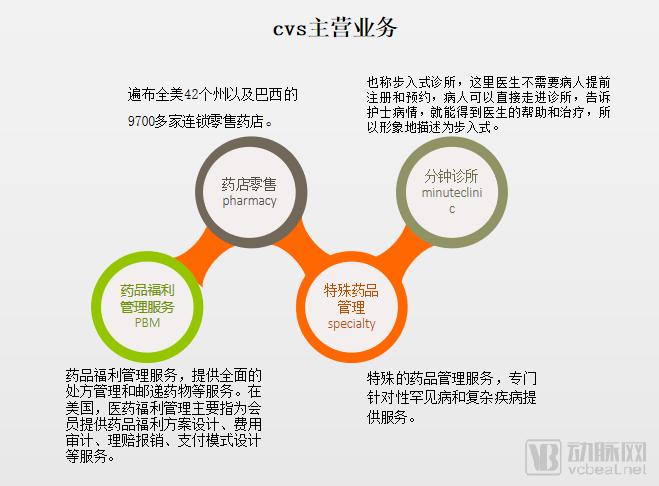
CVS began its transformation early on, focusing on telemedicine, improving medication adherence, and user health management through partnerships with digital health technology companies, aiming to build a health services company that integrates retail pharmacies and pharmacy services.
For example, CVS and the Cleveland Clinic launched a service called “MinuteClinics” in Ohio in April 2016, which has been expanding ever since and now comprises more than 1,100 MinuteClinic locations.
VCBeat Graphic
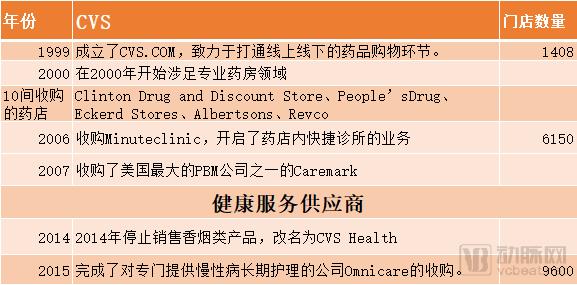
Guided by this thread, VCBeat has outlined the digital health initiatives of this U.S. pharmacy retail giant. Traditionally, leveraging their substantial financial resources, these established pharmacy giants’ most common strategy over the past two decades was to acquire competitors and expand their store networks to capture market share. However, since 2010, CVS’s acquisition spree has been aimed at building an integrated healthcare delivery system encompassing “PBM + pharmaceutical retail + health insurance + medical services.”
Nowadays, they increasingly choose to collaborate with digital health startups to refine the details of their ecosystem strategy. In the past, their focus was on maximizing pharmaceutical sales; today, they are working together to improve consumer health. In 2014, CVS discontinued its cigarette retail business and rebranded as CVS Health, demonstrating its strong commitment to transformation.
CVS MinuteClinic has previously made multiple forays into telehealth services. In 2015, CVS partnered with three leading telehealth companies—Doctor on Demand, American Well, and Teladoc—to pilot telehealth services in six states, leveraging different telehealth providers across various regions nationwide. CVS also updated its MinuteClinic app to improve consumer wait times and remote appointment scheduling.
In addition to telemedicine, CVS has also been working to bridge the last mile from users to clinics.
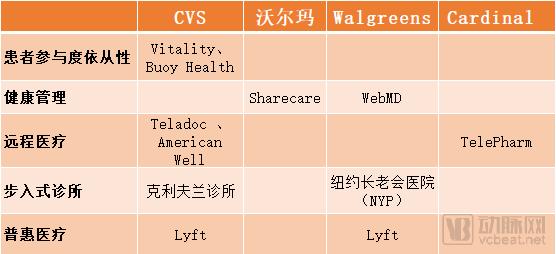
In early May 2018, CVS partnered with Buoy Health’s AI chatbot to provide users with health consultations. When users interact with Buoy Health’s online or app-based chatbot interface, the diagnostic results provided by the bot may recommend that users visit a nearby CVS MinuteClinic.
The application locates the nearest MinuteClinic and provides navigation. This partnership can drive traffic to CVS’s MinuteClinics, directing users who might not have previously considered seeing a doctor to these facilities.
Dr. Andrew Le, CEO of Buoy Health, stated, “Partnering with CVS MinuteClinic is the first step toward recommending personalized healthcare services to users based on their needs.”
In 2010, CVS launched its first mobile application, enabling CVS members to fill prescriptions, check prescription order status, view prescription history, review medication costs, and locate nearby pharmacies.
CVS, in addition to refining its own services and striving for perfection,Its transformation journey continues to improve user health.
In March 2018, CVS also appeared in news about the collaboration between the U.S. Blue Shield insurance organization New BCBS Institute, ride-hailing giant Lyft, and another pharmaceutical retail giant Walgreens.
Several industry giants are preparing to join forces in eliminating social barriers, enabling more consumers in underserved areas to access a wider range of healthcare services. For instance, they aim to assist consumers who struggle to obtain adequate nutrition from supermarkets and encourage the adoption of healthy lifestyles.
“An increasing number of Americans live in areas where healthcare is inaccessible, even if they have health insurance,” added Dr. Troyen Brennan, Executive Vice President and Chief Medical Officer of CVS Health. “Through our partnership with the Blue Cross Blue Shield Institute, we are committed to addressing issues that are inextricably linked to health outcomes, enabling people to engage with pharmacies before their conditions become critical.”
In 2013, CVS announced a partnership with Vitality, a subsidiary of NantWorks, to sell GlowCaps smart medication caps, which help users track their medication adherence history. The two companies announced that they would jointly conduct randomized controlled trials to evaluate the efficacy of GlowCaps in improving medication adherence.
Soon after, the company launched a new CVS iPad app, a virtual pharmacy that provides users with a 3D virtual pharmacy experience, where each section of the pharmacy corresponds to a feature within the app.
In July 2014, CVS added a drug interaction check to its mobile app, alerting consumers when over-the-counter medications might interact with other drugs. The company claimed to be the first chain pharmacy to include this feature in its mobile application. That same year, CVS launched a digital innovation lab in Boston.
In Boston’s innovation labs, several health-related products were introduced in 2015. The first was an otoscope that allows users to insert it directly into the ear canal when experiencing ear problems, enabling remote consultation and diagnosis with a physician. Another product was an app called “Allen,” which can be shared with family members and friends; they receive notifications if the patient fails to take medication on time.
CVS’s move was widely seen as a response to Amazon’s high-profile $1 billion acquisition of the online pharmacy PillPack. In fact, CVS had begun laying the groundwork for its digital health strategy well before Amazon’s entry into the space.
In November last year, CVS announced its $69 billion acquisition of health insurer Aetna, making it the largest merger and acquisition deal of 2017. By bringing Aetna under its wing, CVS aims to further complete its healthcare service system covering “PBM + pharmaceutical retail + health insurance + medical services.”
On its digital health journey, CVS leverages mobile devices and applications to enhance patient engagement. The acquisition of Aetna by CVS is seen as a sign that traditional pharmaceutical companies are beginning to transform, shifting from merely providing services to patients to finding their role in an era where consumer power is increasingly dominant.
The CEO of Sharecare believes that CVS’s acquisition of Aetna is accelerating vertical integration, with CVS beginning to control the entire value chain to fend off Amazon’s incursion into the prescription drug market.
In this vertical integration, if CVS can form a data closed loop by leveraging artificial intelligence to integrate data on prescription drug purchases, beauty product consumption, and insurance claims.
CVS can gain deeper insights into consumers and create 360-degree consumer profiles. CVS can guide people on how to purchase food and use over-the-counter medications, providing personalized healthcare services.
“If they can leverage data in the right way, they will have the opportunity to integrate and analyze it, and feed the insights back to individuals with healthy behaviors to encourage health-promoting actions—this is a game-changer.”
Traditional Pharmaceutical Retail Digital Health Partner
Walmart
Walmart is one of the largest pharmacy chains in the United States, with more than 4,700 retail pharmacies operating nationwide. At the end of 2017, CB Insights compiled merger and acquisition data from 2012 to 2017 and found that among these major pharmacy chain giants, Walmart engaged in acquisitions most frequently.
In 2014, Walmart announced its ambition to become the leading healthcare provider in the industry. Over the past decade, Walmart has made significant strides, including the following measures:
Prescription Plan: Walmart offers consumers prescriptions at a total price of $4 to help them reduce medication costs;
Healthcare Convenience: Walmart offers healthcare consultant services to consumers in its stores, charging a flat fee of $40 per visit;
Primary Care Clinics: By establishing clinics within retail stores, consumers can conveniently obtain prescriptions for common illnesses at Walmart, with fees as low as $40 per visit;
Walmart has not been left behind in the vertical integration trend exemplified by CVS. In March 2018, reports emerged that Walmart was considering acquiring Humana, an insurance giant valued at $37 billion. Although Walmart already operates approximately 4,500 in-store pharmacies and 2,900 vision centers, the acquisition of Humana could accelerate its efforts to develop in-store clinics.
Gurpreet Singh, a partner in the health services division at consulting firm PwC, stated that acquiring Humana would also enable Walmart to gain deeper insights into its customers’ healthcare needs. By accessing Humana’s medical data, Walmart can achieve a more profound understanding of its customers and the populations residing near its stores.
For example, if a community has high incidence rates of heart disease or diabetes, Walmart can showcase and promote programs that more prominently address these conditions.
“In addition to selling prescription drugs, Walmart can develop a highly attractive business through walk-in or appointment-based clinics,” said Eric Gordon, a professor at the University of Michigan’s Ross School of Business.
Walmart is not only the world’s largest retailer but also the largest private employer globally. As of 2017, Walmart employed 2.3 million people, compared with Amazon’s 540,000. It would be no small feat for Walmart to address the healthcare needs of its own workforce.
In May 2018, Walmart announced a partnership with Sharecare to improve the health of its employees and communities. Sharecare is a health and wellness engagement platform that provides consumers with personalized information, plans, and resources to enhance their health outcomes.
The online platform will provide users with tools to monitor and understand their health status. It also enables users to develop actionable plans to improve their health, while offering participants health trackers, health content, and wellness tips.
Last year, Walmart also leveraged the ZP Challenge to enhance employee health and well-being. This is not the first time the retail giant has utilized digital health solutions to address employee health issues.
Four years ago, the company launched the ZP Challenge, a rewards program designed to encourage holistic well-being in fitness, family, diet, and spending. Walmart stated that ZP users can now access Sharecare, providing them with additional health tools and wellness programs.
Walgreens
Walgreens is one of the largest pharmaceutical retailers in the United States. According to IBISWorld data, CVS holds a 58% share of the U.S. retail pharmacy market, while WBA and Rite Aid account for 31% and 10%, respectively. Rite Aid lags behind its larger competitors, CVS and Walgreens, in digital transformation. While CVS and Walgreens launched their pharmacy apps as early as 2010, Rite Aid did not introduce a similar application until 2012.
Walgreens’ notable move came in 2015, when it planned to acquire Rite Aid, then the third-largest pharmacy chain in the United States, for $9.4 billion. However, the deal failed to secure antitrust approval. The company subsequently announced that it would purchase nearly half of Rite Aid’s U.S. stores for $5.18 billion.
Walgreens’ most notable digital health initiative is likely its Balance Rewards program, which was launched in 2012 and currently boasts 82 million active members. Initially conceived as a typical retail consumer rewards program, it has since evolved into a behavior-change platform that both promotes healthy activities and tracks and records health information. Walgreens has also partnered with Qualcomm Life, Misfit, and UnitedHealthcare to enhance the Balance Rewards program.
Walgreens also offers its own mobile application, allowing users to log in to their pharmacy accounts and order prescription medications. Users can identify their medications by accessing their account information or scanning the prescription number. The app also features a medication reminder function to help users take their doses on time. Additionally, it provides recommendations for preferred pharmacies based on geographic location and offers navigation services once a pharmacy is selected. The app also enables data export, allowing users to share their medication lists with their prescribers.
Walgreens and WebMD have entered into a deep partnership in telemedicine.Walgreens has integrated Live Doctor Consultation and Pharmacy Chat features into its app, partnering with MDLive to provide nationwide remote consultations with physicians. However, these services are limited to non-emergency medical conditions, such as acne, allergies, and urinary issues. Each consultation is priced at $49.
The collaboration between Walgreens and WebMD extends beyond telemedicine. WebMD also provides health counseling services to Walgreens. Consumers can visit Walgreens.com to enroll in the Digital Health Advisor, a virtual health advisory program powered by WebMD, designed to create customized goals and action plans that support lasting lifestyle changes. Participants can engage in interactive programs addressing smoking cessation, weight management, nutrition, physical activity, and emotional well-being. Walgreens Pharmacy Chat health experts are also available to provide real-time guidance, encouraging positive lifestyle choices and healthy behaviors. Users who participate in the Digital Health Advisor program earn Walgreens Balance Rewards points as they make progress toward their goals.
In addition, Walgreens and WebMD have expanded their prescription transfer services. Consumers can now access Walgreens’ prescription refill and transfer services through WebMD’s iPhone app. By simply scanning the barcode on a prescription label or manually entering the information, consumers can refill prescriptions at their local Walgreens pharmacy. This service will also be introduced to WebMD’s desktop platform later this year.
In terms of incentivizing user health, iPhone users can connect Apple Health to the Walgreens app and earn extra reward points for setting and meeting health-related goals, such as exercise and blood pressure management. This feature is powered by WebMD.
In December 2017, Walgreens also partnered with NewYork-Presbyterian Hospital (NYP), one of the top hospitals in the United States, to launch telemedicine services. Physicians from NYP will provide remote consultations for patients with non-life-threatening conditions through Walgreens’ online portal and self-service kiosks located in select Duane Reade stores in New York.
This collaboration with NYP extends Walgreens’ OnDemand platform, which was launched in 2016 to focus on telemedicine and mobile health. Priced at $99 per visit, the service allows patients to access secure, private kiosks where physicians conduct examinations via video chat. The kiosks are also equipped with connected diagnostic devices, including blood pressure cuffs, forehead thermometers, and dermal sensors. Physicians can also send prescriptions directly to the patient’s preferred pharmacy. As early as 2013, Walgreens had already enabled users to consult directly with Walgreens pharmacists through its mobile app. The telemedicine technology is powered by American Well.
Cardinal Health
Cardinal Health is a global multinational corporation integrating the production of healthy nutritional foods and health supplements, as well as healthcare services. It supplies pharmaceuticals and nutritional products to 90% of hospitals in the United States. In 2016, Cardinal Health acquired TelePharm, a digital health startup focused on pharmacies.
TelePharm has two core technologies. The first is providing medical education to pharmacy staff. In the United States, prescriptions are not necessarily written by physicians; nurse practitioners can also provide diagnostic and prescribing services, as can registered nurses and licensed practical nurses further down the hierarchy. TelePharm operates several different business lines that help pharmacists disseminate their expertise across multiple pharmacies. This enables local pharmacy chains with outlets dispersed in rural areas to significantly reduce their overhead costs. One of its offerings is TeleCheck, which allows for remote verification of medications—one of the most critical and time-consuming tasks performed by pharmacists.
Another service, called TeleCounsel, enables pharmacists to interact directly with patients. Adopted by hospitals, it leverages pharmacy staff to provide discharge counseling as patients prepare to leave the facility. Engaging with a pharmacist prior to discharge can improve patients’ medication adherence; however, this is often challenging, as it requires pharmacists to be present across numerous locations within large hospitals or hospital systems. With TeleCounsel, pharmacists can consult with a wide range of patients, even providing follow-up counseling after patients have returned home.
From the above analysis, we can observe that several traditional pharmacy giants have integrated into multiple segments of the digital healthcare industry chain as part of their digital health engagement strategies. They are transitioning from being mere medication suppliers to becoming user-centric advisory healthcare service providers. Their initiatives also offer practical implementation models for entrepreneurs in the digital healthcare sector. To thoroughly transform itself into a comprehensive healthcare service provider, CVS decisively discontinued its cigarette retail operations. Traditional pharmacy retail giants are facing challenges related to health insurance reimbursement.
Following vertical integration of the value chain, traditional pharmacies can leverage robust data analytics capabilities and their extensive offline pharmacy networks across the United States to reduce hospital readmission rates and improve chronic disease management by incentivizing healthy behaviors. High-deductible health insurance plans and rising premiums are prompting consumers to take greater ownership of their healthcare decisions, further driving shifts in industry trends. Negotiations between pharmacies and payers have also compressed profit margins in the U.S. prescription drug market. Even if traditional pharmacies fail to innovate proactively, Amazon is poised to drive change on their behalf.
Although CVS’s revenue exceeded market expectations in its latest quarterly earnings report, growth remained primarily driven by the prescription drug market. Performance from Omnicare and its Pharmacy Benefit Management (PBM) segment was sluggish, with Omnicare’s long-term care-focused business falling short of expectations. CVS’s PBM business is also facing downward pressure on pricing and adverse impacts on revenue from increased generic drug utilization.
However, such fluctuations are preferable to the shock triggered by Amazon’s entry into the market. After Amazon announced its acquisition of the online pharmacy PillPack, the combined market capitalization of Walgreens Boots Alliance, CVS Health, Rite Aid, and pharmaceutical distributors Cardinal Health, AmerisourceBergen, and McKesson evaporated by approximately $14.5 billion. Meanwhile, Walmart saw its market cap shrink by $3.04 billion on Thursday after losing the bid for PillPack.
Such consolidation is largely a result of the shift toward value-based healthcare, in which providers bear increasing responsibility for improving quality and reducing costs.