

Nuanxin Yiyi: China's First Internet-Based Mental Health Hospital Building a Closed-Loop Pharma Model and Seeking Payers for Mental Healthcare
As we come to realize that the brain is arguably the most complex entity in the known universe, a hundred-billion-dollar market spanning from physical to mental health awaits exploration.
Amid the mental health needs of 250 million people, VCBeat has recently launched a special series on the Mental Health Industry. Spanning from enterprises to markets, and from China to overseas, this sector presents both challenges and opportunities. We will conduct a comprehensive scan of this field. If you are part of this industry, you are welcome to engage with our authors at any time; for media coverage inquiries, please contact VCBeat directly.
(Click for the special feature)
“Regarding mood disorders, both she and I know too little, but we are both trying very hard.”
——Yu Jingping
In recent days, my WeChat Moments have been repeatedly flooded by a viral article titled “Please Don’t Forget Her Once She Drops Off the Trending List,” which has garnered over 100,000 views. The “her” referred to in the article is a 32-year-old Hong Kong female singer whose death was announced on August 4. She died from a fall from a high-rise building, with depression widely speculated by the public as the most likely cause.
Two days later, the female singer’s partner posted a response to address public concerns. One line in particular—“Regarding mental health conditions, both she and I know too little, but we are trying our best”—evokes a sense of regret tinged with helplessness.
Depression is a common mental disorder, with an incidence rate as high as 3%. According to statistics from the Chinese Association for Mental Health, there are currently over 40 million individuals with depression in China, among whom 60% are unaware of their condition, and only 10% receive pharmacological treatment. Although depression has the highest mortality rate among mental disorders, its cure rate can actually reach 80%. Nearly half of the suicide cases attributed to depression each year could be prevented through timely and systematic treatment.
In addition to depression, common mental disorders include anxiety disorders and obsessive-compulsive disorder (OCD). Among these, anxiety disorders have the highest prevalence rate at 5%, making them the most frequent diagnosis in psychiatric outpatient clinics; OCD is the most difficult to treat, with a prevalence rate of approximately 2.5%.
Currently, the overall prevalence of various mental and psychological disorders in China stands at 17.5%, affecting a population of 250 million individuals, while there are only 20,000 psychiatrists. This equates to 1.46 psychiatrists per 100,000 people, which is less than one-quarter of the international standard. According to an analysis of the National Mental Health Work Plan (2015–2020),Psychiatric Medical Resources in ChinaMainly distributed in provinces and prefecture-level cities. The supply of mental health services is insufficient and uneven.
Peng Kaiping, former Chair of the Department of Psychology at Tsinghua University, proposed the concept of the “happiness inflection point.”Theory. Based on big data analysis, the Happiness Inflection Point Theory posits that when a society’s per capita GDP exceeds US$3,000, psychosocial issues will enter a period of high prevalence. In China, per capita GDP has exceeded US$3,000 since 2008, and the “Happiness Inflection Point” undoubtedly poses a profound challenge to everyone pursuing a better life.
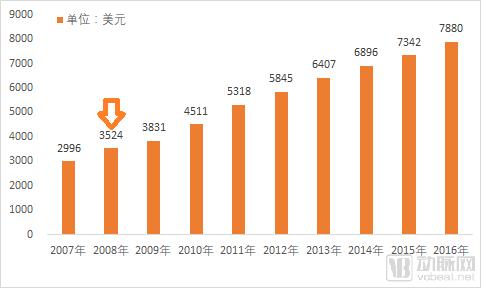
Per Capita GDP in China, 2007–2016 (Calculated at the USD Exchange Rate on August 10, 2018)
Data Source: National Bureau of Statistics; Chart by VCBeat
Jin Fangyi, who has been engaged in the sales of antidepressant medications since graduation, is well-versed in the underlying logic of the mental health supply chain. “Mental illnesses have two characteristics that are highly suitable for internet-based healthcare.” Jin Fangyi remains firmly convinced of her judgment.
In 2015, Jin Fangyi founded Nuanxin Yiliao. “When you know what you want to do, the whole world will make way for you.” This quote aptly captures Jin Fangyi’s mindset when she embarked on her entrepreneurial journey.
That year, she met Dr. Wu Lu, a Ph.D. in Physics from the University of Kentucky who was engaged in quantitative research overseas. Dr. Wu had recently suffered the loss of a close friend to depression and was motivated to make a difference for this large affected population. After their discussions, they quickly found common ground and formed a team: Jin Fangyi took charge of operations, while Wu Lu handled technology, creating a stable and efficient partnership.
The following year, Professor Mei Meng and Professor Peng Kaiping established the Tsinghua University Happiness Technology Laboratory. As the world’s first technological innovation incubation platform dedicated to translating research findings in positive psychology into practical applications, the laboratory has fostered Nuanxin Yiliao as one of its standout projects. With the support of this incubation platform, Jin Fangyi was able to devote herself fully to refining Nuanxin Yiliao’s business model and technical solutions.
Recently, VCBeat (WeChat ID: vcbeat) conducted an exclusive interview with Jin Fangyi, founder of Nuanxin Yiliao, to discuss the pain points in mental health service supply and her unique solutions.
Jin Fangyi identified two characteristics of mental disorders that make them well-suited for internet-based healthcare: prolonged disease course and high patient stickiness. A prolonged disease course means that mental disorders are typical chronic conditions requiring long-term, continuous care. High stickiness refers to the fact that once patients engage in the diagnosis and treatment process and develop trust in their physicians, a strong one-on-one doctor-patient relationship is established.
Jin Fangyi believes that, at the current stage, the most critical factor is to provide physicians with effective tools for managing patient relationships. The platform she has chosen is an internet-based psychiatric hospital; “to date, psychiatry has become the best-developed specialty within internet hospitals.”
Unlike common internet-based mental health platforms that focus primarily on matching patients with doctors, Nuanxin Yiliao adopts a different approach by creating a closed-loop system for psychiatric care, embedding internet technology into the entire process—including appointment scheduling, consultations, prescription issuance, and medication pickup. In Jin Fangyi’s view, efficient diagnosis and treatment of mental disorders cannot be achieved through purely online or offline methods alone.
The OMO (Online-Merge-Offline) model should be the preferred choice. The internet-based psychiatric hospital created by Nuanxin Yiliao delivers integrated online and offline medical services on a city-by-city basis. When users first experience psychological distress, they can opt for online consultations due to greater privacy; if a more definitive diagnosis is required, they can schedule in-person visits to reduce waiting times. Once the condition stabilizes, patients can follow up with their doctors online, with medications delivered directly to their homes, thereby ensuring a seamless and convenient end-to-end service experience.
In March 2017, Nuanxin Yiliao partnered with the Second People's Hospital of Guizhou Province to establish the first internet-based psychiatric hospital, migrating the entire spectrum of psychiatric diagnostic and therapeutic activities online.
First-time patients can use the Internet Psychological Hospital APP to schedule appointments and visit partner hospitals on time. The consultation process for follow-up patients also begins with appointment scheduling; however, the consultation session is initiated by the physician, who conducts the evaluation online via video or audio. During the consultation, the physician reviews the patient’s previous electronic medical records and combines them with the patient’s current chief complaints to make a diagnosis and issue an online prescription. The online prescription is first sent to the backend for price verification, after which the patient completes the payment online. Upon successful payment, the medication is delivered to the patient’s home either by the hospital pharmacy or by a third-party pharmacy.
Jin Fangyi pointed out that the integration of medical services and pharmaceuticals is a hallmark of Nuanyi Yiliao, as well as a key aspect of quality control. In July 2018, the National Health Commission explicitly stated in its "Notice on Deepening the Implementation of 'Internet + Healthcare' Convenience and Benefit Activities" that the construction of "smart pharmacies" should be promoted to achieve seamless integration between prescription systems and pharmacy dispensing systems, thereby facilitating timely medication pickup for the public. After online prescriptions are reviewed by pharmacists, medical institutions and pharmaceutical operating enterprises may entrust qualified third-party agencies with delivery. Remote medication delivery, as a policy innovation, requires particular caution during implementation.
Prerequisites for Nuanyi Yiliao’s remote medication delivery service include complete electronic medical record information and stable patient condition. The dosage and types of medications delivered are strictly controlled, and Class II psychotropic drugs are excluded from delivery. Over the past year since the pilot launch of the Internet Psychological Hospital in Guizhou Province, Nuanyi Yiliao has established a comprehensive set of service standards for remote medication delivery, with operations running smoothly.
The primary users of Nuanyi Yiliao are hospitals, with the product offered in both physician-facing and patient-facing interfaces.
Jin Fangyi believes that another pain point in the domestic mental health supply is the lack of insurance reimbursement integration. “The cost of psychotherapy is not low; if users have to bear the full expense, it will be difficult to revitalize the market in the short term.” Therefore, in the business model of Nuanxin Yiliao, the primary objective is to identify payers for users.
According to Jin Fangyi, the payers for mental health services should be enterprises and medical insurance. “Especially enterprises, because when employees experience psychological issues, it is the enterprise’s productivity that suffers directly.” However, currently, there are limited companies in China that are both willing and able to bear the mental health costs of their employees, and market education will take time. Therefore, the first payer identified by Nuanyi Yiliao for its users is medical insurance, with hospitals serving as an inevitable channel. According to Jin Fangyi, Nuanyi Yiliao is currently positioned as building a cluster of internet hospitals specializing in psychiatry and psychology.
Physician Side: Electronic Medical Record Library Enhances Diagnosis and Treatment Efficiency
In the development of internet hospitals, Nuanyi Yiliao provides comprehensive digital solutions for healthcare institutions. Starting with a specialized follow-up system for psychiatric care, Nuanyi Yiliao’s digital solution has achieved deep integration with hospital information systems and empowers physicians through a doctor-facing mobile app, thereby enhancing the management of patient data and electronic medical records.
Among these improvements, optimizing electronic medical record (EMR) management can reduce physicians’ consultation time by up to 70%. Previously, patient visits were isolated events. During each visit, doctors spent considerable time inquiring about patients’ prior medical histories and treatment records. Patients’ memory biases or omissions in describing their conditions could also adversely affect diagnostic and therapeutic outcomes.
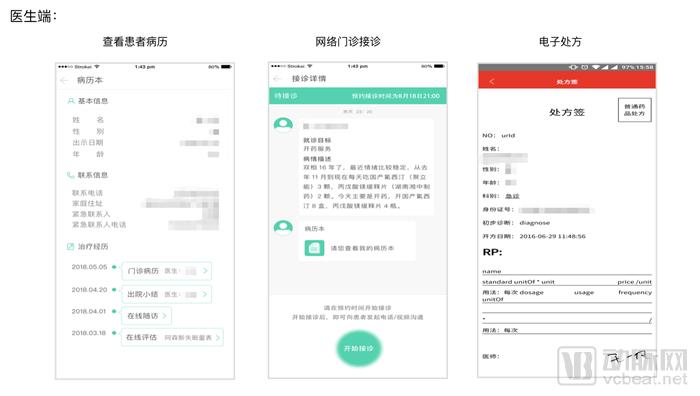
Nuanxin Yiliao Doctor-Side App Interface. Image provided by Nuanxin Yiliao
Nuanxin Yiliao leverages big data technology to aggregate patient medical record data, enabling physicians to access it on a personalized basis according to their clinical needs. Furthermore, Nuanxin Yiliao employs artificial intelligence algorithms to proactively push patient information to physicians, serving as an assistant to doctors.
Patient Side: High Accessibility Drives High Repurchase Rates
Patients access the Nuanxin Yiliao service through a patient-facing app. In addition to appointment scheduling and remote consultations, patients can consult with physicians and upload medical records. According to Jin Fangyi, the demand-side users of Nuanxin Yiliao include not only psychiatric patients in hospitals but also specific populations who have not yet entered the formal healthcare system, such as working professionals, adolescents, and perinatal women. Due to the strong medical orientation of Nuanxin Yiliao, user trust is relatively easy to establish, resulting in high user retention. More than 20% of users are paying customers who make purchases on average more than twice per month.
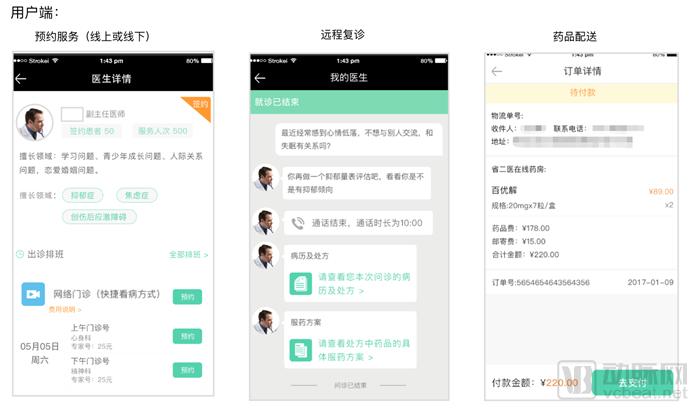
Patient-side Application Interface of Nuanyi Yiliao. Image provided by Nuanyi Yiliao.
Jin Fangyi pointed out that providing professional and accessible psychological services is the ultimate goal of Nuanxin Yiliao. It is expected that by the end of 2018, Nuanxin Yiliao will collaborate with 20 psychiatric specialty hospitals to jointly establish internet hospitals, covering 4,000 to 5,000 psychiatrists, which accounts for approximately one-quarter of the total number of psychiatrists in China. In addition, Nuanxin Yiliao is exploring cooperation plans with large employers such as state-owned banks.
Starting with psychiatric follow-up care, Nuanxin Yiliao has, over nearly three years of development, established a viable business model and formed a paid service ecosystem encompassing hospitals, enterprises, and patients, which can be continuously scaled through an expanding partner network. Over the past three years, Nuanxin Yiliao has garnered favor from the capital market and successfully completed its Series A financing round.

Nuanyi Yiliao Financing Record
Data Source: VCBeat Database; Graphic by VCBeat
At the conclusion of the interview, Jin Fangyi told VCBeat that Nuanyi Yiliao’s strategic path is already very clear and will be pursued consistently.
Related Links to the Mental Health + Case Series Special Topics:
Selected Reports on the Mental Health Industry:
【AI + Mental Health】Widespread Anxiety: Can AI-Driven Cognitive Behavioral Therapy Help?