

Ping An Good Doctor Builds a Closed-Loop Pharmaceutical Platform Covering Over 80 Cities and 4,000 Pharmacies

Ping An Healthcare
One-stop Solution Provider for Health Management
Ping An Good Doctor successfully went public less than four years after its establishment. Leveraging its unique development logic and business model, and supported by a self-employed team of over 1,000 full-time medical professionals and 3,100 contracted partner hospitals, the company has built a one-stop healthcare ecosystem platform centered on online consultations.
On August 16, Ping An Good Doctor released its 2018 interim financial report, marking its first earnings disclosure since going public. The report showed that the company’s revenue maintained rapid growth, with family doctor services and the health mall becoming the primary drivers of this expansion.
Among these, the family doctor business generated RMB 186.2 million in revenue, a year-on-year increase of 91.4%. The rapid growth in family doctor business revenue was primarily driven by the significant growth in 2018 of “Jiuyi 360,” a new product launched at the end of 2017, as well as a substantial increase in e-prescription service revenue. Meanwhile, the “1-minute consultation + 1-hour medication delivery” service under the family doctor business also performed remarkably, covering 62 cities with 4,150 partner pharmacies. By the end of July, this service had expanded to more than 80 cities across China.
The Health Mall business contributed a GMV of RMB 1.56 billion, representing a year-on-year increase of 130.4%. Revenue from the Health Mall business reached RMB 628.2 million, up 302.7% year on year; gross profit amounted to RMB 63.9 million, a year-on-year increase of 120.2%. As of June 30, 2018, its Health Mall offered approximately 265,000 SKUs, covering a wide range of categories including traditional Chinese and Western medicines, nutritional supplements, medical devices, maternal and child care products, and sports and fitness equipment.
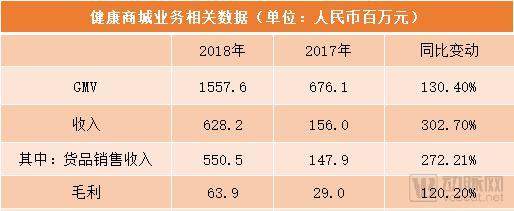
Among these two high-growth business segments, the pharmaceutical business accounts for a larger proportion. Recently, Ping An Healthcare has made significant moves in the pharmaceutical sector, launching services such as “Minute Clinic + One-Hour Medication Delivery.” This demonstrates that the pharmaceutical segment is not only a key growth driver for Ping An Healthcare but also continuously expanding its operational scope. These developments have drawn our considerable attention and curiosity: Do they signal new strategic layouts and approaches for Ping An Healthcare’s pharmaceutical business? On the occasion of the interim report release and in light of recent business changes, VCBeat conducted an in-depth interview with Mr. Wang Kun, Vice President of Ping An Healthcare and General Manager of its Pharmaceutical Business Division.

Wang Kun, Vice President of Ping An Healthcare and General Manager of the Pharmaceutical Business Division (Image source: CPEO)
Build a Trusted Pharmaceutical Platform
According to VCBeat’s previous strategic analysis of Ping An Healthcare, the pharmaceutical segment has always been a key component and one of the major revenue sources for the company. It permeates various business lines, including the Health Mall, Family Doctor services, and Health Management, as evidenced by insights from the interim financial report.
In this regard, Wang Kun stated that Ping An Good Doctor’s vision is to provide every family with a family doctor, and every individual with an electronic health record and a health management plan. Central to this ecosystem are medical services, pharmaceuticals, and data information. Therefore, pharmaceuticals constitute a critical link in this framework.
However, unlike other platforms that strengthen their in-house pharmaceutical operations, Ping An Good Doctor enters the pharmaceutical sector through partnerships, encompassing both the operation of its e-pharmacy business and collaborations with pharmacies. “Patients do not want to visit hospitals daily, spend three hours queuing only to have a three-minute consultation. They prefer having a family doctor or resolving health issues online, obtaining necessary medications either through delivery services or at nearby pharmacies. This is where Ping An Good Doctor truly shines, rather than merely operating as a large-scale e-pharmacy platform,” stated Wang Kun.
Taking Ping An Good Doctor’s pharmaceutical e-commerce business as an example, it is a necessary component for closing the loop. The online pharmacies on the platform operate through partnerships with merchants, rather than being scaled and operated directly by the company. Strategically, Ping An Good Doctor has always positioned itself as a platform, aiming to enhance service accessibility through collaborations, rather than venturing into numerous small, vertical segments on its own.
Empowering the Pharmaceutical Industry to Drive Its Growth
Positioned as a platform, Ping An Good Doctor has consistently adopted an online-to-offline (O2O) model since its launch. It avoids heavy asset investment in offline operations, instead expanding its business primarily through partnerships. Recent initiatives include one-hour medication delivery services in collaboration with pharmacies and the deployment of smart medicine cabinets by Minute Clinics. These efforts aim to empower offline entities, thereby facilitating the transformation of pharmacies into clinic-like facilities.
According to the “2017 Statistical Analysis Report on the Operation of the Pharmaceutical Distribution Industry” issued by the Ministry of Commerce, the total sales of seven major categories of pharmaceuticals nationwide reached RMB 2,001.6 billion in 2017, with the retail pharmaceutical market totaling RMB 400.3 billion, a year-on-year increase of 9.0%. Although the pharmaceutical retail market continues to grow, challenges such as consumers’ difficulty in purchasing medications and pharmacies’ difficulty in attracting customers persist.
Wang Kun stated, “For pharmacies, the primary objective is to maximize profits. Currently, the net profit margin of the four major listed pharmacy chains stands at only around 4%, which is extremely thin. At present, chain pharmacies generally exhibit a ‘3-3-4’ performance pattern: out of every ten stores, three operate at a loss, three break even, and four are profitable. Even if the three loss-making stores are gradually closed, this does not necessarily mean that the remaining four profitable stores will generate higher profits or that the three break-even stores will turn profitable. In fact, such a move would lead to a decline in the chain’s market share, adversely affecting its bargaining power, procurement costs, and other operational aspects. Ping An Healthcare empowers pharmacies by facilitating drug sales through our prescription services and physician consultations. As we do not adopt an asset-heavy model, we aim to collaborate more effectively with pharmacies to help them achieve profitability.”
In terms of industry empowerment, Ping An Good Doctor has made numerous attempts. Its pharmaceutical e-commerce platform officially began operations in March 2016, and by the end of June 2018, its gross merchandise volume (GMV) had reached RMB 1.56 billion. Over this two-year period, sales figures for the pharmaceutical e-commerce business multiplied several fold.
Online pharmaceutical e-commerce is complemented by Ping An Healthcare’s highly effective offline patient management. Leveraging electronic health records, the company conducts precise analysis and targeted marketing based on patients’ medical histories and data. This approach not only enhances patient care but also provides pharmaceutical companies with an effective channel for product engagement.
“In terms of patient education, we are also collaborating with pharmaceutical companies on some initiatives, and the feedback data obtained at this stage is very positive.”
Interpreting “One-Minute Consultation, One-Hour Drug Delivery”
“1-Minute Consultation + 1-Hour Medicine Delivery” is the new business system of Ping An Good Doctor, offering a one-stop service featuring rapid online consultations and one-hour home delivery of medications. The “1-Hour Medicine Delivery” service aims to address the “last mile” challenge in pharmaceutical distribution for patients, with plans to expand into third- and fourth-tier cities. Meanwhile, the “Minute Clinic” empowers pharmacies and large enterprises by providing efficient medical consultation and pharmaceutical services. According to the interim report, as of the end of June 2018, Ping An Good Doctor had partnered with over 3,100 hospitals, including more than 1,200 Grade A tertiary hospitals, and over 12,000 pharmacies, among which more than 4,000 were covered by the “1-Hour Medicine Delivery” service.
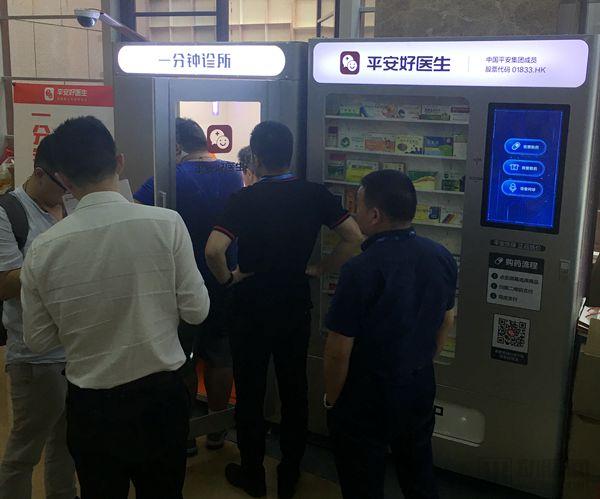
Ping An Good Doctor’s Minute Clinic (Photo by VCBeat)
“The Minute Clinic is an integrated smart medicine cabinet we launched, combining AI-powered intelligent consultations with real-time online doctor consultations. It began its nationwide rollout in early August. This is an industry-first product; unlike the automated retail medicine cabinets designed by many other players in the sector, the Minute Clinic completes a full service loop encompassing doctor consultations, prescription issuance, and medication dispensing. Furthermore, leveraging our extensive user data and integration with the Ping An Good Doctor app, users can locate smart medicine cabinets and learn how to conduct consultations and purchase medications directly on the Ping An Good Doctor platform. Additionally, our third-party delivery partners can all serve as pickup points. The medications provided through the Minute Clinic are sourced in partnership with pharmacies, rather than being self-operated by Ping An Good Doctor, thereby empowering pharmaceutical companies and pharmacies,” introduced Wang Kun.
Moreover, MinuteClinic has resolved the issue of pharmacies being unable to provide 24-hour service. While the National Medical Products Administration (NMPA) encourages pharmacies to operate around the clock, implementation remains challenging. Adding just one or two staff members incurs an annual cost of over RMB 100,000, meaning only a very small number of pharmacies can currently achieve this. The emergence of MinuteClinic addresses this challenge by offering 24/7 real-time online physician consultations, with plans to introduce additional services such as video calls. Integrated diagnostic equipment is also part of the offering; currently, blood pressure monitors and thermometers are available, with more devices to be added in the future.
Data from the interim report reveals that as of the end of June 2018, Ping An Good Doctor’s “1-minute consultation + 1-hour medicine delivery” service had covered 62 cities, with 4,150 partner pharmacies. By the end of July, the service had expanded to more than 80 cities across China, including partnerships with well-known national pharmacy chains such as Yifeng, Neptunus Drugstore, Laobaixing Pharmacy, and Guoda Pharmacy.
In addition to empowering pharmaceutical companies and pharmacies, Minute Clinic is also a product offered by Ping An Good Doctor to serve large enterprises. The target clients include banks, traditional enterprises, and large internet companies with workforces of over 1,000 employees, as these organizations face high employee healthcare costs and tend to place greater emphasis on employee health management.
For Ping An Group’s existing major insurance clients, Minute Clinic also serves as a significant value-added service. All large enterprises collaborating with Ping An Pension Insurance contribute to a pooled fund, which is utilized for employees’ medical expenses, including medication and hospitalization. However, in the past, many individuals were unaware of how or where to access these benefits. Moving forward, minor health issues among employees of partner enterprises can be addressed through Minute Clinic, with settlement and claims processing handled seamlessly via Ping An’s internal system, thereby streamlining the previously cumbersome procedures for both companies and their staff. “Of course, even if services are not accessed through Minute Clinic, the same experience is available via the Ping An Good Doctor APP, ensuring a fully integrated closed-loop process for consultations and medication purchases.”
Minute Clinics are not designed to “treat all conditions for everyone.” According to Wang Kun, Minute Clinics can currently manage more than 60 common conditions, with 100 medications stocked in adjacent dispensing cabinets, thereby covering most routine health issues. For conditions and medications beyond the clinic’s predefined scope, patients are advised to undergo relevant examinations at hospitals after consultation. “We refrain from indiscriminately issuing prescriptions or providing arbitrary medical advice.”
Given that both offer 24-hour services, primarily operate within pharmacies, and provide medical consultation services, it is inevitable to compare Ping An Good Doctor’s Minute Clinic with CVS Health’s MinuteClinic in the United States. When asked about the differences between the two, Wang Kun stated, “The most significant difference between us and CVS MinuteClinic is that we have our own employed team of physicians who communicate with patients in real time, enabling them to address patient issues immediately. In contrast, CVS employs a model where registered nurses and physician assistants work alongside clinical decision support systems to complete diagnoses. There are indeed differences between the two in terms of diagnostic quality and efficiency.”
More Attempts, Empower More
In addition to its “1-Hour Medicine Delivery” and “1-Minute Clinic” services, Ping An Good Doctor will also launch initiatives such as “Transforming Ten Thousand Pharmacies into Clinics,” “Internet Healthcare + Insurance + Pharmacy,” and “Chronic Disease Management,” collaborating with pharmaceutical companies to create a new retail closed loop for “Internet + Pharmaceuticals.”
Pharmacies themselves represent a highly effective user scenario, and scenario-based marketing is a key factor in pharmaceutical brand building. Ping An Good Doctor aims to collaborate with pharmaceutical partners to jointly establish user scenarios within hospitals and health management centers.
The transformation of pharmacies into clinic-like facilities is one of the future development trends. According to VCBeat, the “10,000 Pharmacies Clinic Transformation” initiative was specifically proposed for this purpose. Currently, there are more than 400,000 pharmacies in China, but many remain independent outlets that do not meet the national requirement for licensed pharmacists. Ping An Healthcare aims to empower pharmacies with professional services and a vast user base by leveraging its proprietary internet hospital, medical team, and online healthcare traffic, thereby creating a closed-loop ecosystem.
In other respects, Ping An Good Doctor’s AI consultation service has entered into discussions with Xiaomi and Baidu regarding collaboration with their smart speakers. This initiative will enable users to conduct medical consultations directly through smart speakers, targeting home-based healthcare scenarios—a novel endeavor.
Through continuous engagement with Ping An Good Doctor, we have gained a profound appreciation for their extensive and beneficial collaborative initiatives. These include the acquisition of Wanjia Medical, as mentioned in public announcements, which accelerates their offline expansion and strengthens the integrated online-to-offline family doctor service ecosystem; as well as the subscription agreement signed with Grab to establish a joint venture in Southeast Asia, marking their entry into the Southeast Asian market. Such endeavors exemplify the vision and corporate responsibility characteristic of a major enterprise.
Returning to the pharmaceutical sector, while minute clinics have been established in the United States for many years, they remain a novelty in China, facing numerous challenges such as users’ willingness to pay, user experience, patient education, and consultation efficacy. VCBeat will continue to closely monitor developments and initiatives in this area. Through Ping An Healthcare’s platform empowerment strategy, we hope to genuinely address the needs of pharmaceutical companies and alleviate the pain point of patients “waiting three hours for a five-minute consultation,” which would ultimately benefit all stakeholders.