

Zhang Yingnan, CEO of ForceClouds: Digital Transformation Reshapes Pharma Industry; Chinese Innovators Are Poised to Lead
Recently, VCBeat launched a special feature on “Digital Transformation in the Pharmaceutical Industry,” which will analyze the digital innovation initiatives of large pharmaceutical companies and conduct interviews with outstanding innovative enterprises to provide an in-depth analysis of the drivers, underlying logic, and strategic pathways of digital transformation.Click here for the special feature。
This episode’s guest is Zhang Yingnan, CEO of CloudPower Software. He previously held positions at Microsoft, Johnson & Johnson, and Veeva, and founded CloudPower Software in 2012. Leveraging artificial intelligence and big data technologies, CloudPower Software provides comprehensive digital transformation solutions for the life sciences industry.

Yunshi Software CEO Zhang Yingnan, photo provided by the company
His main argument is:
l From a global perspective, the life sciences industry is undergoing digital transformation, with mature intelligent tools already being applied in areas such as AI-driven drug discovery, clinical trial management, big data analytics, and market insights;
l From the perspective of domestic and international differences, innovative technologies often originate overseas. Digital innovation abroad is relatively focused and refined, with innovative services typically deeply embedded in a specific business segment or representing iterative improvements to existing innovations; whereas in China, technological innovation tends to exhibit a certain time lag.
- Relatively speaking, domestic pharmaceutical companies are more eager to obtain comprehensive digital innovation solutions. Driven by policy and market forces, their willingness to embrace digital innovation is stronger. This may enable more enterprises in China to emerge successfully amid the wave of digitalization—including both pharmaceutical manufacturers and innovative service providers.
From a global perspective, the life sciences industry, particularly pharmaceutical companies, is actively embracing digital transformation. This transformation is unfolding across multiple fronts, including AI-driven drug discovery, digital therapeutics, digitization of clinical trials, clinical data mining, electronic health records (EHR), real-world evidence (RWE) studies, pharmacovigilance, and market data insights. Corresponding case studies can be found in each of these domains.
AI-Driven Drug Discovery: One of the Hottest Concepts TodayThe appeal of artificial intelligence (AI) to pharmaceutical companies lies in its ability to significantly shorten the timeline and enhance the efficiency of drug discovery. A research report by TechEmergence indicates that leveraging AI can increase the success rate of new drug development from 12% to 14%, potentially saving the biopharmaceutical industry billions of dollars. By “training” computers on existing academic and drug discovery data, AI can draw inspiration from known patterns in drug discovery to identify targets, compounds, and reaction pathways that have been overlooked or unnoticed by humans. Another key application area is the design of drug structures. More importantly, the industry aims for AI to play a role throughout the entire drug discovery process, including target identification and validation, lead compound optimization, candidate drug development, and clinical trials—capabilities that are currently being progressively developed.
The digitization of clinical trial data capture and management represents another critical requirement. Under the traditional model, data is transmitted back and forth among pharmaceutical companies, contract research organizations (CROs), and hospitals, making unified data management difficult. However, the implementation of an Electronic Data Capture (EDC) system enables real-time oversight of data across multiple stages.
Electronic health records and big data tools provide support for companies to access richer market data, enabling them to identify value points within structured datasets and offer stronger support for drug development, patient recruitment, and market strategies.
Following drug development and clinical trials, once a medication reaches the market, its academic dissemination and patient education are also influenced by the wave of digitalization. For instance, while pharmaceutical companies previously relied on conferences and sales visits to convey academic information to physicians, the emergence of physician-focused tools and online communities has provided more effective channels for academic outreach, giving rise to digital marketing strategies.
From the perspective of patient services, the way information is accessed has changed, with more information being obtained through online media. Patients are also becoming more actively involved in their own diagnosis, treatment, and medication management. Therefore, companies can leverage digital tools to conduct medical education and provide patient services, thereby building new types of market relationships.
From practical cases, it is evident that leading pharmaceutical companies such as Pfizer, Novartis, and Roche have made substantial investments in digital transformation: Pfizer has collaborated with IBM Watson Health and XtalPi; Novartis has established partnerships with Medidata and Cota Healthcare; and Roche acquired Flatiron Health, an oncology big data company, for a total of $2.1 billion. These examples undoubtedly demonstrate the significant appeal of digital technologies and tools to pharmaceutical enterprises.
Driven by policy, market dynamics, and corporate initiatives, China’s pharmaceutical industry is undergoing digital transformation. On the policy front, recent years have witnessed unprecedented changes in domestic pharmaceutical regulations, spanning healthcare services, pharmaceuticals, and medical insurance, thereby exerting a systematic and comprehensive impact.
In the past, China was a major producer of generic drugs with very weak innovation capabilities. In recent years, policies have encouraged the development of generics and introduced supporting measures. Coupled with the return of overseas talent and technology imports, the domestic innovative drug sector has experienced exceptional prosperity. This boom in innovative drugs has driven up demand for clinical trials, thereby strengthening the need for “productivity tools” such as AI-driven drug discovery and clinical informatics.
In addition, measures such as the rectification of pharmaceutical distribution, the “Two-Invoice System,” and the Golden Tax Project reform have challenged the industry’s traditional marketing-driven business model. To establish a market presence, companies must rely on substantial product manufacturing capacity, which in turn drives greater investment in R&D and clinical development, thereby stimulating demand for digitalization tools.
Amidst changes in policy and market dynamics, some enterprises have proactively embraced change, exploring transformations in management and technology. Both of these transformational directions require digital tools to provide support.
For Chinese enterprises, digital transformation may present a completely new opportunity. This involves differences between domestic and international innovation: abroad, the focus is more on technological innovation, whereas in China, it is more on business model innovation. The same holds true in the digital transformation of the pharmaceutical industry. Foreign companies tend to focus more on specific niche segments, while Chinese companies emphasize systematic solutions.
Certainly, this is closely related to the technological background and the core needs of enterprises. Overseas companies have long maintained a technological lead, with clearly defined divisions of technical labor; new technologies there often represent iterations and updates of existing ones. In contrast, the application of technologies such as AI and big data in China represents an entirely new environment, enabling more systematic adoption and comprehensive integration.
Therefore, we observe that most overseas technology innovation companies focus deeply on a single niche, with their collaborations with large enterprises limited to specific business areas; in contrast, Chinese companies tend to provide comprehensive, turnkey solutions, demonstrating greater technological scalability.
Overall, the wave of digital transformation is also sweeping through China’s pharmaceutical industry. Due to differences in technological and industrial backgrounds, we are adopting and leveraging new technologies more proactively, which creates greater room for innovation in digital transformation. In the future, a cohort of innovative enterprises may well lead the way in this digital shift.
Amid the wave of digitalization, Yunshi Software has emerged as a direct “beneficiary.” Since its establishment in 2012, the company has been deeply engaged in providing informatics services to the life sciences sector. Leveraging core technologies such as big data, artificial intelligence, and cloud computing, it delivers solutions for sales management, clinical trials, artificial intelligence, and big data analytics to the life sciences industry.
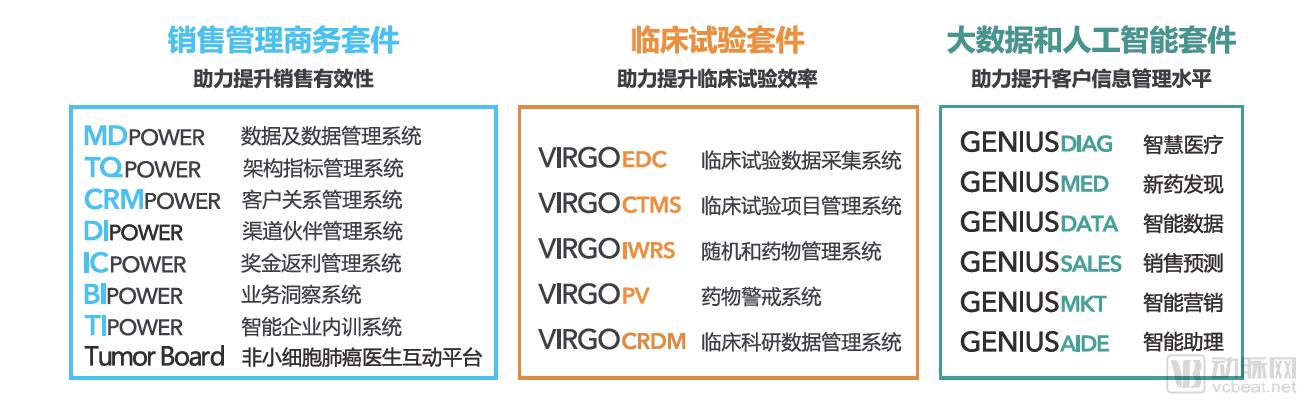
Yunshi Software Product Line, image provided by the enterprise
Yunshi Software employs approximately 150 people worldwide. Its core management team boasts over a decade of industry experience, with technical professionals and industry experts comprising 80% of the workforce. As a technology innovation company in the life sciences sector, Yunshi Software has secured more than RMB 100 million in financing from top-tier venture capital firms both in China and abroad.
Currently, Yunshi Software serves nearly 100 leading enterprises in the life sciences industry, including AstraZeneca, Bayer Pharmaceuticals, Abbott Laboratories, Qilu Pharmaceutical, China Resources Pharmaceutical, and Tasly. More than 50,000 employees from Fortune 500 companies and leading domestic enterprises are using Yunshi Software’s products and innovative services.
Previously, the industry largely viewed Yunshi Software as China’s counterpart to Veeva. Founded in 2007, this company carved out a niche in the life sciences vertical within the SaaS sector—already dominated by giants such as Oracle, Microsoft, and Salesforce—and achieved a market capitalization exceeding $10 billion within a decade of its establishment, making it a model for Chinese startups. It serves nearly all of the top 20 pharmaceutical companies, with revenues reaching $686 million in 2017.
Yunshi Software and Veeva share both similarities and differences in their strategic approaches. The similarity lies in the fact that both companies focus on the vertical sector of life sciences, enabling them to continuously deepen their expertise. The difference is that Yunshi Software offers a broader product portfolio, providing systematic solutions for enterprises undergoing digital transformation, which proves more advantageous in the Chinese market.
Furthermore, the integration of AI into new drug R&D may be a key area of breakthrough for Yunshi Software. In July 2017, Yunshi Software entered into a strategic partnership with Weill Cornell Medicine, a prestigious member of the Ivy League, to jointly establish a medical artificial intelligence laboratory, with AI-driven new drug discovery as one of its primary focuses.
Zhang Yingnan told VCBeat that Yunshi Software’s strategic layout in AI-driven new drug development is more akin to that of BenevolentAI, a UK-based unicorn in this field. Founded in 2013, BenevolentAI announced in April of this year that it had raised an additional $115 million from both new and existing investors, boosting its valuation to $2 billion. This represents one of the largest funding rounds in the AI pharmaceutical industry.
BenevolentAI’s high valuation is closely tied to its unique business model. While also applying AI to drug discovery, BenevolentAI operates more like an innovative pharmaceutical company than a technology firm. It leverages artificial intelligence to extract knowledge from vast amounts of information that can drive drug development, generating novel, testable hypotheses and thereby accelerating the drug discovery process.
BenevolentAI already has a pipeline of twenty drug candidates in development, which will undergo preliminary clinical trials to validate their efficacy. More importantly, the drugs discovered by BenevolentAI have significant commercial value. In 2014, BenevolentAI licensed the commercialization rights for two Alzheimer’s disease drug candidates to a U.S. pharmaceutical company for a total of $800 million. In 2017, BenevolentAI further licensed an investigational drug candidate to Johnson & Johnson.
Yunshi Software’s philosophy in its AI-driven drug discovery business is to align itself with innovative pharmaceutical companies rather than AI technology firms. While technology has its limits, the future of innovative drugs holds infinite possibilities. Since AI technology always serves to “empower” drug discovery, Yunshi Software will focus on accumulating capabilities in the “pharmaceutical” domain along this trajectory.
“Currently, whether viewed from the global or domestic market perspective, digital technologies represented by AI and big data have indeed ushered in a wave of transformation for the industry. However, it is far from the time for comprehensive adoption. ‘Disruptive’ technological shifts will not occur rapidly. What Yunshi Software aims to do is empower the industry by providing holistic solutions, helping enterprises stay competitive during their digital transformation,” said Zhang Yingnan.