

Traditional Pharmacies Empowered to Transform into Billion-Dollar Smart Pharmacies
The 11th annual Westlake Pharmaceutical Conference (Xipu Hui) is currently underway in Boao, Hainan. As a deep strategic media partner of the conference, VCBeat (WeChat ID: vcbeat) is attending the event and providing comprehensive coverage.
At the conference, numerous major pharmaceutical companies and healthcare-related enterprises announced their new strategies and plans. In the realm of smart pharmacies, Baiyang Pharmaceutical Group, which has always been highly active, not only sponsored the theme of the opening night banquet but also unveiled its significant “One City, Three Stores” initiative. This marks another major industrial collaboration signed at the Westpu Conference, following last year’s agreement with Takeda Pharmaceutical for the distribution rights to six prescription drugs.
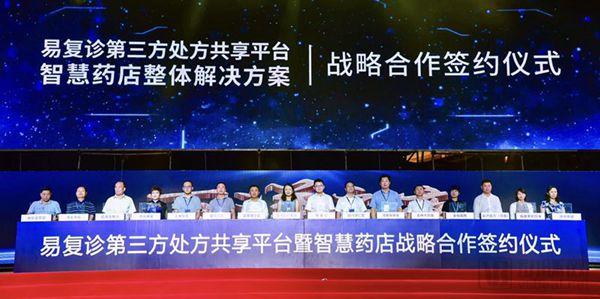
On the evening of August 12, Baiyang Pharmaceutical Group jointly signed agreements with 14 chain pharmacy operators, including Yunnan Jianzhijia, Sichuan Derentang, and Chongqing Wanhe, to collaborate on the Yi Fuzhen third-party prescription sharing platform and comprehensive smart pharmacy solutions. This marks the second batch of centralized signings, following the initial round in June involving 16 major national chain pharmacies.
According to VCBeat, Baiyang Pharmaceutical Group will select three chain pharmacies in different cities across China to create pilot projects, driving the pharmaceutical marketing sector in China into a new era of intelligence and fostering the emergence of new smart pharmacies with a billion-yuan scale that prioritize both efficiency and expansion.
Catalyzing a Billion-Yuan Smart Pharmacy Chain with the “One City, Three Stores” Model
In the pharmaceutical retail sector, traditional pharmacy models that have historically relied on high-margin individual products to sustain profitability are facing significant survival pressures, with overall revenue struggling to achieve new breakthroughs. To address this challenge, specialized pharmacies—exemplified by chronic disease management pharmacies and Direct-to-Patient (DTP) pharmacies—are shifting their focus from pursuing high margins to expanding revenue streams. They aim to boost store sales through stable customer traffic, chronic disease management services, and health management solutions.
However, as specialty drugs and prescription drugs increasingly flow into retail channels, professional pharmacies that are exploring new business models face significant challenges in transformation. The primary difficulty lies in how to provide more specialized services to patients, with the main contradictions centered on insufficient professionalism in pharmaceutical care, the need for upgrading hardware facilities, and a low level of informatization.
Only by upgrading to smart pharmacies can a leap in both quality and quantity be achieved. In the view of Fu Gang, Chairman of Baiyang Pharmaceutical Group, the challenges facing existing pharmacies are no longer isolated issues that can be addressed individually; rather, they require a more comprehensive solution.
Baoyang Pharmaceutical Group holds the exclusive agency rights for IBM Watson artificial intelligence solutions and has partnered with Oracle to jointly develop the “Baoyang Mingjing Marketing Cloud.” This platform addresses key pain points for pharmaceutical companies, including product sales performance, operational efficiency, and omnichannel communication between healthcare providers and patients. Meanwhile, Baoyang Pharmaceutical Group leverages a team of thousands of marketing professionals to collaborate with pharmacies on offline customer acquisition and patient education. Complementing these efforts is its third-party prescription-sharing platform, Yifuzhen, which has successfully implemented its business model in Wuzhou, Guangxi, enabling brick-and-mortar pharmacies to sell prescription drugs online. Building on this robust portfolio of offerings, Baoyang Pharmaceutical Group integrates individual products into cohesive suites, delivering smart pharmacy solutions tailored for retail pharmacies.
To accelerate the creation of benchmark projects for smart pharmacies, Baiyang Pharmaceutical Group officially launched the “One City, Three Stores” initiative at the 2018 Xipu Conference. By applying comprehensive criteria—including store size, location, foot traffic, surrounding medical resources, and in-store clinic qualifications—the group selected three chain pharmacies under different brands in various cities across China to jointly develop a cohort of smart pharmacies with enhanced professional service capabilities.
According to VCBeat, Baiyang Pharmaceutical Group has entered into strategic partnerships with 30 major pharmacy chains, covering more than 200 prefecture-level cities across over 30 provinces in China, to jointly promote the development of smart pharmacies. At the signing ceremony, Fu Gang stated, “Yi Fuzhen and its smart pharmacy solutions are gradually establishing a nationwide presence. We will collaborate with government authorities, hospitals, and pharmacy chains to drive the transformation of retail terminal marketing models and rapidly create a cohort of smart pharmacies with annual revenues reaching the RMB 1 billion level.”
Empowering Traditional Pharmacies: Baiyang Pharmaceutical Group Provides Four Core Capabilities
According to monitoring data from Sinopharm CMH, the scale of China’s pharmaceutical retail industry expanded rapidly, reaching RMB 366.4 billion by 2017. In terms of pharmacy scale, as of the end of November 2017, there were a total of 454,000 pharmacies nationwide, with a chain affiliation rate of 50.44%; the number of chain pharmacies exceeded that of independent stores for the first time. Benefiting from favorable factors such as the outflow of prescription drugs, pharmaceutical sales reached RMB 69.3 billion, a year-on-year increase of 12%; non-pharmaceutical sales amounted to RMB 23.1 billion, a year-on-year increase of 0.4%.
As traditional chain pharmacies undergo rapid expansion, issues such as insufficient specialization, lack of chain management expertise, severe product homogenization, the need for effective patient management, and outdated information systems will severely constrain their sustainable development. Traditional pharmacies that are not technology-driven will struggle to meet the demands of the times.
Therefore, in empowering traditional pharmacies, Baiyang Pharmaceutical Group proposes the concept of making pharmaceutical retail terminals irreplaceable through intelligent services, reducing operating costs and improving efficiency for pharmacies via comprehensive integrated marketing solutions, effectively integrating industrial resources, and providing holistic services and solutions.
It is understood that Baiyang Smart Pharmacy will empower traditional pharmacies with four major service capabilities:
First, by leveraging the capability to handle external prescriptions and integrating Yifuzhen with hospital HIS systems, we channel hospital-issued external prescriptions to pharmacies. During this process, we standardize the review procedures and implement multi-party joint monitoring to ensure rational drug use, thereby providing patients with safe and traceable pharmaceutical services.
Meanwhile, pharmacies extend medical services to pre-consultation and post-diagnosis management through Yifuzhen, offering services such as out-of-hospital chronic disease prescription refills, dynamic virtual inventory, and direct supply of specialty and prescription drugs, thereby providing customers with full-process health management services.
Second, intelligent medical service capabilities: The Baiyang Smart Pharmacy comprehensive solution introduces world-leading artificial intelligence tools into pharmacies and establishes service centers such as the “Watson Intelligent Physician Studio.” These resources assist pharmacy-based physicians in providing authoritative, standardized, and personalized second opinions on cancer treatment, thereby sparing patients the hardship of traveling extensively to seek multiple verifications.
Third, health experience service capabilities. Smart pharmacies can provide patients with health experience services. In a comfortable experience area, they guide consumers on how to use and maintain products, and provide health data for post-use evaluation, helping consumers use products correctly and understand their effectiveness.
Fourth, the ability to enhance operational efficiency. By leveraging Baiyang Mingjing Marketing Cloud to implement customer tagging, digitize process data, and ensure timely feedback, we help chain pharmacies comprehensively understand and manage their customers, delivering precise, personalized service solutions.
Smart Pharmacies Will Accelerate the Rapid Iteration of the Pharmaceutical Industry
Policies have always been a key driver of industrial development. On July 10, the “Notice on Deepening Convenient and Beneficial ‘Internet + Healthcare’ Services” was officially released, explicitly stating under the goal of “ensuring greater confidence in medication services for patients” that hospitals at Level II and above should strengthen the informatization of their pharmacy departments. Medical institutions with the necessary conditions are encouraged to promote the construction of “smart pharmacies,” achieving seamless integration between prescription systems and pharmacy dispensing systems to facilitate timely medication pickup for the public.
From this perspective, the state is also consciously promoting smart pharmacies, aiming to meet the substantial demand driven by prescription outflow and respond to the development of digitalization trends.
As is well known, the outflow of prescription drugs from hospitals in China holds significant market potential. According to IMS statistics, the total size of China’s pharmaceutical market reached RMB 1.262 trillion in 2016, with prescription drugs and over-the-counter (OTC) medicines accounting for 85% and 15% of sales, respectively. Notably, 77% of prescription drug sales remained within hospitals, while only approximately 23% flowed to out-of-hospital channels such as pharmacies and supermarkets. In contrast, the proportion of prescriptions filled outside hospitals in developed countries is substantially higher than in China; in 2016, Japan’s out-of-hospital dispensing rate for prescription drugs was approximately 71.7%, and the United States had already exceeded 83% by 2015.
Driven by external factors such as the separation of prescribing and dispensing and the outflow of prescriptions, the development of retail pharmacies is facing new opportunities and challenges. The opportunity lies in the fact that retail pharmacies, with their advantages in providing medications and pharmaceutical care services as well as high coverage rates, have become a key channel for accommodating prescription outflow.
Meanwhile, retail pharmacies are facing immense challenges. As listed companies, industrial capital, and regional pharmacy leaders rapidly expand their market share, industry consolidation continues to intensify, further exacerbating competition in the pharmaceutical retail sector. To survive and enhance their channel influence, chain pharmacies must possess capabilities such as more professional pharmaceutical care services, efficient information systems, and resource integration.
In the future, pharmacies that lack specialized core competencies and fail to focus on patient needs or provide value-added services will be eliminated by the market.
Driven by policy, market, and technology, only smart pharmacies have a higher ceiling.
Fu Gang thus proposed three major changes in the industry:
First, the necessity of new-generation healthcare informatization: for any industry to reach maturity, it must be premised on a mature level of informatization; without such maturity in informatization, the industry cannot achieve maturity.
Second, the 19th National Congress of the Communist Party of China strengthened the top-level design of the “three-medical linkage” and established the National Healthcare Security Administration to manage costs and procurement. However, for the three medical sectors to truly achieve coordinated operation, a third-party information platform must be leveraged, ultimately ensuring that hospitals focus on delivering quality medical care, pharmacies handle professional medication dispensing, and the health insurance system manages cost-based payments.
Third is the shift in channel dynamics. Under the National Healthcare Security Administration’s national procurement scheme, 70% of originator drugs are to be replaced by products that have passed the Consistency Evaluation, with these evaluated products entering the tender market for competitive bidding. This makes it difficult for large generic drug manufacturers to maintain their existing pricing structures. Consequently, 2018 will mark the inaugural year for the development of classified pharmaceutical marketing, as both patented and non-patented drugs will need to explore new marketing models at the retail level.
With the liberalization of policies, all chain pharmacies will have the opportunity to sell prescription drugs online, provided they meet three conditions: ensuring the authenticity of prescriptions, the security of logistics and distribution, and the completeness and traceability of information. In this context, whether physicians have genuinely examined patients before issuing prescriptions becomes particularly critical. Therefore, the primary scenarios for online sales of prescription drugs in the future will be “online ordering with in-store pickup” and “online ordering with store-based delivery,” both fulfilled through digital processing of prescriptions issued by physical hospitals.
Fu Gang stated that advancements in technology will empower pharmacies with three core competitive advantages: digital marketing capabilities, category synergy capabilities, and service upgrade capabilities. Only by possessing these three capabilities can a pharmacy be considered a “smart pharmacy” and truly achieve a patient-centric model.