BioMap InnoHub and HKUST Pioneer Global First Life Science Foundation Model in Undergraduate Curriculum

BioMap
Developer of Innovative Drug R&D Platform
Source | Commercial Radio News
Author | Li Zhicheng
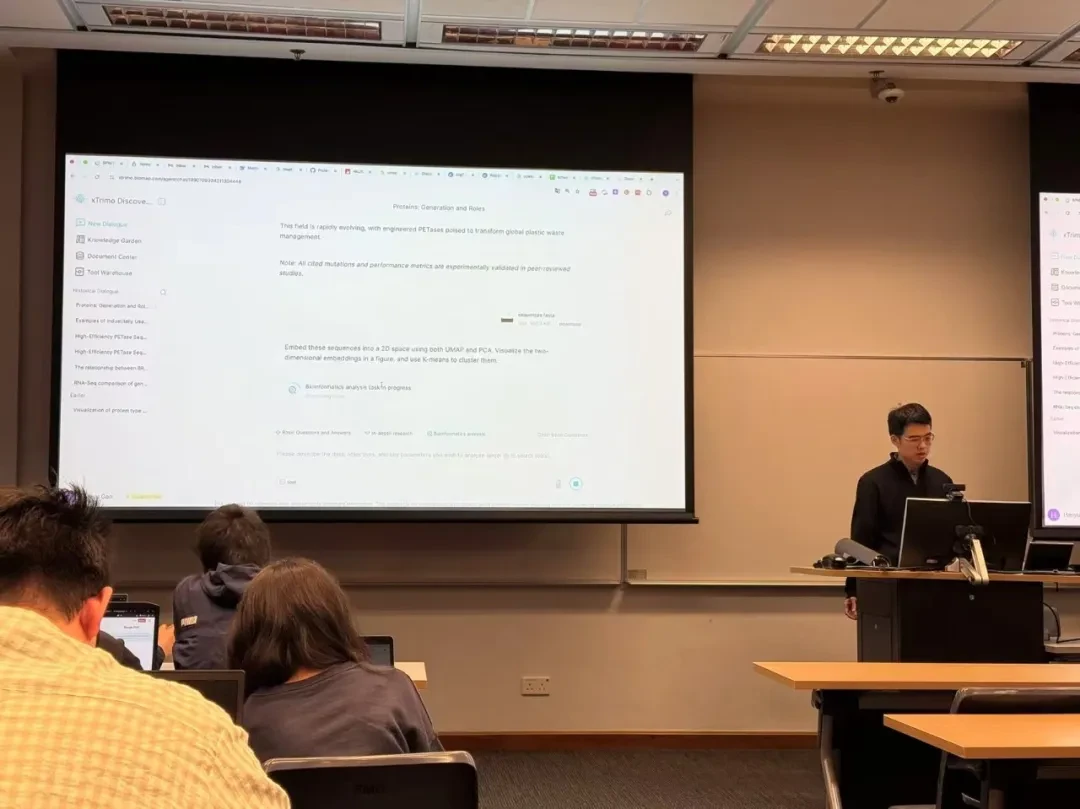
Recently, BioMap and the Hong Kong University of Science and Technology launched an innovative collaboration. In the past semester, they successfully introduced the world's first large-scale life science model into the university course "Data Science in Molecular Engineering," allowing students to acquire relevant skills at an early stage.AIA new research paradigm driven by.
This collaboration applies BioMap's self-developedxTrimoThe large multimodal foundational model for life sciences, equipped with a natural language dialogue interface, can understand and execute professional bioinformatics tasks. Gao Hanyu, assistant professor at the University of Science and Technology's School of Engineering, stated that traditional life sciences education follows a strict progression, requiring students to accumulate substantial foundational knowledge before engaging with cutting-edge topics, often leading to confusion about "why they are studying." However, with the advent of the large life sciences model, students can explore content from basic to advanced levels using a more natural language approach. After mastering the basics, students can independently delve into more challenging substantive issues, effectively bridging theoretical knowledge with practical applications.
BioMapInnoHubLin Yiwei, the person in charge, added that this collaboration is the world's first case of truly introducing a large life science model into undergraduate classroom practice. For undergraduates, scientific research is a relatively complex field, but with BioMap's tools, they can be exposed to real scientific research as early as their freshman or sophomore year, or even earlier, helping them explore and discover.
In the first practice of the last semester, students were required to use large models to complete specific projects, such as analyzing enzyme sequence characteristics or improving protein design. Gao Hanyu revealed that students provided positive feedback, finding the large models easy to use and believing they would be very helpful for their future advanced bioinformatics courses. Lin Yiwei also noted that student feedback, as a young user group, is highly beneficial for the company's product development.
Targeting the Future of the Industry: Reserving Compound Talents for Hong Kong
Gao Hanyu believes that such cooperative directions have enormous potential, aligning with Hong Kong's development trends in "new industrialization" and the biotechnology industry. He pointed out that many biotechnologies, including vaccine development, plastic degradation, and fine chemical production, rely heavily on protein design tools. He believes that students mastering such tools will embrace more career opportunities.
For BioMap, this collaboration also holds long-term strategic significance. Lin Yiwei stated directly that the company values the versatility of talent, and this interdisciplinary course is precisely a cradle for nurturing such talent. Since students are exposed to this foundational knowledge at an early stage, the novel ideas they generate are highly valued by the company. She hopes to identify outstanding students in the future for internships and exchanges, and even support their innovative ideas, thereby building a talent pool for the development of Hong Kong's bio-computing ecosystem.
Gao Hanyu expects that integrating domain-specific large AI models into teaching will become a major trend and an essential skill for future talents. The University of Science and Technology is also actively promoting the integration.AIEducation is integrated into various disciplines. He also pointed out that relevant cooperation is both an opportunity and a challenge for educators. The key lies in how to design courses and assessment methods to guide students to use tools for in-depth learning, rather than merely as a shortcut to obtain answers.
Lin Yiwei revealed that, in addition to university courses, the company also plans to extend its collaborations to the high school level and carry out public science popularization activities. It will also collaborate with Hong Kong public institutions to host exhibitions, continuously promoting cutting-edge knowledge in life sciences.